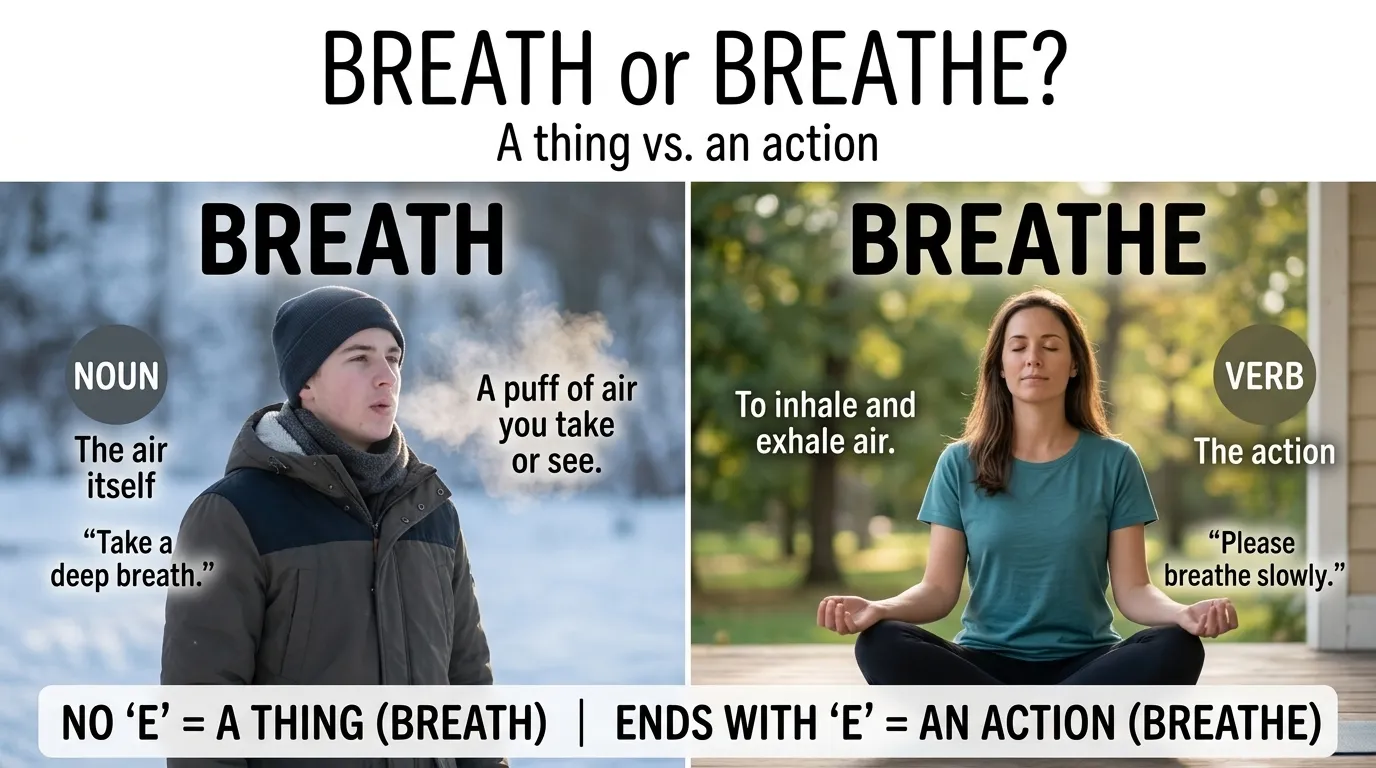
A teacher writes on the board before a big test: “Stay calm and take a deep breathe.” Can you spot the slip? The line should say “take a deep breath.”
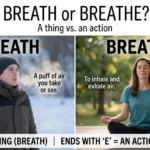
One tiny letter makes the difference. Breath is a thing you take. Breathe is something you do. The silent E at the end changes the sound, the job, and the meaning.
Below, you will see what each word means and how each one sounds. You will also learn where they come from, and a few quick tricks will help you pick the right one. A short quiz waits at the end.
Pronunciation
The two words sound different, even though they look almost the same.
Breath
- US: /brɛθ/ (BRETH)
- UK: /brɛθ/ (BRETH)
- It comes from the Old English word “bræð,” which first meant “smell” or “vapor.”
Breathe
- US: /briːð/ (BREETH)
- UK: /briːð/ (BREETH)
- It appeared around the year 1200, and it comes from “breath.”
Breath has a short vowel, like the “e” in “bed.” Breathe has a long vowel, like the “ee” in “see.” Also, the “th” in breath is soft and airy, as in “thin.” In breathe, the “th” is voiced, as in “this.” Now let us look at the real differences.
Breath or Breathe: The Quick Answer
The table below shows the main point.
| Word | Part of speech | Meaning | Example |
| Breath | noun | Air that you take in or let out | Take a deep breath. |
| Breathe | verb | To take air in and let it out | Please breathe slowly. |
A noun is a name word, such as a thing or an idea. A verb is an action word. So, breath names the air, and breathe describes the act.
What Does “Breath” Mean?
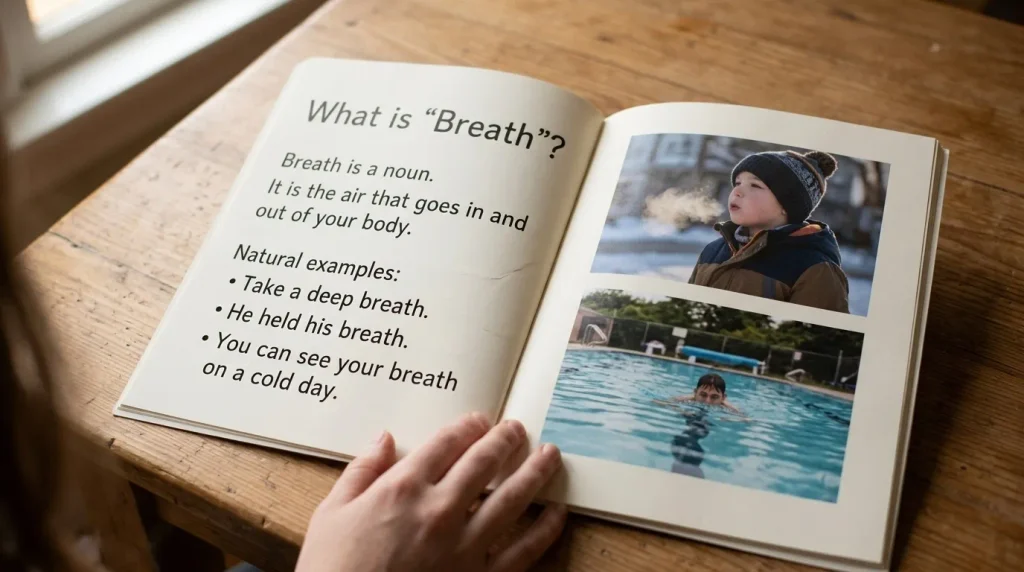
Breath is a noun. It means the air that goes in and out of your body. It can also mean one single round of that air.
You can hold a breath, take a breath, or catch a breath. You can also see your breath on a cold day, because it looks like a little cloud.
Breath has a few other uses too.
- One round of air. “She took a big breath before she sang.”
- The air you let out. “His breath was warm in the cold.”
- A short moment. “Wait a breath, and then go.”
- A light touch of air. “A breath of wind moved the leaves.”
Examples with “Breath”
- Take a deep breath before you start.
- He held his breath under the water.
- After the race, she was out of breath.
- Mint gum can freshen your breath.
- I need a moment to catch my breath.
- The cold morning turned every breath into a white puff.
In each sentence, breath is a thing. You can count it, hold it, or see it.
What Does “Breathe” Mean?
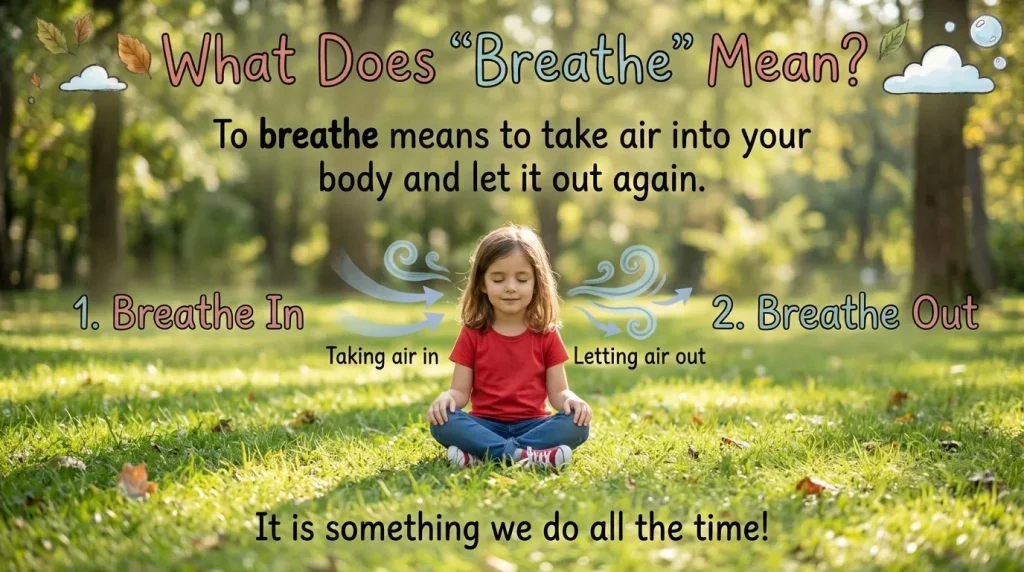
Breathe is a verb. It means to take air into your body and let it out again. It is something you do all day without thinking.
You can breathe in, breathe out, breathe deeply, or breathe slowly. People also use the word in a few figures of speech.
Examples with “Breathe”
- Please breathe slowly and stay calm.
- Fish breathe through their gills.
- I can hardly breathe in this smoke.
- The doctor asked him to breathe in.
- Try to breathe easy before the test.
- The baby seemed to breathe more softly in her sleep.
In every sentence, breathe is an action. It tells what someone or something does.
The Sound Clue
The sound gives you a handy hint. English has several pairs where the noun has a soft “th” and a short vowel, while the verb has a voiced “th,” a long vowel, and a silent E.
| Noun (soft th) | Verb (voiced th, silent E) |
| breath | breathe |
| bath | bathe |
| cloth | clothe |
| teeth | teethe |
So, if your word ends with “-the,” it is likely a verb. If it ends with just “-th,” it is likely a noun.
Where the Words Come From
The two words are family, and the old forms explain why.
Breath comes from the Old English word “bræð.” At first, it meant “smell,” “scent,” or “vapor.” It did not mean the air in the lungs. Later, it grew to mean the air that you breathe. The meaning “one single act of breathing” appeared in the late 1400s.
Breathe came later. It showed up around the year 1200, and it was not in Old English at all. It was built from breath. Still, it kept the original long vowel of the old word, while the noun “breath” later shortened its vowel.
So, the long vowel in breathe is the older sound. The short vowel in breath is the newer one. That is why the sounds differ, even though the words are related.
Why the Two Get Mixed Up
Several things cause the mix-up.
The spelling is the first culprit. The words differ only by one letter at the end, and a silent letter is easy to miss.
The meaning is the second. Both are about air and your lungs, so they feel like the same idea.
Speech is the third. In fast talk, people pay less attention to the final “th” sound, so the difference gets lost.
Writing habits are the last. Many people type fast and let the spell checker fix things. However, both words are real, so the tool may not flag the wrong one.
Before and After
Here are wrong and right versions, side by side.
| Before (wrong) | After (right) |
| Take a deep breathe. | Take a deep breath. |
| I can hardly breath in here. | I can hardly breathe in here. |
| She is out of breathe. | She is out of breath. |
| Please breath slowly. | Please breathe slowly. |
| He held his breathe for a minute. | He held his breath for a minute. |
| Fish breath through gills. | Fish breathe through gills. |
| The baby is breatheing softly. | The baby is breathing softly. |
Watch the last row. When you add “-ing” to breathe, the silent E drops, and you get breathing.
Read more about:https://verboix.com/separate-or-seperate/
Three Ways to Pick the Right One
Choose the trick that works best for you.
The “A” Test
Put the word “a” or “my” in front of the blank. If it fits, you need the noun breath.
- “Take a ___.” You can say “a breath.” So, write breath.
- “I ___ slowly.” You cannot say “I a breathe.” So, write breathe.
The “To” Test
Put the word “to” in front of the blank. If it fits, you need the verb breathe.
- “I want to ___.” You can say “to breathe.” So, write breathe.
- “I want to ___ a deep.” This does not work, so the word is breath.
The Long Word Rule
Breathe is the longer word, and it describes the longer action. The extra E at the end gives you a quiet reminder: the action takes a little longer than the thing.
Common Phrases with Each Word
Many everyday phrases use one of these words. The table below sorts them out.
| With breath (noun) | With breathe (verb) |
| take a deep breath | breathe in and breathe out |
| hold your breath | breathe deeply |
| catch your breath | breathe easy |
| out of breath | breathe a sigh of relief |
| bad breath | breathe new life into something |
| a breath of fresh air | do not breathe a word |
| waste your breath | breathe down someone’s neck |
| under your breath | breathe in the sea air |
Breath and Breathe in Real Sentences
More examples will help both words stay in your mind.
At school
- The teacher asked us to take a deep breath before the quiz.
- Sam had to breathe slowly to stay calm.
- After running laps, the class was out of breath.
Inside the home
- Mom told the baby to breathe easy.
- Dad held his breath while he painted the tiny window.
- My brother’s cold made it hard to breathe.
At the gym
- The coach said, “Breathe in, and breathe out.”
- She stopped for a breath after the long climb.
- Good runners learn to breathe in a steady rhythm.
Outdoors
- A breath of cold air woke him up.
- We stood on the hill to breathe the fresh air.
- Every breath showed as a white cloud.
In stories
- She let out a long breath of relief.
- The dragon could breathe fire.
- He dared not breathe a word.
The Word Family
Each word has relatives. Here is the full set.
| Word | Type | Meaning | Example |
| breath | noun | one round of air | Take a breath. |
| breaths | noun | more than one breath | Take three slow breaths. |
| breathy | adjective | full of air, soft | She has a breathy voice. |
| breathless | adjective | out of breath | He was breathless after the run. |
| breathtaking | adjective | amazing | The view was breathtaking. |
| breathe | verb | to take air in and out | Breathe slowly. |
| breathes | verb | takes air in and out (he, she, it) | She breathes with ease. |
| breathed | verb | took air in and out | He breathed deeply. |
| breathing | verb or noun | the act of taking air | Her breathing was calm. |
| breather | noun | a short rest | Let us take a breather. |
| breathable | adjective | that lets air pass through | The shirt is breathable. |
Breaths or Breathes?
These two look alike, but they play different roles.
- Breaths is the plural noun: “She took three deep breaths.”
- Breathes is the verb for he, she, or it: “He breathes slowly.”
Slips to Avoid
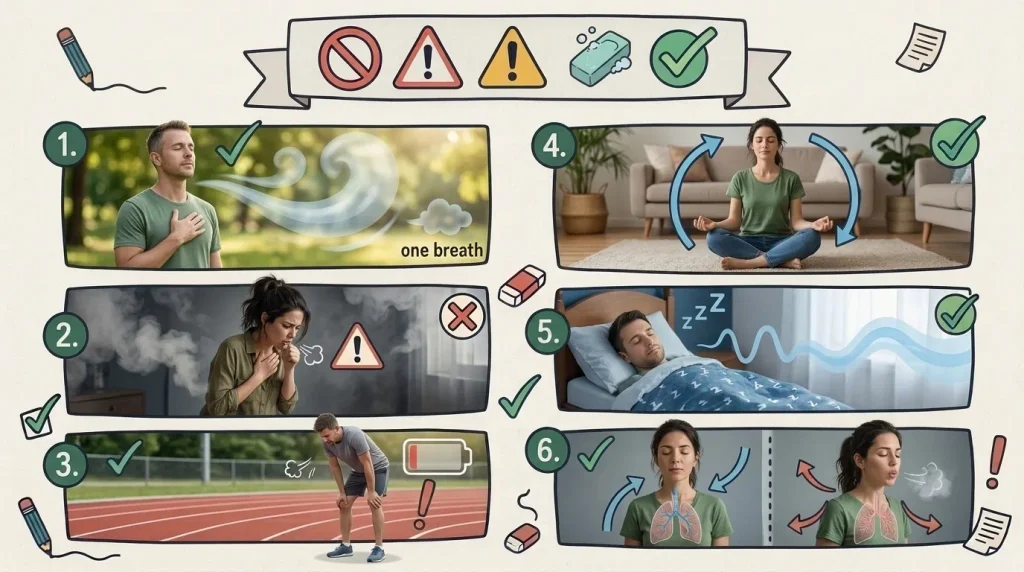
These mistakes show up often.
- Take a deep breathe. The noun is breath, so drop the E.
- I cannot breath. The verb is breathe, so add the E.
- Out of breathe. It should be “out of breath.”
- Breatheing. The silent E drops before “-ing,” so write breathing.
- Breathes for breaths. Use “breaths” for the plural noun.
- Breath in, breath out. The action words are “breathe in” and “breathe out.”
Print and Save: Breath or Breathe Cheat Card
| Topic | Breath | Breathe |
| Part of speech | noun | verb |
| Meaning | air that goes in or out | to take air in and out |
| Sound | BRETH (short vowel) | BREETH (long vowel) |
| “th” sound | soft, as in “thin” | voiced, as in “this” |
| Memory trick | no E = a thing | E on the end = an action |
| “A” test | “a breath” works | “a breathe” does not work |
| “To” test | “to breath” does not work | “to breathe” works |
| Plural or -s form | breaths | breathes |
| -ing form | none | breathing |
| Similar pairs | bath, cloth, teeth | bathe, clothe, teethe |
| Word story | from Old English “bræð” (smell, vapor) | from “breath,” around 1200 |
Quick Quiz: Multiple Choice
Pick the best answer. The key comes after the next section.
Question 1. Which word is a noun?
- A. breath
- B. breathe
- C. both of them
Question 2. Which sentence is correct?
- A. Take a deep breathe.
- B. Take a deep breath.
- C. Take a deep breeth.
Question 3. Which word rhymes with “health”?
- A. breath
- B. breathe
- C. both of them
Question 4. Which word fits: “I can hardly ___ in this smoke.”
- A. breath
- B. breathe
- C. breaths
Question 5. What is the plural of “breath”?
- A. breathes
- B. breaths
- C. breathe
Quick Quiz: Fill in the Blanks
Choose the correct word for each gap.
- Please take a deep ______. (breath / breathe)
- Try to ______ slowly through your nose. (breath / breathe)
- After the race, she was out of ______. (breath / breathe)
- Fish ______ with gills. (breath / breathe)
- The baby is ______ softly in her sleep. (breathing / breatheing)
Answer Key
Multiple choice
- A. Breath is the noun.
- B. After “a deep,” you need the noun breath.
- A. Breath rhymes with health, death, and wealth.
- B. “Can hardly” is followed by a verb, so breathe fits.
- B. The plural noun is breaths.
Fill in the blanks
- breath. After “a deep,” you need the noun.
- breathe. It follows “to,” so it is a verb.
- breath. The phrase is “out of breath.”
- breathe. Fish do this action.
- breathing. The silent E drops before “-ing.”
Missed a few? Try the “a” test and the “to” test, then run the quiz again tomorrow.
Frequently Asked Questions
What is the difference between breath and breathe?
Breath is a noun, and it means the air you take in or let out. Breathe is a verb, and it means to take that air in and out.
How do you say breath and breathe?
Breath is said BRETH, with a short vowel and a soft “th.” Breathe is said BREETH, with a long vowel and a voiced “th.”
Is it “take a deep breath” or “take a deep breathe”?
It is “take a deep breath.” After “a deep,” you need the noun.
How do you spell the -ing form of breathe?
The spelling is breathing. The silent E drops before “-ing.”
Is “breathes” the same as “breaths”?
No. Breathes is the verb form for he, she, or it. Breaths is the plural noun.
Where does the word breath come from?
It comes from the Old English word “bræð.” At first, it meant “smell” or “vapor.” Later, it grew to mean the air that you breathe.
Why does breathe have a silent E?
The silent E signals a long vowel and a voiced “th.” It also marks the word as a verb, as in bathe and clothe.
Final Thoughts
Breath or Breathe became clear when Leo stood at the edge of the pool, goggles on and heart racing. His coach said, “Take a big breath, then breathe out slowly as you swim.” Both words have different jobs: breath is the air you take in, while breathe means to take air in and let it out. Remember, breath has no E at the end, while breathe has a silent E. This small letter can help you choose the right word every time.









1 thought on “Breath or Breathe? A Thing You Take, an Action You Do”