
A bakery window says: “Fresh bread baked everyday. Come grab your everyday loaf!” One of those uses is right, and one is wrong. Can you tell which is which?
The second one is right. An “everyday loaf” is an ordinary loaf, so the word is joined. The first one should read “baked every day,” because it means each day.
Everyday describes something ordinary. Every day means each day. One small space changes the whole meaning.
Below, you will see what each form means and how it sounds. You will also find where the words come from, and an easy swap test will settle the choice. A short quiz waits at the end.
Pronunciation
The two forms are made of the same sounds, but the stress lands in different places.
Everyday (one word, an adjective)
- US: /ˈɛv.riˌdeɪ/ [EV-ree-day]
- UK: /ˈɛv.ri.deɪ/ [EV-ree-day]
- Fact: The stress falls on the first part, “EV,” and the word “day” is light.
Every day (two words, an adverb phrase)
- US: /ˈɛv.ri ˈdeɪ/ [EV-ree DAY]
- UK: /ˈɛv.ri ˈdeɪ/ [EV-ree DAY]
- Fact: Here, “day” gets a strong beat of its own.
Say them out loud. In “everyday shoes,” your voice rushes past “day.” In “I run every day,” your voice lands firmly on “day.” That small difference in stress matches the difference in meaning.
The Quick Answer
The short version fits in one small table.
| Form | Part of speech | Meaning | Example |
|---|---|---|---|
| Everyday | adjective | ordinary, used daily | These are my everyday shoes. |
| Every day | adverb phrase | each day | I walk to school every day. |
An adjective describes a noun, such as a person, place, or thing. An adverb tells how often, how, or when something happens. So the joined word describes a thing, and the two-word form tells how often.
What Does “Everyday” Mean?
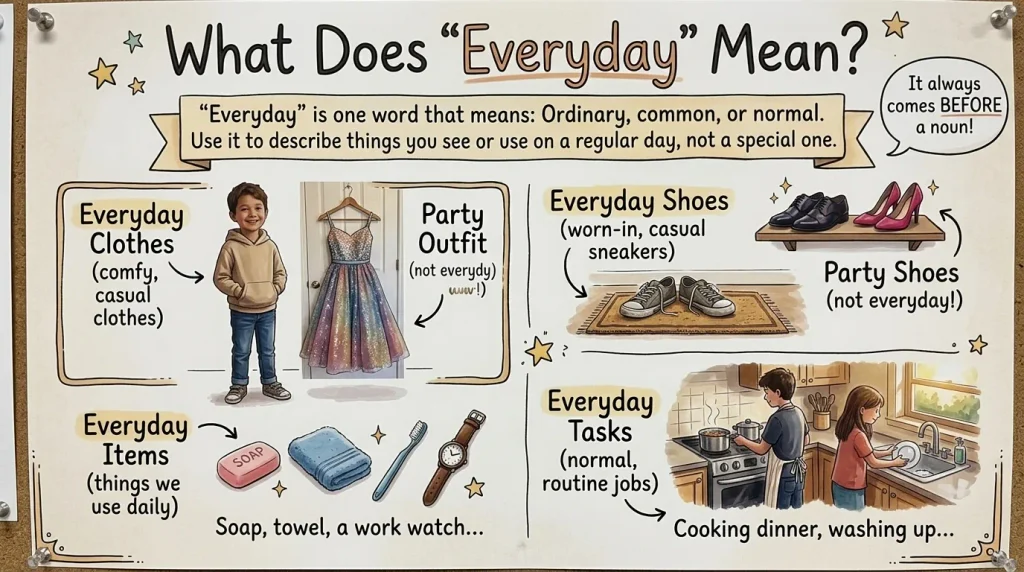
Everyday is one word. It means ordinary, common, or normal. It describes things that you see or use on a regular day, not on a special one.
This word always comes before a noun. You can have everyday shoes, an everyday meal, or everyday life. You cannot use it to say how often something happens.
It has three main shades of meaning.
- Ordinary. An everyday task is a normal task.
- For regular days. Everyday clothes are what you wear when nothing special is going on.
- Common. An everyday word is one that many people use.
Examples with “Everyday”
- These are my everyday shoes, not my party shoes.
- Cooking dinner is an everyday job in our house.
- She tells stories about everyday life in the village.
In each sentence, the word sits right before a noun. It tells what kind of thing the noun is.
What Does “Every Day” Mean?
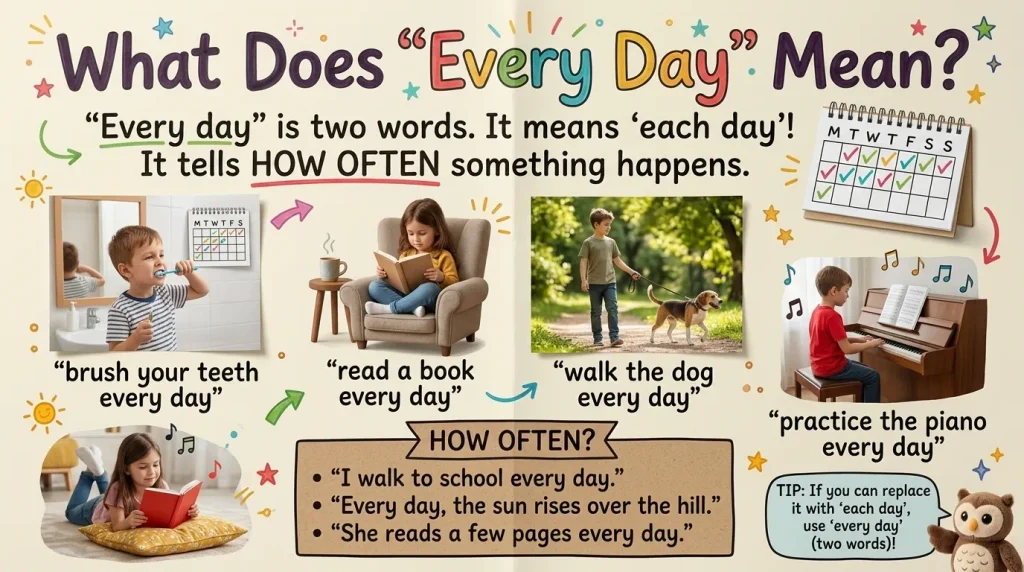
Every day is two words, and it means each day. It tells how often something happens. It often goes with a verb, which is an action word.
You can brush your teeth, read, or walk the dog every day. The phrase answers the question, “How often?”
Examples with “Every Day”
- I walk to school every day.
- She reads a few pages every day.
- The shop opens every day at nine.
In each sentence, the phrase tells how often. You could swap in “each day” and keep the meaning.
Where the Words Come From
Both forms are built from two small, very old words.
Every comes from the Old English phrase æfre ælc, which meant “ever each.” It was squeezed into one word in the early 1200s. Day comes from the Old English dæg, which named the time when the sun is up.
The one-word form came later, as an adjective. In the 1600s, it described clothes worn on ordinary days, as opposed to Sundays or holidays. Over time, it grew to mean “ordinary” in many other cases.
Why People Mix Them Up
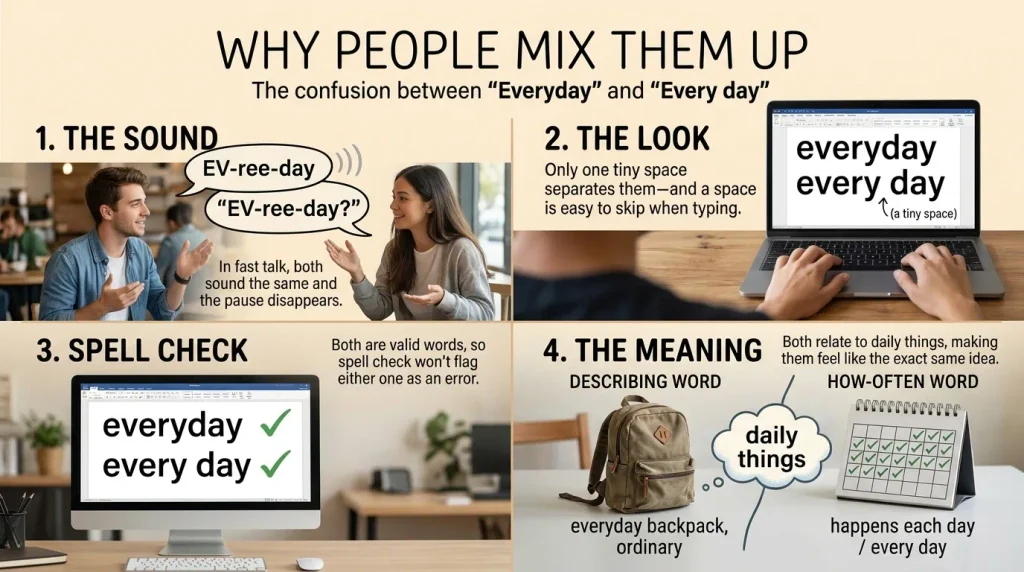
Several things cause the slip.
The sound is the first culprit. In fast talk, both forms come out as “EV-ree-day,” and the pause between the words disappears.
The look is the second. Only one small space separates them, and a space is easy to skip when typing.
Spell check is the third. Both forms are real, so a tool will not flag the wrong one.
Last, both ideas relate to daily life, so they feel like the same thing. Still, one is a describing word, and the other is a how-often word.
Before and After
Seeing a mistake next to its fix makes the rule easier to remember.
| Before (wrong) | After (right) |
|---|---|
| I walk to school everyday. | I walk to school every day. |
| These are my every day shoes. | These are my everyday shoes. |
| Cooking is an every day job. | Cooking is an everyday job. |
| He wears the same every day jacket. | He wears the same everyday jacket. |
Look at the pattern. A noun right after the word means one word, as in everyday shoes. A verb right before the word means two words, as in walk every day.
Read more about:https://verboix.com/necessary-or-neccessary/
Three Tests to Pick the Right One
Choose the test that clicks for you.
The Swap Test
Replace the word with another and read the sentence again. Swap in “each day.” If it fits, write two words. Swap in “ordinary” or “regular.” If it fits, write one word.
For example, take “I walk to school ___.” The words “each day” fit, so the answer is two words. Now take “These are my ___ shoes.” The word “ordinary” fits, so the answer is one word.
The Noun Test
Look at the word right after the blank. If it is a noun, such as shoes, task, or life, you need the joined form. If a verb comes before it, or the sentence ends, you need two words.
The “Single” Test
Add the word “single” in the middle. If “every single day” makes sense, write two words. The test fails for the joined word, because “every single day shoes” sounds odd.
Phrases You Will See
Many common phrases use one of these forms.
| Joined form (adjective) | Two-word form (adverb phrase) |
|---|---|
| everyday life | every day of the week |
| everyday objects | every other day |
| everyday English | every day, rain or shine |
Where You Will See Them
Signs, emails, and menus are full of these two forms. A shop window might say “Open everyday,” when it should say “Open every day.” A thank-you note might say “Thanks for your help every day,” and that is right, because it tells how often. A menu might list an “everyday special,” and that is right too, because it describes a plain, regular dish.
Next time you walk past a sign, read it with the swap test in your head. It turns an ordinary walk into a quick spelling check.
Other Pairs with the Same Trap
Some other word pairs follow the same pattern. One is a joined word, and the other is two words. Each pair has a small test of its own.
Everyone and Every One
“All the people” means everyone. “Everyone loves a snow day.” Every one means each single thing in a group, and it is often followed by “of.” “Every one of the cookies is gone.” If “everybody” fits, write the joined word.
Anytime and Any Time
Anytime means “whenever.” “Call me anytime.” Any time means a length of time. “Do you have any time to talk?” If “whenever” fits, use the joined word. If “a bit of time” fits, use two words. Some writers, especially in British English, prefer two words even for the “whenever” meaning.
Sometime and Some Time
Sometime means at a point that is not named yet. “Let us meet sometime next week.” Some time means a stretch of time. “It took some time to finish the puzzle.” Do not mix these with “sometimes,” which means now and then.
Maybe and May Be
The word “maybe” is an adverb that means “perhaps.” “Maybe it will rain.” May be is a verb pair, and it means “might be.” “It may be raining by noon.” If “perhaps” fits, write one word.
Anyway and Any Way
You can write:
The word anyway means “in any case.”“Anyway, we won the game.” Any way means any method. “Is there any way to fix this?” If “in any case” fits, write one word.
The same idea sits behind all of these. A joined word acts as one unit, like an adverb or a pronoun. Two words keep their own jobs, so a small word like “one,” “time,” or “way” stays a separate noun.
A Memory Trick That Sticks
Picture a pair of shoes with the laces tied together. The one-word form works like that. It is tied to the noun that comes after it, as in everyday shoes, and the two cannot be pulled apart.
Now picture a person walking, with a clear gap between each step. The two-word form works like that. Each small word keeps its own space, and the phrase tells you how often the steps happen.
If the word is tied to a noun, write it as one word. If the phrase answers “how often,” leave the gap.
Sayings About Days
English has many sayings built around the word “day.” A few of them hide the same idea of daily or ordinary life.
- Day in, day out means something goes on without a break.
- Make every day count is a wish to use each day well.
- Call it a day means to stop working for now.
- Every dog has its day is a proverb. It says that everyone gets a lucky turn.
- Save it for a rainy day means to keep something for hard times.
- A day late and a dollar short means too slow and too small to help.
None of these sayings changes the rule. A plain adjective before a noun still needs the joined word, and a phrase about how often still needs the gap.
Print and Save Cheat Card
| Topic | Joined form | Two-word form |
|---|---|---|
| Part of speech | adjective | adverb phrase |
| Meaning | ordinary, regular | each day |
| Comes before | a noun | a verb, or the end of the sentence |
| Swap test | “ordinary” fits | “each day” fits |
| “Single” test | does not work | “every single day” works |
| Stress | EV-ree-day | EV-ree DAY |
| Example | everyday shoes | I walk every day |
| Word story | used in the 1600s for ordinary-day clothes | “ever each” plus “day” |
| Also try | everyone / every one | anytime / any time |
Quick Quiz: Multiple Choice
Pick the best answer. The key comes after the next section.
1. Which form is an adjective meaning “ordinary”?
A. everyday
B. every day
C. both of them
2. Which sentence is correct?
A. I walk to school everyday.
B. I walk to school every day.
C. I walk to school every-day.
3. Which swap works for the two-word form?
A. ordinary
B. each day
C. tomorrow
4. Which phrase is right?
A. every day shoes
B. everyday shoes
C. every-day shoes
5. What is “every” a short form of?
A. “ever each”
B. “every day”
C. “each ever”
Quick Quiz: Fill in the Blanks
Choose the correct form for each gap.
- I drink water ______. (everyday / every day)
- These are my ______ shoes. (everyday / every day)
- She practices piano ______ after school. (everyday / every day)
- Cooking dinner is an ______ job in our house. (everyday / every day)
- He wears the same ______ jacket to work. (everyday / every day)
Answer Key
Multiple choice
- A. The joined word is the adjective that means ordinary.
- B. The sentence tells how often, so it needs two words.
- B. “Each day” fits in place of the two-word form.
- B. It describes the noun “shoes,” so it is one word.
- A. Every came from the Old English æfre ælc, meaning “ever each.”
Fill in the blanks
- every day. It tells how often, and “each day” fits.
- everyday. It describes the noun “shoes.”
- every day. It tells how often.
- everyday. It describes the noun “job.”
- everyday. It describes the noun “jacket.”
Frequently Asked Questions
What is the difference between everyday and every day?
Everyday is one word, and it means ordinary or regular. Every day is two words, and it means each day.
Is it “I go there everyday” or “every day”?
It is “every day.” The sentence tells how often, so it needs two words.
How can I remember the difference?
Use the swap test. If “each day” fits, write two words. If “ordinary” fits, write one word.
Where do the words come from?
Every comes from the Old English æfre ælc, meaning “ever each.” Day comes from the Old English dæg.
Final Thoughts
Everyday or every day? By closing time, the baker had wiped the window sign clean and written it again. Now it said, “Fresh bread baked every day. Come grab your everyday loaf!”
Each phrase on that sign had its own job. A noun right after the word, like loaf, calls for one word. A verb right before it, like baked, calls for a space. Check which side your word is leaning on, and the choice is made.