On a phone, autocorrect quietly fixes this word every single day. Then comes a handwritten test, and the safety net is gone. Suddenly, the pen stops. Is it an “a” or an “i” in the middle?
The right spelling is definitely. The other one, definately, is not a word. It is only a very popular typo.
Below, you will see what the word means and how it sounds. You will also learn where it comes from, and a hidden word will show you how to spell it for good. A short quiz waits at the end.
Pronunciation
Definitely is a long word, and the way we say it explains the typo.
Definitely
- US: /ˈdɛf.ə.nət.li/ (DEF-uh-nit-lee)
- UK: /ˈdɛf.ɪ.nət.li/ (DEF-ih-nit-lee)
- It comes from the word “definite,” plus the ending “-ly.”
Definately
- It is not a real word, so it has no official pronunciation.
- People write it because the middle sounds like “uh,” and the letter “a” feels natural there.
In fast speech, many people squeeze the word into three beats: DEF-nit-lee. The middle sound is soft and easy to miss. Because of this, your ear cannot tell you which vowel goes there. Now let us look at the real differences.
Definitely or Definately: The Quick Answer
The table below shows the main point.
| Spelling | Is it correct? | What it means | Example |
| Definitely | Yes | Without any doubt, for sure | I will definitely come to your party. |
| Definately | No | Nothing, it is a typo | Do not use it. |
Write definitely whenever you mean “for sure.” The letters go D-E-F-I-N-I-T-E-L-Y. Look at the vowels: E, I, I, E. There is no “a” anywhere in the word.
What Does “Definitely” Mean?

Definitely is an adverb. An adverb is a word that tells more about a verb, an adjective, or another adverb. Most adverbs end in “-ly.”
The word means “in a clear and certain way.” It tells the reader that something is sure. It can also work as a strong “yes” on its own.
Let us look at the main ideas.
- Without doubt. “She is definitely the fastest runner.”
- In a clear way. “He said no, and he said it definitely.”
- A strong “yes.” “Are you coming?” “Definitely!”
Examples with “Definitely”
- I will definitely call you tonight.
- That movie is definitely worth seeing.
- Mia is definitely the best singer in class.
- We will definitely need our umbrellas.
- This is definitely my favorite book.
- Do you want pizza? Definitely!
In each sentence, the word adds a sense of certainty. Nobody is guessing.
Words That Mean the Same Thing
Some words are close in meaning to definitely.
- certainly
- surely
- absolutely
- for sure
- without a doubt
Each of these can replace “definitely” in most sentences, which is handy when you want to avoid using one word too often.
The Hidden Word Trick
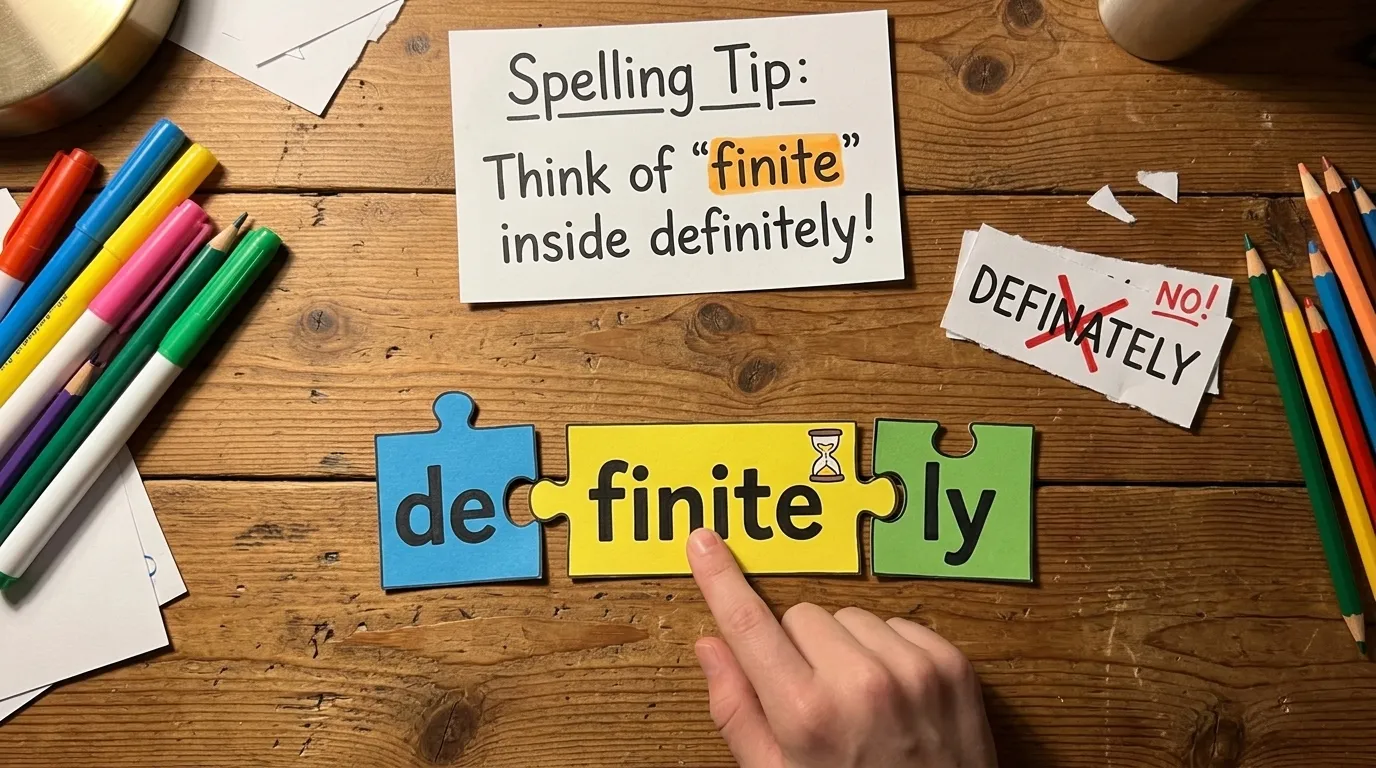
Here is the key to the whole word. Hidden inside definitely, there is a small real word: finite.
- de + finite + ly = definitely
“Finite” means having an end or a limit. It is a real word, and it is spelled with an “i” and an “e” at the end. So, if you can spot “finite” inside the longer word, you know the spelling is right.
Now try the wrong version. “Definately” would hide “finate,” and that is not a word. So, the typo gives itself away.
Where the Word Comes From
Every word has a story. Here is the short one for definitely.
It starts with the Latin word “definitus,” which meant “defined” or “limited.” That came from the verb “definire,” which meant “to limit” or “to explain.” It has two small parts.
- de- means “completely.”
- finire means “to set a limit.”
Finire grew from “finis,” which meant “boundary” or “end.” This is the same root that gives us finish, final, and finite.
The English word “definite” appeared around the year 1500. At first, it meant “fixed” or “certain.” Then, in the 1580s, people added “-ly” and made definitely. By 1931, writers also used it as a strong, everyday “yes.”
So, the “finite” hiding in the middle is no accident. It is the old Latin “finis” showing through, and it means “end” or “limit.”
Why the Typo Is So Common
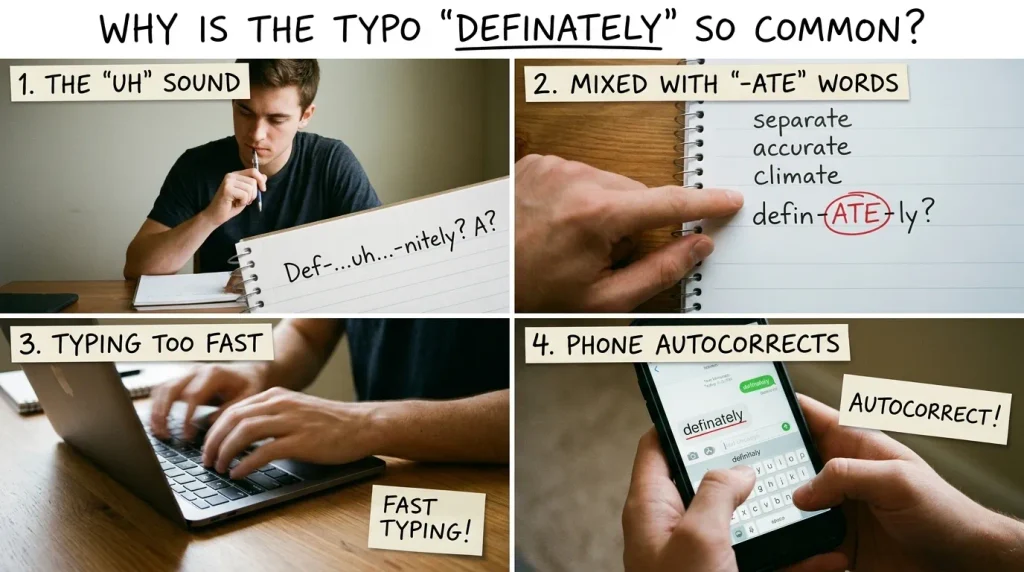
Many people write “definately.” A few clear reasons explain it.
The sound is the first culprit. The middle vowel is so soft that it sounds like “uh.” Your brain picks “a” because it is the most common “uh” letter.
Look-alike endings are the second. Many words end in “-ate,” such as “separate,” “accurate,” “climate,” and “delicate.” So, the brain sees the sound “-it” and guesses “-ate.”
Speed is the third. We say the word quickly, so the middle part gets less attention. As a result, the spelling gets lost.
Finally, autocorrect adds to it. Phones fix the word for us, so we never learn it. When we write by hand, the habit shows up.
Read more about:https://verboix.com/adapt-or-adopt/
Before and After
Here are wrong and right versions, side by side.
| Before (wrong) | After (right) |
| I will definately be there. | I will definitely be there. |
| She is definatly the winner. | She is definitely the winner. |
| It is definitly time to go. | It is definitely time to go. |
| That is a definate yes. | That is a definite yes. |
| He left the job indefinately. | He left the job indefinitely. |
| We will defanitely win. | We will definitely win. |
| I definetly agree. | I definitely agree. |
Watch the pattern. The fix is always the same. Put an “i” in the middle part, and keep the “e” before “-ly.”
Three Ways to Spell It Right
Pick the one that clicks for you.
Spot the Hidden Word
Look for finite inside the word: de-finite-ly. If you can see it, the spelling is right.
No “A” Allowed
Check the vowels. They are E, I, I, E. The letter “a” never shows up. So, if you wrote an “a,” take it out.
Keep the E
The word comes from “definite” plus “-ly.” Many people drop the “e” by mistake, and that gives “definitly.” Keep the “e,” and write definite + ly = definitely.
Do Not Mix It Up with “Defiantly”
Sometimes, people write “defiantly” when they mean “definitely.” These are two different words.
| Word | Meaning | Example |
| Definitely | for sure, without doubt | I will definitely go. |
| Defiantly | in a bold, stubborn way | The child defiantly crossed his arms. |
“Defiantly” comes from “defy,” which means to refuse to obey. So, it is about being bold or stubborn. If you mean “for sure,” write definitely.
Definite or Definitive?
Another pair gets mixed up often. Definite means clear and certain. Definitive means final and complete.
- Definite: “We have a definite plan for Friday.”
- Definitive: “This is the definitive guide to the topic.”
Both come from the same Latin root. Even so, they carry different shades of meaning.
Definitely in Real Sentences
More examples help the word settle in.
At school
- I will definitely finish my homework tonight.
- Sam is definitely the tallest in the class.
- The test was definitely harder than the last one.
At home
- Dad definitely wants pancakes on Sunday.
- We will definitely need more milk.
- My sister is definitely not sleeping yet.
With friends
- I am definitely coming to your party.
- She is definitely the funniest person I know.
- “Want to play?” “Definitely!”
At work
- The report is definitely due on Friday.
- Please definitely check the numbers twice.
- The team will definitely finish on time.
Outdoors
- It will definitely rain this afternoon.
- That hill is definitely steeper than it looks.
- We will definitely see stars tonight.
The Word Family
Definitely has many relatives. Each one keeps the “finite” or “finit” part.
| Word | Type | Meaning | Example |
| define | verb | to explain what something means | Please define the word. |
| definition | noun | the meaning of a word | I looked up the definition. |
| definite | adjective | clear and certain | We have a definite plan. |
| definitely | adverb | for sure | I will definitely go. |
| indefinite | adjective | not clear or not fixed | The trip is for an indefinite time. |
| indefinitely | adverb | with no end date | The shop is closed indefinitely. |
| definitive | adjective | final and complete | It is the definitive answer. |
| definitively | adverb | in a final way | The judge ruled definitively. |
| finite | adjective | having an end or limit | The supply is finite. |
| infinite | adjective | without an end | Space seems infinite. |
A Note on “Indefinitely”
When you add “in-” to definitely, you get indefinitely. It means “for a time with no end.” Many people also write this one with an “a” by mistake. The right spelling keeps the same “finite” in the middle.
Slips to Avoid
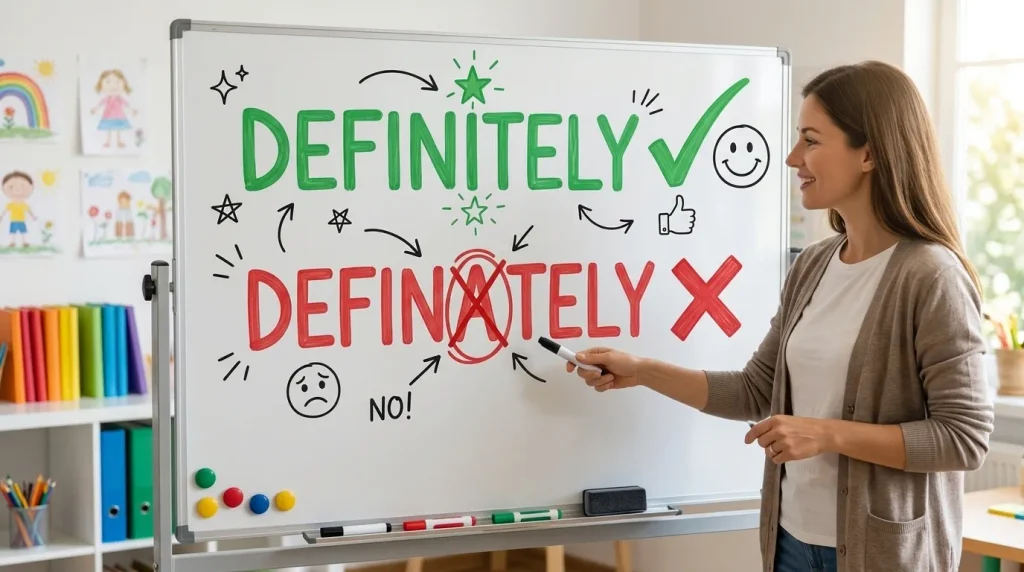
These mistakes show up often.
- Definately. This is the biggest one. The right spelling is definitely.
- Definatly. The “a” is wrong, and the “e” before “-ly” is missing.
- Definitly. The “e” is missing before “-ly.” Keep it.
- Definetly. The “e” is in the wrong spot, and the “i” is missing.
- Defanitely. An “a” slips into the middle again.
- Definently. Extra letters sneak in. The right spelling is cleaner.
- Defiantly for definitely. These are two different words.
Print and Save: Definitely Cheat Card
| Topic | Quick Fact |
| Correct spelling | definitely |
| Wrong spelling | definately |
| Part of speech | adverb |
| Meaning | without doubt, for sure |
| Memory trick | find the hidden word “finite” |
| Vowel check | E, I, I, E (no A) |
| Build the word | definite + ly (keep the E) |
| Do not mix with | defiantly (boldly) |
| Word family | define, definite, indefinitely, definitive, finite |
| Wrong forms to avoid | definately, definatly, definitly, definetly |
| Pronunciation | DEF-uh-nit-lee (US) |
| Word story | from Latin “definitus” (limited), from “finis” (end) |
| Best example | I will definitely be there at six. |
Quick Quiz: Multiple Choice
Pick the best answer. The key comes after the next section.
Question 1. Which spelling is correct?
- A. definately
- B. definitely
- C. definatly
Question 2. What small word is hidden inside definitely?
- A. finite
- B. final
- C. fine
Question 3. How many A’s does definitely have?
- A. none
- B. one
- C. two
Question 4. Which word means “in a bold, stubborn way”?
- A. defiantly
- B. definite
- C. definitive
Question 5. What is definitely built from?
- A. define + ly
- B. definite + ly
- C. defy + ly
Quick Quiz: Fill in the Blanks
Choose the correct word for each gap.
- I will ______ be there at six. (definitely / definately)
- Her answer was a ______ yes. (definite / definate)
- The toddler stood there ______ and refused to wear his hat. (defiantly / definitely)
- The shop will stay closed ______. (indefinitely / indefinately)
- A ______ number has an end, unlike infinity. (finite / finate)
Answer Key
Multiple choice
- B. Definitely is the only correct spelling here.
- A. The word “finite” hides in the middle.
- A. The word has no A at all.
- A. Defiantly comes from “defy.”
- B. Definitely is definite + ly.
Fill in the blanks
- definitely. The sentence means “for sure.”
- definite. It describes the noun “yes,” so it is the adjective.
- defiantly. The toddler is being stubborn.
- indefinitely. It means with no end date.
- finite. It means having an end or limit.
Missed a few? Hunt for the hidden word again, then run the quiz tomorrow.
Frequently Asked Questions
Is “definately” a real word?
No. Definately is not a word in English. It is a very common spelling mistake. The right word is definitely.
How do you spell definitely?
The spelling is D-E-F-I-N-I-T-E-L-Y. Remember that the word “finite” hides in the middle, and no “a” is allowed.
Why do so many people spell it “definately”?
The middle sound is soft, so it is easy to guess the wrong vowel. Also, many words end in “-ate,” so the brain picks “a.” Autocorrect also hides the mistake.
What is the difference between definitely and defiantly?
Definitely means “for sure.” Defiantly means “in a bold, stubborn way.” They come from two different roots.
What does definitely mean?
It means without doubt or for sure. It can also stand alone as a strong “yes.”
Where does the word definitely come from?
It comes from “definite,” plus “-ly.” Definite came from the Latin “definitus,” which meant “limited.” That in turn came from “finis,” which meant “end.”
Is “definite” the same as “definitive”?
No. Definite means clear and certain. Definitive means final and complete.
Final Thoughts
Definitely or Definately becomes easier to remember when you picture yourself taking a handwritten test. Your pen keeps moving as you write the word and spot a small friend hiding inside it: “finite.” The correct spelling is definitely, not definately. Remember, the word contains “finite,” so you do not need an extra “a.” Whenever you feel unsure, look for “finite” before you send your message, and you will find the right spelling.