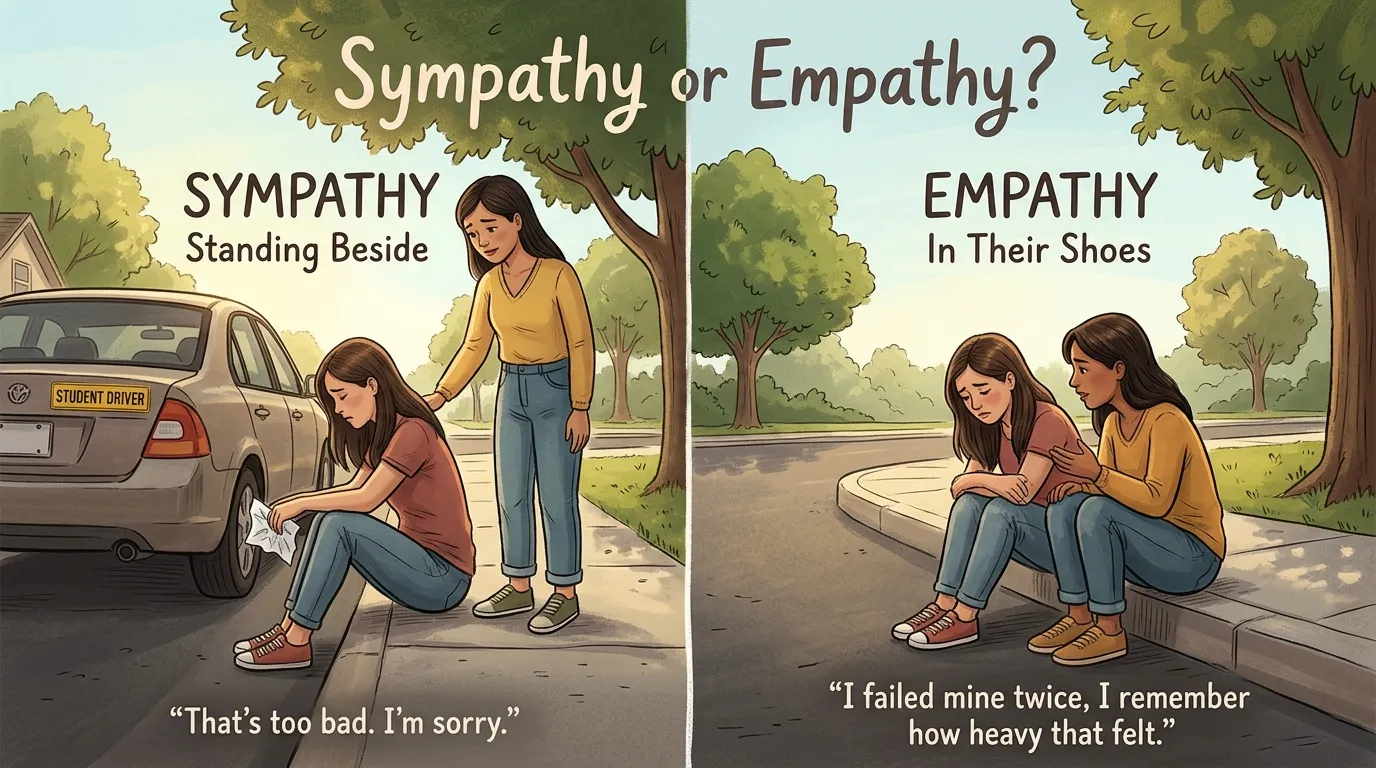
Your friend fails a driving test and sits quietly on the curb. You could say, “That’s too bad.” Or you could say, “I failed mine twice, and I remember how heavy that felt.” Both are kind. Yet they are not the same kind of kind.
The first reply shows sympathy, which means feeling sorry for someone. The second shows empathy, which means feeling what the other person feels. One stands beside you, and the other steps into your shoes.
Below, you will see what each word means, where each one comes from, and how to pick the right one for the moment. A short quiz waits at the end.
Pronunciation
Both words are long, and they rhyme except for the first part.
Sympathy
- US: /ˈsɪm.pə.θi/ (SIM-puh-thee)
- UK: /ˈsɪm.pə.θi/ (SIM-puh-thee)
- It comes from the Greek word “sympatheia,” which meant “fellow feeling.”
Empathy
- US: /ˈɛm.pə.θi/ (EM-puh-thee)
- UK: /ˈɛm.pə.θi/ (EM-puh-thee)
- It was coined in the early 1900s, based on a German word that meant “feeling into.”
The stress falls on the first part in both words: SIM and EM. The “th” sounds like the one in “thin,” not the one in “this.” Because the endings match, only the first letters tell them apart. Now let us look at the real differences.
Sympathy or Empathy: The Quick Answer
The table below shows the main point.
| Word | Meaning | Easy way to think of it | Example |
| Sympathy | Feeling sorry for someone | Standing beside them | I felt sympathy for the boy who lost his ball. |
| Empathy | Feeling what someone else feels | Stepping into their shoes | I felt empathy, because I had lost a ball too. |
Both words are nouns. Both are about caring. The gap is in how close you get to the other person’s feelings.
What Does “Sympathy” Mean?
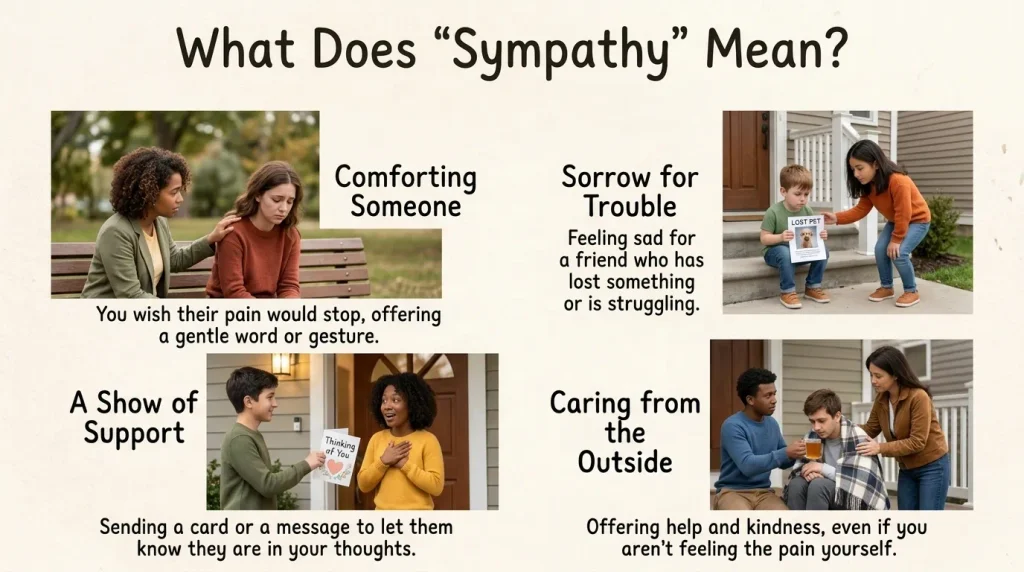
Sympathy is the care you feel when someone is hurting. You see the pain, and you wish it would stop. You may say you are sorry, send a card, or offer help. Even so, you do not have to feel the same pain yourself.
Sympathy has a few other uses too.
- Sorrow for someone’s trouble. “She felt sympathy for the lost puppy.”
- A show of support. A sympathy card tells a family you are thinking of them.
- Agreement. If you are “in sympathy with” an idea, you agree with it.
Examples with “Sympathy”
- The class showed sympathy when Leo lost his pet.
- She sent a sympathy card to her neighbor.
- Mom had little sympathy for the boy who did not study.
- He gave her a look full of sympathy.
- Please accept my sympathy for your loss.
- The crowd felt sympathy for the tired runner.
In each sentence, someone cares from the outside. They stand next to the problem, not inside it.
What Does “Empathy” Mean?
Empathy goes one step further. It means you feel what another person feels. You can imagine their place so well that their sadness, fear, or joy becomes a little bit yours.
Empathy often comes from your own life. If you have been through something like it, you know how it feels. That memory helps you share the feeling.
Examples with “Empathy”
- Mia had been lonely in a new school, so she felt empathy for the new girl.
- A good doctor listens with empathy.
- The coach showed empathy after the team lost.
- It takes empathy to see why your friend is upset.
- Reading stories can help children build empathy.
- He felt such empathy that his eyes filled with tears.
Here, someone steps inside the feeling. The care is close and personal.
A Story in Two Scenes
A short story can make the difference clearer. Two kids see a boy fall off his bike and scrape his knee.
Scene one. Ava walks over and says, “Oh no, poor you. I hope it stops hurting soon.” She feels sorry for the boy. That is sympathy.
Scene two. Sam kneels down and says, “I fell off mine last week. It stung so much! Here, let me help.” He remembers the sting. That is empathy.
Both kids were kind. Ava cared from beside the boy. Sam cared from inside the boy’s shoes.
Where the Words Come From
Both words end in the Greek word “pathos,” which means “feeling.” The front parts are different, and they carry the whole difference.
- Sympathy starts with syn-, which means “together.” So it is “feeling together,” or fellow feeling. It comes from the Greek “sympatheia.”
- Empathy starts with en-, which means “in.” So it is “feeling in,” as in feeling inside another person’s experience.
Empathy is the newer word. It showed up in English in 1908. It was modeled on a German word, “Einfühlung,” which means “feeling into.” Writers first used it when talking about how people feel their way into art and into other minds. A psychologist named Edward Titchener helped bring it into English.
The “pathos” part also lives in other words you may know, such as apathy (no feeling), antipathy (feeling against), and pathetic.
Why People Swap Them
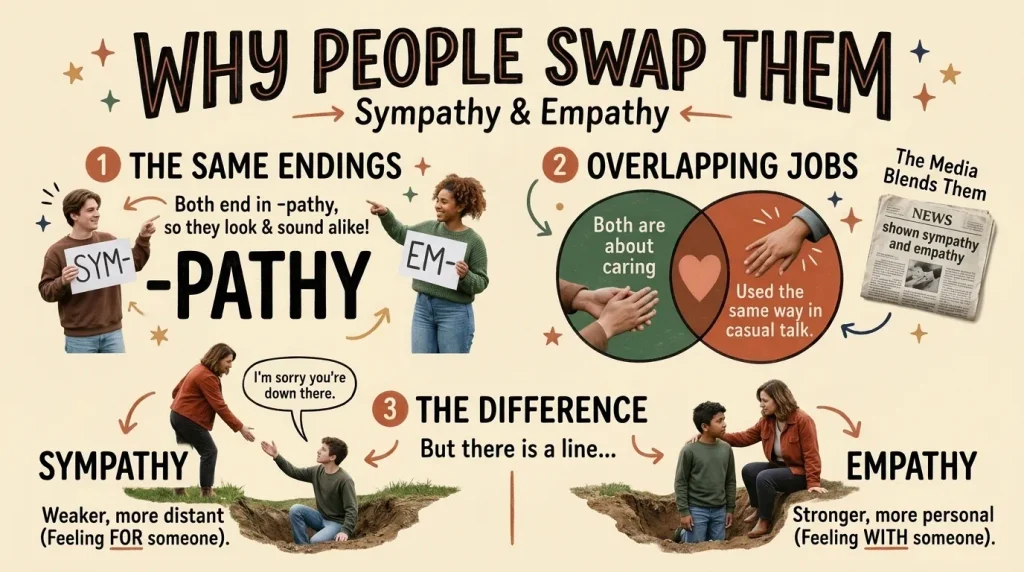
Many people use the two words as if they were twins. A few reasons explain why.
The endings are the same. Both finish with “-pathy,” so the words look and sound alike.
The jobs overlap, too. Both are about caring for others. In casual talk, people use them in the same way, and dictionaries note that the two are interchangeable in loose use.
Another reason is how often they appear together. News stories often say a leader showed “sympathy and empathy,” so the two words blend in people’s minds.
Even so, careful writers keep a line between them. Wiktionary describes it well: in stricter use, empathy is stronger and more personal, while sympathy is weaker and more distant.
Read more about:https://verboix.com/crete-or-corfu/
Before and After
Here are wrong and right versions, side by side.
| Before (wrong) | After (right) |
| We sent an empathy card to the family. | We sent a sympathy card to the family. |
| I failed a test too, so I feel sympathy for you. | I failed a test too, so I feel empathy for you. |
| I empathize you. | I empathize with you. |
| She felt sympathy because she had lived the same thing. | She felt empathy because she had lived the same thing. |
| He was empathetic card. | He sent a sympathetic card. |
| A strong, empathic “No!” | A strong, emphatic “No!” |
| I feel apathy for your loss. | I feel sympathy for your loss. |
Watch the pattern. Cards and kind words from a distance call for sympathy. Shared feeling from your own life calls for empathy.
Three Ways to Tell Them Apart
Pick the one that clicks for you.
Beside or Inside
Picture two people. One stands beside a sad friend with a hand on the shoulder. That is sympathy, from “syn-,” meaning “together.” The other steps inside the friend’s shoes. That is empathy, from “en-,” meaning “in.”
“Sorry” or “Me Too”
- Sympathy says, “I am sorry for you.”
- Empathy says, “Me too, I know how that feels.”
The first two letters of empathy, “Em,” sound like “me.”
Match the First Letters
- Sympathy goes with Sorry.
- Empathy goes with Equal feeling.
Which One Fits the Moment?
Each word has its place. The table below can help you pick.
| Moment | Better word | Why |
| Writing a card after a loss | sympathy | It shows care from a distance. |
| Sharing a story of your own hard time | empathy | It links your feeling to theirs. |
| Feeling sorry for a stranger in the news | sympathy | You have not lived it yourself. |
| Helping a friend through the same trouble you had | empathy | You know how it feels. |
| Agreeing with an idea | sympathy | “In sympathy with” means in agreement. |
| Listening closely without judging | empathy | You try to feel their point of view. |
Neither word is better than the other. Sometimes sympathy is exactly right, because you may not have lived the same thing. Empathy is a gift when you can offer it.
Sympathy and Empathy in Sentences
More examples help the words settle in.
At school
- The teacher showed sympathy when Ben forgot his lunch.
- Lena had moved too, so she felt empathy for the new student.
- The class signed a sympathy card for their friend.
Back home
- Mom listened with empathy after the hard day.
- Dad gave a sympathetic hug.
- My sister felt empathy because she had the same fear last year.
At work
- A good boss shows empathy to the team.
- The company sent its sympathy to the family.
- She felt empathy for the new worker who was nervous.
With friends
- I have sympathy for anyone who loses a pet.
- He has empathy because he went through the same thing.
- She offered sympathy, and he felt a little better.
In the news
- People around the world expressed sympathy after the flood.
- Readers felt empathy for the families in the story.
- The mayor sent her sympathy to the town.
The Word Family
Each word has relatives. Here is the full set.
| Word | Type | Meaning | Example |
| sympathy | noun | feeling sorry for someone | She showed sympathy. |
| sympathies | noun | expressions of care | Our sympathies are with you. |
| sympathetic | adjective | showing sympathy | He gave a sympathetic smile. |
| sympathize | verb | to feel or show sympathy | I sympathize with you. |
| sympathizer | noun | a person who supports a cause | He was a sympathizer. |
| unsympathetic | adjective | not showing sympathy | The guard was unsympathetic. |
| empathy | noun | sharing another person’s feelings | She felt empathy. |
| empathetic | adjective | showing empathy | He is an empathetic listener. |
| empathic | adjective | able to share feelings | An empathic nurse sat with her. |
| empathize | verb | to share another’s feelings | I empathize with you. |
A Note on “Empathic” and “Emphatic”
“Empathic” is not the same as emphatic. Emphatic means strong and clear, as in an emphatic “No!” These two look close, so they trip people up.
Slips to Avoid
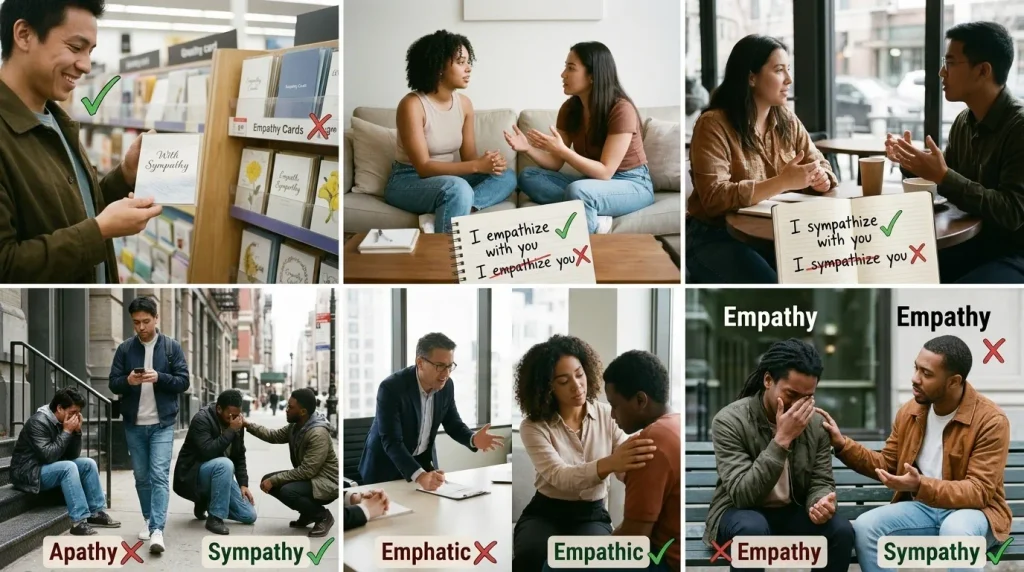
These mistakes show up often.
- Empathy card. The usual phrase is “sympathy card.”
- Empathize you. Add “with”: “I empathize with you.”
- Sympathize you. Add “with” here too: “I sympathize with you.”
- Apathy for someone’s pain. Apathy means no feeling at all. You likely mean sympathy.
- Emphatic for empathic. Emphatic means strong. Empathic means able to share feelings.
- Using empathy when you have never felt the same thing. Sympathy may fit better then.
Print and Save: Sympathy or Empathy Cheat Card
| Topic | Sympathy | Empathy |
| Meaning | feeling sorry for someone | feeling what someone else feels |
| Part of speech | noun | noun |
| Think of | standing beside them | stepping into their shoes |
| Short phrase | “I am sorry for you.” | “Me too, I know that feeling.” |
| Prefix | syn- = together | en- = in |
| Verb | sympathize (with) | empathize (with) |
| Adjective | sympathetic | empathetic, empathic |
| Common phrase | sympathy card | empathy for others |
| Memory trick | S = sorry | E = equal feeling |
| Pronunciation | SIM-puh-thee | EM-puh-thee |
| Word story | Greek “sympatheia” (fellow feeling) | 1908, from German “Einfühlung” (feeling into) |
Quick Quiz: Multiple Choice
Pick the best answer. The key comes after the next section.
Question 1. Which word means feeling sorry for someone?
- A. sympathy
- B. empathy
- C. apathy
Question 2. Which word means feeling what another person feels?
- A. sympathy
- B. empathy
- C. antipathy
Question 3. Which card do you send to a family after a loss?
- A. an empathy card
- B. a sympathy card
- C. an apathy card
Question 4. What does “syn-” mean in sympathy?
- A. against
- B. together
- C. without
Question 5. Which sentence shows empathy?
- A. “Too bad about your test.”
- B. “I failed a test once, so I know how that feels.”
- C. “I do not care.”
Quick Quiz: Fill in the Blanks
Choose the correct word for each gap.
- “I am sorry your dog is sick,” said Dad. He showed ______. (sympathy / empathy)
- Mia fell off her bike last year, so she felt ______ for her friend. (sympathy / empathy)
- We sent a ______ card to the family. (sympathy / empathy)
- I was lost once too, so I can ______ with you. (empathize / sympathize)
- She gave him a ______ pat on the back and said she was sorry. (sympathetic / empathic)
Answer Key
Multiple choice
- A. Sympathy means feeling sorry for someone.
- B. Empathy means feeling what another person feels.
- B. The usual phrase is “sympathy card.”
- B. “Syn-” means together.
- B. Sharing a past experience shows empathy.
Fill in the blanks
- sympathy. Dad feels sorry from the outside.
- empathy. Mia had the same experience.
- sympathy. The phrase is “sympathy card.”
- empathize. The speaker shares the same past.
- sympathetic. The pat on the back shows care from outside.
Missed a few? Try the “beside or inside” picture again, then retake the quiz.
Frequently Asked Questions
What is the difference between sympathy and empathy?
Sympathy means feeling sorry for someone. Empathy means feeling what someone else feels. Sympathy is care from outside, and empathy is care from inside.
Can I use sympathy and empathy the same way?
In casual talk, many people do, and dictionaries note this loose use. Still, careful writers keep sympathy for sorrow and empathy for shared feeling.
Is empathy better than sympathy?
Not always. Sympathy fits when you have not lived the same thing. Empathy fits when you can truly feel what the other person feels.
What does “sympathy card” mean?
It is a card you send to someone who has lost a loved one. It shows that you care and are thinking of them.
Is it “empathetic” or “empathic”?
Both are used. They mean about the same thing. The word “empathetic” is a bit more common in everyday talk.
Where does empathy come from?
It was coined in the early 1900s. It is based on the German word “Einfühlung,” which means “feeling into,” and on the Greek “empatheia.”
Is apathy the opposite of empathy?
Apathy means having no feeling or interest at all. It is the opposite of caring. Empathy means feeling with someone, so apathy is a strong contrast.
Last Word
Sympathy and empathy both come from caring, but they stand in different places. Sympathy stands beside a person and says, “I am sorry you are hurting.” Empathy steps into their shoes and says, “I know how that feels.”
Neither one is better. Sympathy is the right fit when you have not lived the same thing. Empathy is the right fit when you have.
So before you write the next card or message, picture where you are standing. Beside them? Write sympathy. In their shoes? Write empathy.