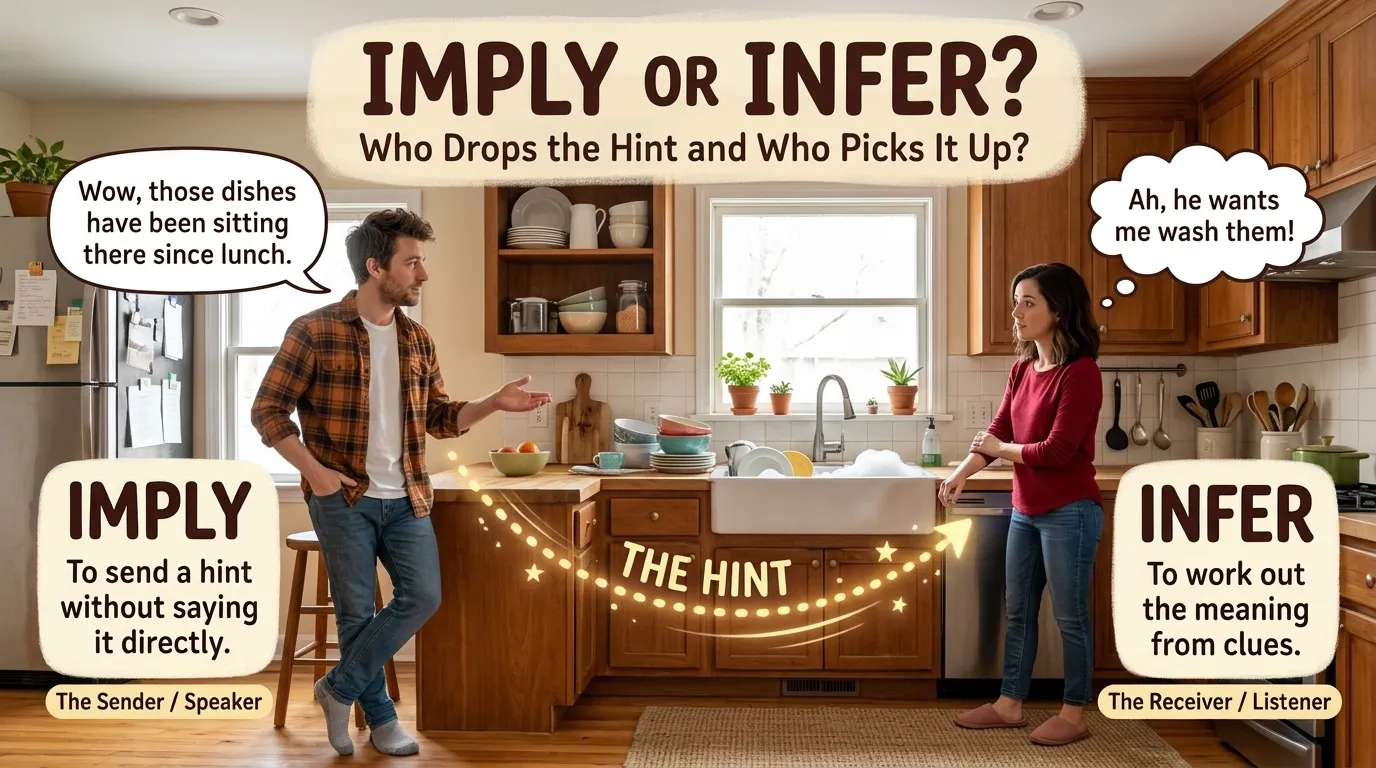
Dad glanced at the sink and said, “Wow, those dishes have been sitting there since lunch.” He never asked anyone to wash them. Still, Mom walked over, rolled up her sleeves, and turned on the water.
In that small moment, Dad implied that the dishes needed washing. Mom inferred it. Two different words were at work, and each one belonged to a different person.
One word belongs to the person who sends a hint, and the other belongs to the person who catches it. Below, you will learn how each word sounds, what it means, and where it came from. You will also get a few tricks to keep them straight, plus a short quiz at the end.
Pronunciation
Both words put the stress on the second part, so they sound a little like cousins.
Imply
- US: /ɪmˈplaɪ/ [im-PLY]
- UK: /ɪmˈplaɪ/ [im-PLY]
- Fact: The word goes back to a Latin verb that meant “to fold in.”
Infer
- US: /ɪnˈfɜːr/ [in-FUR]
- UK: /ɪnˈfɜː/ [in-FUR]
- Fact: The word goes back to a Latin verb that meant “to carry in.”
The first rhymes with reply, supply, and comply. The second rhymes with refer, prefer, and defer. Each word starts with a short “ih” sound, so the ending is where you can hear the difference. In most UK accents, the final “r” in the second word is silent.
The Quick Answer: Who Does What?
The person who speaks or writes sends the hint, and the word for that is imply. The person who listens or reads catches it, and the word for that is infer.
Ask yourself one question: “Am I sending the hint, or catching it?” If you send it, use the first word. If you catch it, use the second.
- Her smile implied that she loved the gift.
- From her smile, I inferred that she loved the gift.
Both sentences describe the same moment. The first looks at the person who smiled, and the second looks at the person who noticed.
What Does “Imply” Mean?
This verb means to suggest something without using plain words. The meaning sits behind what is said, like a note tucked inside an envelope.
The Sender’s Word
The person who talks, writes, or acts is the one who implies. A hint can hide in a voice, a look, a long pause, or a short sentence. Because the message is never stated, the listener has to find it.
Things can send hints too. A dark cloud implies rain. A locked door implies that nobody is home. No person is speaking, yet the sign still points to something.
The word has a second use as well. It can mean that one thing comes with another. For example, owning a dog implies daily walks.
Examples with “Imply”
- Her long pause implied that she did not agree.
- Are you implying that I forgot your birthday?
- He never said sorry, but the flowers implied it.
The verb changes to implies, implied, and implying. Its noun is implication, which means the hidden meaning itself. Implicit comes from the same family, and it describes something that is understood but not said.
What Does “Infer” Mean?
This verb means to work something out from clues, facts, or signs. Nobody told you the answer, so your brain has to build it.
The Catcher’s Word
The person who listens, reads, or watches is the one who infers. Think of a small puzzle. The clues are on the table, and the listener puts them together.
The answer you reach is called an inference. Sometimes it is right, and sometimes it is wrong. Even so, the word describes the thinking, not the result.
Examples with “Infer”
- We inferred that it was raining when we saw the wet umbrellas by the door.
- Because the lights were off, I inferred that the store had closed.
The verb changes to infers, inferred, and inferring. Watch for the double R in the last two. The noun, inference, has only one R, and the spelling follows the same rule as refer and referred.
The Difference Between Imply and Infer
Now that you have seen both words alone, let us put them next to each other.
The Direction of the Message
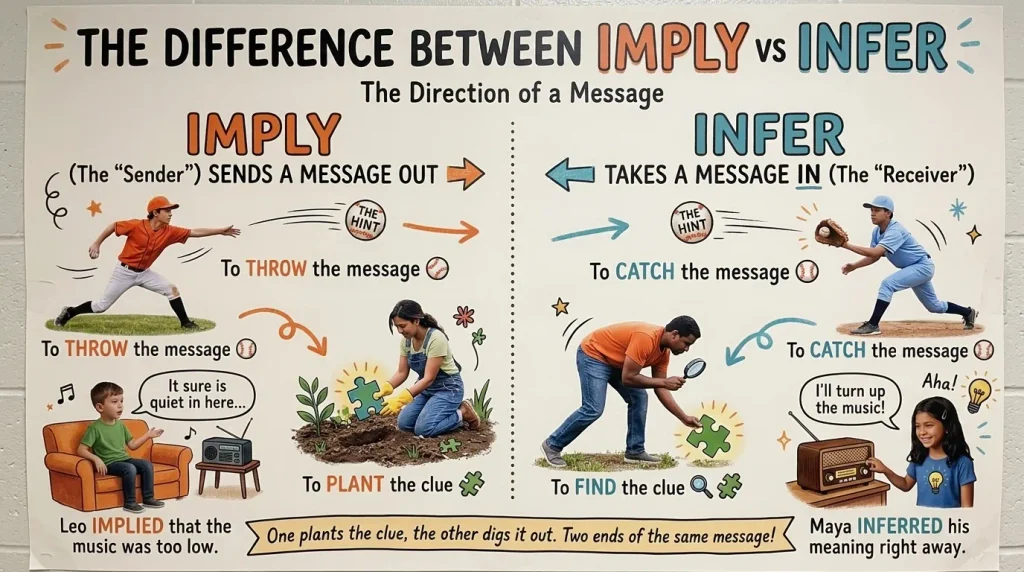
One sends a message out, and the other takes a message in. Picture a ball game. One player throws, and the other player catches. The throw is imply, and the catch is infer.
The Job Each Word Does
One word is about hiding a meaning inside words or actions. Its partner digs that meaning back out. One person plants the clue, and the other person finds it.
One Message, Two Words
A single moment can hold both words. When Leo said, “It sure is quiet in here,” he implied that the music was too low. Maya inferred it right away and turned up the radio.
Neither word is better. They simply sit at opposite ends of the same hint.
Read more about:https://verboix.com/breath-or-breathe/
Comparison Table
| Imply | Infer | |
|---|---|---|
| Who does it | The speaker or writer | The listener or reader |
| Direction | Sends meaning out | Takes meaning in |
| What it means | To hint without saying | To work out from clues |
| Noun | implication | inference |
| Past form | implied | inferred |
| Can a thing do it? | Yes, a sign can | No, only a thinker can |
| Sample sentence | His smile implied he was happy. | I inferred he was happy from his smile. |
Why People Get Confused
Several things make this pair tricky.
First, both words are about meaning that is not said out loud. That one idea links them tightly.
Second, they look and sound close. Each has two beats, each starts with a short “ih,” and the stress lands on the second beat.
Third, one hint often leads to one conclusion. Since the two happen together, many people treat them as one thing.
Finally, people have swapped them in casual speech for a long time. Some dictionaries even record the second word being used for the first. Still, many teachers, editors, and style guides ask writers to keep the two apart. For school, work, and any careful writing, the safest choice is to keep them separate.
The Origin of Imply and Infer
Both words came to English from Latin, and both tell a small story.
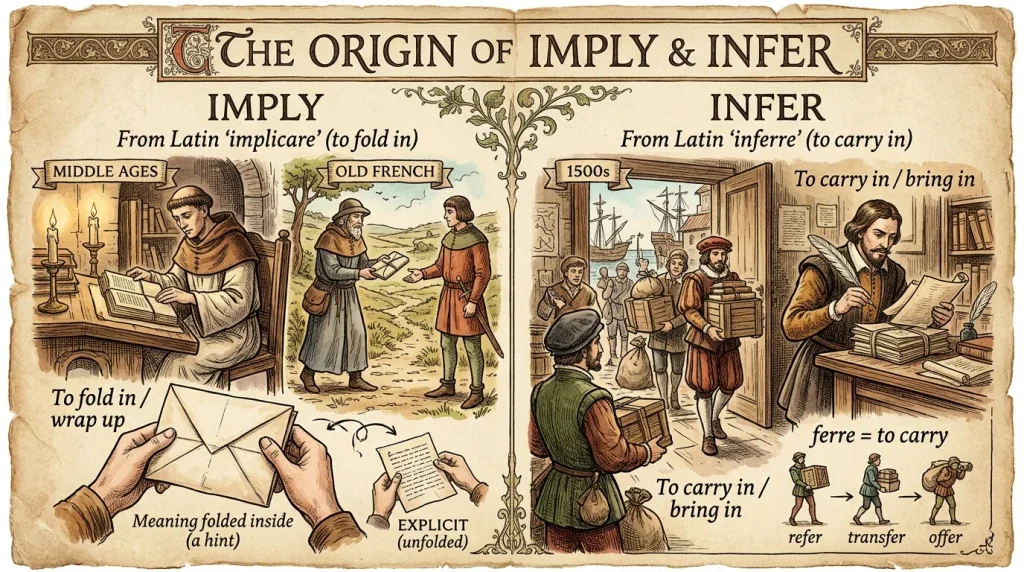
Imply comes from the Latin verb implicare, which meant “to fold in” or “to wrap up.” Old French carried it along, and English took it in around the Middle Ages. At first, it was close to “involve.” Later, it grew into “hint at,” like a meaning folded up inside a sentence. The word explicit has a mirror story. It means “unfolded,” and it describes something said plainly.
Infer comes from the Latin verb inferre, which meant “to carry in” or “to bring in.” It joined English in the 1500s. The second half of that Latin verb, ferre, also shows up in refer, transfer, and offer. Each one has the idea of carrying.
Both Latin roots start with “in,” and that does not help sort them out. So, for the choice between the two, use the tricks you will see below.
Everyday Usage
At School
Reading lessons lean on the catcher’s word all the time. A teacher might ask, “What can you infer about the main character?” That question means, “What clues tell you how she feels?” An answer on a test can imply that a student read the story, even if the student never says so.
At Home
Families trade hints all day long. A parent who says, “It is getting late,” implies that bedtime is near. The child who hears it infers that the game must end.
At Work
Emails are full of hidden meaning. A short reply like “Fine.” can hint at anger, or it can mean nothing at all. When your boss asks, “Are you implying that we missed the deadline?” she wants to know what you meant to hint. If you ask a coworker, “What do you infer from these numbers?” you want to hear the conclusion that person reached.
Imply, Suggest, or Hint?
Other words live near these two, and each one has its own shade.
Suggest is open and polite. “I suggest we leave early” says the idea out loud. Hint is small and playful. A hint is a clue, often dropped on purpose. Conclude means to reach a final answer, so it is stronger than a simple guess. Deduce means to reason step by step, like a detective. Gather is casual, as in “I gather you are not coming.”
The two words from this guide fit between them. Use the sender’s word when meaning hides behind what you say. Use the catcher’s word when you piece a meaning together without being told.
| Situation | Best word | Example |
|---|---|---|
| Saying an idea out loud | suggest | I suggest we start now. |
| Reasoning step by step | deduce | The detective deduced the thief’s name. |
| Casual understanding | gather | I gather you liked the movie. |
Idioms and Proverbs
Many everyday phrases are really about hints and clues.
- Drop a hint means to imply something in a gentle way.
- Take the hint means to infer what someone wants and act on it.
- Read between the lines means to find a meaning that is not written down.
- Put two and two together means to reach an answer from small clues.
- Jump to conclusions means to decide too fast, before you have enough clues.
- Actions speak louder than words is a proverb. It says that what people do can say more than what they say.
- Where there is smoke, there is fire is another proverb. Smoke points to something burning.
Literature and Movies

Stories are one of the best places to watch these two words in action.
In a detective story, the writer scatters small clues on purpose. There may be mud on a boot, a missing key, or a clock that stopped. The clues point to who did it, and the detective works out the answer. Readers often play along and try to solve it first.
Good writers also follow a famous piece of advice: show, do not tell. A writer might never say that a character is sad. Instead, the character sits alone by the window and leaves lunch untouched. The scene implies sadness, and the reader infers it.
Movies work the same way, only with faces and music instead of words. A quick look at a clock can hint that someone wants to leave. A sudden quiet note in the music can hint that danger is near. The audience catches on without a single line of talk.
Before and After
| Before (wrong) | After (right) | Why it changes |
|---|---|---|
| Are you inferring that I am late? | Are you implying that I am late? | The speaker is hinting. |
| From the dark clouds, I implied it would rain. | From the dark clouds, I inferred it would rain. | The person is working out a meaning. |
| She infered that the door was locked. | She inferred that the door was locked. | The R doubles before “-ed.” |
| He implyed that it was my fault. | He implied that it was my fault. | The Y turns into “ied.” |
Read each row and ask who is sending and who is catching. The fix appears right away.
A Memory Trick That Sticks
Try the throw and catch picture first. A hint is thrown, and a hint is caught. Imply is the throw. Infer is the catch.
Here is a letter trick if you like words. Imply starts with I, as in “I am the one speaking.” Infer starts with In, because the meaning goes in to your head.
A third trick uses a question. Before you pick a word, ask yourself, “Who has the clue in their hands?” If it is the speaker, write imply. If it has reached the listener, write infer.
Print and Save Cheat Card
| Topic | Imply | Infer |
|---|---|---|
| Quick job | Send a hint | Catch a hint |
| Who uses it | Speaker, writer, or sign | Listener, reader, or watcher |
| Think of | The throw | The catch |
| Letter clue | I am speaking | In to my head |
| Sound | im-PLY | in-FUR |
| Rhymes with | reply, supply | refer, prefer |
| Noun | implication | inference |
| Idiom | drop a hint | read between the lines |
Test Yourself: Five Quick Questions
Pick the best answer. The key is below the next section.
1. Which sentence is correct?
A. Her silence inferred that she was upset.
B. Her silence implied that she was upset.
C. Her silence implyed that she was upset.
2. Who usually does the inferring?
A. The listener
B. The speaker
C. Nobody
3. Which spelling is correct?
A. infered
B. inferred
C. infurred
4. A teacher asks, “What can you ____ from the picture?”
A. imply
B. infer
C. implication
5. Which phrase is about sending a hint?
A. Read between the lines
B. Take the hint
C. Drop a hint
Fill in the Blanks
Choose imply, infer, or a form of either word.
- The smell of smoke ______ that something was burning.
- From the muddy shoes, Sam ______ that his sister had been outside.
- Are you ______ that my idea is not good?
- We drew an ______ from the data, and it turned out to be right.
Answer Key
Multiple choice: 1) B, 2) A, 3) B, 4) B, 5) C.
Fill in the blanks: 1) implied, 2) inferred, 3) implying, 4) inference.
Frequently Asked Questions
What is the difference between imply and infer?
Imply means to hint at something without saying it. Infer means to work out a meaning from clues. The speaker implies, and the listener infers.
Can infer mean imply?
Some people use it that way in casual talk, and some dictionaries note the habit. However, most teachers and style guides still keep the two words apart. For school and work, use the catcher’s word only for the person who gets the hint.
How do you spell the past tense of infer?
It is inferred, with two R’s. The -ing form, inferring, keeps both. The noun, inference, has only one.
Where do the words come from?
Imply comes from a Latin verb that meant “to fold in.” Infer comes from one that meant “to carry in.” Both reached English through older forms of French and Latin.
Final Thoughts
Imply or infer? Later that night, Dad dried the last plate and said, “Next time, just ask me.” Mom smiled. “I caught the hint,” she said, “but I like it better when it is said out loud.”
Hints are useful, and so are plain words. When you want to talk about a hidden meaning, the choice is easy now. The sender implies, and the catcher infers.