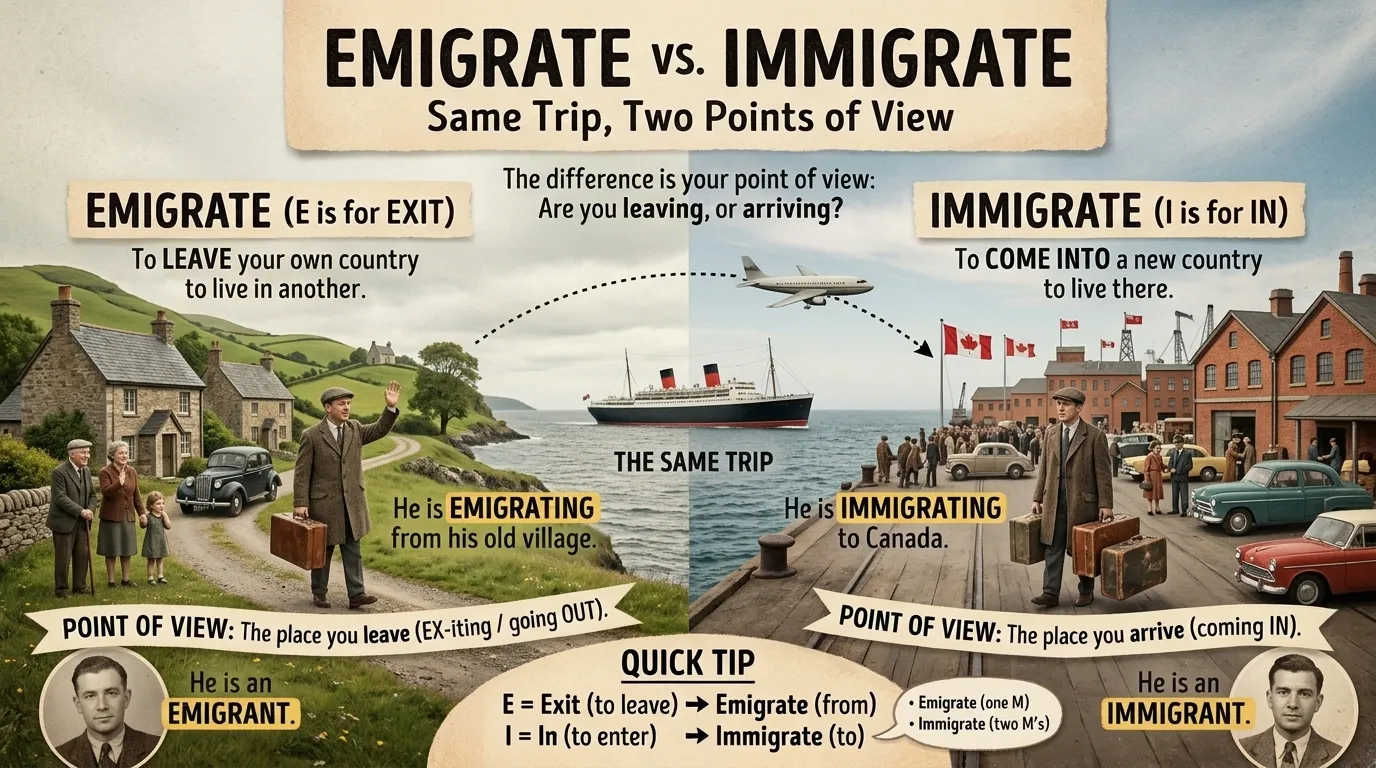
Maria’s grandfather left his small village in 1960 to start a new life in Canada. In his old village, neighbors say he emigrated. In Canada, neighbors say he immigrated. Both are right, and they describe the very same trip.
The difference is the point of view. Emigrate looks back at the place you leave. Immigrate looks ahead to the place you arrive.
Below, you will see what each word means and how they sound. You will also learn where they come from, and a one-letter trick will help you pick the right one. A short quiz waits at the end.
Pronunciation
The two words are close in sound, and the first letter makes the whole difference.
Emigrate
- US: /ˈɛm.ɪˌɡreɪt/ (EM-ih-grayt)
- UK: /ˈɛm.ɪ.ɡreɪt/ (EM-ih-grayt)
- It comes from the Latin word “emigrare,” which meant “to move away.”
Immigrate
- US: /ˈɪm.ɪˌɡreɪt/ (IM-ih-grayt)
- UK: /ˈɪm.ɪ.ɡreɪt/ (IM-ih-grayt)
- It comes from the Latin word “immigrare,” which meant “to move into.”
Both words rhyme, and the stress falls on the first part. Only the opening sound changes: “EM” for emigrate and “IM” for immigrate. Because the two sounds are so close, people mix them up in fast speech. Now let us look at the real differences.
Emigrate or Immigrate: The Quick Answer
The table below shows the main point.
| Word | Meaning | Point of view | Example |
| Emigrate | To leave your own country to live in another | The place you leave | She will emigrate from Poland next year. |
| Immigrate | To come into a new country to live there | The place you arrive | He will immigrate to Canada next year. |
Both are verbs, which means action words. Both describe moving to live in another country for a long time. The difference is which side of the trip you are talking about.
What Does “Emigrate” Mean?

To emigrate is to leave your own country and settle in a different one. The word puts the spotlight on the place you leave.
A person who does this is called an emigrant. The act itself is called emigration.
Examples with “Emigrate”
- My grandfather decided to emigrate from his village in 1960.
- Many families emigrated from Italy long ago.
- She dreamed of the day she would emigrate.
- They had to emigrate to find new work.
- Leo’s aunt emigrated when she was twenty.
- Thousands of people emigrate every year to start over.
In each sentence, the speaker thinks about the home country that is being left behind.
What Does “Immigrate” Mean?

To immigrate is to come into a new country in order to live there. The word puts the spotlight on the place you arrive.
A person who does this is called an immigrant. The act itself is called immigration.
Examples with “Immigrate”
- His family immigrated to Canada in 1960.
- Many people immigrate to a new country to join relatives.
- She hopes to immigrate next spring.
- They chose to immigrate to a city by the sea.
- My neighbor immigrated here ten years ago.
- Students sometimes immigrate with their parents at a young age.
In each sentence, the speaker thinks about the new country that is welcoming someone.
One Trip, Two Words
Let us use one story to see both words at work.
Sam packs his bags in Brazil and boards a plane to Spain. When he leaves Brazil, he emigrates from Brazil. When he lands in Spain and starts his new life, he immigrates to Spain.
So, the same person is an emigrant from Brazil and an immigrant in Spain. The only thing that changes is where you stand when you tell the story.
Where the Words Come From
Both words grow from the same Latin verb, “migrare,” which meant “to move from one place to another.” The prefix in front tells you the direction.
- e- (a form of “ex-”) means “out.” So, emigrate is “move out.”
- im- (a form of “in-”) means “into.” So, immigrate is “move into.”
Immigrate came into English in the 1620s. Emigrate showed up in 1763, first used about the Acadians. The noun immigrant followed in 1792, in American English.
English has other pairs that work the same way. Export and import move goods out and in. Exclude and include keep things out and bring them in. So, the “ex” and “in” idea is easy to spot once you look for it.
The root “migrare” also gives us the plain word migrate. It simply means to move from one place to another, with no direction attached.
Why People Mix Them Up
Several things cause the mix-up.
The sound is the first culprit. “EM” and “IM” are close, and in fast talk they blur.
The spelling is the second. The words differ by only one or two letters at the start, and both have the same long ending.
The shared meaning is the third. Both are about moving to live in another country, so they feel like the same idea.
Finally, a person can be both. Someone who emigrates from one country also immigrates to another. So, it takes a moment to decide which side you mean.
Read more about:https://verboix.com/ensure-or-insure/
Before and After
Here are wrong and right versions, side by side.
| Before (wrong) | After (right) |
| He immigrated from his village in 1960, leaving his family behind. | He emigrated from his village in 1960, leaving his family behind. |
| She emigrated to Canada and became a citizen there. | She immigrated to Canada and became a citizen there. |
| My cousin is an immigrant from Italy, who just left. | My cousin is an emigrant from Italy, who just left. |
| Emmigrate is hard to spell. | Emigrate is hard to spell. |
| They will immigrate their old home soon. | They will emigrate from their old home soon. |
| Birds immigrate south each winter. | Birds migrate south each winter. |
| The immigrate left at dawn. | The emigrant left at dawn. |
Watch the spelling too. Many people write “emmigrate” with two M’s. The correct spelling is emigrate, with just one M.
Three Ways to Pick the Right One
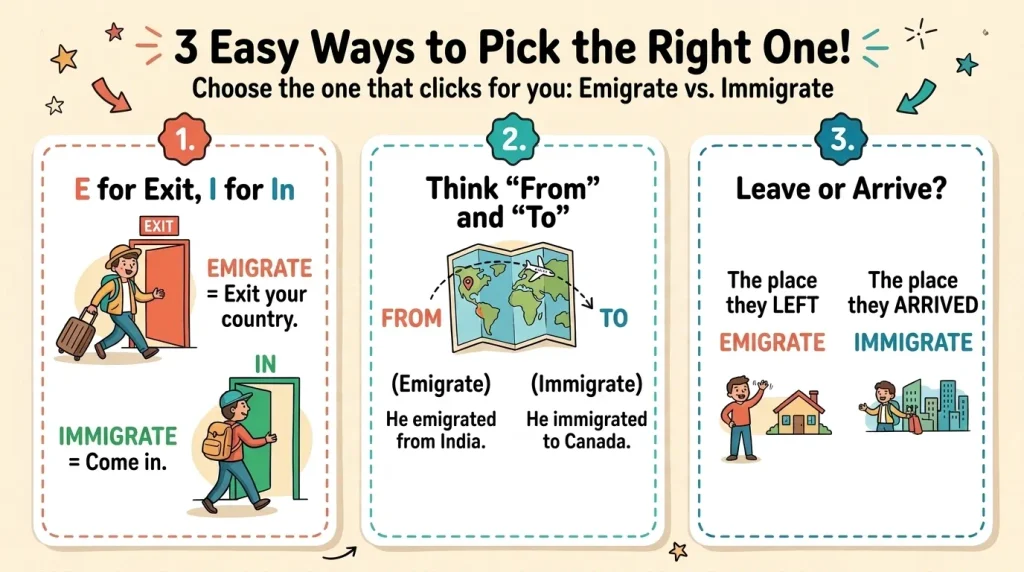
Choose the one that clicks for you.
E for Exit, I for In
- Emigrate starts with E, like Exit. You exit your country.
- Immigrate starts with I, like In. You come in to a new country.
Think “From” and “To”
- Emigrate often goes with from: “She emigrated from Peru.”
- Immigrate often goes with to: “She immigrated to Spain.”
Both words can mention both places, as in “emigrated from India to Canada.” Even so, this trick works as a good first check.
Ask Whose Side You Are On
Ask yourself: “Am I talking about the place someone left, or the place someone arrived?”
- If it is the place they left, write emigrate.
- If it is the place they arrived, write immigrate.
A Spelling Tip: Count the M’s
The two words have a different number of M’s.
- Emigrate has one M: e + migrate.
- Immigrate has two M’s: im + migrate.
Think of it this way. The prefix “im-” brings its own M, and “migrate” brings another. So, immigrate gets two.
Emigrate and Immigrate in Sentences
More examples help both words stay in your mind.
In family stories
- Her great-grandparents emigrated from a small island.
- My uncle immigrated to a big city to find work.
- They emigrated when their father got a new job abroad.
At school
- The class read a story about a girl who immigrated to a new country.
- Our teacher emigrated from Kenya as a young man.
- Sam wrote a report on why people emigrate.
In the news
- Many families emigrated after the storm.
- Experts say fewer people immigrate during hard times.
- The village shrank as young people emigrated.
In history class
- Many people emigrated from Europe in the 1800s.
- A large group immigrated to the harbor town.
- The book tells why some families chose to emigrate.
Daily talk
- My neighbor immigrated six years ago, and she loves the city.
- Lena’s cousin plans to emigrate next summer.
- Did your grandparents immigrate or were they born here?
The Word Family
Each word has relatives. Here is the full set.
| Word | Type | Meaning | Example |
| emigrate | verb | to leave your country to live elsewhere | She will emigrate. |
| emigrated | verb | left your country | He emigrated in 1960. |
| emigrating | verb | leaving right now | They are emigrating this month. |
| emigrant | noun | a person who leaves | The emigrant waved goodbye. |
| emigration | noun | the act of leaving | Emigration rose that year. |
| immigrate | verb | to come into a country to live | He will immigrate. |
| immigrated | verb | came into a country to live | She immigrated in 1960. |
| immigrating | verb | arriving right now | They are immigrating this month. |
| immigrant | noun | a person who arrives | The immigrant found a home. |
| immigration | noun | the act of arriving | Immigration brings new ideas. |
| migrate | verb | to move from place to place | Geese migrate in autumn. |
| migrant | noun | a person or animal that moves | A migrant picks fruit each season. |
| migration | noun | a move from one place to another | The migration took weeks. |
A Note on “Émigré”
You may also meet the French word émigré in books. It means a person who has left their country, often for political reasons. The word is close to “emigrant,” and it shows how far back this idea goes.
Where “Migrate” Fits
The plain word migrate has no direction. It works for birds, whales, and people. Geese migrate south in the fall. Workers may migrate to follow a harvest.
Because it has no direction, migrate is a safe choice when you do not want to take a side. Still, if you want to show leaving or arriving, pick emigrate or immigrate.
Slips to Avoid
These mistakes show up often.
- Emmigrate. Only one M is needed. The right spelling is emigrate.
- Imigrate. Two M’s are needed. The right spelling is immigrate.
- Immigrate when the focus is on leaving. “She immigrated from her village, leaving friends behind” works better as “emigrated.”
- Emigrate when the focus is on arriving. “She emigrated to a new city and loves it” works better as “immigrated.”
- Immigrate for birds. Birds migrate, so write “migrate.”
- Emigrant for immigrant. An emigrant leaves, and an immigrant arrives.
Print and Save: Emigrate or Immigrate Cheat Card
| Topic | Emigrate | Immigrate |
| Meaning | to leave your country to live elsewhere | to come into a country to live there |
| Point of view | the place you leave | the place you arrive |
| Prefix | e- (out) | im- (into) |
| Memory trick | E for Exit | I for In |
| Common pattern | emigrate from | immigrate to |
| Person word | emigrant | immigrant |
| Noun for the act | emigration | immigration |
| M count | one M | two M’s |
| Pronunciation | EM-ih-grayt | IM-ih-grayt |
| Word story | from Latin “emigrare” (move out), 1763 | from Latin “immigrare” (move into), 1620s |
| Plain version | migrate (no direction) | migrate (no direction) |
Quick Quiz: Multiple Choice
Pick the best answer. The key comes after the next section.
Question 1. Which word means to leave your own country to live elsewhere?
- A. emigrate
- B. immigrate
- C. both of them
Question 2. Which word means to come into a new country to live?
- A. emigrate
- B. immigrate
- C. migrate
Question 3. Which word fits: “The family decided to ___ from their home country last year.”
- A. emigrate
- B. immigrate
- C. immigrant
Question 4. How many M’s does “immigrate” have?
- A. one
- B. two
- C. three
Question 5. What does the prefix “e-” stand for in emigrate?
- A. exit, or out
- B. in
- C. again
Quick Quiz: Fill in the Blanks
Choose the correct word for each gap.
- My grandfather decided to ______ from his village in 1960. (emigrate / immigrate)
- After ten years in her new country, she was proud to be an ______. (emigrant / immigrant)
- Birds ______ south every winter. (migrate / immigrate)
- They plan to ______ into Canada and settle there. (immigrate / emigrate)
- The ______ left his home country behind. (emigrant / immigrant)
Answer Key
Multiple choice
- A. Emigrate means to leave.
- B. Immigrate means to come into a country.
- A. The sentence is about leaving, so emigrate fits.
- B. Immigrate has two M’s.
- A. The “e-” means exit, or out.
Fill in the blanks
- emigrate. The sentence is about leaving.
- immigrant. She is in her new country.
- migrate. Birds do not take a side, so use the plain word.
- immigrate. The sentence is about arriving.
- emigrant. The person left, so he is the emigrant.
Missed a few? Try the “E for Exit” trick again, then run the quiz tomorrow.
Frequently Asked Questions
What is the difference between emigrate and immigrate?
Emigrate means to leave your own country to live in another. Immigrate means to come into a new country to live there. The words describe the same trip from two sides.
Can a person emigrate and immigrate at once?
Yes. When you leave one country, you emigrate from it. When you arrive in the new one, you immigrate to it.
Is “emigrate to” correct?
Yes, people say “emigrated to Canada” often. Still, “emigrate from” is a good first check, because the word points to the place you leave.
What is the difference between an emigrant and an immigrant?
An emigrant is a person who leaves a country. An immigrant is a person who arrives in a new country to live.
Is it “emmigrate” or “emigrate”?
It is emigrate, with one M. Immigrate has two M’s.
What does “migrate” mean?
Migrate means to move from one place to another. It has no direction. It works for birds, animals, and people.
Where do the words come from?
Both come from the Latin verb “migrare,” which meant “to move.” The prefix “e-” means “out,” and “im-” means “into.”
Final Thoughts
Emigrate or immigrate? Maria’s grandfather still tells his story two ways. When he talks about the village, he says, “I left.” When he talks about Canada, he says, “I arrived.”
Both sentences are true, and each one fits a different word. Ask which side of the trip your sentence stands on, and the right word will be waiting there.