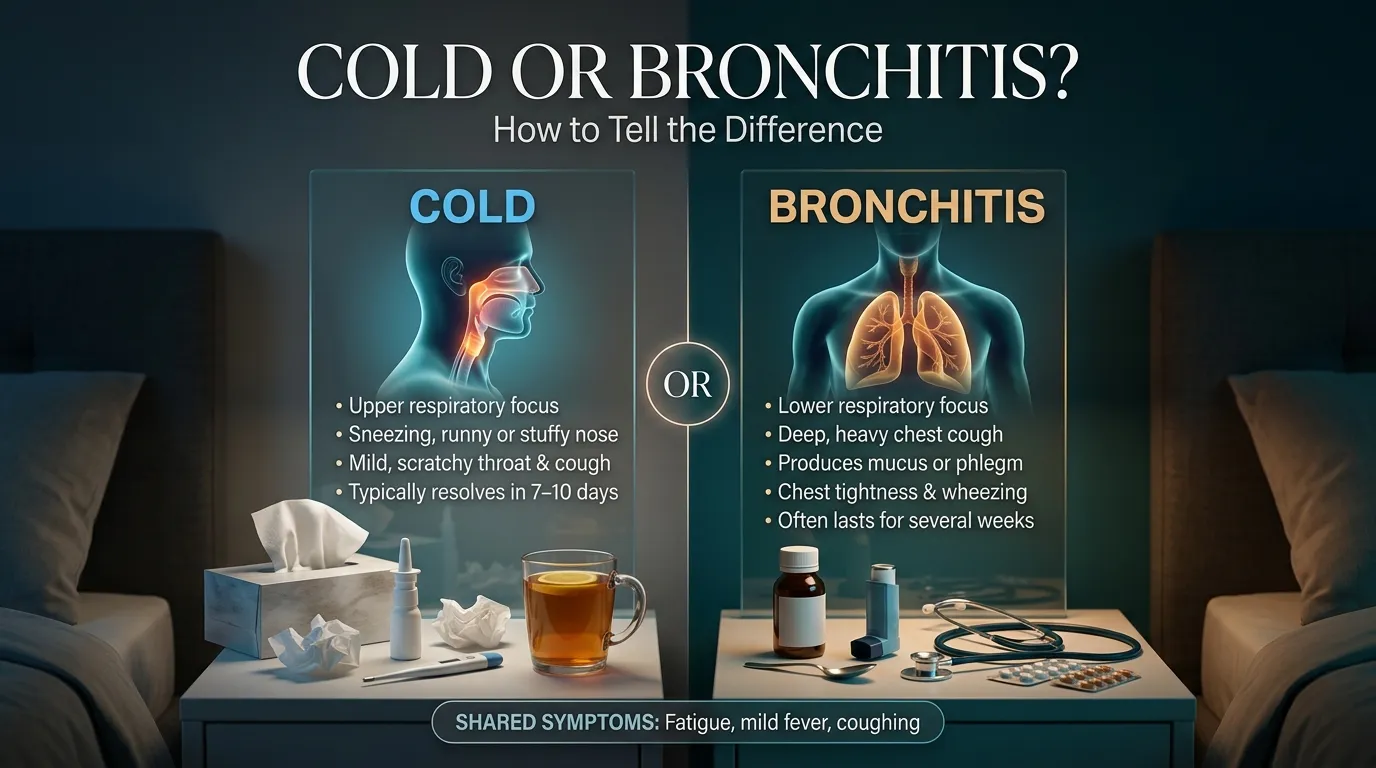
A cold often causes mild problems in your nose and throat. Bronchitis causes a deeper cough from your airways. This guide gives general facts only. It is not medical advice.
Tom had a scratchy throat on Monday. By Wednesday, he had a cough that would not stop. It felt deep and rattly in his chest. His coworker said, “That sounds like more than a cold.” Tom wondered. Was this just a cold? Or was it something more, like bronchitis? He searched cold or bronchitis. He wanted to understand what his body was telling him.
A cold is a common illness. It is usually mild. It affects your nose, throat, and sinuses. Bronchitis means your airways are swollen. These airways carry air to your lungs. Bronchitis often causes a deep cough that lasts a while. People search cold or bronchitis because the two can feel alike at first. This guide explains the differences in simple words. For your own symptoms, always see a doctor. Only a doctor can tell you for sure what you have.
Pronunciation
Both words are easy to say.
Cold
US: /koʊld/ (KOHLD)
UK: /kəʊld/ (KOHLD)
Bronchitis
US: /brɒŋˈkaɪ.tɪs/ (brong-KY-tis)
UK: /brɒŋˈkaɪ.tɪs/ (brong-KY-tis)
Both words sound almost the same in the US and UK.
Difference Between Cold and Bronchitis
1. Basic Meaning
A cold is a common, mild illness. Bronchitis means your airways are swollen and irritated.
- She caught a cold from her coworker.
- The doctor said he had bronchitis after a long cough.
2. What Part of the Body It Hits
A cold mostly hits your nose, throat, and sinuses. Bronchitis hits deeper, in the tubes that lead to your lungs.
- A cold often gives you a stuffy or runny nose.
- Bronchitis often gives you a deep cough in your chest.
3. Common Signs
A cold often brings sneezing, a runny nose, and a mild sore throat. Bronchitis often brings a cough that will not stop, sometimes with mucus, and a tight feeling in the chest.
- Cold signs include sneezing and a stuffy nose.
- Bronchitis signs include a long cough and chest discomfort.
4. How Long It Lasts
A cold usually gets better in about a week to ten days. Bronchitis can cause a cough that lasts for weeks, even after other signs go away.
- A cold often clears up in seven to ten days.
- A bronchitis cough can last three weeks or more.
5. The Cough
A cold may cause a light cough. This often comes from mucus dripping down your throat. Bronchitis causes a deeper, longer cough. It may bring up mucus too.
- A cold cough is often light and goes away fast.
- A bronchitis cough often sticks around and feels stronger.
6. What Causes It
Colds are almost always caused by tiny germs called viruses. Bronchitis is also often caused by viruses. Sometimes other things, like smoke, play a part too.
- The common cold comes from different kinds of viruses.
- Many cases of bronchitis start from the same kinds of viruses as a cold.
7. Different Kinds
A cold is just one kind of illness. Bronchitis has two main types. One is short-term, called acute bronchitis. The other is long-term, called chronic bronchitis. It is often linked to ongoing irritation in the airways.
- A cold does not have different “types” like bronchitis does.
- Acute bronchitis is short. Chronic bronchitis lasts much longer.
8. How Bad It Feels
A cold is usually mild. You can often rest at home to feel better. Bronchitis can also often be treated at home. But since it hits deeper in your chest, it can feel more uncomfortable.
- Most colds get better with rest and fluids alone.
- Bronchitis signs, especially if bad or long-lasting, are worth telling a doctor about.
9. Word Type
Both words name a kind of illness. They are nouns.
- He has a cold. (noun)
- She was told she has bronchitis. (noun)
10. The Swap Test
Ask, “Is this mostly in my nose and throat? Or deep in my chest?” If it feels like your nose and throat, think cold. If it feels like a deep cough that will not go away, it could be bronchitis. Only a doctor can say for sure.
- “My nose is stuffy and my throat feels scratchy.” This sounds like a cold.
- “I have a deep cough that will not stop.” This could be bronchitis. Check with a doctor.
Before and After: Fix It Fast
- ❌ “A cold always turns into bronchitis.”
✅ “A cold can sometimes turn into bronchitis, but not always.”
Not every cold leads to bronchitis. - ❌ “Bronchitis and a cold have the exact same signs.”
✅ “Bronchitis and a cold share some signs, but bronchitis often causes a deeper, longer cough.”
The two overlap, but they are not the same. - ❌ “You can always tell the difference yourself.”
✅ “It can be hard to tell the difference yourself. A doctor can help.”
Guessing on your own is not always reliable. - ❌ “Bronchitis always needs medicine called antibiotics.”
✅ “Bronchitis is often caused by a virus, so antibiotics may not help. A doctor can tell you what is best.”
Many cases of bronchitis come from viruses, not bacteria. - ❌ “A cold lasts just as long as bronchitis.”
✅ “A cold usually clears up faster than bronchitis, which can bring a cough lasting weeks.”
The two illnesses often last different amounts of time.
Nature and Behaviour of Cold and Bronchitis
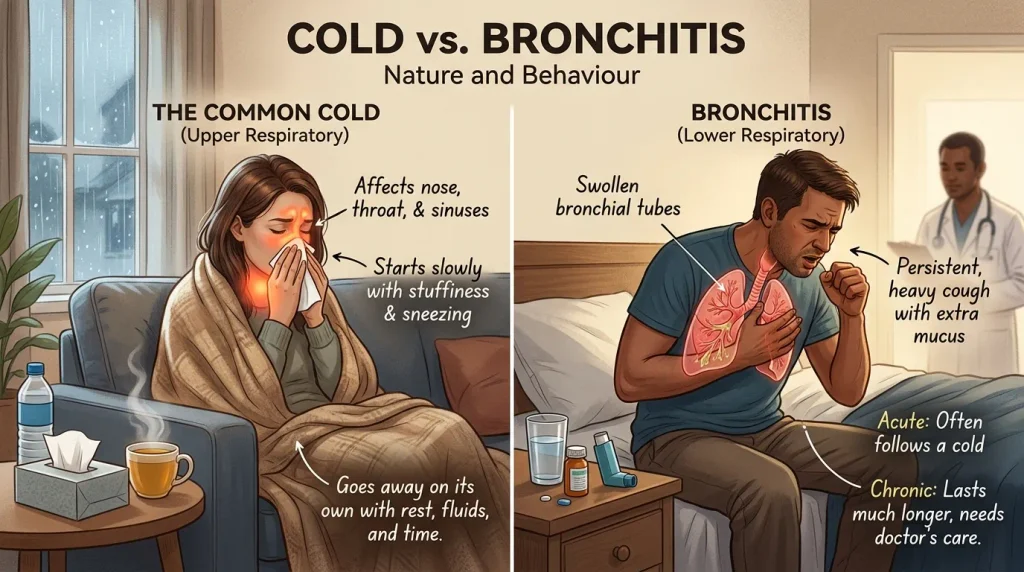
A cold is one of the most common illnesses. Most people get one several times a year, especially in cold months. It mostly affects your nose, throat, and sinuses. Signs often build up slowly. It might start with a scratchy throat. Then come stuffiness and sneezing. Most colds go away on their own. Rest, fluids, and time are often all you need.
Bronchitis means the tubes that carry air to your lungs are swollen. This swelling makes extra mucus form. That mucus often leads to a cough that will not quit. Acute bronchitis often follows a cold or another illness. This is one reason the two feel connected. Chronic bronchitis is different. It lasts much longer. It is often linked to ongoing irritation in the airways, sometimes from smoking. A doctor should guide care for this type.
Why People Get Confused About Cold and Bronchitis
There are four simple reasons.
- Bronchitis often follows a cold, so they can feel like one long illness.
- Both share some signs, like coughing and feeling tired.
- Many people do not know exactly which part of the body each one hits.
- Without a doctor’s check, it can be hard to tell them apart just by how you feel.
The fix is simple, but it is not a full answer on its own. Notice where your signs feel strongest, and how long they last. If you are ever unsure or worried, a doctor can give you a clear answer.
Read more about:https://verboix.com/flossing-or-waterpik/
Comparison Table
| Point | Cold | Bronchitis |
| Main meaning | Common, mild illness | Swollen airways |
| Body part hit | Nose, throat, sinuses | Tubes leading to the lungs |
| How long | About 7-10 days | Cough can last weeks |
| Common cause | Viruses | Often viruses, sometimes other things |
| Cough type | Often light | Often deep and long |
| Types | One main kind | Short-term and long-term kinds |
| Similarity | Both can bring a cough and tired feeling | Same |
This table shows general patterns only. Every person’s case can be different. A doctor’s check is the best way to know for sure.
The Origin of Cold and Bronchitis
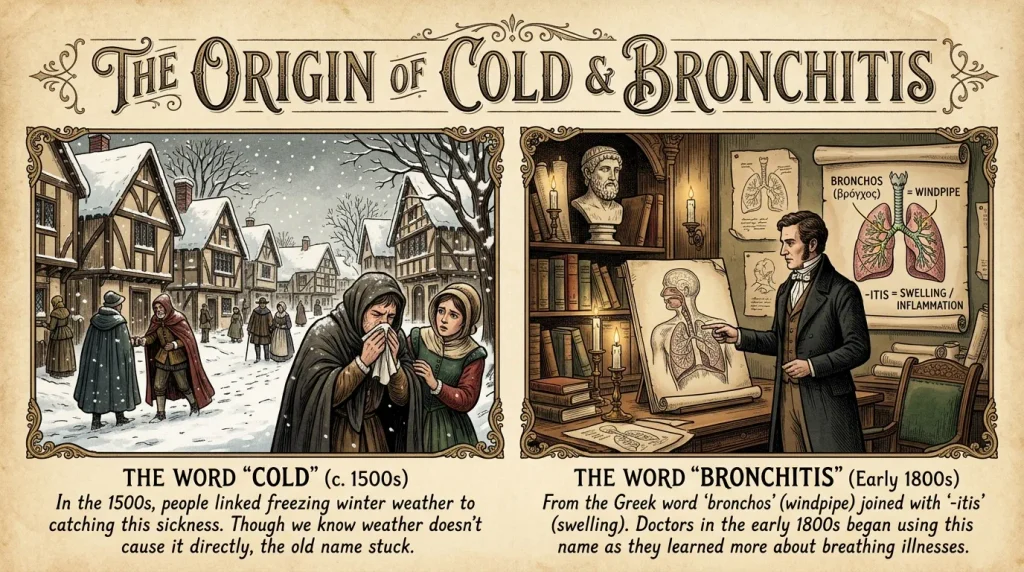
The word “cold,” for this illness, has been used since at least the 1500s. People likely linked cold weather to catching this kind of sickness. We now know cold weather itself does not cause the illness directly, but the old name stuck.
The word “bronchitis” comes from a Greek word, bronchos, which means “windpipe.” It is joined with “-itis,” a word part that means swelling. Doctors have used this word since the early 1800s, as they learned more about different breathing illnesses.
British vs American English
The spelling and meaning are the same in both places.
- Spelling: “Cold” and “bronchitis” are spelled the same in the US and UK.
- Medical words: Doctors in both countries use these words the same way.
- Everyday talk: People in the US and UK both say “I have a cold” or “I have bronchitis.”
Examples:
- US: “I think I’m coming down with a cold.”
- UK: “I think I’m coming down with a cold.”
Which One Should You Use?
This is not really about picking a word. It is about noticing which signs match your body, and asking a doctor to be sure.
- If signs are mild and mostly in your nose and throat: This often matches a common cold.
- If you have a deep cough that lasts, especially after a cold: This could be bronchitis. A doctor can check.
- If signs are strong, getting worse, or lasting a long time: Please see a doctor, no matter which one you think it might be.
Common Mistakes
- ❌ “Bronchitis is just a bad cold.” ✅ “Bronchitis means your airways are swollen. It is different from a cold, though it can follow one.”
- ❌ “Only smokers get bronchitis.” ✅ “Short-term bronchitis can happen to anyone, often after a cold. Not just smokers.”
- ❌ “A cold always needs antibiotics.” ✅ “Colds come from viruses. Antibiotics do not fight viruses.”
- ❌ “A cough that lasts a few days is always bronchitis.” ✅ “A lasting cough could be many things. A doctor’s check is the best way to know.”
- ❌ “A cold and bronchitis are not related at all.” ✅ “A cold can sometimes lead to bronchitis, since both often come from similar germs.”
Everyday Usage Examples
In emails
- “I won’t be in today. I think I’m fighting off a cold.”
- “My doctor said I have bronchitis after my cough lasted three weeks.”
On social media
- “Down with a cold this week. Soup and rest are my best friends right now. 🍲”
- “Finally feeling better after a rough bout of bronchitis.”
In the news
- “Cold and flu season usually peaks in winter.”
- “Doctors see more bronchitis cases during times of poor air quality.”
In formal writing
- “Patients with a lasting cough after a viral illness may be checked for acute bronchitis.”
- “The common cold is one of the most common reasons people visit a doctor.”
Usage Trends
Both words come up a lot in everyday talk about health, especially in cold months. Many people search for the difference between a cold and bronchitis when their cough feels stronger or lasts longer than expected, often after a cold seems to move deeper into the chest.
Online searches for this topic often rise during cold and flu season. People want to know if they should rest at home or see a doctor.
Why This Difference Matters
Knowing these general signs can help you decide when to rest at home and when to ask a doctor for help. Families can also watch for signs that seem more serious and talk to a doctor sooner. Schools and workplaces can use this knowledge to help sick people stay home and stop germs from spreading.
Usefulness in Daily Life
- At home: Resting and drinking fluids is often advised for a mild cold. For a cough that lasts or gets worse, see a doctor.
- At work: Many workplaces ask people to stay home with cold or flu-like signs to protect coworkers.
- With kids: Parents are often told to watch for trouble breathing, a long cough, or a high fever, and to call a doctor with worries.
- During cold and flu season: Washing hands often can help lower the chance of catching a cold or similar illness.
- When signs feel worse: Asking a doctor for help is always a smart step if you feel unsure or worried.
A Quick Note on Seeing a Doctor
This guide shares general facts only. It does not replace a doctor’s advice, check-up, or care. If you have signs that worry you, like a cough lasting several weeks, trouble breathing, chest pain, or a high fever, please contact a doctor. They can check your signs and tell you the right next steps.
Situational Preference
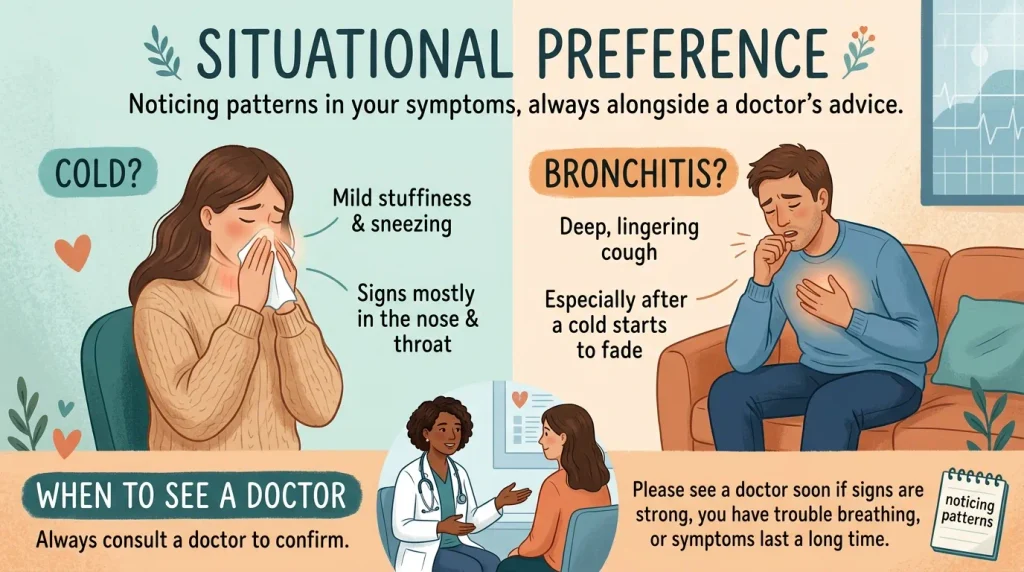
This part is less about what you want, and more about noticing patterns, always alongside a doctor’s advice. If your signs sit mostly in your nose and throat, with mild stuffiness and sneezing, this often fits a cold. If you get a deep cough that sticks around, especially after a cold starts to fade, this could point to bronchitis. A doctor’s check can help confirm this. If signs are strong, you have trouble breathing, or signs last an unusually long time, please see a doctor soon, no matter which one you suspect.
Cheat Card
| Cold | Bronchitis | |
| Means | Common, mild illness | Swollen airways |
| Mostly affects | Nose, throat, sinuses | Tubes leading to the lungs |
| Typical length | About a week | Cough can last weeks |
| Cough | Often light | Often deep and long |
| Remember | Centered in the nose and throat | Centered deeper in the chest |
This card shares general facts only. Always ask a doctor for a clear answer about your own health.
Quick Answers
1. What is the difference between a cold and bronchitis?
A cold mostly affects your nose, throat, and sinuses, usually with mild signs. Bronchitis means your airways are swollen, often causing a deeper cough that lasts longer.
2. Can a cold turn into bronchitis?
Yes, short-term bronchitis can sometimes follow a cold, since both are often caused by similar germs. But not every cold leads to bronchitis.
3. How long does bronchitis usually last?
The cough from short-term bronchitis can last several weeks, even after other signs feel better. This can be different for each person.
4. Do I need antibiotics for bronchitis?
Many cases of short-term bronchitis come from viruses. These do not respond to antibiotics. A doctor can tell you the right treatment for your case.
5. When should I see a doctor for a cough?
If your cough lasts more than a few weeks, feels very strong, or comes with trouble breathing, chest pain, or a high fever, it is a good idea to see a doctor.
6. Is bronchitis catching?
Short-term bronchitis caused by a virus can spread to others in a way similar to a cold, through coughing, sneezing, or close contact.
7. What is the difference between the two types of bronchitis?
Short-term bronchitis usually follows a viral illness and does not last too long. Long-term bronchitis lasts much longer. It is often linked to ongoing airway irritation, and a doctor should help manage it.
Conclusion
Cold or Bronchitis? A cold usually affects your nose, throat, and sinuses. Its signs often get better within about a week. Bronchitis means your airways are swollen, often causing a deeper cough that can last for weeks. Since the signs can be alike, it may be hard to tell them apart at first. This guide shares general facts only. If you or someone you know has worrying, strong, or long-lasting signs, please see a doctor. They can find the cause and suggest the right care.