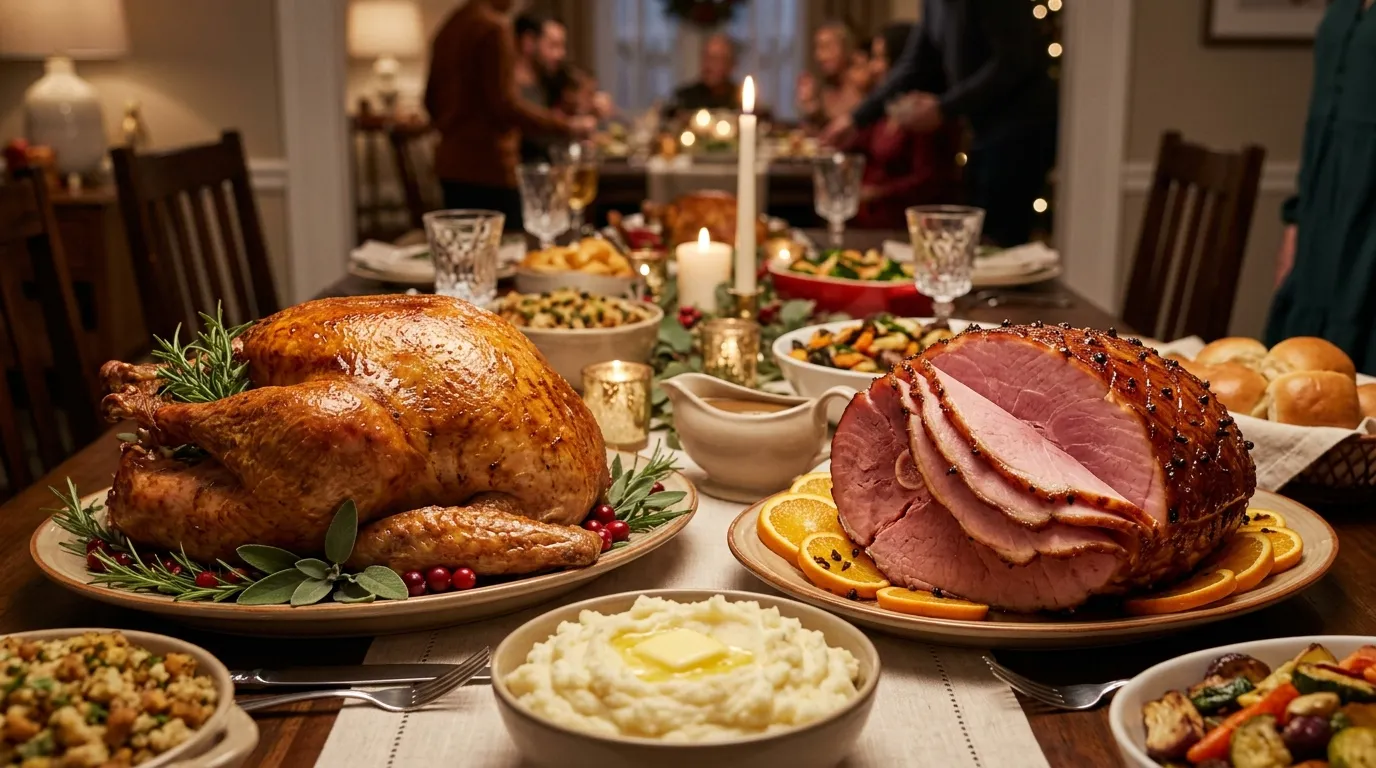
Turkey is a lean bird, often roasted whole for holidays. Ham comes from pork, usually cured or smoked, and served sliced.
Carla stood in the kitchen two weeks before Thanksgiving, staring at her family group chat. Half her family wanted turkey, the classic centerpiece. The other half wanted ham, like her grandmother always made. Carla had never really thought about why some families serve one and not the other. Were they that different? She opened her laptop and typed turkey or ham into the search bar.
Turkey is a large bird, often roasted whole and carved at the table. Ham comes from a pig’s leg, usually cured, smoked, or glazed before serving. People search turkey or ham because both are classic holiday mains, but they come from different animals, cook in different ways, and carry different traditions. This guide breaks down the real differences, so you can decide what belongs on your table this year.
Pronunciation
Both words are short and simple.
Turkey
US: /ˈtɝː.ki/ (TUR-kee)
UK: /ˈtɜː.ki/ (TUR-kee)
Ham
US: /hæm/ (HAM)
UK: /hæm/ (HAM)
Both words sound almost identical in the US and UK.
Difference Between Turkey and Ham
1. Basic Meaning
Turkey is a type of bird. Ham is a cut of meat from a pig.
- They roasted a whole turkey for the feast.
- She served thick slices of ham.
2. Animal Source
Turkey comes from, well, a turkey. Ham comes from a pig, specifically the leg.
- A turkey is a large farm bird.
- A ham comes from the hind leg of a pig.
3. How It’s Prepared
Turkey is usually roasted whole, often stuffed or seasoned. Ham is usually cured first, then baked, smoked, or glazed.
- A whole turkey goes into the oven for hours.
- A ham is often coated in a sweet glaze before baking.
4. Taste and Texture
Turkey has a milder, lighter flavor and can be dry if overcooked. Ham has a saltier, smokier flavor and stays moist due to curing.
- Turkey breast meat is often described as mild and lean.
- Ham has a rich, salty taste from the curing process.
5. Fat Content
Turkey, especially the breast, is leaner and lower in fat. Ham tends to have more fat, especially near the skin.
- Turkey breast is popular as a lower-fat protein choice.
- Ham often has a fat layer that crisps up when baked.
6. Size and Serving
A whole turkey can feed a large group and is carved at the table. A ham is often smaller per piece but very filling, sliced before or during serving.
- A 15-pound turkey can feed a big family gathering.
- A spiral-cut ham is easy to serve in neat slices.
7. Cooking Time
Turkey takes longer to cook due to its size, often three to five hours. Ham, especially a pre-cooked one, takes less time, mainly to heat through and glaze.
- A large turkey needs hours of careful roasting.
- A pre-cooked ham mainly needs reheating and glazing.
8. Cultural Tradition
Turkey is strongly tied to American Thanksgiving and some Christmas meals. Ham is common at Christmas, Easter, and in many European and Southern US traditions.
- Turkey is the centerpiece of most Thanksgiving tables.
- Ham is a classic choice for Easter dinner in many homes.
9. Word Type
Both words work mainly as nouns.
- The turkey is in the oven. (noun)
- Pass the ham, please. (noun)
10. The Swap Test
Ask, “Do I want a whole roasted bird, or a cured, smoky cut of meat?” If you picture a bird, think turkey. If you picture pink, sliced meat, think ham.
- “I want a (whole roasted bird) for the table.” Think turkey.
- “I want something (smoky and already cured).” Think ham.
Before and After: Fix It Fast
- ❌ “Turkey and ham taste exactly the same.”
✅ “Turkey and ham have very different flavors, one mild, one smoky and salty.”
The two meats come from different animals and different cooking methods. - ❌ “Ham is only served at Christmas.”
✅ “Ham is common at Christmas, Easter, and other gatherings too.”
Ham shows up in many holiday meals, not just one. - ❌ “Turkey always takes less time to cook than ham.”
✅ “A whole turkey often takes longer to cook than a pre-cooked ham.”
Turkey size and raw state usually mean longer cook times. - ❌ “All ham is raw before you buy it.”
✅ “Most ham sold in stores is already cured or pre-cooked.”
Many hams only need reheating, not full cooking from raw. - ❌ “You can’t serve both turkey and ham at the same meal.”
✅ “Many families serve both turkey and ham together for variety.”
Serving both is a common holiday tradition in many homes.
Read more about:https://verboix.com/farther-or-further/
Nature and Behaviour of Turkey and Ham
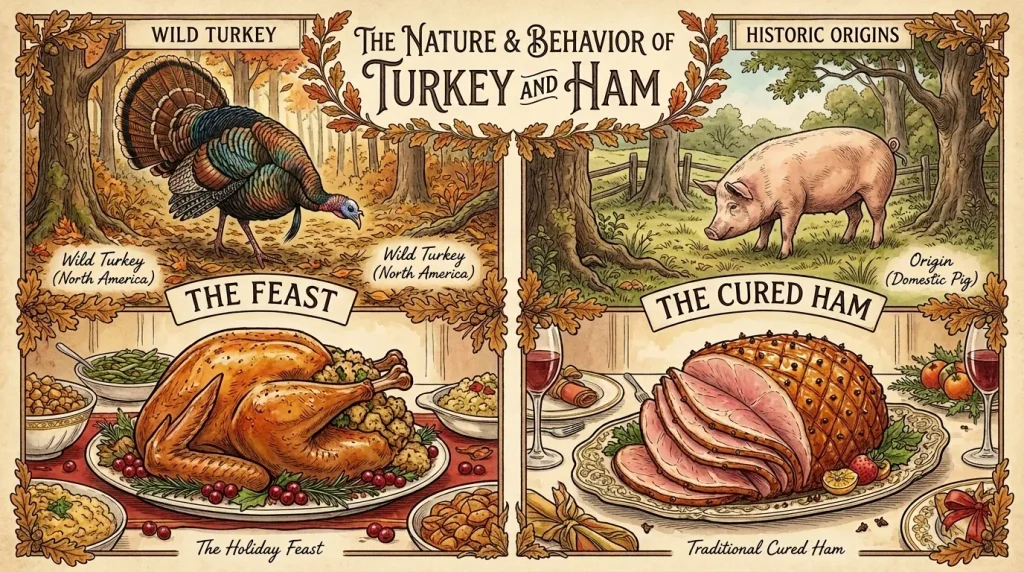
Turkey is a large bird, originally native to North America. For holiday meals, it is usually roasted whole in the oven, often stuffed with bread, herbs, or vegetables. The breast meat is lean and can dry out if not cooked carefully, while the dark meat from the legs stays juicier. Turkey carries strong ties to American Thanksgiving, a tradition that grew from early harvest celebrations.
Ham comes specifically from the hind leg of a pig. Before it reaches your table, it usually goes through curing, a process using salt, sugar, and sometimes smoke to preserve the meat and add flavor. This is why ham tastes salty and smoky compared to fresh pork. Many hams sold in stores are already fully cooked, needing only reheating and a glaze before serving. Ham holds a long history in European cooking and remains a holiday favorite in many cultures.
Why People Get Confused About Turkey and Ham
There are four simple reasons.
- Both are classic holiday centerpieces, so people often think of them as interchangeable options for the same meal.
- Many families have strong traditions around one or the other, making it feel like a bigger decision than it is.
- Both can be purchased whole and require similar oven space, which makes the cooking process feel similar.
- Some people are unsure which meat pairs best with certain side dishes or holidays.
The fix is simple. Think of turkey as the lean, roasted bird, and ham as the salty, cured pork. Many tables happily serve both.
Comparison Table
| Point | Turkey | Ham |
| Main source | A large bird | A pig’s hind leg |
| Flavor | Mild | Salty, smoky |
| Fat content | Lower | Higher |
| Preparation | Roasted whole | Cured, then baked or glazed |
| Cook time | Longer (3-5 hours) | Shorter, mainly reheating |
| Common holiday | Thanksgiving | Christmas, Easter |
| Texture | Can dry out easily | Stays moist from curing |
| Similarity | Both common holiday mains | Same |
The Origin of Turkey and Ham
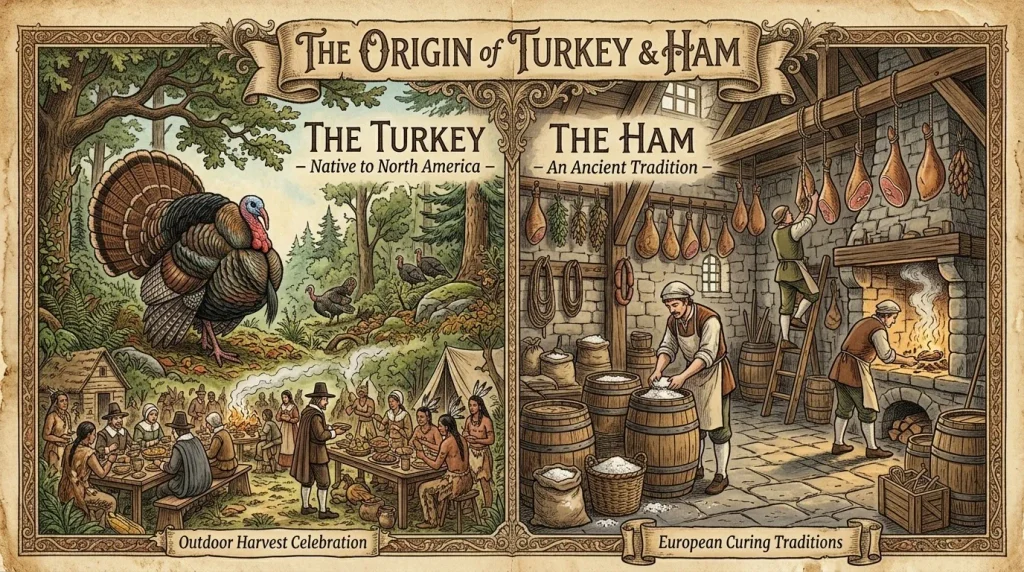
The word “turkey” has an odd history. English speakers once confused this American bird with a different bird imported through Turkey, and the name stuck, even though turkeys are native to North America, not the Middle East. Wild turkeys were an important food source for Indigenous peoples and early American settlers, which helped cement the bird’s place in Thanksgiving tradition, a holiday with roots in early 1600s harvest celebrations.
The word “ham” comes from an Old English word, hamm, referring to the back of the knee or the leg itself. Curing meat, including pork legs, has been practiced for thousands of years as a way to preserve food before refrigeration existed. Ham became especially popular across Europe, where regional curing traditions, like Spanish jamón or Italian prosciutto, developed distinct styles still famous today.
British vs American English
The spelling is the same in both countries, with some differences in tradition.
- Spelling: “Turkey” and “ham” are spelled the same in the US and UK.
- Holiday habits: In the US, turkey dominates Thanksgiving, a holiday not celebrated in the UK. In the UK, turkey is more associated with Christmas dinner, often alongside or instead of other meats.
- Ham styles: Both countries enjoy ham, though specific styles and glazes can vary by region and family tradition.
Examples:
- US: “We always have turkey for Thanksgiving and ham for Christmas.”
- UK: “We always have turkey for Christmas dinner.”
Which One Should You Use?
This often comes down to tradition, group size, and personal taste rather than one being objectively better.
- For a large gathering: Turkey can feed many people from one bird.
- For rich, bold flavor: Ham offers a salty, smoky taste many people love.
- For variety: Many hosts serve both, giving guests a choice.
There is no single right answer here. Many families choose based on what grandparents always served, or simply what everyone enjoys eating most.
Common Mistakes
- ❌ “Ham is a type of chicken.” ✅ “Ham comes from a pig, not any kind of poultry.”
- ❌ “Turkey is always dry.” ✅ “Turkey can be dry if overcooked, but proper cooking keeps it moist.”
- ❌ “You must cook ham from raw every time.” ✅ “Most store-bought ham is pre-cooked and only needs reheating.”
- ❌ “Turkey and ham require the same cooking time.” ✅ “Turkey usually takes much longer to cook than a pre-cooked ham.”
- ❌ “Only Americans eat turkey for the holidays.” ✅ “Turkey is popular in the UK and other countries too, especially at Christmas.”
Everyday Usage Examples
In emails
- “Can you confirm if we’re doing turkey or ham for Thanksgiving this year?”
- “I’ll bring the glazed ham if someone else handles the turkey.”
On social media
- “Turkey came out perfectly golden this year! 🦃”
- “Nothing beats a honey-glazed ham at Christmas. 🍖”
In the news
- “Turkey prices rise ahead of the holiday season.”
- “Grocery stores see a surge in ham sales before Easter.”
In formal writing
- “The traditional Thanksgiving meal typically centers around a roasted turkey.”
- “Cured ham remains a staple of many European holiday tables.”
Usage Trends
Turkey remains the clear favorite for American Thanksgiving, with millions of birds purchased each November. Ham sees its biggest spike around Christmas and Easter, both in the US and across many parts of Europe.
In recent years, some families have started mixing traditions, serving both turkey and ham at the same holiday table to satisfy different preferences. Online searches for “turkey or ham” tend to rise sharply in the weeks before major holidays, as people plan their menus and settle family debates.
Metaphors and Similes
Turkey
- “The turkey was the proud centerpiece of the table.” (metaphor)
- “The golden skin glistened like a trophy fresh from the oven.” (simile)
Ham
- “The ham was a salty jewel, glazed and gleaming.” (metaphor)
- “Each slice fell away like petals from a flower.” (simile)
Turkey often represents the main event. Ham often represents comfort and rich tradition.
Connotative Meaning
Turkey
- Positive: “The turkey turned out perfectly this year.” It shows pride and success.
- Neutral: “We bought a turkey for Thursday.” It states a plan.
- Negative: “The turkey was dry and overcooked.” It shows disappointment.
Ham
- Positive: “Grandma’s ham is the best part of Christmas.” It shows warmth and tradition.
- Neutral: “We picked up a ham from the store.” It states a fact.
- Negative: “The ham was too salty this time.” It shows a complaint.
Idioms and Proverbs
A few playful idioms connect loosely to these words.
- Talk turkey: “Let’s talk turkey about the budget.” It means to speak honestly and directly.
- Cold turkey: “She quit sugar cold turkey.” It means to stop something suddenly and completely.
- Ham it up: “He always hams it up for the camera.” It means to act in an exaggerated, playful way.
While these idioms use the words “turkey” and “ham,” they do not directly relate to the foods themselves, but they add fun flavor to everyday English.
Literature and Movies
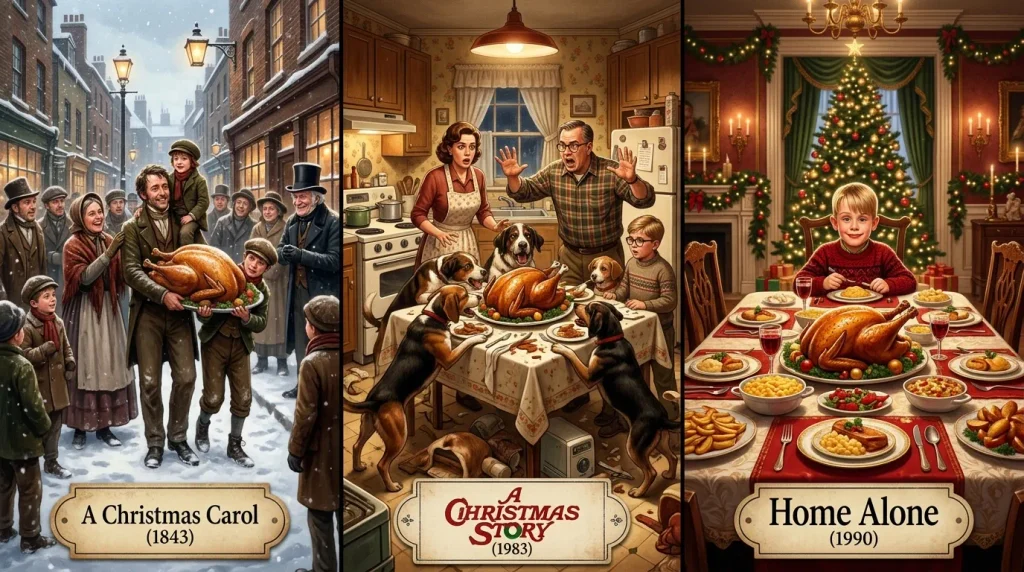
Literature
- A Christmas Carol (novella, Charles Dickens, 1843): Features a famous scene involving a prize turkey sent to the Cratchit family.
Movies
- A Christmas Story (1983, United States): Includes a well-known scene where the family’s holiday turkey plans go hilariously wrong.
- Home Alone (1990, United States): Features scenes with Kevin enjoying classic holiday meals, including turkey.
Why This Difference Matters
For holiday planning, knowing the real differences between turkey and ham helps hosts choose a main dish that fits their group size, budget, and flavor preferences. For cooking success, understanding each meat’s needs, like turkey’s longer roast time or ham’s simpler reheating, helps avoid common holiday kitchen stress.
Families often feel strongly about choosing turkey or ham because of holiday traditions. Understanding both options can help make holiday menu choices easier.
Usefulness in Daily Life
- When hosting Thanksgiving: Turkey remains the traditional centerpiece, though some families add ham too.
- When hosting Christmas or Easter: Ham is a popular, simpler option, especially pre-cooked versions.
- When cooking for a large group: A whole turkey can feed many guests from one dish.
- When short on time: A pre-cooked ham requires far less active cooking than a whole turkey.
- When planning leftovers: Both turkey and ham work well in sandwiches, soups, and other dishes after the holiday.
A Quick Test You Can Use
Ask these three questions:
- Do I want a classic Thanksgiving centerpiece? Turkey is the traditional choice.
- Do I want something simpler to prepare with rich, salty flavor? Ham often fits better.
- Can I serve both? Many hosts offer turkey and ham together for variety.
Situational Preference
Pick your main dish based on your holiday, your guests, and your schedule. For Thanksgiving, turkey remains the expected classic, though ham can join as a second option. For Christmas or Easter, ham is often simpler and just as beloved.
At a large family gathering, a whole turkey offers more servings from one dish. For a smaller, low-stress meal, a pre-cooked ham saves time and effort. When family tradition is strong, that often settles the debate before flavor even comes into play.
Cheat Card
| Turkey | Ham | |
| Means | A roasted whole bird | A cured cut of pork |
| Flavor | Mild | Salty, smoky |
| Prep time | Longer | Shorter |
| Common holiday | Thanksgiving | Christmas, Easter |
| Remember | The classic Thanksgiving bird | The smoky holiday favorite |
Quick Answers
1. What is the difference between turkey and ham?
Turkey is a large bird, usually roasted whole. Ham is a cured cut of meat from a pig’s leg, usually baked or glazed.
2. Which takes longer to cook, turkey or ham?
Turkey usually takes much longer, often three to five hours, while pre-cooked ham mainly needs reheating.
3. Is ham raw when you buy it?
Most store-bought ham is already cured or fully cooked, needing only reheating and glazing before serving.
4. Why is turkey linked to Thanksgiving?
Wild turkeys were an important food source for early American settlers and Indigenous peoples, helping the bird become a lasting holiday tradition.
5. Can I serve both turkey and ham at one meal?
Yes, many families serve both together to offer guests variety and satisfy different traditions.
6. Which has less fat, turkey or ham?
Turkey, especially the breast meat, is generally leaner and lower in fat than ham.
7. Is ham popular outside the US?
Yes, ham is popular across many European countries, especially for Christmas and Easter meals.
Conclusion
Turkey or Ham? Turkey is a large bird, usually roasted whole and linked to Thanksgiving. Ham is a cured cut of pork, often baked with a sweet glaze and served at Christmas and Easter. Turkey offers a lean, classic main dish for large gatherings, while ham brings a rich, salty taste and is often easier to prepare. Neither is always better, as the right choice depends on family traditions, group size, and personal taste. When planning a holiday meal, you can serve turkey, ham, or both. Knowing their differences helps you choose the best dish for your table.