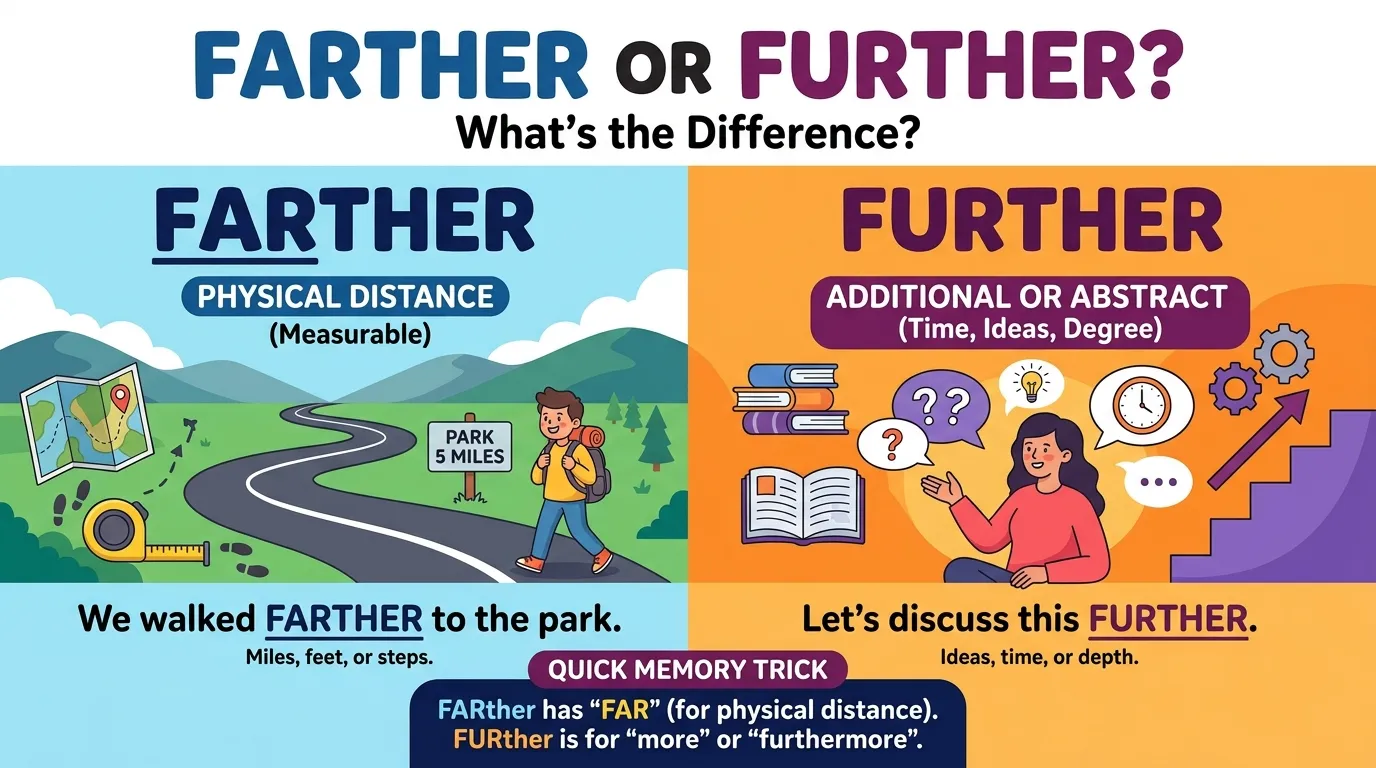
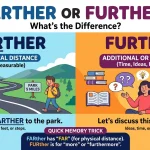
One word is for real distance you can measure. The other is for more of something, like time, degree, or an idea.
Sam and his sister were walking to the park. “How much farther?” Sam asked. His sister said, “Let’s not go any further with this walk. It’s too hot.” Sam stopped. “Wait,” he said. “You used two different words. Are they the same?” His sister laughed. “Almost,” she said. “But not quite.”
The first word means a real distance. You can measure it with a ruler, a map, or your feet. The second word means “more” in a different way. It can mean more time, more talk, or more of an idea. People search this pair often because the words look and sound alike. They both come from the same old root. This guide makes the difference simple, with clear rules and easy examples.
Pronunciation
Both words sound close, but not the same.
Farther
US: /ˈfɑːr.ðɚ/ (FAR-ther)
UK: /ˈfɑː.ðə/ (FAH-thuh)
Further
US: /ˈfɝː.ðɚ/ (FUR-ther)
UK: /ˈfɜː.ðə/ (FUR-thuh)
The first part is the main clue. One starts like “far.” The other starts like “fur.” Say them slowly and you will hear the small change.
The Key Differences
1. Basic Meaning
One means a longer distance. The other means more of something that is not distance.
- The store is farther than the school.
- Let’s not talk about this any further.
2. What It Measures
One measures space. The other measures time, amount, or degree.
- The farther hill is five miles away.
- We need further information.
3. Can You Count It?
You can count the distance word in miles, feet, or steps. You cannot count the other one that way.
- Run two miles farther.
- Think a little further about your answer.
4. Word Type
Both can work as adjectives or adverbs. Only the second one can also work as a verb.
- The farther shore was hard to see. (adjective)
- We walked farther today. (adverb)
- The grant will further her research. (verb)
5. Physical or Not
One is for things you can touch, walk, or drive to. The other is for ideas, plans, or talk.
- The farther path leads to the lake.
- Let’s discuss this further at lunch.
6. Which One Is Safer
The second option is the safer pick when you are not sure. Many writers use it for both distance and other meanings. The first word only works for real distance.
- “How much further is it?” is common and accepted.
- “Tell me farther about it” sounds wrong. The other word fits here.
7. In British English
British writers often use one term for almost everything. American writers keep a cleaner split between the two.
- UK: “The shop is further down the road.”
- US: “The shop is farther down the road.”
8. Related Words
One word comes with “far.” The other comes with “furthermore,” a word used to add a new point.
- Far, farther, farthest.
- Further, furthermore, furthest.
9. In a Sentence With Numbers
When a number of miles or feet is used, the distance word is the traditional pick.
- The car can go ten miles farther on a full tank.
- We need further proof before we decide.
10. The Swap Test
Try the word “additional.” If it fits, use the non-distance option. If you mean real distance, use the other one.
- “I need (additional) time.” Use further.
- “The town is five miles (more) away.” Use farther.
Before and After: Fix It Fast
- ❌ “We drove further than planned, about sixty miles.”
✅ “We drove farther than planned, about sixty miles.”
Sixty miles is a real distance. - ❌ “Let’s not go farther into this topic.”
✅ “Let’s not go further into this topic.”
A topic is not a measured distance. - ❌ “She lives farther away, but I don’t know the exact distance.”
✅ “She lives further away, but I don’t know the exact distance.”
Without a number, the safer pick applies. - ❌ “He needs farther training before the job starts.”
✅ “He needs further training before the job starts.”
Training is not measured in miles. - ❌ “The gas station is further up this road, about two miles.”
✅ “The gas station is farther up this road, about two miles.”
Two miles is a clear, real distance.
Nature and Behaviour of These Two Words
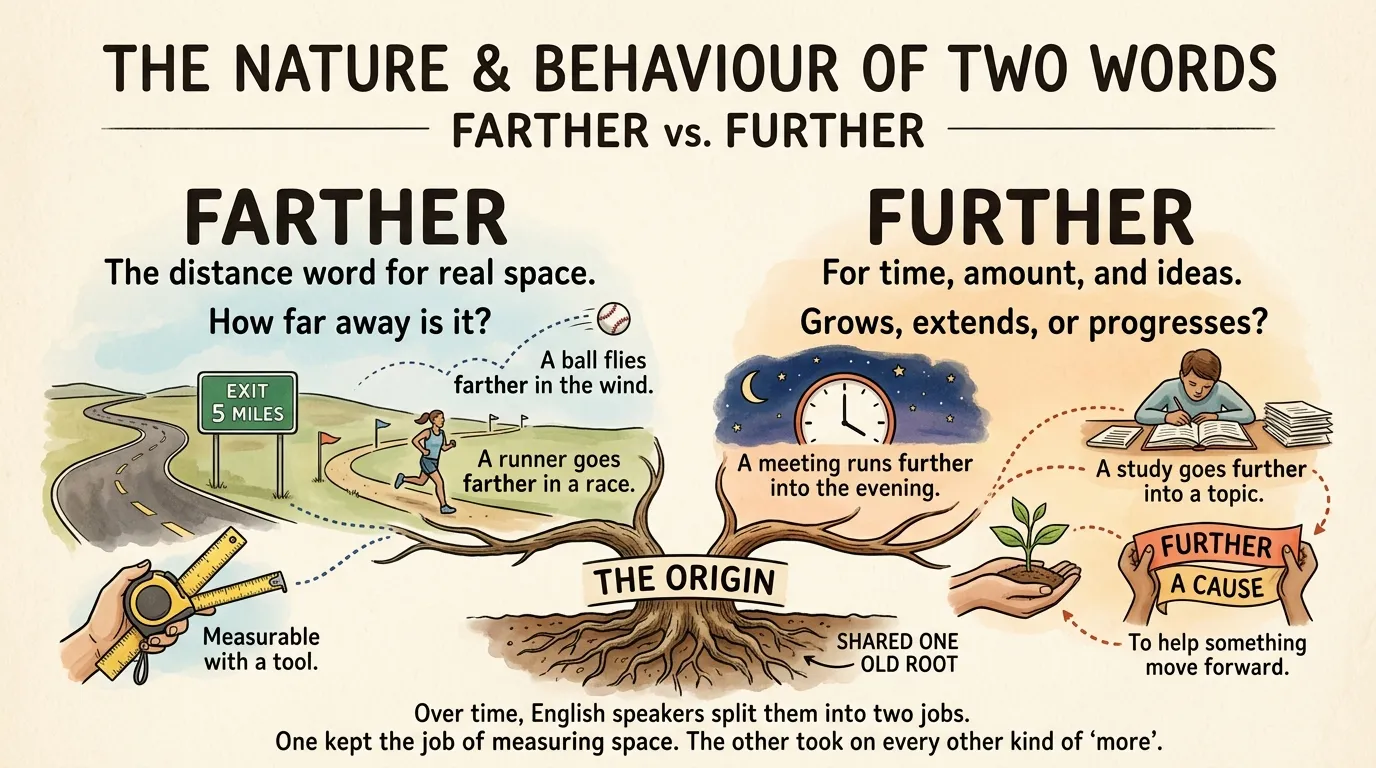
The distance word is for real space. It answers the question, “How far away is it?” You see it on road signs, in travel talk, and in sports. A runner goes farther in a race. A ball flies farther in the wind. It points to something you could, in theory, measure with a tool.
The other term covers everything else that grows or extends. It answers questions about time, amount, or ideas. A meeting runs further into the evening. A study goes further into a topic. It also works as a verb, meaning to help something move forward, like “to further a cause.”
Both words share one old root. Over time, English speakers split them into two jobs. One kept the job of measuring space. The other took on every other kind of “more.”
Read more about:https://verboix.com/ultrasound-or-sonogram/
Why People Mix Them Up
There are four simple reasons.
- They come from the same old word. The two forms grew from one root, so they still feel linked.
- They sound close. Say them fast, and the ear can blur the small sound change.
- British English blends them. Many UK speakers use one term for both meanings, so readers see mixed use online.
- Writers play it safe. Many choose the flexible option for everything, since it rarely sounds wrong. This habit spreads the confusion.
The fix is simple. Ask, “Can I measure this in miles or feet?” If yes, pick the distance word. If not, pick the other one.
Comparison Table
| Point | Farther | Further |
|---|---|---|
| Main meaning | Real, measurable distance | More of something — time, amount, or degree |
| Can measure with a ruler? | Yes | No |
| Word type | Adjective, adverb | Adjective, adverb, verb |
| Safe default | Only for distance | Works for almost everything |
| UK usage | Less common | Very common, for both meanings |
| Related word | Far, farthest | Furthermore, furthest |
| Example | Five miles farther | Further discussion |
| Similarity | Both show “more” of something | Same |
Where These Words Come From
Both grew from the Old English word furðor. This old word was already a comparative form, meaning “more forward” or “more onward.” For centuries, English speakers used both spellings without a strict rule. They were simply two close, overlapping forms.
Over time, writers in America began to split the two. One kept the link to the word “far,” used only for real distance. The other kept its older, wider job: more time, more talk, more of an idea. This split grew stronger through the 1800s and 1900s, especially in American style guides.
British English never fully adopted this split. Many UK writers and dictionaries still treat the flexible option as the main word for both meanings, with the distance-specific one used less often.
British vs American English
The spelling is the same in both places. The real difference is in how strictly each side follows the rule.
- Spelling: Both words are spelled the same in the US and UK.
- Rules: American English keeps a clear split. British English often blends the two.
- Sound: Americans say “FAR-ther” and “FUR-ther.” Britons say “FAH-thuh” and “FUR-thuh.”
Examples:
- US: “The lake is three miles farther than the trailhead.”
- UK: “The lake is three miles further than the trailhead.”
Which One Should You Use?
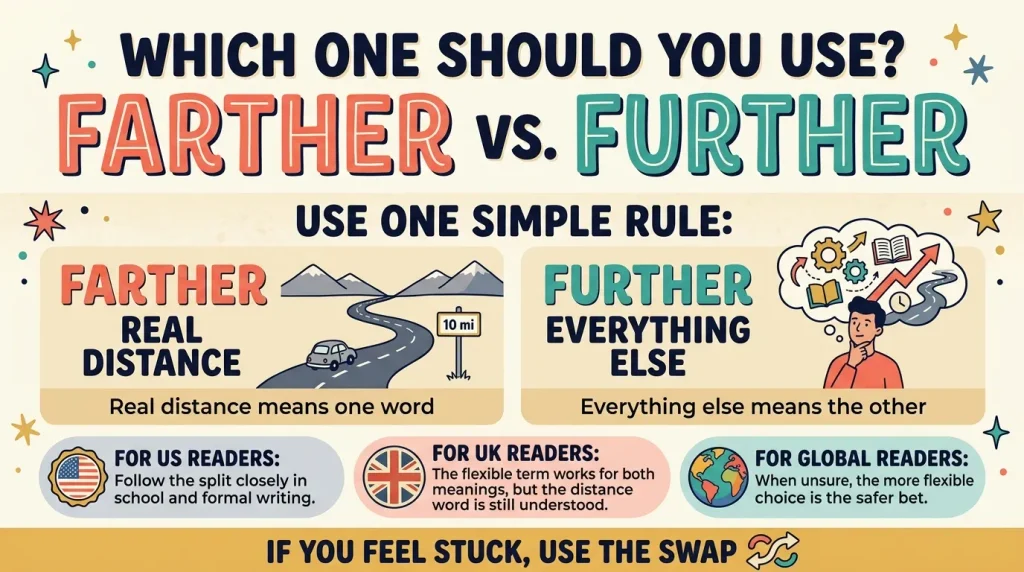
Use one simple rule: real distance means one word, everything else means the other.
- For US readers: Follow the split closely in school and formal writing.
- For UK readers: The flexible term works for both meanings, but the distance word is still understood.
- For global readers: When unsure, the more flexible choice is the safer bet.
If you feel stuck, use the swap test from above. Try “additional.” If it fits, go with the non-distance option.
Common Mistakes
- ❌ “Let’s talk farther about the plan.” ✅ “Let’s talk further about the plan.”
- ❌ “The airport is further than the mall, about ten miles.” ✅ “The airport is farther than the mall, about ten miles.”
- ❌ “I need farther proof.” ✅ “I need further proof.”
- ❌ “She ran farther into debt.” ✅ “She ran further into debt.”
- ❌ “Nothing farther from the truth.” ✅ “Nothing further from the truth.”
Everyday Usage Examples
In emails
- “The office is a bit farther from the station than I thought.”
- “Please let us know if you need further details.”
On social media
- “Ran two miles farther than last week! 🏃”
- “More updates to come. Stay tuned for further news.”
In the news
- “The storm moved farther inland overnight.”
- “Officials are seeking further information on the case.”
In formal writing
- “The research requires further study before any conclusion is drawn.”
- “The nearest hospital is twelve miles farther than the local clinic.”
Usage Trends
Both terms are common across the English-speaking world. In American writing, the split is taught in schools and followed closely in formal texts. In British writing, one term often takes both jobs, and the other appears less often overall.
Online writing blends the two more than books do. Many casual posts use the flexible word for distance too, since it rarely sounds wrong. This trend has made the strict American rule harder to spot in everyday use.
Metaphors and Similes
Farther
- “Her dreams stretched farther than the horizon.” (metaphor)
- “He pushed on, farther than his legs wanted to go.” (simile-like phrase)
Further
- “Her curiosity carried her further into the mystery.” (metaphor)
- “The talks went further than anyone expected, like a river overflowing its banks.” (simile)
One often paints a picture of physical distance. The other often paints a picture of depth or growth.
Connotative Meaning
Farther
- Positive: “She ran farther than ever before.” It shows achievement.
- Neutral: “The farther sign shows two miles.” It states a fact.
- Negative: “The storm pushed the boat farther from shore.” It can suggest danger.
Further
- Positive: “The team moved further toward their goal.” It shows progress.
- Neutral: “Further details will follow.” It states a plan.
- Negative: “The news pushed her further into worry.” It can suggest a troubled state.
Idioms and Proverbs
Idioms with “further”
- Further ado: “Without further ado, let’s begin.”
- Further notice: “The pool is closed until further notice.”
- Look no further: “Look no further, your answer is here.”
Idioms with “farther”
- Farther afield: “His search took him farther afield than he expected.”
Proverb-like phrase
- “The farther you go, the more you learn.” A common saying about travel and growth.
Literature and Movies
Literature
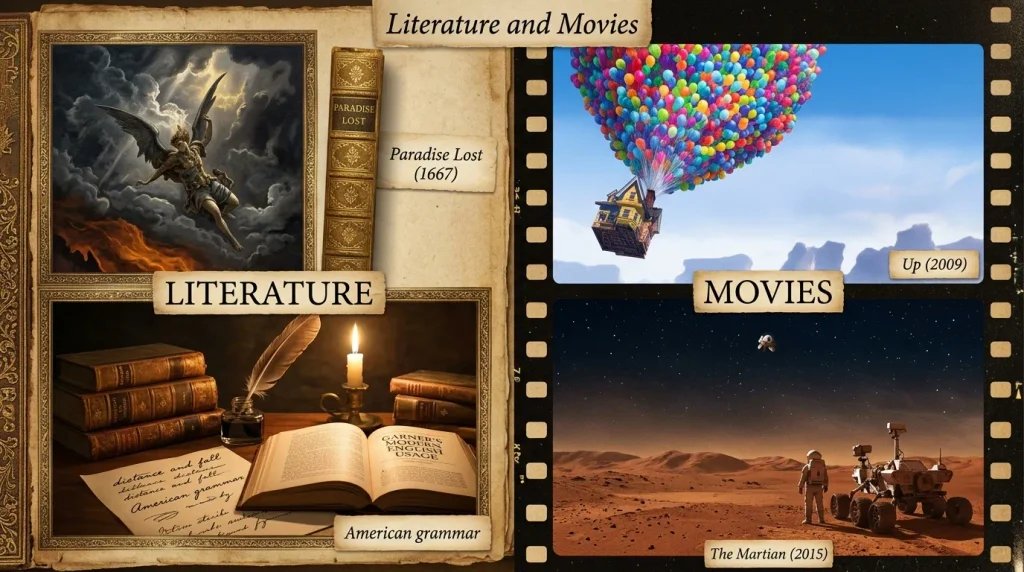
- Paradise Lost (epic poem, John Milton, 1667): Uses older English forms close to the flexible term in its long passages about distance and fall.
- Style guides like Garner’s Modern English Usage (various editions) discuss this split as a point of American grammar.
(Note: Please double-check any literary reference before publishing, since exact wording can vary between editions.)
Movies
- Up (2009, United States): A story about an old man’s house that travels farther than anyone expects.
- The Martian (2015, United States): A film where characters discuss how much farther help must travel to reach Mars.
Why This Difference Matters
For learners, this split is one of the clearer rules in English grammar once you know the test: can you measure it? For work, clean writing in emails and reports builds trust. Mixing up the words rarely causes real confusion, but using them correctly shows care.
For society, small word choices still shape how clearly we communicate distance, time, and ideas. A careful writer helps readers picture the right thing, whether it is a road trip or a long conversation.
Usefulness in Daily Life
- At home: “The store is farther than the park.” “Let’s not discuss this further tonight.”
- At school: A teacher says, “We will study this further next week.” A student asks, “How much farther until the field trip stop?”
- At work: “The new office is farther from downtown.” “We need further approval before moving forward.”
- While traveling: “The next town is ten miles farther.” “Ask the guide for further directions.”
- In writing: Use the swap test whenever you pause to think about which word fits.
A Quick Test You Can Use
Ask these two questions:
- Can I measure this with a number, like miles or feet? If yes, pick the distance word.
- Am I talking about time, amount, or an idea? If yes, pick the other one.
Situational Preference
Pick your word by asking what you are measuring. In a road trip story, go with real distance. In a business email about more discussion, use the flexible term. In British writing, that flexible term is a safe choice for both. In American school writing, follow the strict split. When a sentence has a number of miles or feet, lean toward the distance word. When a sentence has no number and talks about ideas, lean toward the other one. When truly unsure, the flexible option is almost always accepted.
Cheat Card
| Farther | Further | |
|---|---|---|
| Means | Real, measurable distance | More time, amount, or degree |
| Measure with a number? | Yes | No |
| Safe default | Only for distance | Works almost everywhere |
| Example | “Two miles farther.” | “Further discussion needed.” |
| Quick test | Can I use a ruler or a map? | Does “additional” fit here? |
Quick Answers
1. What is the difference between these two words?
One is for real, measurable distance. The other is for more of something else, like time, amount, or an idea.
2. Which word is safer to use if I’m not sure?
The flexible option is the safer choice. It works in almost every case, even some distance examples.
3. Is the distance word used in British English?
Yes, but less often. British writers often use the other term for both meanings.
4. Can the non-distance word be a verb?
Yes. “To further” means to help something move forward, like “to further a cause.”
5. Is it “furthermore” or “farthermore”?
It is “furthermore.” There is no word “farthermore.”
6. Does a number always mean I should use the distance word?
Usually yes, if the number measures real distance, like miles or feet.
7. Why do these two words look so similar?
They both grew from the same Old English root, furðor, which meant “more forward.”
Conclusion
Farther or Further? Now you know the simple difference between these two words. Farther is for real distance, something you could measure with a map or a ruler. Further is for everything else that grows or extends, like time, talk, or ideas. Remember the quick test: ask if you can measure the distance with a number. If yes, write farther. If not, write further. When you are unsure, further is often a safe choice, especially in British English. Both words came from the same old root, but American English often separates their uses more clearly, while British English allows more overlap. Use the cheat card above whenever you feel unsure, and your writing will stay clear and correct.





1 thought on “Farther or Further: Easy Difference + Memory Trick”