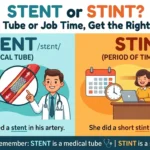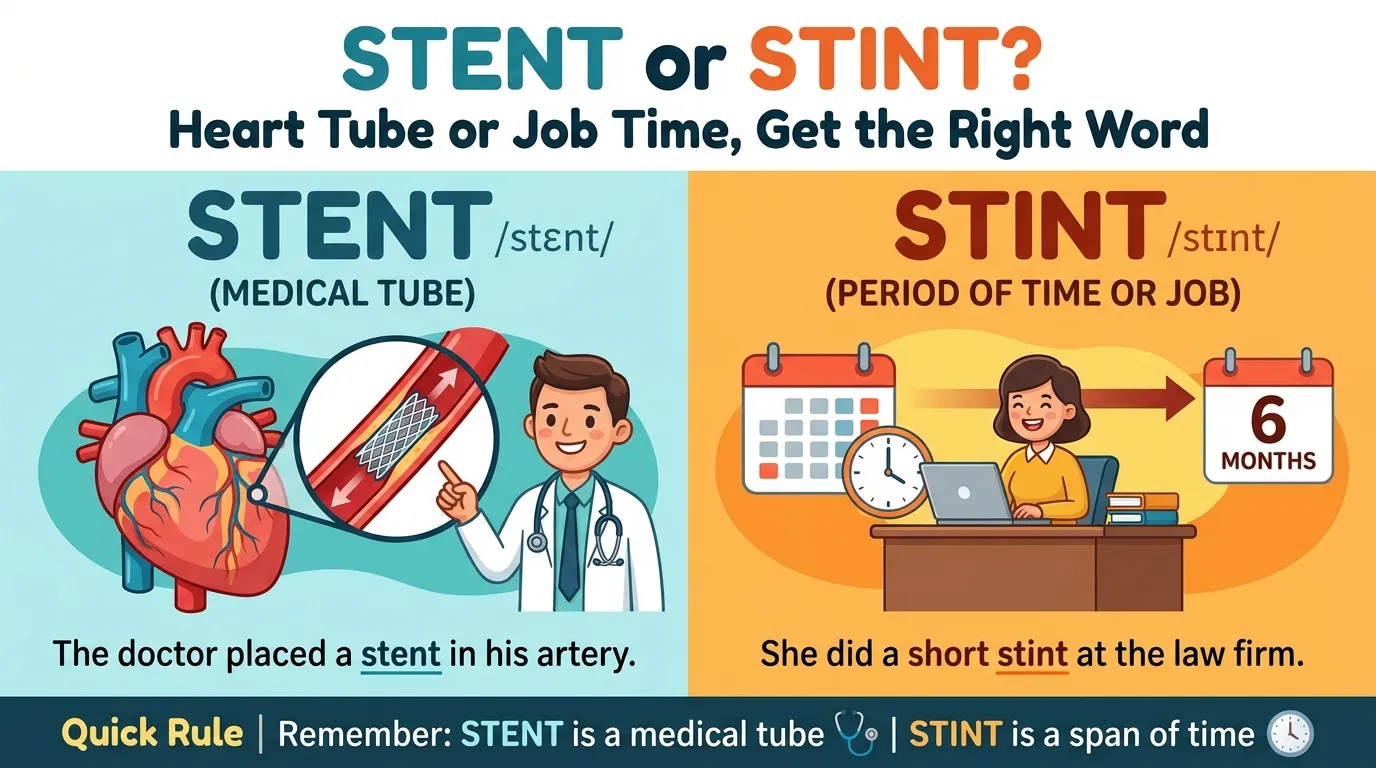
A stent is a small medical tube that holds a blood vessel open. A stint is a set period of time doing a job or task.
Maria’s grandfather came home from the hospital. He told her, “The doctor put in a stent.” Maria nodded, but later she saw a job posting that said, “a two-year stint abroad.” She paused. Were these the same word? She looked closer. One letter was different. Her grandfather had a stent in his heart. The job was a stint, a short time at work.
A stent is a small tube doctors use to keep a blood vessel or other body part open. A stint is a short period of time spent doing something, like a job or a task. People search stent or stint because the words look alike and sound almost the same. Only one small vowel sets them apart. This guide makes stent or stint simple, with clear rules and easy examples.
Pronunciation
The words sound close, but not the same.
Stent
US: /stɛnt/ (STENT)
UK: /stɛnt/ (STENT)
Stint
US: /stɪnt/ (STINT)
UK: /stɪnt/ (STINT)
The middle sound is the clue. “Stent” has an “eh” sound, like in “tent.” “Stint” has an “ih” sound, like in “mint.”
Difference Between Stent and Stint
1. Basic Meaning
A stent is a medical device. A stint is a period of time or a limit.
- The doctor placed a stent in his artery.
- She did a two-year stint at the company.
2. Word Type
Stent is a noun. It names a thing. Stint can be a noun or a verb.
- The stent kept the blood vessel open. (noun)
- She did a short stint overseas. (noun)
- Don’t stint on quality. (verb)
3. The Field It Belongs To
Stent belongs to medicine and health. Stint belongs to work, time, and effort.
- A heart stent helps blood flow.
- A coaching stint can last one season.
4. What It Looks Like
A stent is a small, thin tube, often made of metal mesh or plastic. A stint is not a physical object. It is a span of time or an act of limiting something.
- A stent is tiny, often just a few centimeters long.
- A stint has no size. It is a length of time.
5. Can You See It?
You can see and hold a stent, since it is a real object. You cannot see a stint, since it is an idea about time or effort.
- Doctors can show you an image of a stent on an X-ray.
- You cannot photograph a stint, only describe it.
6. How Long Does It Last?
A stent often stays in the body permanently, or for a long set time. A stint is usually short to medium in length, like a job, trip, or project.
- Many stents stay in place for the rest of a patient’s life.
- A summer stint at a camp might last a few months.
7. The Verb Use
Stint can work as a verb, meaning to limit or be stingy with something. Stent does not work as a verb in common use.
- She did not stint on effort during the project.
- There is no common verb form of “stent.”
8. Common Pairings
Stent often pairs with words like heart, artery, or surgery. Stint often pairs with words like work, job, coaching, or abroad.
- Heart stent, coronary stent, stent surgery.
- Work stint, coaching stint, a stint abroad.
9. Plural Forms
Both words have simple plural forms, though they are used differently.
- The patient has two stents in his heart.
- She has done several stints at different companies.
10. The Swap Test
Try the word “tube.” If it fits, use stent. Try the word “period of time” or “limit.” If it fits, use stint.
- “The doctor placed a small (tube) in his artery.” Use stent.
- “He worked there for a short (period of time).” Use stint.
Before and After: Fix It Fast
- ❌ “He had a stint placed in his heart during surgery.”
✅ “He had a stent placed in his heart during surgery.”
A medical tube needs the “e” spelling. - ❌ “She did a short stent at the law firm before moving on.”
✅ “She did a short stint at the law firm before moving on.”
A period of work time needs the “i” spelling. - ❌ “The doctor said not to stent on his medication.”
✅ “The doctor said not to stint on his medication.”
The verb meaning “to limit” uses the “i” spelling. - ❌ “The stint kept his artery open after the procedure.”
✅ “The stent kept his artery open after the procedure.”
A medical device needs the “e” spelling. - ❌ “He completed a two-year stent in the military.”
✅ “He completed a two-year stint in the military.”
A set period of service needs the “i” spelling.
Nature and Behaviour of Stent and Stint
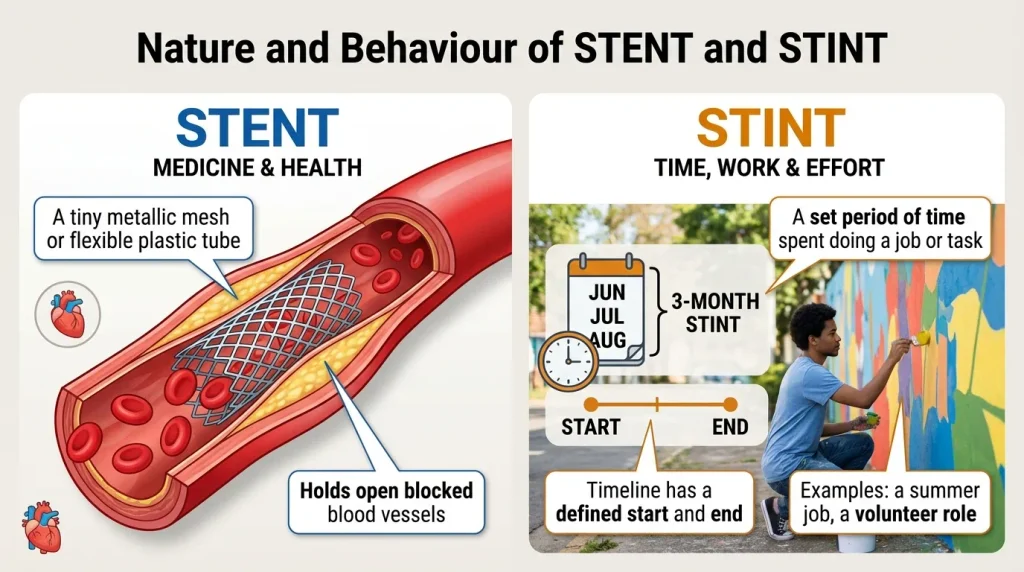
Stent belongs firmly in the world of medicine. Doctors use stents to treat blocked or weak blood vessels, most often in the heart, but also in other parts of the body, like the kidneys or airways. A stent is usually made of thin metal mesh or flexible plastic. During a procedure, doctors guide the stent into place using a thin tube called a catheter. Once in position, the stent expands and holds the vessel open, allowing blood or other fluids to flow more easily.
Stint belongs to the world of time, work, and effort. It describes a set period spent doing something, often a job, a volunteer role, or a personal project. A stint can be short, like a summer internship, or longer, like a multi-year job assignment. The word can also work as a verb, meaning to hold back or limit something, as in “don’t stint on quality,” meaning don’t cut corners or hold back effort.
Why People Get Confused About Stent and Stint
There are four simple reasons.
- They look almost identical on the page, with only one vowel different.
- They sound similar when spoken quickly, especially in casual conversation.
- Both words are somewhat uncommon in everyday speech, so people may not use either word often enough to feel fully confident.
- Neither word has an obvious clue in its spelling to hint at its meaning, unlike some confusable word pairs.
The fix is simple. Think “e” for the medical “tube,” since both have an “e.” Think “i” for a short “time” period, since both have an “i.”
Read more about:https://bloomsyflower.com/lotus-flower-tattoos-meaning/
Comparison Table
| Point | Stent | Stint |
| Main meaning | A medical tube device | A period of time or a limit |
| Field | Medicine | Work, time, effort |
| Word type | Noun | Noun, verb |
| Physical object | Yes | No |
| Typical length | Often long-term or permanent | Usually short to medium |
| Example | Heart stent | Summer stint |
| Similarity | Close spelling, similar sound | Same |
The Origin of Stent and Stint
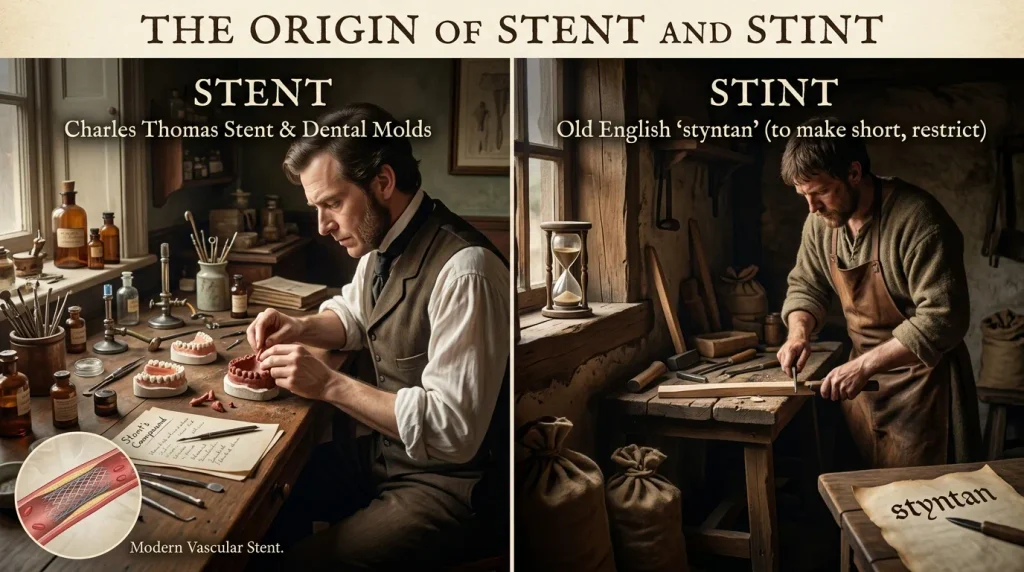
The word “stent” has a surprisingly specific origin. It is named after Charles Thomas Stent, a 19th-century English dentist who developed a compound used to create dental molds. Over time, the word came to describe any device used to hold tissue or a vessel open, and it eventually became the standard term for the small tubes used in modern heart and blood vessel procedures.
The word “stint” comes from an Old English word, styntan, meaning “to make short” or “to blunt.” Over centuries, this evolved into its modern meaning of a limited, defined period of time or effort, as well as the verb meaning to hold back or restrict something.
British vs American English
The spelling and meaning stay the same in both countries.
- Spelling: Stent and stint are spelled the same in the US and UK.
- Medical use: Both countries use “stent” the same way in medical settings.
- Everyday use: Both countries use “stint” the same way for jobs, time periods, and the verb meaning to limit.
Examples:
- US: “He recovered well after his stent procedure.”
- UK: “He recovered well after his stent procedure.”
Which One Should You Use?
Use one simple rule: medical tube means stent, period of time or limiting means stint.
- For medical writing: Always use stent when referring to the device.
- For work or time-related writing: Always use stint when referring to a period of time or effort.
- For global readers: The rule stays the same everywhere, since spelling does not change by region.
If you feel unsure, use the swap test. Try “tube” for stent, and “short period” for stint.
Common Mistakes
- ❌ “He had a stint put in during his heart surgery.” ✅ “He had a stent put in during his heart surgery.”
- ❌ “She did a quick stent as a substitute teacher.” ✅ “She did a quick stint as a substitute teacher.”
- ❌ “Don’t stent on the details of the report.” ✅ “Don’t stint on the details of the report.”
- ❌ “The stint helped keep his artery open.” ✅ “The stent helped keep his artery open.”
- ❌ “He finished his two-year stent in the Navy.” ✅ “He finished his two-year stint in the Navy.”
Everyday Usage Examples
In emails
- “My father is recovering well after his stent procedure last week.”
- “She just finished a six-month stint with the marketing team.”
On social media
- “Grateful for modern medicine. Dad’s stent surgery went smoothly! ❤️”
- “Wrapping up my summer stint at the farm. What an experience! 🌾”
In the news
- “Doctors successfully placed a new type of stent during the trial.”
- “The senator began her political career with a short stint as a local volunteer.”
In formal writing
- “The patient received a coronary stent to improve blood flow.”
- “He completed a two-year stint as a research assistant before graduate school.”
Usage Trends
“Stent” appears most often in medical news, health articles, and conversations about heart care, since stent procedures have become increasingly common as treatments for blocked arteries. “Stint” appears across many fields, including careers, sports, military service, and volunteer work, since it broadly describes any defined period of time spent on an activity.
Online searches for the difference between these two words often come from people researching a loved one’s medical procedure, or from writers and students trying to use the correct word in a sentence about work or time.
Metaphors and Similes
Stent
- “The stent was a tiny bridge, holding the pathway open.” (metaphor)
- “It worked like a scaffold, propping up what had weakened.” (simile)
Stint
- “Her stint abroad was a chapter she would never forget.” (metaphor)
- “The years passed like a brief stint, over before she knew it.” (simile)
Stent suggests support and structure. Stint suggests a limited chapter in time.
Connotative Meaning
Stent
- Positive: “The stent gave him a new lease on life.” It shows hope and recovery.
- Neutral: “The patient has a stent in his artery.” It states a fact.
- Negative: “The stent procedure came with some risk.” It shows concern.
Stint
- Positive: “Her stint at the nonprofit was deeply rewarding.” It shows fulfillment.
- Neutral: “He completed a six-month stint at the office.” It states a fact.
- Negative: “His short stint at the job ended badly.” It shows disappointment.
Idioms and Proverbs
There are no well-known idioms built directly from “stent,” since it is a specific medical term. However, “stint” appears in a few common phrases.
- Without stint: “She gave without stint,” meaning she gave generously, without holding back.
- Do a stint: “He did a stint in the army,” a common way to describe a period of service.
- Don’t stint on effort: A common phrase meaning to give your full effort, without cutting corners.
Literature and Movies

No famous book or movie centers on the word “stent,” since it is a precise medical term rarely used in creative titles. The word “stint,” however, appears often in biographies and career-focused stories, usually describing a specific period in someone’s life.
Notable mentions
- Many biographies and memoirs describe a person’s “stint” in the military, in a particular job, or living abroad, as a common way to frame a defined chapter of their life story.
Why This Difference Matters
Understanding what a stent is helps patients and families follow medical talks and treatment plans during stressful times. Job seekers and writers can use “stint” to describe work history and experience clearly in resumes and cover letters. Clear word choice matters because mixing up these terms in medical or work settings can cause confusion.
Usefulness in Daily Life
- At the doctor’s office: “The cardiologist explained how the stent would work.” “Recovery after a stent procedure usually takes a few weeks.”
- At work: “I did a short stint in customer service before switching departments.” “She doesn’t stint on preparation before big meetings.”
- On a resume: Listing a “stint” at a previous company clearly describes a defined period of employment.
- In family conversations: Understanding “stent” helps you follow along when a relative discusses a heart procedure.
- In writing: Use the swap test whenever you pause to think about which word fits your sentence.
A Quick Test You Can Use
Ask these two questions:
- Am I talking about a medical device that holds something open? If yes, use stent.
- Am I talking about a period of time, or limiting something? If yes, use stint.
Situational Preference
Pick your word by thinking about the topic at hand. In a medical conversation about heart health, use stent. In a conversation about a job, trip, or volunteer role, use stint. If someone mentions “not stinting” on something, they mean not holding back or cutting corners. If someone mentions a stent procedure, they are discussing a specific medical treatment. When unsure, picture the topic: health and surgery point to stent, while time and effort point to stint.
Cheat Card
| Stent | Stint | |
| Means | Medical tube device | Period of time or a limit |
| Field | Medicine | Work, time, effort |
| Word type | Noun | Noun, verb |
| Example | “He has a heart stent.” | “She did a summer stint.” |
| Quick test | Does “tube” fit? | Does “short period” fit? |
Quick Answers
1. What is the difference between stent and stint?
A stent is a small medical tube used to hold a blood vessel open. A stint is a period of time spent doing a job or task, or a verb meaning to limit something.
2. Do stent and stint sound the same?
No, though they sound similar. “Stent” has an “eh” sound, while “stint” has an “ih” sound.
3. Can “stint” be used as a verb?
Yes. “Stint” can mean to hold back or limit something, as in “don’t stint on effort.”
4. Is “stent” ever used outside of medicine?
Rarely. “Stent” is almost always used in a medical context, referring to the device itself.
5. How long does a stent usually stay in the body?
Many stents stay in place permanently, though this depends on the specific medical situation and type of stent used.
6. What is an example of a work stint?
A “stint” could be a summer internship, a short-term job, a season of coaching, or a period of military service.
7. Why do people confuse these two words?
The words look and sound similar, with only one vowel different, and neither word is extremely common in daily speech.
Conclusion
Stent or Stint? A stent is a small medical tube that holds a blood vessel or another body part open. A stint is a period spent on a job or task, or a verb that means to limit something. The two words look alike, but one vowel changes their meanings. Here is an easy way to remember the difference: “E” is for a medical tube, while “I” is for a time period. Next time you hear about a loved one’s heart procedure or describe your work history, you can choose the right word with confidence. Keep this simple trick in mind to avoid confusion.