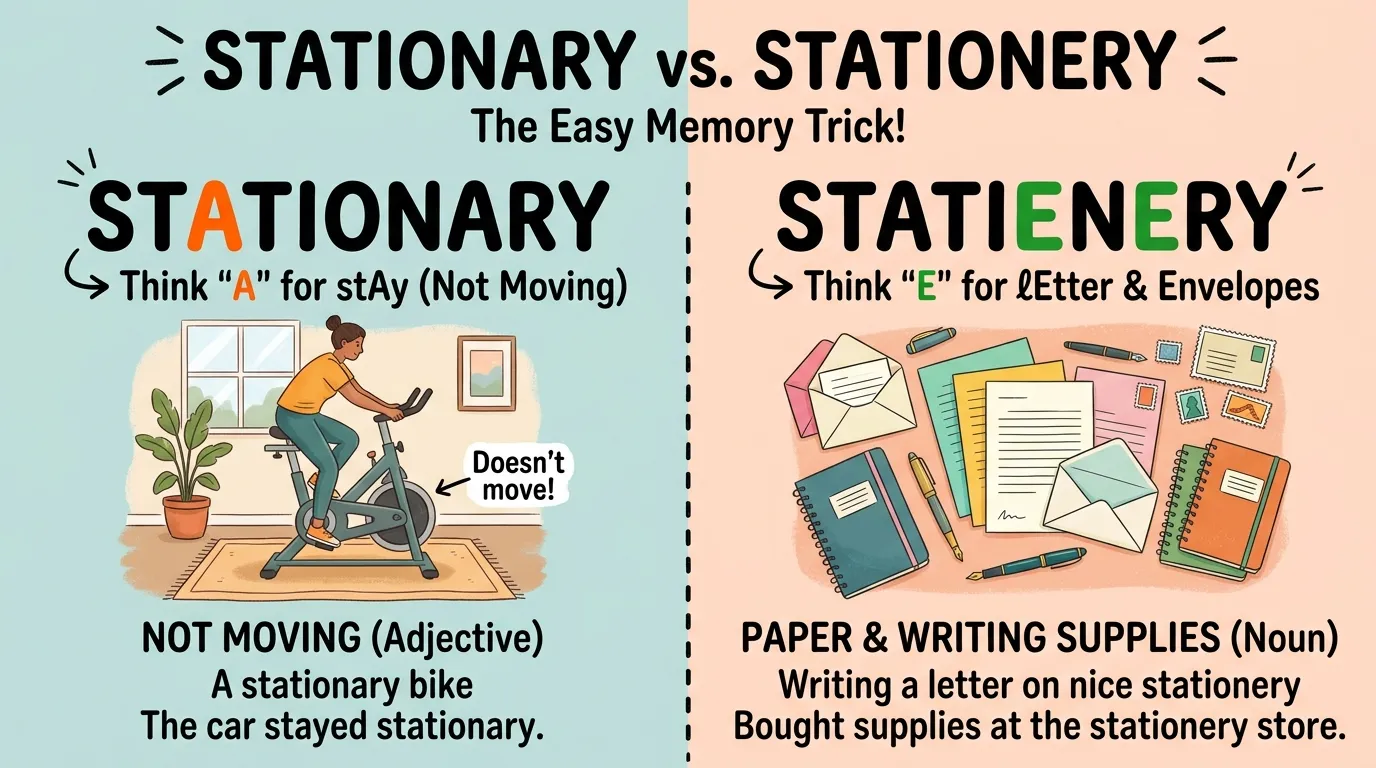
Stationary means staying still, not moving. Stationery means paper, pens, and writing supplies.
Mr. Lee wrote a note to his class. It said, “Please pick up your new stationary from the front desk.” A student raised her hand. “Mr. Lee, do you mean the paper and pens?” Mr. Lee looked at his note. He had spelled the word wrong. He meant stationery, not stationary. One small letter changed the whole meaning.
Stationary means something that does not move. A stationary bike stays in place while you pedal. Stationery means paper, envelopes, pens, and other writing supplies. People search stationary or stationery because the two words sound exactly the same. Only one letter tells them apart. This guide makes stationary or stationery simple, with clear rules and easy examples.
Pronunciation
Both words sound exactly the same. They are homophones.
Stationary
US: /ˈsteɪ.ʃə.nɛr.i/ (STAY-shuh-nair-ee)
UK: /ˈsteɪ.ʃən.ri/ (STAY-shun-ree)
Stationery
US: /ˈsteɪ.ʃə.nɛr.i/ (STAY-shuh-nair-ee)
UK: /ˈsteɪ.ʃən.ri/ (STAY-shun-ree)
You cannot hear the difference. You must look at the spelling. Let’s look at the details.
Difference Between Stationary and Stationery
1. Basic Meaning
Stationary means not moving. Stationery means paper and writing supplies.
- The car stayed stationary at the red light.
- She bought new stationery for her letters.
2. Word Type
Stationary is an adjective. It describes a noun. Stationery is a noun. It names a thing.
- A stationary object does not move. (adjective)
- The stationery is in the top drawer. (noun)
3. The Spelling Clue
Stationary has an “a” near the end, like the word “stay.” Stationery has an “e” near the end, like the word “letter.”
- StationAry: think “stAy” in one place.
- StationEry: think “lEtter” and paper.
4. What It Describes
Stationary describes things that stay still: cars, bikes, objects, or even people.
- The guard stood stationary at the gate.
- A stationary bike is used for exercise indoors.
5. What It Names
Stationery names a group of items: paper, pens, envelopes, and cards.
- The shop sells fancy stationery for weddings.
- He wrote his letter on blue stationery.
6. Where You Find Each Word
You see “stationary” in science, traffic, and fitness talk. You see “stationery” in office supply stores and card shops.
- A stationary satellite stays in one spot in the sky.
- A stationery store sells notebooks and greeting cards.
7. Can It Move?
A stationary thing cannot move, or is not moving right now. Stationery itself is a physical object, like paper, which obviously can be picked up and moved.
- A stationary train has stopped completely.
- You can carry a box of stationery anywhere.
8. Related Words
Stationary relates to words like “station” (a fixed point) and “stand.” Stationery relates to the word “stationer,” an old word for someone who sold books and paper.
- A train station is a fixed stop.
- A stationer once sold paper near a fixed shop location.
9. Common Pairings
Stationary often pairs with words like bike, object, car, or point. Stationery often pairs with words like set, store, paper, or letter.
- Stationary bike, stationary object, stationary point.
- Stationery set, stationery store, stationery paper.
10. The Swap Test
Try the word “still.” If it fits, use stationary. Try the word “paper.” If it fits, use stationery.
- “The car remained (still) at the stop sign.” Use stationary.
- “She wrote on fancy (paper).” Use stationery.
Before and After: Fix It Fast
- ❌ “I bought new stationary for my desk.”
✅ “I bought new stationery for my desk.”
Paper and pens need the “e” spelling. - ❌ “The bike stayed stationery during the workout.”
✅ “The bike stayed stationary during the workout.”
A bike that does not move needs the “a” spelling. - ❌ “The shop sells greeting cards and other stationary.”
✅ “The shop sells greeting cards and other stationery.”
Greeting cards count as stationery, not stationary. - ❌ “The satellite stays stationery above the same spot on Earth.”
✅ “The satellite stays stationary above the same spot on Earth.”
Staying in one place calls for the “a” spelling. - ❌ “She printed her wedding invitations on custom stationary.”
✅ “She printed her wedding invitations on custom stationery.”
Invitations are a type of stationery.
Read more about:https://verboix.com/miter-or-mitre/
Nature and Behaviour of Stationary and Stationery
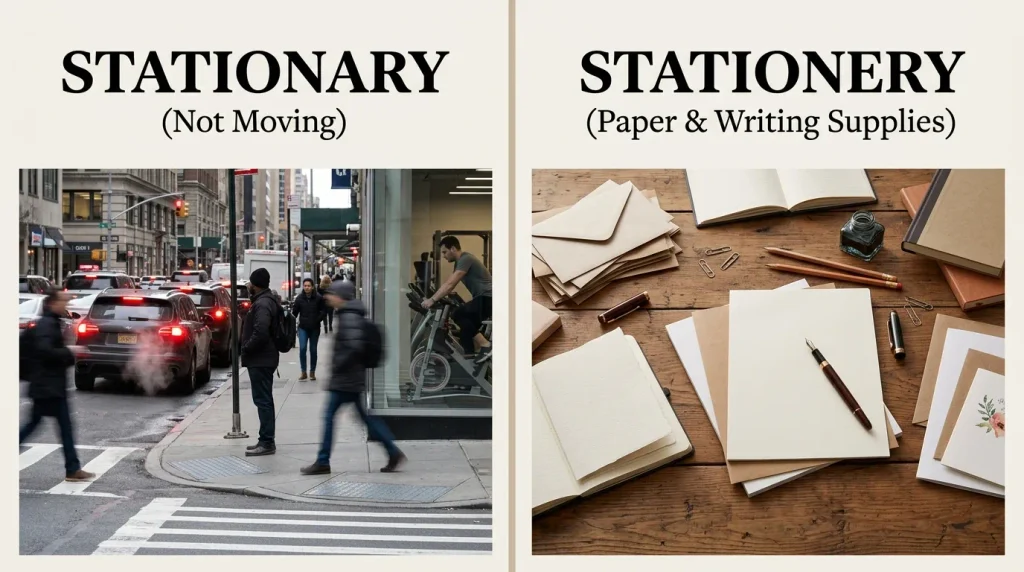
Stationary describes a state of rest. It can apply to a car stuck in traffic, a bike used indoors for exercise, a satellite that orbits in a fixed spot, or even a person standing still in one place. The word always points to the idea of “not moving,” whether for a moment or for a long time. Scientists, drivers, and fitness coaches all use this word often.
Stationery names a category of goods, not an action or state. It covers paper, envelopes, pens, pencils, notebooks, and greeting cards. Long ago, people who sold these items were called “stationers,” since they often sold their goods from a fixed shop, rather than traveling from place to place like other merchants did. Over time, the goods themselves became known as “stationery.”
Why People Get Confused About Stationary and Stationery
There are four simple reasons.
- They sound exactly the same. In speech, there is no way to tell them apart.
- They look nearly identical. Only one letter, deep inside the word, changes.
- Spell check often misses the mistake, since both are real, correctly spelled words.
- Few people use the word “stationer” anymore, so the link between “stationery” and paper feels less obvious today.
The fix is simple. Think “a” for “stay” (not moving), and “e” for “envelope” (paper goods).
Comparison Table
| Point | Stationary | Stationery |
| Main meaning | Not moving | Paper and writing supplies |
| Word type | Adjective | Noun |
| Memory clue | “A” like “stAy” | “E” like “lEtter” |
| Common use | Science, traffic, fitness | Office supplies, cards |
| Example | A stationary bike | A box of stationery |
| Related word | Station, stand | Stationer |
| Similarity | Same sound, close spelling | Same |
The Origin of Stationary and Stationery
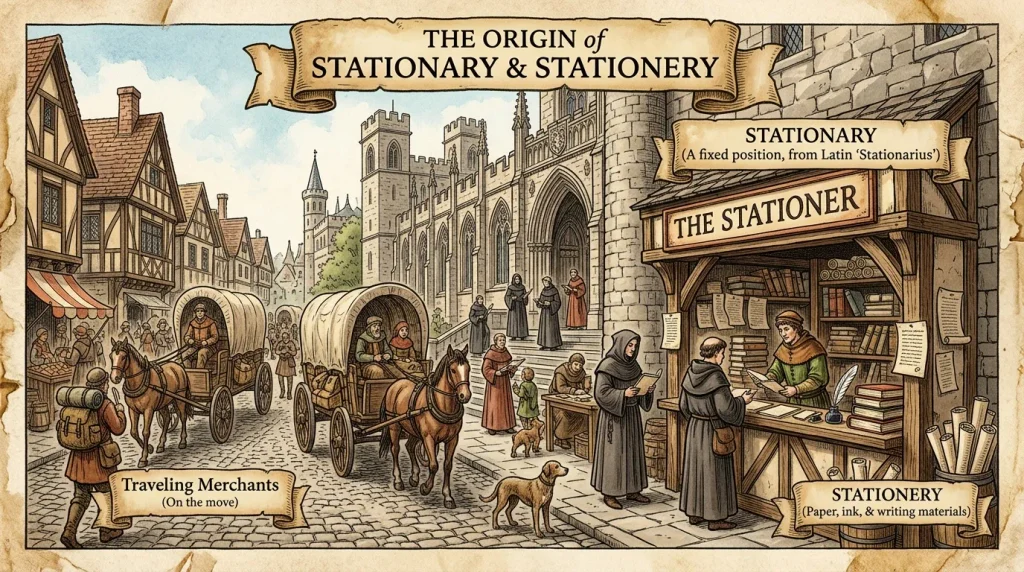
Both words trace back to the Latin word stationarius, meaning “of a fixed station or position.” This root also gives us the word “station,” a fixed point or place.
In medieval times, most traveling merchants sold goods from town to town. A small group of sellers, however, stayed in one fixed spot, often near a university, selling books and paper. These sellers were called “stationers,” since they worked from a stationary location rather than traveling around.
Over time, the goods these fixed-location sellers offered, mainly paper, pens, and writing materials, became known as “stationery.” The spelling split happened gradually in English, with “stationary” keeping the “a” to match words like “stable” and “stand,” while “stationery” took the “e” to match the word “stationer.”
British vs American English
The spelling and meaning are the same in both countries.
- Spelling: Stationary and stationery are spelled the same in the US and UK.
- Rules: The rules are identical. Stationary means not moving. Stationery means paper goods.
- Sound: Both words sound the same in American and British speech, with only small accent differences.
Examples:
- US: “The train remained stationary for ten minutes.”
- UK: “The train remained stationary for ten minutes.”
Which One Should You Use?
Use one simple rule: “not moving” means stationary, “paper and pens” means stationery.
- For US readers: Follow the same rule as everywhere else, since the spelling does not change.
- For UK readers: The rule is identical here too.
- For global readers: Use the swap test. Try “still” for stationary, and “paper” for stationery.
When you feel unsure, picture the item in your head. For paper or a pen, write stationery.
When something is standing still, write stationary.
Common Mistakes
- ❌ “The shop sells birthday cards and other stationary.” ✅ “The shop sells birthday cards and other stationery.”
- ❌ “He stood stationery by the door.” ✅ “He stood stationary by the door.”
- ❌ “She ordered custom wedding stationary.” ✅ “She ordered custom wedding stationery.”
- ❌ “The satellite orbits in a stationery position.” ✅ “The satellite orbits in a stationary position.”
- ❌ “I need to buy stationary for the office.” ✅ “I need to buy stationery for the office.”
Everyday Usage Examples
In emails
- “The delivery truck remained stationary outside our building for an hour.”
- “Please order more stationery for the front office.”
On social media
- “Just got a stationary bike for my home gym! 🚲”
- “Found the cutest floral stationery at the craft store today. ✉️”
In the news
- “Traffic came to a stationary halt during the storm.”
- “Local stationery shops see a rise in sales before the holidays.”
In formal writing
- “The object remained stationary throughout the experiment.”
- “All official letters must be printed on company stationery.”
Usage Trends
Both words remain common today, though in very different contexts. “Stationary” shows up often in science, fitness, and everyday descriptions of objects that do not move. “Stationery” remains popular in office supply stores, wedding planning, and craft hobbies, especially among people who enjoy handwritten letters and cards.
Many people only encounter this mix-up when writing at work or school, often while typing quickly or relying on autocorrect. Since both spellings are valid words, spell-checking tools do not catch the error, which keeps this confusion common even among careful writers.
Metaphors and Similes
Stationary
- “He stood stationary, like a statue in the busy square.” (simile)
- “Her career felt stationary, stuck in the same place for years.” (metaphor)
Stationery
- “The blank stationery waited like a quiet invitation to write.” (metaphor)
- “Her handwriting flowed across the stationery like a gentle stream.” (simile)
Stationary often suggests stillness or being stuck. Stationery often suggests creativity and personal expression.
Connotative Meaning
Stationary
- Positive: “The stationary bike gave her a great workout at home.” It shows convenience.
- Neutral: “The car remained stationary at the light.” It states a fact.
- Negative: “His progress felt stationary for months.” It shows frustration.
Stationery
- Positive: “She loved writing on her new floral stationery.” It shows joy.
- Neutral: “The office ordered more stationery this month.” It states a fact.
- Negative: “The old stationery had faded and yellowed.” It shows decay.
Idioms and Proverbs
There are no well-known idioms built directly from “stationary” or “stationery,” since both are fairly technical, modern words. However, a few related phrases touch on similar ideas.
- Stuck in place: “His career felt stuck in place for years.” This phrase shares the idea behind “stationary.”
- Put it in writing: “Let’s put it in writing.” This phrase connects loosely to the idea of using stationery.
- A fresh start: “She loved opening a fresh pack of stationery.” This phrase often appears alongside stationery in casual talk.
Literature and Movies
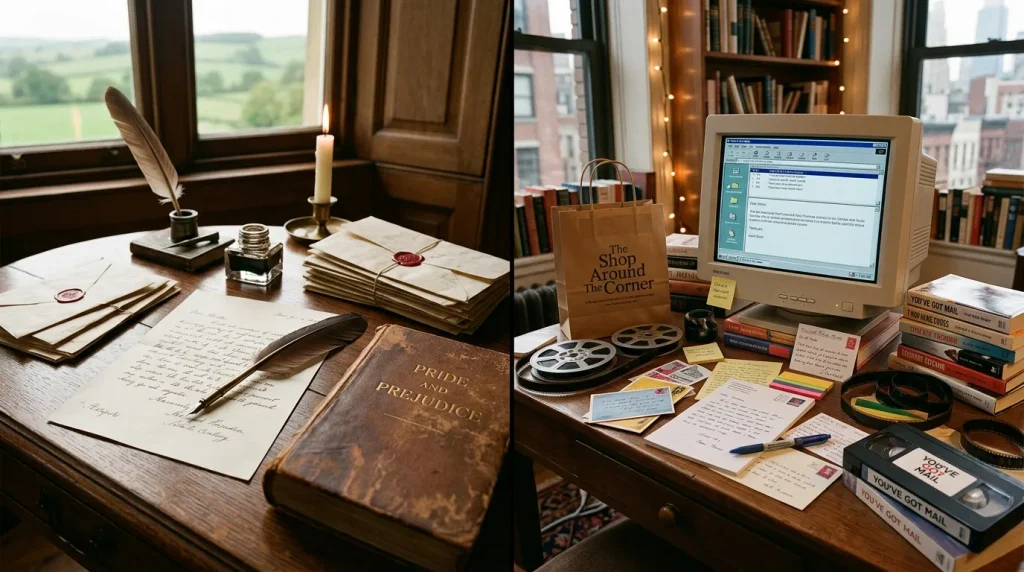
No famous book or movie centers on the words “stationary” or “stationery” themselves, since these are everyday vocabulary words rather than dramatic subjects. However, letters and handwritten notes appear often in classic literature and film.
Literature
- Pride and Prejudice (novel, Jane Austen, 1813): Letters play a major role in the story, often written on fine stationery of the era.
Movies
- You’ve Got Mail (1998, United States): A film centered on letters and written communication, including a small bookstore that sells stationery and books.
Why This Difference Matters
For students and office workers, using the correct spelling shows attention to detail in schoolwork, emails, and official documents. For businesses, ordering the wrong item, like requesting “stationary” instead of “stationery,” could cause confusion with a supplier.
Getting this one letter right helps prevent awkward misunderstandings, especially in writing, where tone of voice cannot clarify the intended meaning.
Usefulness in Daily Life
- At the office: “We need to order more stationery before the meeting.” “The printer remained stationary throughout the move.”
- At school: A teacher says, “Pick up your new stationery from the supply closet.” A science class discusses a stationary object in an experiment.
- While shopping: You browse a stationery store for greeting cards and notebooks.
- During exercise: You hop on a stationary bike for a home workout.
- While writing: You choose nice stationery for a handwritten thank-you note.
A Quick Test You Can Use
Ask these two questions:
- Does the word describe something not moving? If yes, use stationary.
- Does the word describe paper, pens, or writing supplies? If yes, use stationery.
Situational Preference
Pick your word by thinking about what you mean. In a science class, use stationary to describe something at rest. In an office supply order, use stationery for paper and pens. During a workout, a stationary bike stays in one place.In a gift shop, stationery includes cards, notebooks, and envelopes. When unsure, picture the item: if it moves or stays still, think stationary; if it is something you write on, think stationery.
Cheat Card
| Stationary | Stationery | |
| Means | Not moving | Paper and writing supplies |
| Word type | Adjective | Noun |
| Memory clue | “A” for stAy | “E” for lEtter |
| Example | “The car stayed stationary.” | “She bought new stationery.” |
| Quick test | Does “still” fit? | Does “paper” fit? |
Quick Answers
1. What is the difference between stationary and stationery?
Stationary means not moving. Stationery means paper, pens, and other writing supplies.
2. Do stationary and stationery sound the same?
Yes. Both words sound identical in speech. Only the spelling shows the difference.
3. How can I remember which spelling to use?
Think “a” for “stay” (not moving), and “e” for “envelope” (paper goods).
4. Is “stationary” always an adjective?
Yes. Stationary describes something that is not moving.
5. Is “stationery” always a noun?
Yes. Stationery names paper, pens, and similar writing items.
6. Why does “stationery” relate to paper?
It comes from the word “stationer,” someone who once sold books and paper from a fixed shop location.
7. Can spell check catch this mistake?
Usually not. Both words are spelled correctly on their own, so spell check often misses the error.
Conclusion
Stationary or Stationery? Stationary means not moving, like a parked car or a stationary bike. Stationery means paper, pens, and writing supplies, such as greeting cards and notebooks. The two words sound the same, so people often mix them up. Here is an easy way to remember the difference: “A” is for “stay,” while “E” is for “envelope.” Stationary means staying in one place, while stationery means paper goods. Next time you write about paper supplies or something that is not moving, you can choose the right word with confidence. Keep this simple trick in mind to avoid spelling mistakes.