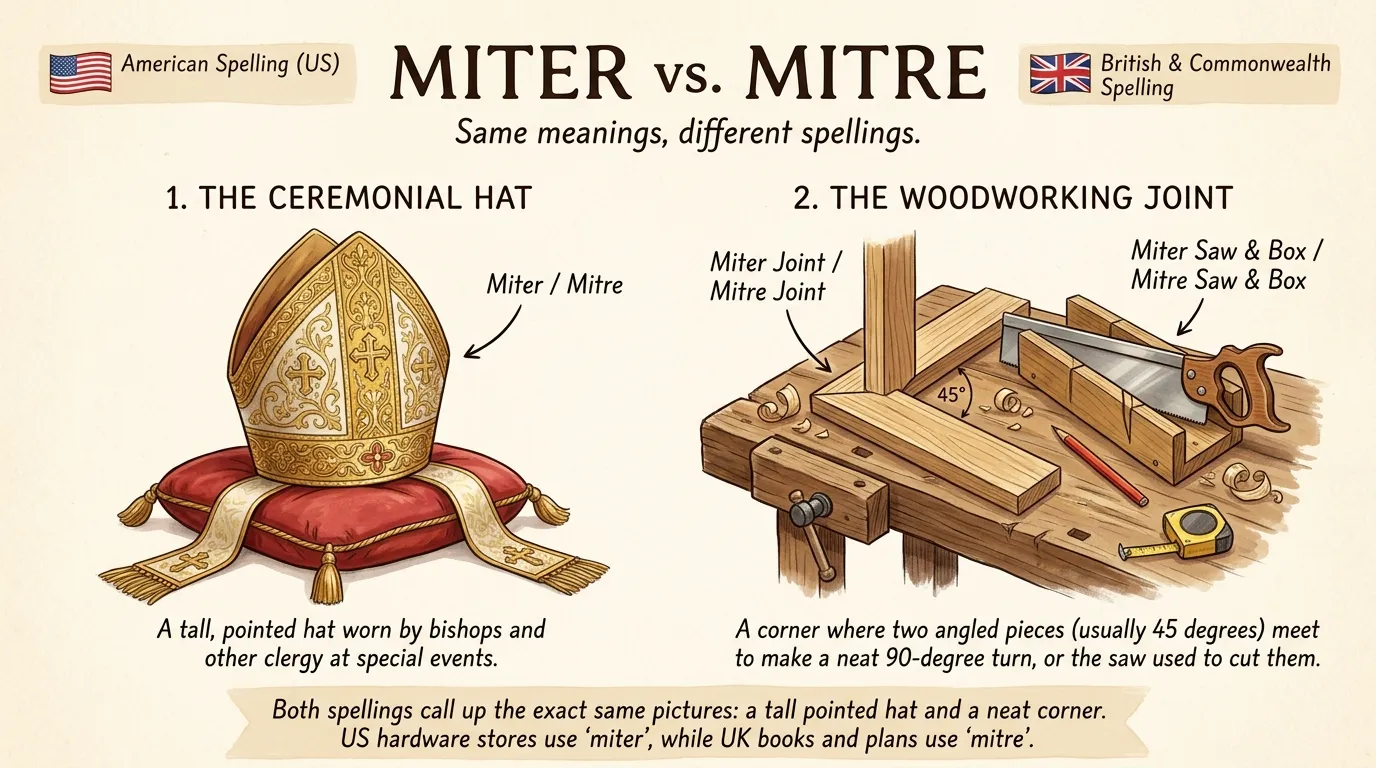
Miter is the US spelling and mitre is the UK spelling of the same word.
Jake wanted to make a wooden picture frame. He went online to buy a saw. One shop sold a “miter saw.” Another shop sold a “mitre saw.” Jake stared at his screen. Were they two different saws? He asked his neighbor, who loved woodworking. His neighbor laughed. “Same saw. Different spelling,” he said.
A miter or mitre is a corner joint cut at an angle. It is also a bishop’s tall pointed hat. People search for miter or mitre because they see both spellings in shops, books, and videos. It is easy to think one is wrong. Neither is wrong. This guide clears up the mix-up with simple words and clear examples. By the end, you will know which spelling to use, and why. You will never wonder about miter or mitre again.
Pronunciation
Both spellings sound almost the same. They are the same word.
- Miter
- US: /ˈmaɪ.t̬ɚ/ (MY-ter)
- UK: /ˈmaɪ.tə/ (MY-tuh)
- Mitre
- US: /ˈmaɪ.t̬ɚ/ (MY-ter)
- UK: /ˈmaɪ.tə/ (MY-tuh)
The first part rhymes with “eye.” Say “MY.” Do not say “MIT.” The only small change is at the end. Americans say the “r” sound. Britons often do not.
You cannot tell the spellings apart when someone speaks. You can only see the difference in writing. Let’s look at the details.
Difference Between Miter and Mitre
Here is the honest truth. The meaning is the same. The differences are in spelling and style.
1. Meaning
Both words mean the same things. They name a bishop’s hat and an angled joint.
- The bishop wore a tall miter.
- The bishop wore a tall mitre.
2. Spelling Ending
Miter ends in “-er.” Mitre ends in “-re.”
- “Miter” has the same ending as “center.”
- “Mitre” has the same ending as “centre.”
3. Where People Use It
Miter is the US spelling. Mitre is the UK and Commonwealth spelling.
- A US shop sells a miter saw.
- A UK shop sells a mitre saw.
4. Tool Names
The tool names follow the spelling.
- Americans say “miter box.”
- Britons say “mitre box.”
5. Verb Forms
The verb also changes with the spelling.
- Americans write “mitered” and “mitering.”
- Britons write “mitred” and “mitring.”
6. Plural Forms
The plural follows the spelling.
- Two miters sat on the shelf.
- Two mitres sat on the shelf.
7. Sound
The sound is almost the same. Americans say the last “r.” Britons often drop it.
- US: “MY-ter.”
- UK: “MY-tuh.”
8. Dictionary Listing
US dictionaries often list “miter” first. UK dictionaries often list “mitre” first. Each one shows the other as a variant.
- An American dictionary shows “miter” as the main word.
- A British dictionary shows “mitre” as the main word.
9. Names and Brands
Some names keep “mitre” even in the US. A well-known US non-profit is spelled MITRE. Some sports brands also use “Mitre.”
- The MITRE Corporation keeps the “-re” spelling.
- A football brand may use “Mitre” on its logo.
10. Age of the Spelling
“Mitre” is the older form. It has been in English since the 1300s. “Miter” is the newer American form.
- “Mitre” came from Old French.
- “Miter” is the same word with an American ending.
Before and After: Fix It Fast
See the mistake. See the fix. Read the reason.
1.
❌ Before: “A miter and a mitre are two different tools.”
✅ After: “Miter and mitre are two spellings of the same word.”
Why: They mean the same thing.
2.
❌ Before: “The carpenter cut a mitter joint.”
✅ After: “The carpenter cut a miter joint.”
Why: Only one “t.” The word is spelled m-i-t-e-r.
3.
❌ Before: “Use the miter saw to cut a mitre joint.”
✅ After: “Use the miter saw to cut a miter joint.”
Why: Pick one spelling and keep it the same.
4.
❌ Before: “Mitre is only for bishops. Miter is only for wood.”
✅ After: “Both spellings can mean a bishop’s hat or a wood joint.”
Why: The meaning does not change with the spelling.
5.
❌ Before: “It sounds like ‘MIT-er.'”
✅ After: “It sounds like ‘MY-ter.'”
Why: The first part rhymes with “eye.”
Nature and Behaviour of Miter and Mitre
Miter
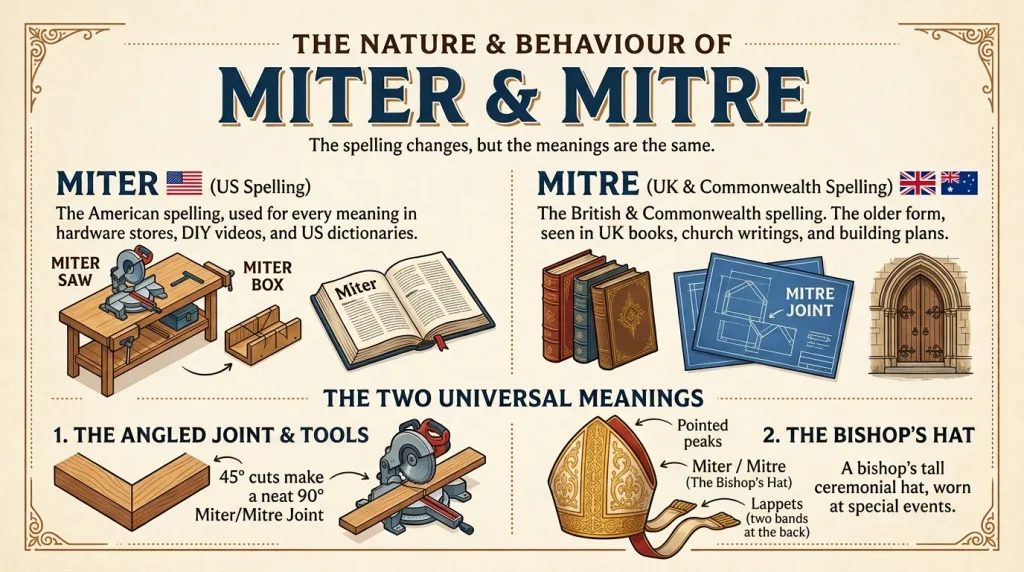
Miter is the American spelling. Americans use it for every meaning. You will see it in hardware stores, how-to videos, and US dictionaries.
As a tool word, it is very common. A miter saw is a saw that cuts at angles. A miter box is a small guide that holds the saw at the right angle. As a shape, a miter joint is a corner where two pieces meet. Each piece is cut at an angle. Often the angle is 45 degrees. Two pieces make a neat 90-degree corner.
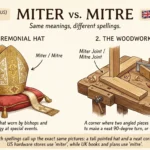
As a hat, a miter is the tall, pointed hat that a bishop wears at special events. It has two points, one at the front and one at the back.
Mitre
Mitre is the British and Commonwealth spelling. It is also the older form of the word. You will see it in UK books, in church writing, and in building plans in many countries.
The meaning is the sameA mitre joint forms a corner with angled cuts. You can use a mitre saw to make these cuts. The word also means a bishop’s hat.
Mitre also shows up in names. Some brands and groups keep this spelling, even in the US. This is one reason why people see both forms.
Both spellings call up the same two pictures: a tall pointed hat and a neat corner.
Why People Get Confused About Miter and Mitre
There are four simple reasons.
Both spellings are used online. Shops in the US and UK use different ones. Videos and blogs do too.
The word has two meanings. A hat and a wood joint seem very far apart. People wonder if each spelling is for one meaning. It is not.
The ending looks odd. Many “-re” and “-er” pairs exist in English. Center and centre. Theater and theatre. Meter and metre. It is easy to lose track.
Names keep old spelling. A brand or group may use “Mitre” even in the US. That makes people think the rule has exceptions.
The fix is easy. Same word. Same meaning. Only the spelling changes with the country.
Comparison Table
| Point | Miter | Mitre |
| Meaning | Bishop’s hat, angled joint | Same |
| Spelling ending | -er | -re |
| Common use | US | UK and Commonwealth |
| Sound | MY-ter | MY-tuh |
| Verb forms | Mitered, mitering | Mitred, mitring |
| Plural | Miters | Mitres |
| Tool names | Miter saw, miter box | Mitre saw, mitre box |
| Age | Newer American form | Older form (1300s) |
| Example | Cut a miter joint. | Cut a mitre joint. |
| Similarity | Same word, same meaning | Same |
The Origin of Mitre and Miter
The word is very old. It started in Greek. The Greek word mitra meant a headband or turban. It was also a belt or cloth worn around the waist under armor. The Latin word mitra came from Greek. Old French took the word as mitre.
English took mitre in the middle 1300s. At that time, it meant a bishop’s tall hat. The Latin roots go back to the idea of “binding” or “tying,” like a band around the head.
The woodworking meaning came later. The word “miter joint” is from the 1670s. Its exact source is not sure. One idea is that it came from the bishop’s hat. The hat has two peaks that meet at the top. Two angled pieces of wood also meet in a neat point. The verb “to miter,” meaning to make such a joint, is from 1731.
The American spelling “miter” came from a wider change. American writers made many “-re” endings into “-er.” They wrote “center” instead of “centre.” They wrote “theater” instead of “theatre.” The same change touched “mitre,” and it became “miter.” Both spellings come from the same old word.
British vs American English
The meaning is the same in both countries. Only the spelling and a few endings change.
- Spelling: Americans write “miter.” Britons write “mitre.”
- Rules: No rule changes the meaning. Both mean a bishop’s hat and an angled joint.
- Sound: Americans say “MY-ter.” Britons say “MY-tuh.”
Examples:
- US: “He used a miter saw to make the frame.”
- UK: “He used a mitre saw to make the frame.”
Other “-er” and “-re” pairs work the same way:
- US: center, theater, meter, fiber
- UK: centre, theatre, metre, fibre
Which One Should You Use?
Use one rule: follow your main readers, and stay steady.
- For US readers: Use miter.
- For UK and Commonwealth readers: Use mitre.
- For global readers: Pick one and keep it the same in the whole text. If your readers come from many places, “mitre” is the older form and is easy to understand.
If you write for a shop, a school, or a company, follow their style guide. If a brand name uses “MITRE” or “Mitre,” keep the name as it is.
Common Mistakes
Here are more common errors, with fixes.
- ❌ “A mitre and a miter are not the same.” ✅ “Mitre and miter are two spellings of one word.”
- ❌ “He cut a mitter joint.” ✅ “He cut a miter joint.”
- ❌ “The bishop wore a mittre.” ✅ “The bishop wore a mitre.” (or “miter”)
- ❌ “She mittered the corners.” ✅ “She mitered the corners.” (or “mitred” in UK writing)
- ❌ “Miter means only a wood cut.” ✅ “Miter can mean a bishop’s hat or a wood cut.”
- ❌ “Use the miter box with the mitre saw.” ✅ “Use the miter box with the miter saw.” (keep one spelling)
Everyday Usage Examples
In emails
- “Please send me the price of a 10-inch miter saw.”
- “The mitre joints on the frame need more glue.”
On social media
- “Finished my first picture frame with perfect miter corners! 🪚”
- “The bishop’s mitre was covered in gold thread.”
In the news
- “The bishop wore a white and gold mitre at the service.”
- “A woodworking school opened a new class on miter cuts.”
In formal writing
- “A miter joint joins two pieces at an angle, often 45 degrees.”
- “The mitre is the traditional headdress of a bishop.”
Usage Trends
Both spellings are used around the world. Miter is common in the US. You will see it in hardware stores, DIY videos, and US books. Mitre is common in the UK and in many Commonwealth countries. You will see it in British books, church writing, and building plans.
Many people search for the difference because they see both. Woodworkers watch videos from both sides of the ocean. Shoppers see both on product pages.
As people share how-to videos worldwide, the two spellings often show up side by side. Most people now understand both.
Metaphors and Similes
Miter and mitre
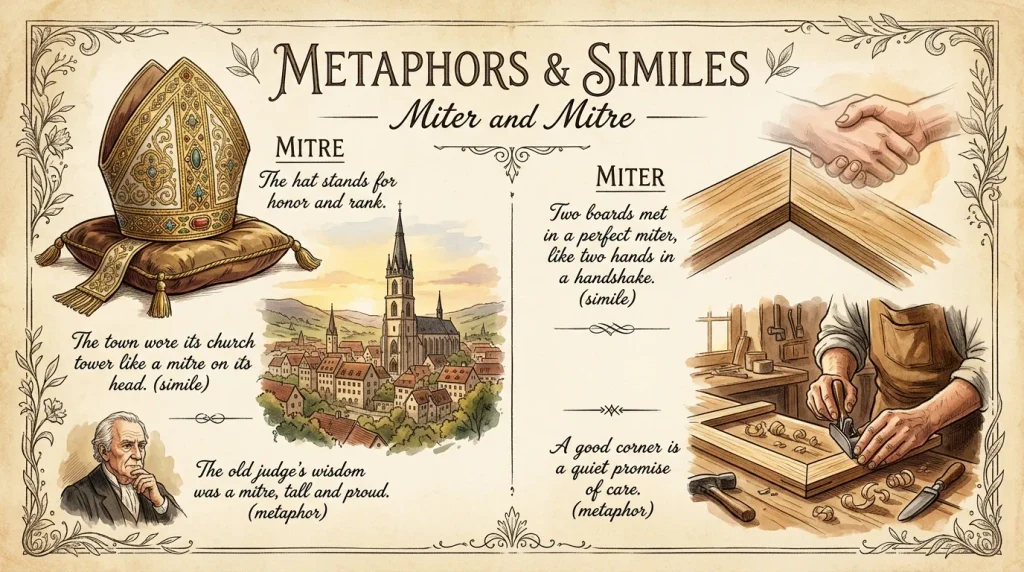
- “The town wore its church tower like a mitre on its head.” (simile)
- “Two boards met in a perfect miter, like two hands in a handshake.” (simile)
- “The old judge’s wisdom was a mitre, tall and proud.” (metaphor)
- “A good corner is a quiet promise of care.” (metaphor)
The hat stands for honor and rank. The joint stands for a neat fit and careful work.
Connotative Meaning
Positive
- “The bishop’s mitre showed respect and duty.” It shows honor.
- “A perfect miter joint shows a skilled worker.” It shows craft.
Neutral
- “She bought a miter saw.” It just names a tool.
Negative
- “He wore his title like a heavy mitre.” It can suggest pride or too much power.
The word itself is neutral. The feeling comes from the picture around it.
Idioms and Proverbs
No well-known idiom uses the word miter or mitre. But these phrases fit the ideas of the hat and the joint.
- Hats off to you: “Hats off to you for finishing the frame.”
- Cut corners: “He did not cut corners. Each miter was neat.”
- Fit together like a glove: “The two boards fit together like a glove.”
- Measure twice, cut once: “Measure twice, cut once, and your miter will be perfect.”
Proverb
- “Many hands make light work.” It fits a team building a frame or a house.
Literature and Movies
No famous book or movie is about the word miter or mitre. But bishops and woodworking show up in many stories.
Literature
- Les Misérables (novel, Victor Hugo, 1862): A kind bishop changes the life of a man named Jean Valjean.
- Murder in the Cathedral (verse play, T. S. Eliot, 1935): A play about the death of Archbishop Thomas Becket.
- The Name of the Rose (historical mystery novel, Umberto Eco, 1980): A mystery set in a medieval abbey.
Movies
- Becket (1964, United Kingdom and United States): A film about King Henry II and Archbishop Thomas Becket.
- Les Misérables (2012, United Kingdom): A musical film with a kind bishop near the start.
- Conclave (2024, United Kingdom and United States): A film about church leaders who choose a new pope.
Why This Difference Matters
For learners: Many students think the two spellings are two words. That can cause worry. Knowing the truth saves time.
For work: In emails, manuals, and shop lists, steady spelling looks careful. A mix of miter and mitre in one text can look messy.
For society: English changes from place to place. Learning why helps us read books from around the world. It also shows how words travel across time, from Greek to Latin to French to English.
Usefulness in Daily Life
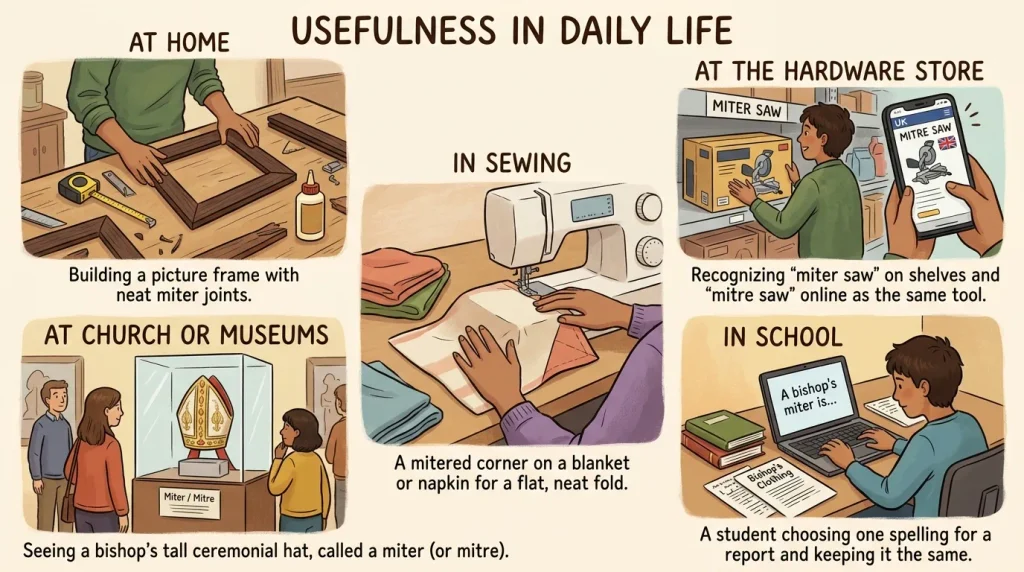
At home: You build a picture frame. Each corner is a miter joint. Two pieces fit into a neat square.
At the hardware store: You see “miter saw” on one shelf and “mitre saw” on a UK website. You now know they are the same tool.
At church or in museums: You see a bishop’s tall hat. It is called a miter or mitre, based on the writer’s country.
In sewing: A mitered corner on a blanket or napkin makes a neat fold. It looks smooth with no bulk.
In school: A student writes a report on a bishop’s clothing. They pick one spelling and keep it the same.
Quick Guide: Cutting a Miter Joint
- Measure the pieces you need.
- Set your saw to 45 degrees.
- Cut one end of each piece.
- Fit the two cut ends together. They make a 90-degree corner.
- Glue and hold them in place until they dry.
Situational Preference
Pick your spelling by asking who reads your text. For US readers, use miter, while UK and Commonwealth readers use mitre. A global site should choose one spelling and use it throughout. In a shop listing, match the spelling buyers search for. Church writing should follow your group’s style. For a brand name, keep the spelling the brand uses. In a school paper, follow your teacher’s guide. When writing to a friend, either spelling is fine.The key rule is to stay steady. Do not switch between miter and mitre in the same paper.
Print and Save: Cheat Card
Take a screenshot or print this card. Keep it near your workbench.
| Miter | Mitre | |
| Means | Bishop’s hat, angled joint | Same |
| Spelling | -er ending | -re ending |
| Where | US | UK and Commonwealth |
| Sound | MY-ter | MY-tuh |
| Verb | Mitered, mitering | Mitred, mitring |
| Tool | Miter saw | Mitre saw |
| Rule | Pick one and stay steady | Pick one and stay steady |
Quick Answers
1. What is the difference between miter and mitre?
There is no difference in meaning. Miter is the US spelling. Mitre is the UK and Commonwealth spelling.
2. What does miter mean?
It can mean a bishop’s tall pointed hat. It can also mean a joint where two pieces meet at an angle, often 45 degrees.
3. Which spelling is correct?
Both are correct. Use miter for US readers and mitre for UK readers.
4. How do you say miter and mitre?
Both are said “MY-ter.” Britons often say “MY-tuh.”
5. Is a miter saw the same as a mitre saw?
Yes. They are the same tool. Only the spelling is different.
6. Can I use both spellings in one paper?
It is better not to. Pick one and keep it the same.
7. Why do some names use “MITRE” in the US?
Some brands and groups choose an older or British spelling. Keep the spelling as it is when you write the name.
Conclusion
Miter or Mitre is easy to understand once you know the spelling rule. Both words have the same meaning and sound almost the same. Miter is the American spelling, while mitre is used in British and Commonwealth English. Both can mean a bishop’s tall hat or a joint cut at an angle. Use the spelling that fits your readers, and keep it the same throughout your writing. Next time you see “miter saw” or “mitre saw,” you will know that both names are correct.








2 thoughts on “Miter or Mitre: Same Word, Two Spellings”