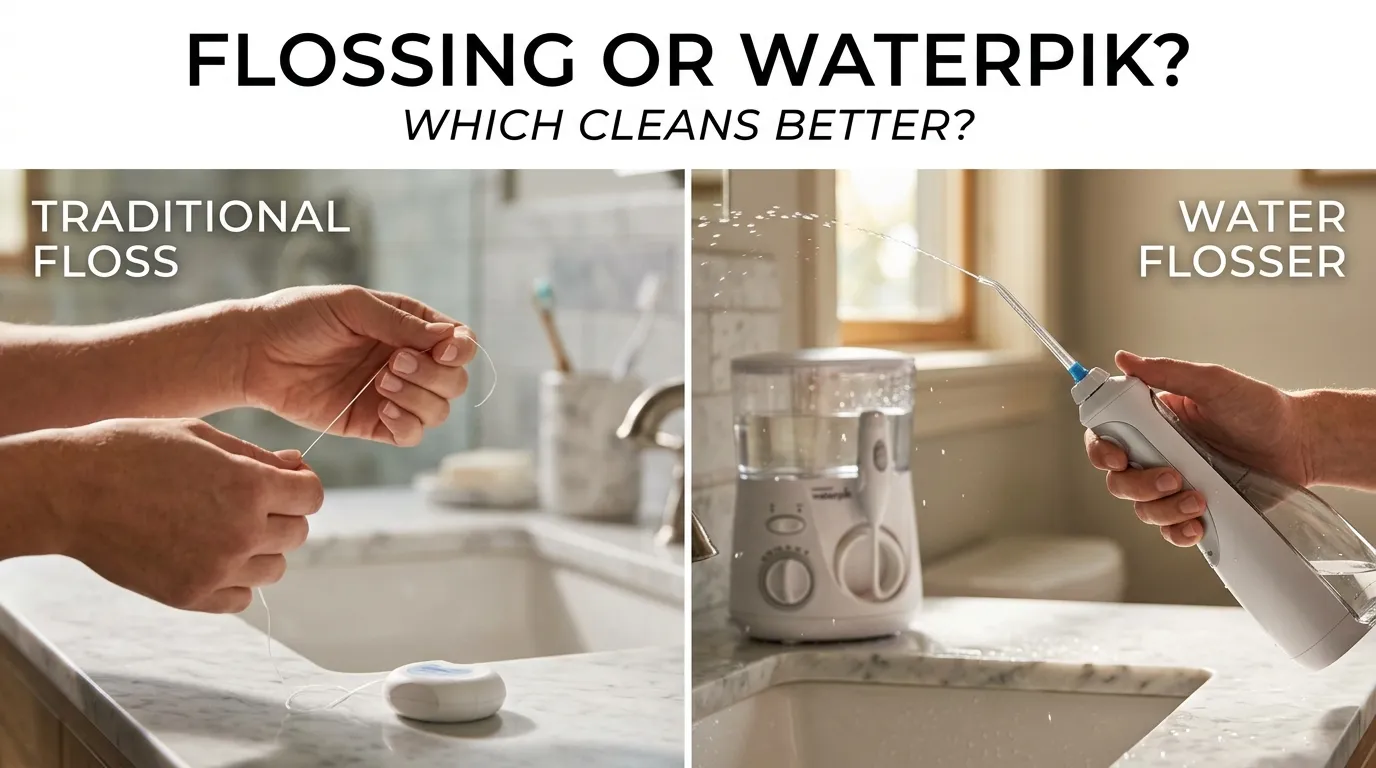
Flossing uses thin string to clean between teeth. A Waterpik uses a stream of water to do the same job, in a different way.
Mia stood in the toothpaste aisle, staring at two items in her cart: a box of floss and a Waterpik. Her dentist had told her to clean between her teeth every day, but never said which tool to use. She picked up the Waterpik box and read the words “water flosser.” Was this the same as regular floss, just in a new shape? She looked at both boxes and wondered which one to buy.
Flossing is the classic way to clean between teeth. It uses a thin thread that slides into tight spaces. A Waterpik, also called a water flosser, is a small machine. It shoots a thin stream of water to push out food and plaque. People search flossing or waterpik because both promise clean teeth and healthy gums, but they work in very different ways. This guide breaks down the difference with clear facts, so you can pick the tool that fits your teeth, your gums, and your daily routine.
Pronunciation
Both words are common and simple to say.
Flossing
US: /ˈflɔː.sɪŋ/ (FLAW-sing)
UK: /ˈflɒs.ɪŋ/ (FLOSS-ing)
Waterpik
US: /ˈwɔː.tɚ.pɪk/ (WAH-ter-pik)
UK: /ˈwɔː.tə.pɪk/ (WAW-tuh-pik)
“Waterpik” is actually a brand name, much like how some people say “Band-Aid” for any bandage. The general term for the tool is “water flosser.”
Difference Between Flossing and Waterpik
1. Basic Meaning
Flossing uses a thin string. A Waterpik uses a stream of water.
- She flossed before bed.
- He used his Waterpik after breakfast.
2. How It Works
String floss is pulled gently between each tooth by hand. A Waterpik sprays a thin, pulsing jet of water along the gum line and between teeth.
- Floss scrapes along the side of each tooth.
- Water pressure flushes out loose bits of food.
3. What It Removes
Floss is very good at scraping off sticky plaque, a soft, clear film of bacteria. A Waterpik is strong at flushing out loose food bits and reaching deep gum pockets, but it does not scrape plaque as well as floss does.
- Floss can lift plaque stuck tight to a tooth.
- A Waterpik can clear food stuck near braces or bridges.
4. Equipment Needed
Floss needs no machine, no plug, and no batteries. A Waterpik needs a power source, a water tank, and a small motor.
- Floss fits in a tiny bag for travel.
- A Waterpik needs a counter spot and an outlet.
5. Skill and Technique
Floss takes some hand skill. You must guide the string, curve it around each tooth, and avoid snapping it into the gum. A Waterpik is simpler. You aim the tip and let the water do most of the work.
- New flossers often need practice to avoid sore gums.
- A Waterpik is often easier for kids or people with braces.
6. Who It Helps Most
Floss works well for most healthy mouths. A Waterpik often helps people with braces, bridges, implants, or gum disease, since it reaches spots that string floss may miss.
- A teen with braces may find a Waterpik easier than string.
- Someone with tight teeth may prefer the reach of floss.
7. Cost Over Time
Floss is cheap and lasts a long time per box. A Waterpik costs more upfront, since it is a small appliance.
- A box of floss may cost a few dollars.
- A Waterpik unit can cost much more at first.
8. Noise and Mess
Floss is silent and clean. A Waterpik makes a soft buzzing sound and can splash water if used without care.
- Floss needs no cleanup after use.
- A Waterpik often needs a bent-over position near the sink.
9. Word Type
“Flossing” is a verb form, from “to floss.” “Waterpik” is a brand name, often used as a noun.
- She is flossing right now. (verb)
- He bought a Waterpik. (noun, brand name)
10. The Swap Test
Ask, “Do I want a string, or a stream of water?” If you picture a thread, think floss. If you picture a spray, think Waterpik.
- “I want something (thin and stringy).” Think floss.
- “I want something that (sprays water).” Think Waterpik.
Before and After: Fix It Fast
- ❌ “A Waterpik replaces the need for a toothbrush.”
✅ “A Waterpik works alongside a toothbrush, not instead of one.”
Water flossers clean between teeth. They do not replace brushing the tooth surface. - ❌ “Floss and Waterpik do the exact same job in the exact same way.”
✅ “Floss and Waterpik both clean between teeth, but in different ways.”
One uses string. The other uses water pressure. - ❌ “A Waterpik is always better for gum health.”
✅ “A Waterpik can help gum health, especially for braces or sensitive gums, but both tools support healthy gums when used well.”
Research shows both methods can help, depending on the person. - ❌ “You never need floss if you have a Waterpik.”
✅ “Some dentists suggest using both floss and a Waterpik for the best clean.”
Many dental professionals recommend combining the two methods. - ❌ “Waterpik is just the name for any water flosser.”
✅ “Waterpik is a specific brand. ‘Water flosser’ is the general term for this type of tool.”
Not all water flossers are made by the Waterpik brand.
Read more about:https://verboix.com/living-or-nonliving/
Nature and Behaviour of Flossing and Waterpik
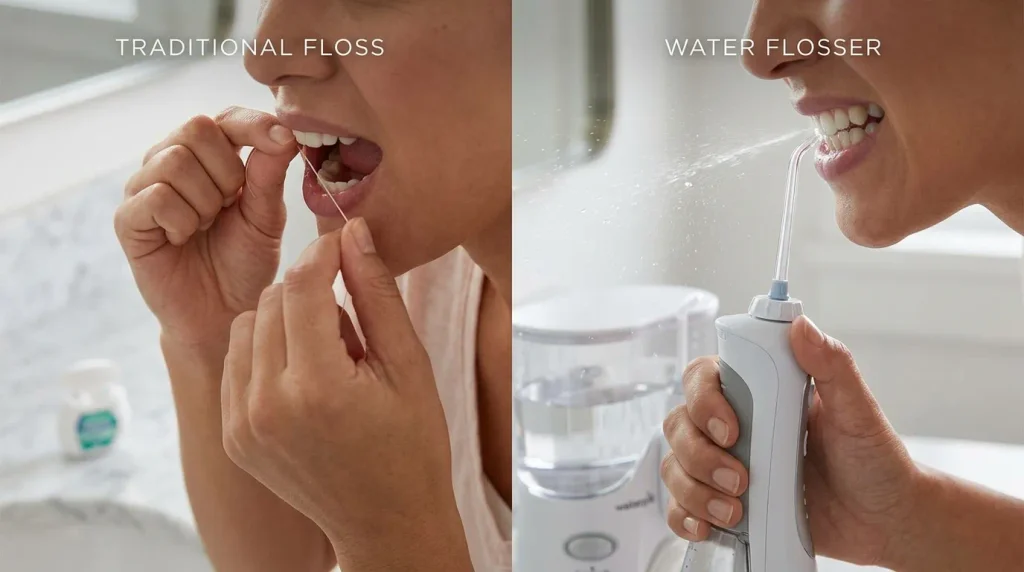
Flossing is the older, more traditional method. It has been part of dental care routines for many decades. The string physically scrapes along each tooth’s surface, lifting off sticky plaque before it hardens into tartar. Floss comes in many types: waxed, unwaxed, flavored, and wide “dental tape” for people with larger gaps. It takes a steady hand and a bit of practice to use well, especially in back teeth.
Waterpik and other water flossers are newer tools, first becoming popular in the late 1900s and growing fast in recent years. The device holds a small tank of water and pushes it out through a narrow tip in quick pulses. This pressure can reach spots that are hard for string floss, like deep gum pockets or the space under a dental bridge. It is often gentler on sore or sensitive gums, since there is no string tugging against the gum tissue.
Why People Get Confused About Flossing and Waterpik
There are four simple reasons.
- Both tools aim to do the same basic job: clean between teeth. People think one must be a complete replacement for the other.
- Marketing can blur the lines. Some ads suggest a Waterpik alone is enough, which is not quite accurate.
- “Waterpik” is a brand name, but many people use it like a general word, the way some say “Kleenex” for any tissue.
- Dentists sometimes recommend one or the other based on a person’s specific needs, which can make the advice feel inconsistent from person to person.
The fix is simple. Think of floss as the classic scraper and Waterpik as a rinser and flusher. Many people get the best results from using both.
Comparison Table
| Point | Flossing | Waterpik |
| Main meaning | Cleaning with thin string | Cleaning with a stream of water |
| Needs power | No | Yes |
| Best at | Scraping off plaque | Flushing food and reaching gum pockets |
| Good for braces | Harder to use | Often easier |
| Cost | Low | Higher upfront |
| Skill needed | Some hand skill | Simple aim and spray |
| Travel-friendly | Yes, very small | Less portable |
| Similarity | Both clean between teeth | Same |
The Origin of Flossing and Waterpik
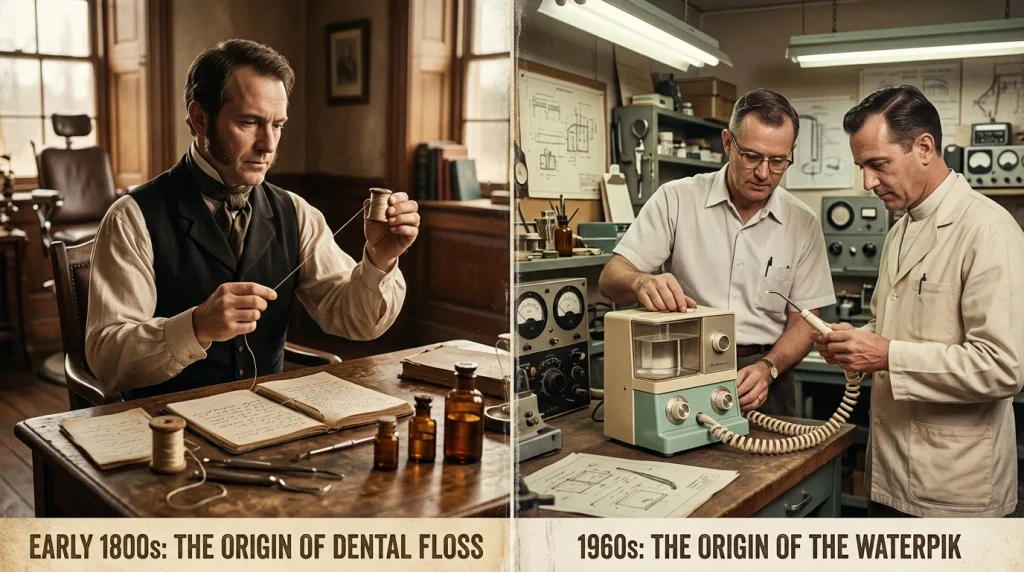
The word “floss” has roots in French and English words for soft, fine thread, like silk fibers. Dental floss as a product was first suggested by a dentist named Levi Spear Parmly in the early 1800s. He recommended silk thread to clean between teeth. Floss did not become a common household item until the 1900s, when companies began making and selling it widely.
“Waterpik” began as a brand name. A man named John Mattingly, working with a dentist, developed an early water-pressure device for cleaning teeth in the 1960s. The company that grew from this invention became known as Waterpik, and the brand name became so common that many people now use it as a general term for any water flosser, much like “Jacuzzi” or “Thermos.”
British vs American English
The spelling is the same in both countries, with small habits that differ.
- Spelling: “Flossing” and “Waterpik” are spelled the same in the US and UK.
- Term use: Americans often say “Waterpik” even for other brands. Britons are more likely to say “water flosser” as the general term.
- Dental habits: Dental care routines are broadly similar, though some studies note different average flossing rates between countries.
Examples:
- US: “I floss every night and use my Waterpik twice a week.”
- UK: “I floss every night and use a water flosser twice a week.”
Which One Should You Use?
Use one simple rule: if your dentist has not given specific advice, string floss is the proven daily basic, and a Waterpik is a strong addition, especially if you have braces, gum sensitivity, or dental work like bridges or implants.
- For most people: Daily floss, with a Waterpik added for extra care, works well.
- For braces or dental work: A Waterpik often reaches spots string floss cannot.
- For sensitive gums: A Waterpik can feel gentler than pulling string floss tight.
Common Mistakes
- ❌ “I use my Waterpik, so I never need to floss.” ✅ “I use my Waterpik along with floss for a full clean.”
- ❌ “Floss and Waterpik are the same tool.” ✅ “Floss is a string. A Waterpik is a water-spraying device.”
- ❌ “Waterpik is the only brand of water flosser.” ✅ “Waterpik is one brand. Other companies also make water flossers.”
- ❌ “A Waterpik can replace brushing.” ✅ “A Waterpik and floss both work alongside brushing, not instead of it.”
- ❌ “Floss is old and no longer recommended.” ✅ “Floss is still widely recommended by dental professionals.”
Everyday Usage Examples
In conversation
- “Did you floss this morning?”
- “I switched to a Waterpik after I got my braces.”
On social media
- “Just got a new Waterpik and my gums feel amazing! 🦷”
- “Reminder to floss before bed tonight.”
In the news
- “Dentists say most people still don’t floss enough.”
- “Water flosser sales have grown as more people seek gum care at home.”
In formal writing
- “Patients with periodontal concerns may benefit from a water flosser in addition to standard flossing.”
- “Daily flossing remains a core part of recommended oral hygiene.”
Usage Trends
Flossing has been a standard part of dental care advice for generations, and most dentists still recommend it as a daily habit. Water flossers, including the Waterpik brand, have grown quickly in popularity over recent years, especially as more people look for tools that feel easier or gentler to use.
Many people now search for comparisons between the two, often right after getting braces, a bridge, or advice from a dentist about gum health. Online reviews and dental influencers have also helped spread interest in water flossers as a modern alternative or addition to string floss.
Metaphors and Similes
Flossing
- “Floss is a tiny broom, sweeping between each tooth.” (metaphor)
- “The string slid between her teeth like a key into a lock.” (simile)
Waterpik
- “The Waterpik is a gentle rainstorm for your gums.” (metaphor)
- “The water pulsed like a tiny wave against her teeth.” (simile)
Floss suggests precision and scraping. Waterpik suggests flow and flushing.
Connotative Meaning
Flossing
- Positive: “She never skips flossing.” It shows discipline and care.
- Neutral: “He flosses once a day.” It states a routine.
- Negative: “Flossing always makes my gums bleed.” It can suggest discomfort.
Waterpik
- Positive: “My Waterpik made flossing so much easier.” It shows relief and ease.
- Neutral: “She keeps her Waterpik by the sink.” It states a fact.
- Negative: “The Waterpik splashed water everywhere.” It can suggest mess.
Idioms and Proverbs
There are no well-known idioms built from the words “flossing” or “Waterpik.” But a few phrases connect to the spirit of daily dental care.
- An ounce of prevention is worth a pound of cure: A classic saying that fits daily habits like flossing, which prevent bigger problems later.
- Slow and steady wins the race: Fits the patient, careful motion of flossing well.
- Go with the flow: A playful phrase that fits the idea of a water flosser’s stream.
Literature and Movies
No famous book or movie centers on flossing or water flossers, since these are everyday health tools rather than dramatic subjects. However, dental care and dentist visits appear in many stories and shows, often for comic effect.
Movies
- Finding Nemo (2003, United States): Features a dentist’s office as a key setting, though dental hygiene itself is not a major plot point.
- Little Shop of Horrors (1986, United States): Includes a well-known scene set in a dental office.
Why This Difference Matters
For daily health, knowing the difference between flossing and using a Waterpik helps people build a routine that fits their mouths and habits. The right tool can make a real difference in comfort and results, especially for people with braces, bridges, or sensitive gums. Clear knowledge of these tools also helps dental professionals guide patients toward better home care between checkups. Over time, good daily care may help reduce cavities and gum disease. Families can use this knowledge to help children and teens choose tools they feel comfortable using every day.
Usefulness in Daily Life
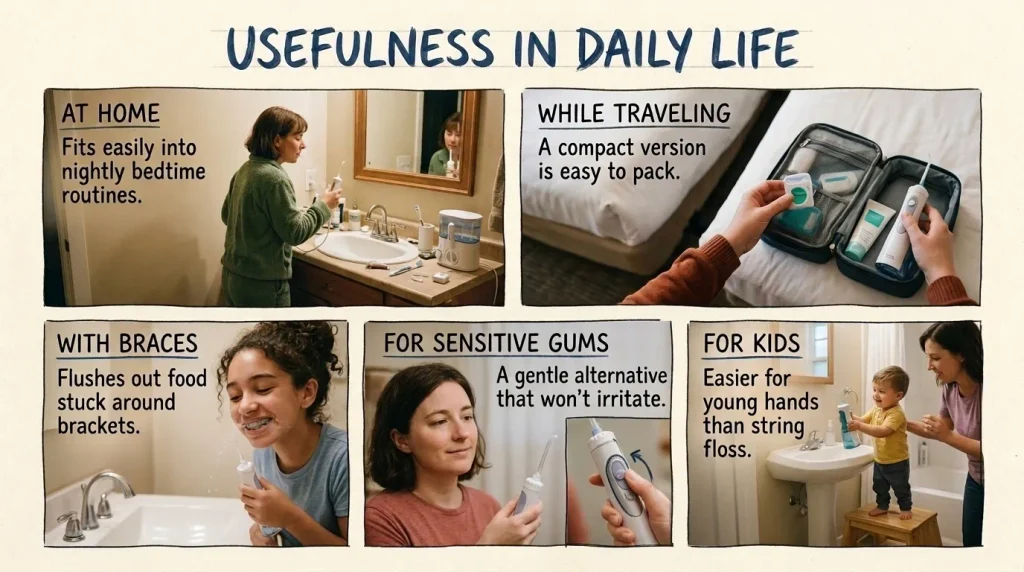
- At home: “I floss after dinner, then use the Waterpik before bed.”
- While traveling: A small floss pack fits easily in a bag, while a Waterpik may need a travel-sized version.
- With braces: A Waterpik can flush out food stuck around brackets and wires.
- For kids: A Waterpik’s simple aim-and-spray action can be easier for young hands than guiding string floss.
- For sensitive gums: A gentle setting on a Waterpik may feel more comfortable than pulling floss tight.
A Quick Test You Can Use
Ask these three questions:
- Do I have braces, a bridge, or dental work that traps food? A Waterpik may help more.
- Do I want the most proven method for scraping off plaque? Floss is strong here.
- Can I use both? Many dental professionals suggest combining them for the best results.
Situational Preference
Pick your tool by thinking about your mouth and your routine.For people with straight, healthy teeth and steady hands, floss alone may be enough. A Waterpik can add real value if you have braces, implants, or sensitive gums. When you travel often, floss is easier to pack. For a thorough daily routine, many dentists suggest using floss and a Waterpik together. You can use floss first, followed by a Waterpik, or reverse the order based on personal comfort.When unsure, ask your dentist what fits your specific teeth and gums.
Cheat Card
| Flossing | Waterpik | |
| Means | Cleaning with thin string | Cleaning with a stream of water |
| Best at | Scraping off plaque | Flushing food, reaching gum pockets |
| Needs power | No | Yes |
| Good for braces | Harder | Often easier |
| Cost | Low | Higher upfront |
| Remember | The classic scraper | The modern flusher |
Quick Answers
1. What is the difference between flossing and using a Waterpik?
Flossing uses thin string to scrape plaque off teeth. A Waterpik uses a pulsing stream of water to flush out food and clean along the gum line.
2. Can a Waterpik replace flossing completely?
Many dental professionals suggest using both, since floss and water flossers clean in different ways. Ask your dentist what fits your needs.
3. Is Waterpik a specific brand?
Yes. Waterpik is a brand name. The general term for this type of tool is “water flosser.”
4. Which is better for braces?
A Waterpik is often easier to use around brackets and wires, since it does not require threading string between tight spaces.
5. Does flossing or a Waterpik hurt more?
This varies by person. Floss can irritate sore or sensitive gums, while a Waterpik is often gentler, though it may feel odd at first.
6. How often should I floss or use a Waterpik?
Most dental guidance suggests daily cleaning between teeth, whether with floss, a Waterpik, or both. Follow your dentist’s specific advice.
7. Is a Waterpik good for gum health?
Some studies suggest water flossers can help reduce gum bleeding and inflammation, especially for people with certain gum conditions. Ask your dentist for guidance specific to your gums.
Conclusion
Flossing or Waterpik? Both help keep your teeth and gums clean, but they work in different ways. Flossing uses a thin string to remove plaque from between teeth, while a Waterpik uses a pulsing stream of water to flush out food and clean along the gum line. Neither tool fully replaces the other for everyone. Floss is a proven daily basic, while a Waterpik can help people with braces, dental work, or sensitive gums. Many dental professionals suggest using both for a more thorough clean. Next time you visit the dental aisle, choose the tool that fits your teeth, comfort, and daily routine. For advice that suits your needs, ask your dentist.