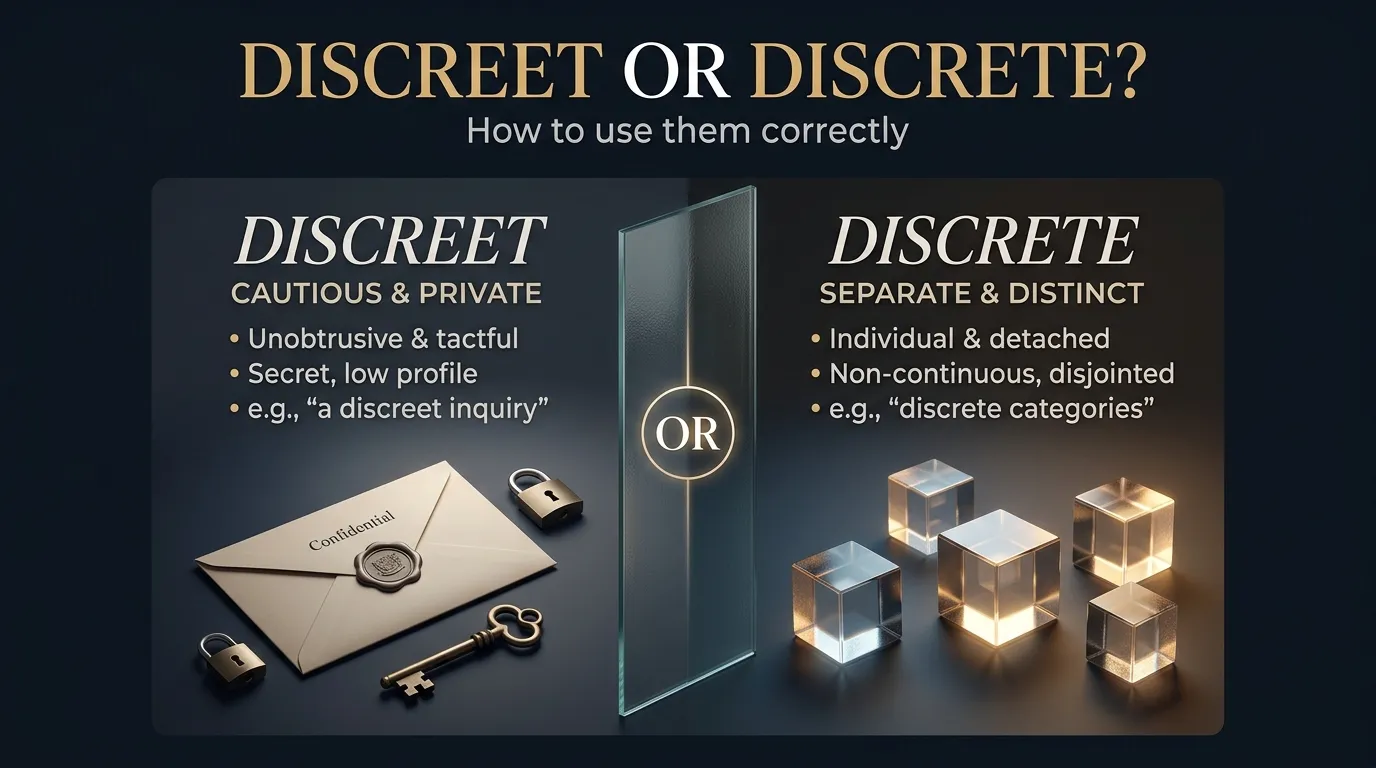
Have you ever stopped while writing and wondered, “Is it discreet or discrete?” Many people do. The two words sound the same. They also look almost the same. Only two letters switch places. Yet the meanings are not alike at all.
Here is the short answer. Discreet means careful and quiet. It is about keeping something private. Discrete means separate. It is about things that stand apart from each other.
In this guide, you will learn both meanings in a simple way. You will also see where the words came from and why people mix them up. After that, you will get easy tricks, fun examples, and a short quiz. By the end, you will pick the right word every time.
Pronunciation
Both words are short, but they sound the same, so people often mix them up.
Discreet
- US: /dɪˈskriːt/ (dis-KREET)
- UK: /dɪˈskriːt/ (dis-KREET)
- It comes from the Latin word “discretus” through Old French.
Discrete
- US: /dɪˈskriːt/ (dis-KREET)
- UK: /dɪˈskriːt/ (dis-KREET)
- It comes straight from the Latin word “discretus.”
Notice that both words rhyme with “meet” and “street.” The stress falls on the second part, “KREET.” Also, the first part, “dis,” is short and quick. Because the two words sound alike, they are called homophones. So, you cannot hear the difference when someone speaks. Now let us look at the real differences.
Discreet or Discrete: The Quick Answer
Take a look at the table below. It shows the big difference at a glance.
| Word | Meaning | Easy way to think of it | Example |
| Discreet | careful, quiet, private | A secret kept safe | She was discreet about the surprise party. |
| Discrete | separate, apart | Things that stand alone | The box had four discrete parts. |
Both words are adjectives. An adjective is a word that describes a person, place, or thing. So, they tell us more about a noun. However, they describe very different things. One describes how a person acts. The other describes how things are set apart.
What Does “Discreet” Mean?
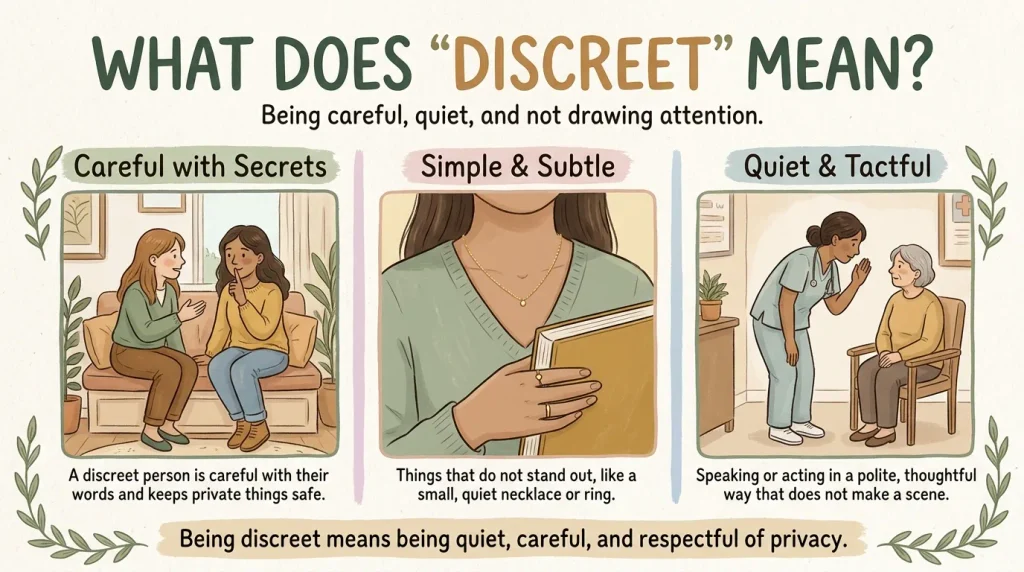
Discreet describes a person who is careful with words and actions. A discreet person does not talk too much. They know when to stay quiet. Also, they do not tell private things to others.
Discreet can also describe things that do not stand out. For example, a small gold necklace can be discreet. It is simple and quiet. Nobody stares at it.
Let us look at the main ideas.
- Careful with secrets. A discreet friend keeps your secrets safe.
- Polite and tactful. A discreet person chooses kind words at the right time.
- Quiet and not loud. A discreet gift or color does not draw much attention.
Simple Examples of “Discreet”
- Ava was discreet and did not tell anyone about the gift.
- The nurse asked the question in a discreet voice.
- Dad parked at a discreet distance from the school gate.
- Please be discreet about our plan.
- Lena wore a discreet little ring.
- The waiter made a discreet move and fixed the table.
In each sentence, the word points to quiet and careful behavior. Nothing is loud. Nothing is shared with the whole world.
Who Can Be Discreet?
People are discreet. Actions can be discreet too. So can small things, like a necklace or a note. On the other hand, you would not say that a pile of apples is discreet. For that, you would use a different word.
What Does “Discrete” Mean?
Discrete means separate or apart. When things are discrete, each one stands alone. You can count them one by one. Nothing is stuck to anything else.
Think of a box of crayons. Each crayon is its own piece. So, the crayons are discrete. Now think of a puddle of paint. It is all one blob. That is not discrete.
Simple Examples of “Discrete”
- The pizza came in eight discrete slices.
- A week has seven discrete days.
- The book has three discrete parts.
- Each student gets a discrete desk.
- The teacher gave us five discrete tasks.
- Beads on a string are discrete, because each one is separate.
In every sentence, the word means “separate and not joined.”
Discrete in Math and Science
You will often see this word in math and science. For instance, a discrete number is one you can count, like 1, 2, or 3. You cannot have 2.5 kids in a classroom. So, the number of kids is discrete.
Computers also use this word. They treat time as small, separate steps instead of one flowing line. This is why you may read about “discrete data” in school. It simply means data you can count in separate pieces.
Read more about:https://verboix.com/master-or-masters/
Where Do These Words Come From?
Words have stories, and this one is fun. Both words come from the same old Latin word, “discretus.” It meant “separated.” That Latin word grew out of another one, “discernere,” which meant to tell things apart. This is also where we get the English word “discern.”
So, these two words are cousins. They started as one idea. The idea was “set apart.”
Here is how the story went.
- Both words came into English in the 1300s.
- At first, people spelled them in many ways. In the 1400s, the spellings were used for all the meanings.
- In the 1500s, the spellings went their separate ways. “Discrete” kept the meaning of separate. “Discreet” kept the meaning of careful and wise.
Why did “discreet” mean careful? Think about it. A careful person can tell things apart. That person knows what to say and what to hide. In other words, they have good judgment. So, the meaning grew from “tell apart” to “act wisely.”
Today, the two words share the same sound. But they do two different jobs.
Why Do People Mix Them Up?
If the meanings are so different, why does this mistake happen so often? There are a few clear reasons.
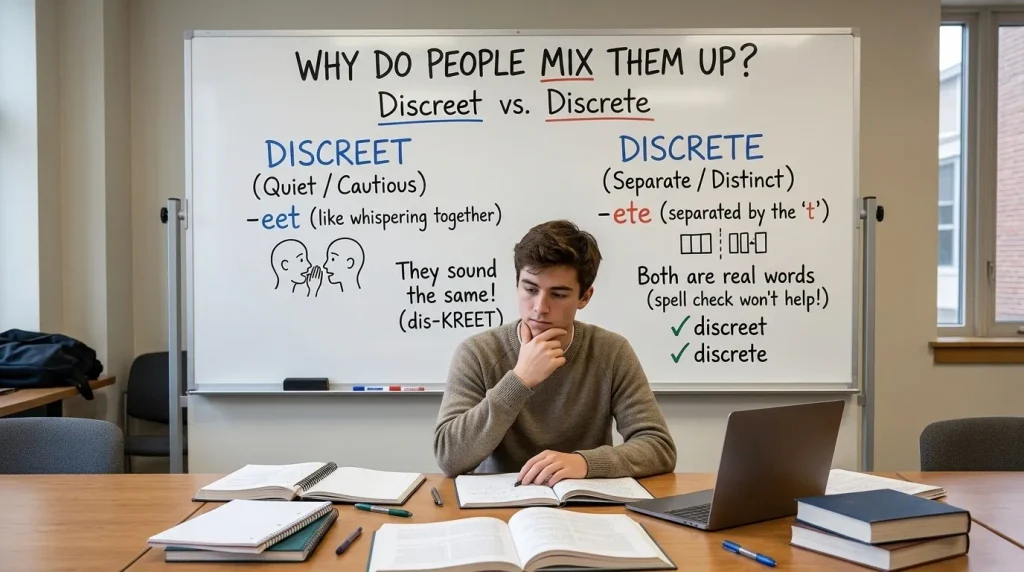
First, they are homophones. Homophones are words that sound the same but mean different things. Both words sound like “dis-KREET.” Because of this, your ear cannot help you.
Second, the spelling is very close. Only the last few letters differ. One word ends in “-eet.” The other ends in “-ete.” That tiny change is easy to miss.
Third, spell check may not catch it. Both are real words. As a result, a tool will not mark either one as wrong. Only you know which meaning you want.
Finally, the shared history does not help. The words started as one. So, it feels natural to blend them. That is why a good trick is so useful. You will find some below.
Before and After: See the Mistake and the Fix
Seeing a mistake next to its fix helps a lot. Read these pairs.
| Before (wrong) | After (right) |
| Please be discrete about the surprise. | Please be discreet about the surprise. |
| The cake had six discreet layers. | The cake had six discrete layers. |
| He gave a discrete cough to get her attention. | He gave a discreet cough to get her attention. |
| The two rooms are discreet spaces. | The two rooms are discrete spaces. |
| She is known for her discrete manner. | She is known for her discreet manner. |
| The data has discreet values. | The data has discrete values. |
Now look at the pattern. When the sentence is about quiet and secrets, use discreet. When the sentence is about separate parts, use discrete.
Three Easy Tricks to Remember the Difference
Pick the trick that you like best.
Trick 1: The Two E’s Together or Apart
Look at the middle of each word.
- In discreet, the two E’s sit right next to each other. Imagine one E whispering a secret into the other E’s ear. That is why the word means careful and private.
- In discrete, the letter T sits between the two E’s. The T keeps them apart. So, the E’s are separate, just like the meaning.
This is the strongest trick. Picture the T as a fence between two friends.
Trick 2: Use the Noun
Nouns can help you check. The noun for discreet is discretion. You show discretion when you are discreet. It is a word you hear often, so it is easy to remember.
The noun for discrete is discreteness. It is a rare word, so you may not use it much. But if you find yourself writing “discretion,” then you need discreet.
Trick 3: Match the Ending Sound
Say each word slowly. Then match it to a small helper.
- Discreet and quiet both end in T. Discreet means quiet.
- Discrete and separate both end in E. Discrete means separate.
This helps, because quiet and separate are easy words. So, you can link each one to the right spelling in seconds.
Discreet or Discrete in Everyday Sentences
More examples will help the words stick. Here are some from daily life.
At school
- Maya was discreet and did not tell about the test grades.
- The teacher gave us three discrete steps to follow.
- Sam asked a discreet question after class.
At home
- Mom picked a discreet spot to hide the gift.
- Dad put the toys into five discrete boxes.
- My sister was discreet about her birthday wish.
In the Shop
- The guard stayed at a discreet distance.
- The store sells two discrete kinds of juice.
- The clerk gave a discreet nod to her boss.
At work
- A good helper is discreet with private papers.
- The report has four discrete sections.
- Please be discreet when you talk about the new plan.
In math and computers
- Counting apples gives discrete numbers.
- A computer reads music as discrete bits of sound.
- The graph shows discrete dots, not a line.
Notice the pattern again. When you read about people being careful, think “discreet.” When you read about separate items, think “discrete.”
The Word Family
Each word has relatives. Let us meet them.
| Word | Type | Meaning | Example |
| discreet | adjective | careful and quiet | He is a discreet friend. |
| discreetly | adverb | in a careful, quiet way | She left discreetly. |
| discretion | noun | good judgment and care | Use your discretion. |
| indiscreet | adjective | not careful with secrets | It was an indiscreet remark. |
| discrete | adjective | separate | We have six discrete teams. |
| discretely | adverb | in a separate way | The files are stored discretely. |
| discreteness | noun | the state of being separate | The discreteness of each step helps. |
A Common Mix-Up with Nouns
Many people think “discretion” is the noun for both words. That is not true. Discretion belongs only to discreet. The noun for discrete is discreteness.
So, if you want to say “the state of being separate,” use “discreteness.” On the other hand, if you want to say “being careful and wise,” use “discretion.”
One More Fun Fact
“Discretion” also shows up in the phrase “at your discretion.” It means “it is up to you to decide.” For example, “Bring a snack at your discretion.” The phrase comes from the careful, wise meaning, so it goes with discreet.
Common Mistakes to Avoid
These slips happen most often.
- Using “discrete” for secrets. Wrong: “Be discrete about this.” Right: “Be discreet about this.”
- Using “discreet” for separate parts. Wrong: “The three discreet rooms.” Right: “The three discrete rooms.”
- Writing “discretely” when you mean quiet. Wrong: “He left discretely.” Right: “He left discreetly.”
- Writing “discretion” as the noun for separate things. Use “discreteness” instead, or choose a simpler word like “separation.”
- Writing “indiscrete” for careless. The right word for careless is “indiscreet.”
Quick Tip: Test with a Swap
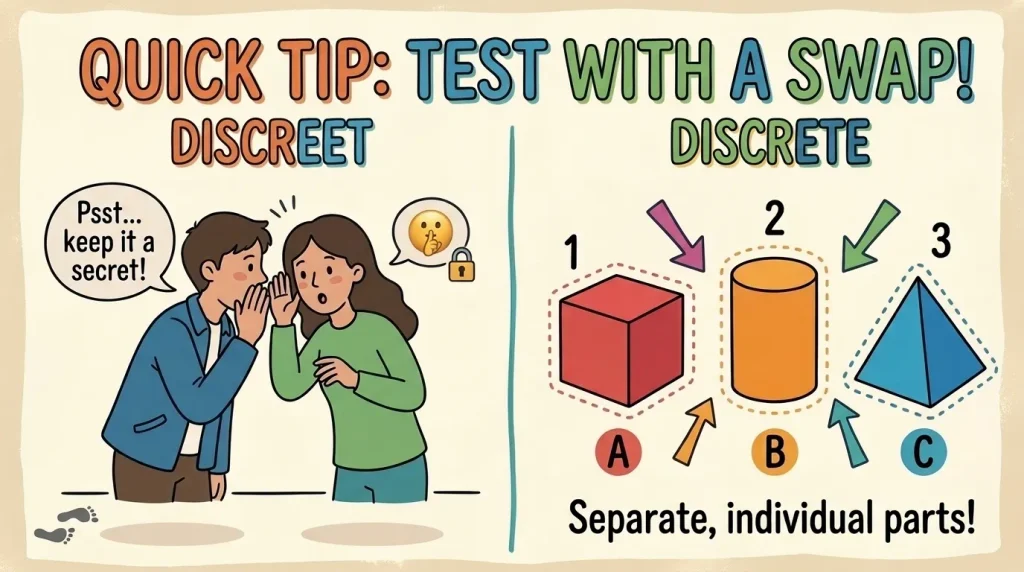
Here is a simple test. Replace the word with another word, then read the sentence again.
- Swap with “quiet and careful.” If the sentence still makes sense, use discreet.
- Swap with “separate.” If the sentence still makes sense, use discrete.
For example, try: “The bus has three ___ seats.” Swap in “quiet and careful.” It sounds odd. Now swap in “separate.” It sounds right. So, the answer is discrete.
Now try: “She was ___ about the news.” Swap in “separate.” That sounds strange. Swap in “quiet and careful.” That works. So, the answer is discreet.
Print and Save: Discreet or Discrete Cheat Card
Save this card and keep it near your desk.
| Topic | Discreet | Discrete |
| Meaning | careful, quiet, private | separate, apart |
| Part of speech | adjective | adjective |
| Noun form | discretion | discreteness |
| Adverb form | discreetly | discretely |
| Memory trick | E’s sit together, whispering | The T keeps the E’s apart |
| Ending trick | ends like “quiet” (T) | ends like “separate” (E) |
| Used for | people, actions, small things | parts, groups, numbers |
| Example | Be discreet about the gift. | The cake has six discrete slices. |
| Opposite | indiscreet | continuous |
| Sounds like | dis-KREET | dis-KREET |
Test Yourself: Multiple Choice Questions
Pick the best answer. The answers are below.
Question 1. Which word means “careful and quiet”?
- A. discrete
- B. discreet
- C. both of them
Question 2. Which sentence is correct?
- A. Please be discrete about the party.
- B. Please be discreet about the party.
- C. Please be discreetely about the party.
Question 3. Which word fits: “The book has four ___ chapters.”
- A. discreet
- B. discrete
- C. indiscrete
Question 4. What is the noun form of “discreet”?
- A. discretion
- B. discreteness
- C. discretely
Question 5. In which word does the T keep the two E’s apart?
- A. discreet
- B. discrete
- C. neither
Test Yourself: Fill in the Blanks
Choose the correct word for each gap.
- My best friend is very ______ and never shares my secrets. (discreet / discrete)
- The teacher gave us two ______ jobs to do. (discreet / discrete)
- He left the room ______ so nobody noticed. (discreetly / discretely)
- Counting people gives you ______ numbers. (discreet / discrete)
- You may use your own ______ to choose a snack. (discretion / discreteness)
Answer Key
Multiple choice
- B. Discreet means careful and quiet.
- B. The sentence is about keeping a secret, so we use “discreet.”
- B. Chapters are separate parts, so “discrete” is right.
- A. The noun for discreet is discretion.
- B. In “discrete,” the T sits between the two E’s.
Fill in the blanks
- discreet. The friend keeps secrets, so the word means careful and private.
- discrete. The jobs are separate from each other.
- discreetly. He left in a quiet way, so we need the adverb for discreet.
- discrete. You can count people, so the numbers are separate.
- discretion. It is the noun that goes with discreet, and it means good judgment.
How did you do? If you got four or five right, great job! If you missed a few, read the tricks again. Then try the quiz once more.
Frequently Asked Questions
What is the difference between discreet and discrete?
Discreet means careful, quiet, and private. It is often used for people who keep secrets. Discrete means separate or apart. It is used for things that stand alone, like parts of a set.
Do discreet and discrete sound the same?
Yes. Both are said “dis-KREET.” Because of this, you cannot tell them apart by ear. You have to look at the spelling and the meaning.
Which word do I use for a secret?
Use discreet. A discreet person keeps a secret safe. For example, “Please be discreet about the news.”
Which word do I use in math?
Use discrete. In math, a discrete number is one you can count, like 1, 2, or 3. A discrete group has separate parts.
Is “discretion” the noun for both words?
No. “Discretion” belongs to discreet. The noun for discrete is discreteness.
Why are these two words so alike?
They both come from the same Latin word, “discretus,” which meant “separated.” In the 1500s, the spellings split. After that, each spelling took one meaning.
What is the easiest trick to remember?
Look at the E’s. In discreet, the two E’s sit together, like friends sharing a secret. In discrete, the T sits between the E’s and keeps them apart.
Final Thoughts
Discreet or Discrete? The answer depends on what you want to say. Use discreet for careful, quiet, and private things. Use discrete for things that are separate and apart. Remember the E’s: when they sit together, they whisper a secret. When T stands between them, they stay apart. Keep the cheat card close and take the quiz again in a few days. With a little practice, you will remember the difference and use both words with ease.












1 thought on “Discreet or Discrete? Two E’s, Two Very Different Jobs”