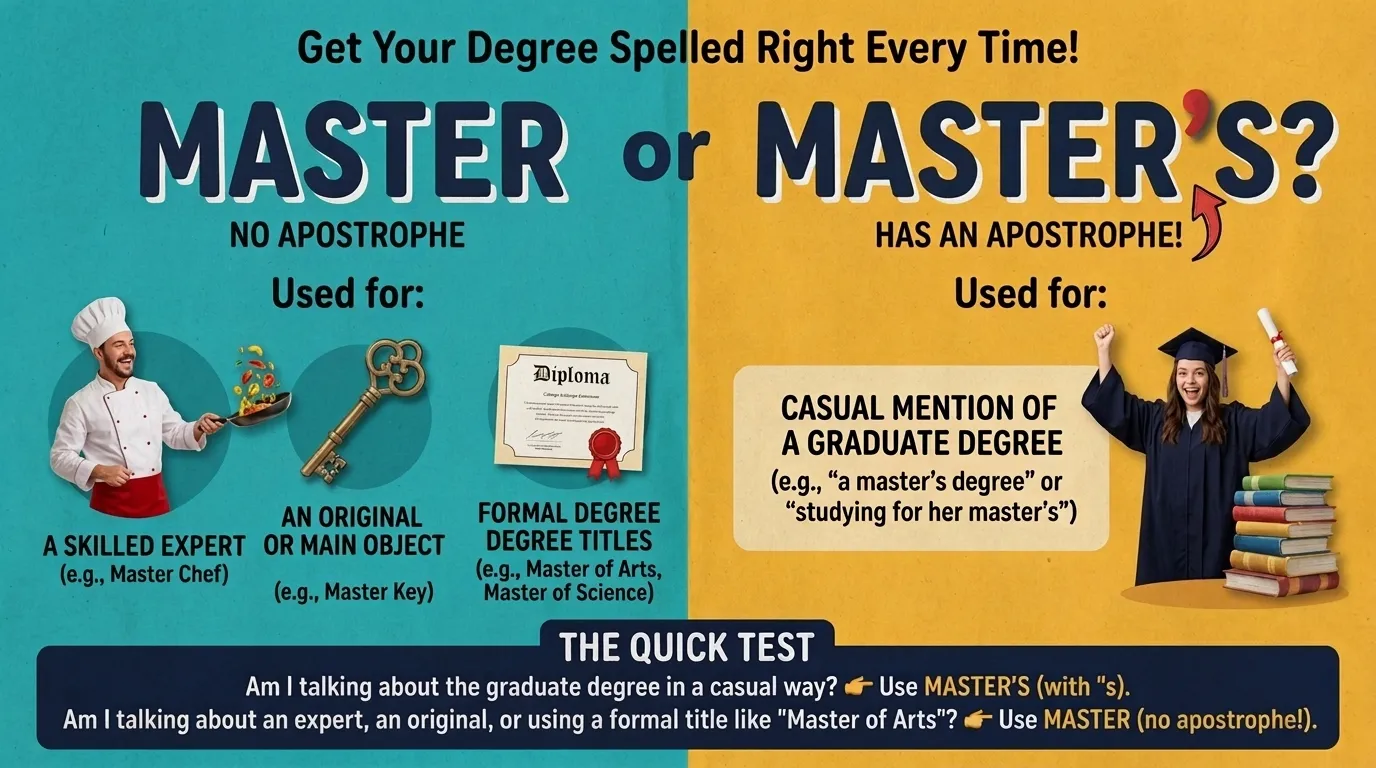
Master is a word on its own. It can mean an expert, or a degree level. Master’s is the short form, used for “master’s degree.”
Ethan filled out his job form. One line asked about his schooling. He typed, “Masters in Business.” His friend looked over his shoulder. “Wait, don’t you need an apostrophe there?” Ethan paused. He had seen the word written both ways online. Was it “masters” or “master’s”? He searched master or master’s. He wanted to clear up the mix-up for good.
Master, on its own, can mean someone very skilled. It can also mean an original copy of something, like a master recording. Master’s is the short form of “master’s degree.” This is a type of degree you earn after a bachelor’s degree. People search master or master’s because this tiny mark, called an apostrophe, trips up even careful writers. This guide clears up the mix-up with simple rules and clear examples.
Pronunciation
Both forms sound almost the same.
Master
US: /ˈmæs.tɚ/ (MAS-ter)
UK: /ˈmɑː.stə/ (MAH-stuh)
Master’s
US: /ˈmæs.tɚz/ (MAS-terz)
UK: /ˈmɑː.stəz/ (MAH-stuhz)
The only sound change is a small “z” sound at the end of “master’s.”
Difference Between Master and Master’s
1. Basic Meaning
Master can describe a person, a role, or an original item. Master’s means a graduate degree, short for “master’s degree.”
- He is a master of chess strategy.
- She earned her master’s in psychology.
2. Word Type
Master works as a noun or describing word on its own. Master’s shows ownership, mostly in the phrase “master’s degree.”
- Master carpenter, master key, master copy. (noun/describing word)
- She has a master’s degree. (ownership form)
3. The Apostrophe
Master has no apostrophe. Master’s always has one, right before the “s.”
- “Master” ends in “r.”
- “Master’s” ends in “r’s,” with that small mark.
4. What Comes After Each Word
“Master” often comes before another word, like “master plan” or “master bedroom.” “Master’s” often comes before the word “degree,” or stands alone to mean the degree itself.
- The builder showed the master plan.
- She is working on her master’s.
5. Degree Names
When you name the real degree title, like “Master of Arts,” you skip the apostrophe. But when you talk about “a master’s degree” in general, you add it.
- He holds a Master of Science in biology.
- She is working toward a master’s degree in teaching.
6. Plural Mix-Up
“Master’s degree” is just one degree, even though it sounds like it could mean many. The word “masters,” with no apostrophe, means more than one expert, or more than one original item.
- She has one master’s degree. (one, ownership form)
- The museum keeps the original masters locked away. (many, no apostrophe)
7. Common Uses of “Master” Alone
“Master” alone shows up in many places: a skilled person, an original recording, a key that opens many locks, or a formal title.
- He became a chess master at a young age.
- The studio kept the master recording safe.
8. Common Uses of “Master’s”
“Master’s” almost always means the graduate degree. It can also show ownership in rare cases, like “the master’s tools,” meaning tools that belong to a master.
- She finished her master’s in two years.
- The master’s tools hung neatly on the wall.
9. Formality
Both forms show up in formal writing, like resumes and school papers, where getting it right really matters.
- “Master’s degree” appears on diplomas.
- “Master craftsman” appears in job titles.
10. The Swap Test
Ask, “Am I talking about the degree?” If yes, use master’s. If you mean a skilled person, an original item, or a general word, use master.
- “She earned her (degree) in nursing.” Use master’s.
- “He is a (skilled expert) at woodworking.” Use master.
Before and After: Fix It Fast
- ❌ “She has a masters degree in finance.”
✅ “She has a master’s degree in finance.”
You need the small mark before the “s” here. - ❌ “He is studying for his master.”
✅ “He is studying for his master’s.”
Without the mark and “s,” “master” alone does not mean the degree. - ❌ “The museum showed original master’s paintings.”
✅ “The museum showed original master paintings.”
When “master” describes the paintings, skip the mark. - ❌ “She holds a Master’s of Science degree.”
✅ “She holds a Master of Science degree.”
The formal degree name skips the mark. - ❌ “He finished his masters in record time.”
✅ “He finished his master’s in record time.”
Talking about the degree needs the mark.
Nature and Behaviour of Master and Master’s
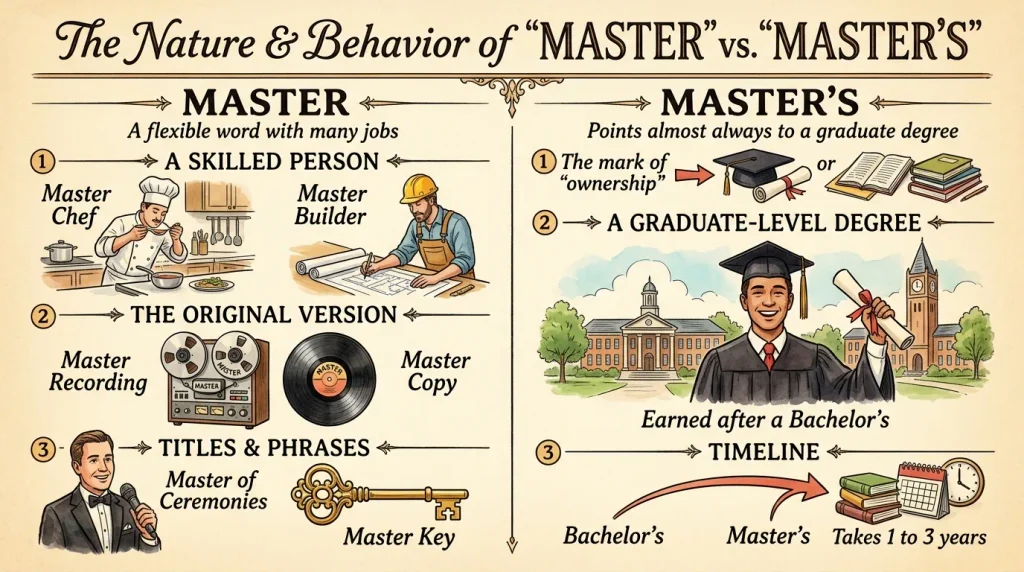
Master, on its own, is a flexible word with many jobs.
It can describe a very skilled person, such as a “master chef” or “master builder.” It can also mean the original version of something, like a “master copy” or “master recording.” You may see it in formal titles, such as “Master of Ceremonies,” or in common phrases, such as “master key.”
Master’s almost always points to one thing: a graduate-level school degree, earned after a bachelor’s degree. This degree often takes one to three years, depending on the subject and school. The small mark shows a kind of ownership, like saying “a master’s degree” belongs to someone who has reached that level in their field of study.
Why People Get Confused About Master and Master’s
There are four simple reasons.
- The small mark is easy to miss, especially when typing fast.
- Many people are not sure if the degree name itself needs the mark, since formal titles like “Master of Arts” skip it.
- Spell check often misses this mistake, since both forms are real words.
- The word “masters,” with no mark, is also a real word. It is the plural of “master,” which adds to the mix-up.
The fix is simple. If you mean the graduate degree in a casual way, add the mark. If you are naming the formal degree title, or talking about a skilled person, leave it out.
Read more about:https://verboix.com/highlight-or-balayage/
Comparison Table
| Point | Master | Master’s |
| Main meaning | Skilled person, original item, general word | Graduate degree (short form) |
| Apostrophe | No | Yes |
| Word type | Noun, describing word | Ownership form |
| Common phrase | Master key, master plan | Master’s degree |
| Formal degree title | Master of Science, Master of Arts | Not used this way |
| Example | He is a chess master. | She has a master’s in law. |
| Similarity | Both tie to the idea of being skilled | Same |
The Origin of Master and Master’s
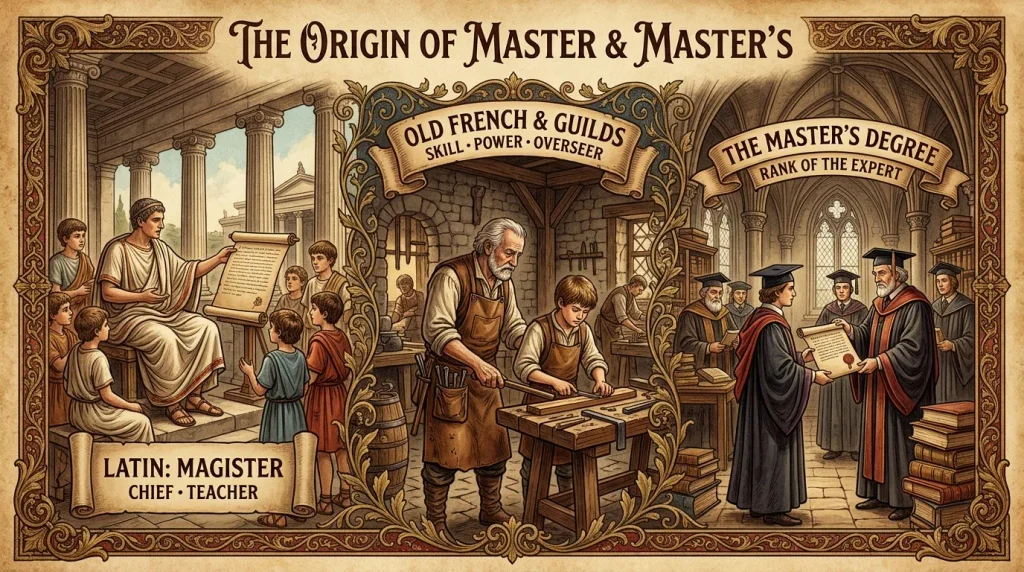
The word “master” comes from a Latin word, magister. It means “chief” or “teacher.” It came into English through Old French. People have used it for centuries to describe someone with skill or power over something.
The school use of “master’s degree” grew over time, as colleges built levels of learning past a basic bachelor’s degree. The ownership mark in “master’s” shows that the degree belongs to, or stands for, the rank of “master” in that subject. This echoes old times, when skilled workers earned the title “master” after years of training.
British vs American English
The spelling and meaning stay the same in both places.
- Spelling: “Master” and “master’s” are spelled the same in the US and UK.
- Degree names: Both countries use “master’s degree” the same way. Both skip the mark in formal titles like “Master of Arts.”
- School systems: The general word is shared, but exact programs and lengths can change by country and school.
Examples:
- US: “She earned her master’s at a school in Boston.”
- UK: “She earned her master’s at a school in London.”
Which One Should You Use?
Use one simple rule: talking about the degree in a casual way means master’s, everything else usually means master.
- For resumes and everyday writing: Use “master’s degree” or “a master’s” with the mark.
- For formal degree titles: Use “Master of Arts” or “Master of Science” with no mark.
- For talking about skill or originals: Use “master” with no mark, like “master builder” or “master copy.”
If you feel unsure, try the swap test. Ask if you mean the degree itself, in a casual way, or something else.
Common Mistakes
- ❌ “I’m getting my masters next year.” ✅ “I’m getting my master’s next year.”
- ❌ “She has a Master’s of Arts degree.” ✅ “She has a Master of Arts degree.”
- ❌ “He is a true master’s at painting.” ✅ “He is a true master at painting.”
- ❌ “The company keeps the masters recording safe.” ✅ “The company keeps the master recording safe.”
- ❌ “They gave him an honorary masters degree.” ✅ “They gave him an honorary master’s degree.”
Everyday Usage Examples
In emails
- “I just finished my master’s in computer science.”
- “Please update my resume to show my new master’s degree.”
On social media
- “Officially a master’s graduate! So proud of this step. 🎓”
- “Working on my master’s while holding a full-time job.”
In the news
- “More students are earning a master’s degree to stand out in a tough job market.”
- “The school announced a new Master of Business Administration program.”
In formal writing
- “Candidates must hold a master’s degree in a related field.”
- “She earned her Master of Education from a well-known school.”
Usage Trends
The phrase “master’s degree” stays very common in talk about school and jobs, as more people choose to study further to grow their careers. Many job ads and resumes list a “master’s” as something they want or need.
This small apostrophe mistake is one of the most common writing errors seen in resumes and cover letters, since schools do not always teach the exact rule clearly.
Metaphors and Similes

Master
- “He moved through the kitchen like a true master, calm and sure.” (simile)
- “She was a master of her own path.” (metaphor)
Master’s
- “Her master’s felt like a key, opening new doors in her career.” (metaphor)
- “Earning her master’s felt like climbing one more hill after a long walk.” (simile)
Master suggests skill and power. Master’s suggests hard work and growth.
Connotative Meaning
Master
- Positive: “He is a master of his craft.” It shows deep respect.
- Neutral: “The master copy is kept safe.” It states a fact.
- Negative: “He acted like the master of everyone around him.” It can sound bossy.
Master’s
- Positive: “Earning her master’s opened new doors.” It shows pride.
- Neutral: “He is finishing his master’s this spring.” It states a fact.
- Negative: “The cost of a master’s degree can feel like a lot.” It shows worry.
Idioms and Proverbs
A few sayings use the word “master” in a general way, not tied to the degree.
- Master of one’s own fate: “She became the master of her own fate after starting her own shop.”
- Jack of all trades, master of none: A saying about someone who knows a little about many things, but is not great at just one.
- No man can serve two masters: An old phrase about split focus or loyalty.
There are no common sayings built from “master’s,” since that form almost always points to the school degree.
Literature and Movies
Literature
- The Master and Margarita (novel, Mikhail Bulgakov, written 1928–1940, published 1967): A famous Russian novel. It uses “master” as a character’s title, not tied to a school degree.
Movies
- The Karate Kid (1984, United States): Shows a student and his skilled teacher, often called a “master” figure.
- Kung Fu Panda (2008, United States): Has characters with the title “Master,” like Master Shifu, showing their high skill.
Why This Difference Matters
For job hunters and students, writing “master’s degree” the right way on a resume shows care. This can matter to bosses and school staff who review your papers. For writers, knowing this small but common mistake helps keep writing clean and sharp.
For clear talk, using the mark the right way helps stop mix-ups between the general word “master” and the exact mention of a graduate degree.
Usefulness in Daily Life
- On a resume: “Master’s degree in Marketing” shows your schooling clearly and correctly.
- In talk: “I’m working on my master’s” is a common, easy way to mention your studies.
- In formal papers: Degree names like “Master of Science” show up with no mark on diplomas.
- In everyday phrases: “Master key,” “master plan,” and “master bedroom” all skip the mark.
- When writing emails: Check this small detail before you send work emails about your schooling.
A Quick Test You Can Use
Ask these two questions:
- Am I talking about the graduate degree in a casual way? If yes, use master’s.
- Am I naming the formal degree title, or talking about a skilled person or original item? If yes, use master, with no mark.
Situational Preference
Pick your word by thinking about the exact moment. In talk, or on a resume line, “master’s” with the mark is right when you mean the degree in general. In a formal degree title, like “Master of Arts” or “Master of Science,” skip the mark fully. When you describe a skilled person, an original copy, or a general phrase like “master key,” use “master” with no mark. When unsure, picture whether you mean the exact graduate degree, or something else.
Cheat Card
| Master | Master’s | |
| Means | Skilled person, original item, general word | Graduate degree (casual mention) |
| Apostrophe | No | Yes |
| Example | “He is a master chef.” | “She has a master’s in law.” |
| Formal degree title | Master of Arts, Master of Science | Not used |
| Quick test | Am I describing skill or an original? | Am I talking about the degree casually? |
Quick Answers
1. What is the difference between master and master’s?
Master, with no mark, describes a skilled person, an original item, or shows up in general phrases. Master’s, with the mark, means a graduate degree, as in “master’s degree.”
2. Does “Master of Arts” use an apostrophe?
No. Formal degree titles like “Master of Arts” or “Master of Science” skip the mark.
3. Is “masters” with no apostrophe ever right?
Yes. “Masters,” with no mark, is the plural of “master.” It means more than one skilled person or original item.
4. How long does a master’s degree take?
This changes by program and subject, but many master’s degrees take about one to three years after a bachelor’s degree.
5. Why do people forget the apostrophe in “master’s degree”?
The mark is small and easy to miss. Spell-check tools often miss this mistake too, since both forms are real words.
6. Is “master’s” always about a college degree?
Almost always, yes. In rare cases, “master’s” can show ownership in other ways, like “the master’s tools.” But the school degree is by far the most common use.
7. Should I write “masters program” or “master’s program”?
“Master’s program” is correct, with the mark, since it means a program that leads to a master’s degree.
Conclusion
Master or Master’s can have different meanings. Master describes a skilled person, an original item, or a common phrase like “master key” or “master plan.” Master’s usually means a graduate degree, as in “a master’s degree” or “her master’s.” Remember, formal degree titles like “Master of Science” do not need an apostrophe, but casual forms like “a master’s degree” do. This small mark matters when writing resumes, applications, and school papers. Now you can choose the right form with confidence.











1 thought on “Master or Master’s? Get Your Degree Spelled Right Every Time”