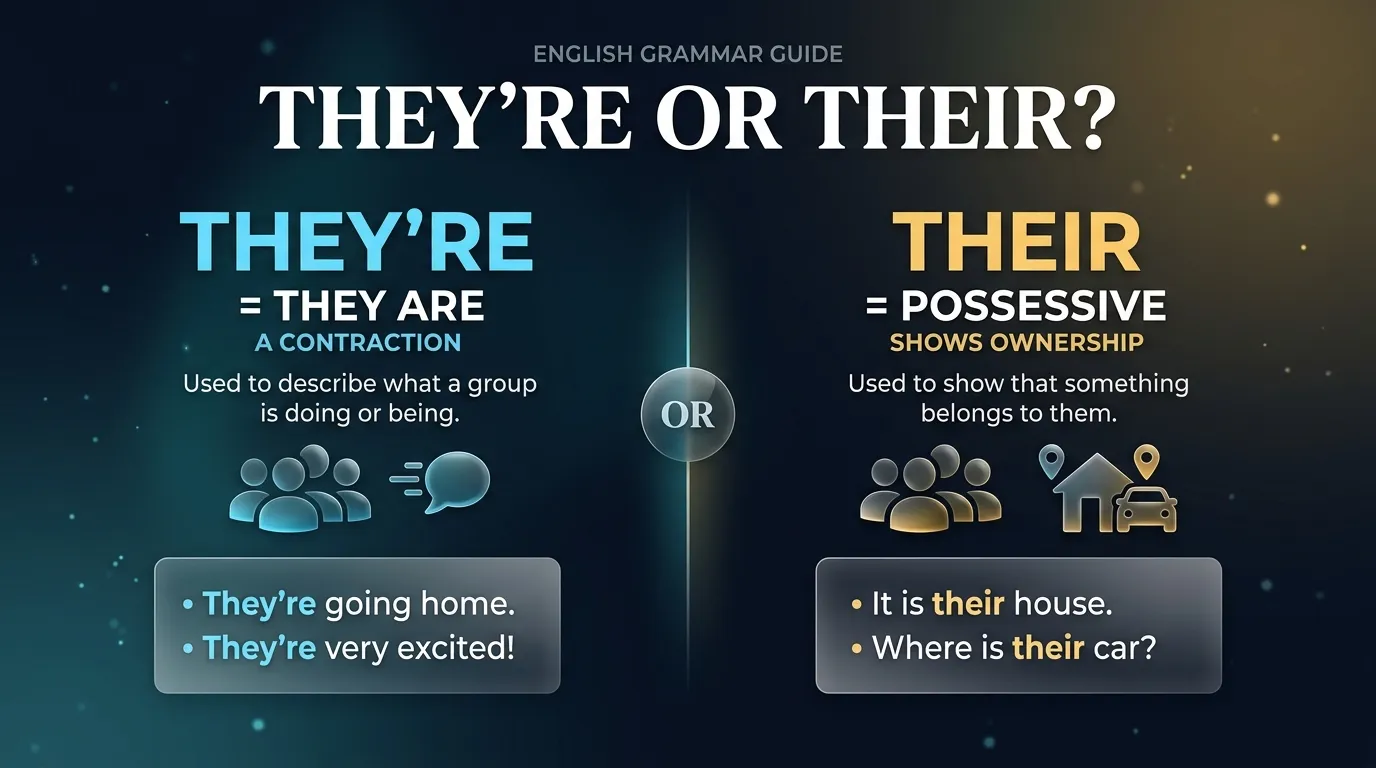
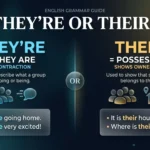
Their shows that something belongs to them, while they’re means “they are.”
Ben sent a text to his friend Ava. It said, “Their coming over at six.” Ava wrote back, “Who is ‘their’?” Ben looked at his text. He felt his face turn red. He wanted to write “They’re.” It was one small slip, but it made a big change. This small mistake shows why They’re or Their can be confusing. Learning They’re or Their makes this common mix-up easier to avoid.
Their shows that something belongs to a group. They’re is a short way to say “they are.” People search for They’re or Their because the two words sound the same. They also look almost the same. Even smart writers mix them up when they type fast. This guide clears up the mix-up with simple rules and easy examples. You will also meet the third word in the trio: there. When you finish, choosing between They’re or Their will feel easy.
Pronunciation
Both words sound the same. They are homophones. The word “there” sounds the same too.
- They’re
- US: /ðɛr/ (THAIR)
- UK: /ðeə/ (THAIR)
- Their
- US: /ðɛr/ (THAIR)
- UK: /ðeə/ (THAIR)
In slow, careful speech, some people say “they’re” like “THAY-er.” But most people say “THAIR” for all three words.
You cannot hear the difference. You must see it in writing. Let’s look at the main points.
Difference Between They’re and Their
1. Basic Meaning
Their shows ownership. They’re means “they are.”
- The kids love their new dog.
- The kids are happy because they’re playing.
2. Word Type
Their is a possessive word. It goes before a noun. They’re is a contraction. It joins two words into one.
- Their car is red.
- They’re late.
3. The Apostrophe
They’re has an apostrophe. Their does not.
- They’re ready. (apostrophe)
- Their bags are ready. (no apostrophe)
4. The Expand Test
You can expand they’re into “they are.” You cannot expand their.
- They’re here = They are here.
- Their here = Their are here. (This makes no sense.)
5. What Comes After
After their, you usually put a noun. After they’re, you put a describing word, an action word ending in “-ing,” or another phrase.
- Their teacher smiled.
- They’re smiling.
6. What It Shows
Their shows who owns or has something. They’re shows a state or an action.
- Their house is big.
- They’re tired.
7. Letters
Their has five letters: t-h-e-i-r. They’re has five letters and one apostrophe: t-h-e-y-‘-r-e.
- “Their” ends in “-eir.”
- “They’re” ends in “-‘re.”
8. Related Forms
Their gives us theirs. They’re is a form of “they are.” It goes with other contractions, like they’ve and they’ll.
- The blue bike is theirs.
- They’ve finished, and they’ll leave soon.
9. Formality
Their is fine in all kinds of writing. They’re is a contraction. Some formal papers avoid contractions and write “they are.”
- Their report was clear.
- In a formal paper: “They are” may be preferred.
10. Spelling Clue
Their has “heir” inside it. An heir is a person who gets things. So “their” shows ownership. In they’re, the apostrophe takes the place of the missing “a” in “are.”
- Look for “heir” in “their.”
- Look for the missing “a” in “they’re.”
Before and After: Fix It Fast
See the mistake. See the fix. Read the reason.
1.
❌ Before: “Their going to be late.”
✅ After: “They’re going to be late.”
Why: You can say “They are going to be late.”
2.
❌ Before: “The kids left they’re shoes at school.”
✅ After: “The kids left their shoes at school.”
Why: The shoes belong to the kids. Use their.
3.
❌ Before: “Put the box over their.”
✅ After: “Put the box over there.”
Why: “There” points to a place.
4.
❌ Before: “Their is a cat on the roof.”
✅ After: “There is a cat on the roof.”
Why: “There is” is a starter phrase. It does not show ownership.
5.
❌ Before: “They’re dog is very friendly.”
✅ After: “Their dog is very friendly.”
Why: “They are dog” makes no sense. The dog belongs to them.
6.
❌ Before: “Their happy with there new car.”
✅ After: “They’re happy with their new car.”
Why: “They are happy.” The car belongs to them.
Nature and Behaviour of They’re and Their
They’re
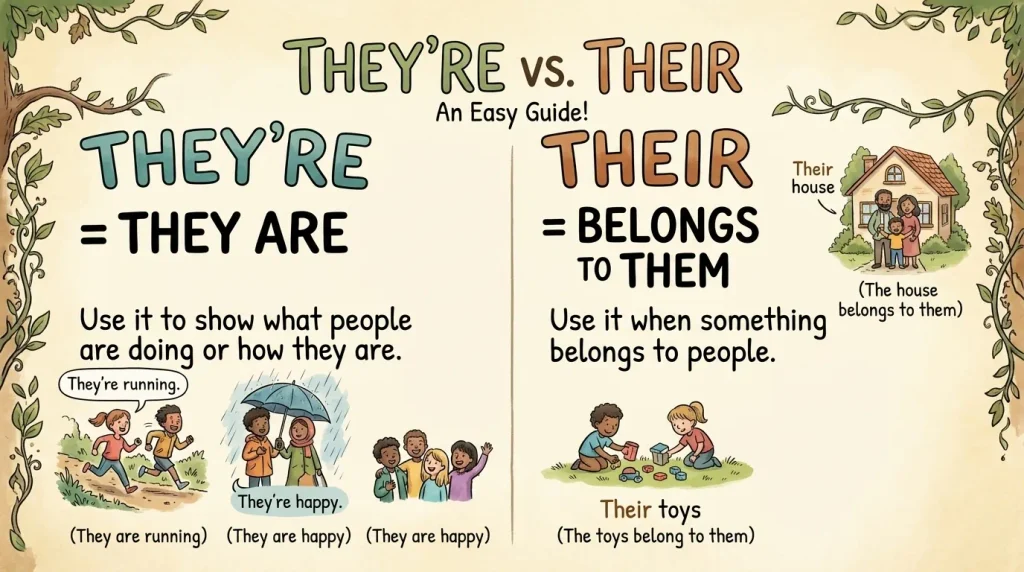
They’re is a short helper. It is a squeeze of two words: “they” and “are.” The apostrophe shows a missing letter. In “they’re,” the missing letter is “a.”
They’re points to a state or an action. It tells us how people or things are, or what they are doing. “They’re kind.”“They are running.” “They’re my friends.”
The word sounds quick and friendly.This short form is common in speech and casual writing. It can also sit in longer phrases, like “They’re all here” or “They’re not sure.”
Their
Their is a possessive word. It tells us who owns or has something. It always comes before a noun.“Their house,” “their idea,” and “their turn.”
The word “their” can refer to more than one person. The kids picked up their toys. For one person, “their” works when we do not know or do not say the person’s gender. A person left their coat here.This use of singular “their” is very old. It is listed in major dictionaries.
Their never has an apostrophe. Words that show ownership, like his, hers, its, ours, yours, and theirs, do not use one.
Why People Get Confused About They’re and Their
There are five simple reasons.
They sound the same. In speech, you hear one sound: “THAIR.”
They look alike. The eye can jump over the small letters.
Typing is fast. Autocorrect and typing habits can swap the words.
Both are real words. Spell check will often miss the mistake. A computer sees no error.
There makes it three. There, their, and they’re all sound the same. Three words that sound alike are harder to keep apart than two.
The fix is simple. Use the expand test. Say “they are” in the sentence. If it works, write they’re. If it doesn’t, ask if the thing belongs to them.When the answer is yes, write “their.”When the word points to a place or starts a sentence, write “there.”
Read more abouthttps://verboix.com/highlight-or-balayage/
Comparison Table
| Point | They’re | Their |
| Main meaning | They are | Belonging to them |
| Word type | Contraction | Possessive word |
| Apostrophe | Yes | No |
| Sound | THAIR | THAIR |
| Followed by | Adjective, “-ing” verb, or phrase | Noun |
| Expand test | Works (“they are”) | Does not work |
| Spelling clue | Missing “a” | “heir” inside |
| Related word | They’ve, they’ll | Theirs |
| Example | They’re ready. | Their bags are ready. |
| Similarity | Both come from “they” and sound the same | Same |
The Origin of They’re and Their
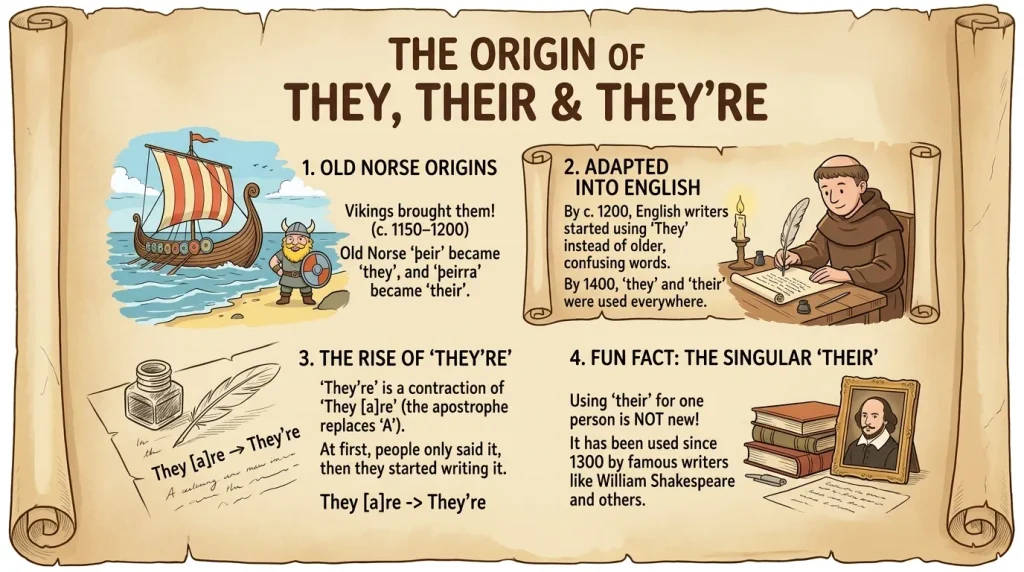
They did not begin in English. It came from Old Norse. The Old Norse word was þeir. English took it in about the year 1200. Before that, English used other words that were close to “he” and “she.” That was confusing. “They” was clearer. By about 1400, it had replaced the old form.
Their came from Old Norse too. The Old Norse word þeirra means “of them.” Dictionary.com says it was first recorded between 1150 and 1200. It took the place of an older English word for “their.” So “their” is a word that traveled from the Vikings into English.
They’re is newer. It is a contraction, or a short form, of “they are.” The apostrophe shows the missing letter “a.” People have used contractions in speech for a long time. They began to show up more in writing over the years.
And here is a fun fact. Using “their” for a single person is not new. It has been in English since around 1300. Old writers like Henry Fielding, Oliver Goldsmith, Sydney Smith, and William Thackeray used it that way, according to the Oxford English Dictionary.
British vs American English
The spelling is the same in both countries. The differences are small.
- Spelling: They’re and their are spelled the same in the US and the UK.
- Rules: The rules are the same. Their shows ownership. They’re means “they are.”
- Sound: Both say “THAIR.” Americans say /ðɛr/. Britons say /ðeə/.
- Groups of people: In the UK, people often treat a team or a group as plural. They may say, “The team are proud of their win.” In the US, people often treat it as one thing. They may say, “The team is proud of its win.” Both are fine.
Examples:
- US: “The family is happy. They’re on their way.”
- UK: “The family are happy. They’re on their way.”
Which One Should You Use?
Use one rule everywhere: They are = they’re. Belonging to them = their. A place or a starter word = there.
- For US readers: Use the rule above. Keep sentences short.
- For UK readers: The rule is the same. Watch for group words like “team” and “family.”
- For global readers: Use “they are” in formal writing. Use “they’re” in emails and chats. Learners around the world will understand you.
If you feel unsure, use the expand test. It works every time.
Common Mistakes
Here are more common errors, with fixes.
- ❌ “Their not coming today.” ✅ “They’re not coming today.”
- ❌ “They’re bags are packed.” ✅ “Their bags are packed.”
- ❌ “I put the keys over their.” ✅ “I put the keys over there.”
- ❌ “Their are three cats.” ✅ “There are three cats.”
- ❌ “That house is their’s.” ✅ “That house is theirs.” (No apostrophe.)
- ❌ “Thier car is new.” ✅ “Their car is new.” (Remember “e” before “i” here: t-h-e-i-r.)
- ❌ “Theyre coming.” ✅ “They’re coming.” (Add the apostrophe.)
Everyday Usage Examples
In emails
- “Please tell the team that they’re welcome to join.”
- “The clients sent their forms this morning.”
On social media
- “They’re so talented! 🎶”
- “Fans waited hours for their favorite band.”
In the news
- “Workers said they’re worried about the new rules.”
- “The players thanked their fans after the win.”
In formal writing
- “The students submitted their essays on time.”
- “The scientists note that they are still testing the results.”
Usage Trends
People use both words all over the world. Their and they’re are two of the most common words people mix up online. Teachers, editors, and writing tools point out this mistake all the time.
Another trend is the rise of singular “they” and “their.” Many people now use them for one person, when they do not know or do not say if the person is a man or a woman. Major dictionaries list this use. Some also note that “themself” is growing as a form.
Many writers now use “they’re” a lot in chats, texts, and social posts. It fits the short and quick style of online writing.
Metaphors and Similes
They’re
- “They’re two sides of the same coin.” (metaphor)
- “They’re like two peas in a pod.” (simile)
Their
- “Their friendship was an open door.” (metaphor)
- “Their laughter rang like bells.” (simile)
They’re often shows what people are like. Their often shows what people have or share.
Connotative Meaning
They’re
- Positive: “They’re wonderful neighbors.” It shows warmth.
- Neutral: “They’re at the station.” It states a fact.
- Negative: “They’re late again.” It shows frustration.
Their
- Positive: “Their kindness made me smile.” It shows admiration.
- Neutral: “Their house is on the corner.” It states a fact.
- Negative: “Their greed hurt the town.” It shows blame.
Idioms and Proverbs
Common Expressions with “They’re”
- They’re a dime a dozen: “Good ideas are easy to find. They’re a dime a dozen.”
- They’re in the same boat: “Both teams lost. They’re in the same boat.”
- They’re two peas in a pod: “The twins are so alike. They’re two peas in a pod.”
Common Expressions with “Their”
- To each their own: “I don’t like spicy food, but to each their own.”
- Their bark is worse than their bite: “The dogs sound loud, but their bark is worse than their bite.”
- Have their hands full: “The new parents have their hands full.”
Proverb
- “Birds of a feather flock together.” It says people who are alike often stay together.
Literature and Movies
Literature
- Their Eyes Were Watching God (novel, Zora Neale Hurston, 1937): A famous story of a woman’s life and search for her own voice. The title has the word “their.”
- Old writers such as Henry Fielding, Oliver Goldsmith, Sydney Smith, and William Thackeray used singular “their” in the 1700s and 1800s, says the Oxford English Dictionary.
Movies
- Their Finest (2016, United Kingdom): A story about making films in London during World War II.
- They Live (1988, United States): A science fiction film with “they” in the title.
- There Will Be Blood (2007, United States): A drama with the third word, “there,” in the title.
Why This Difference Matters
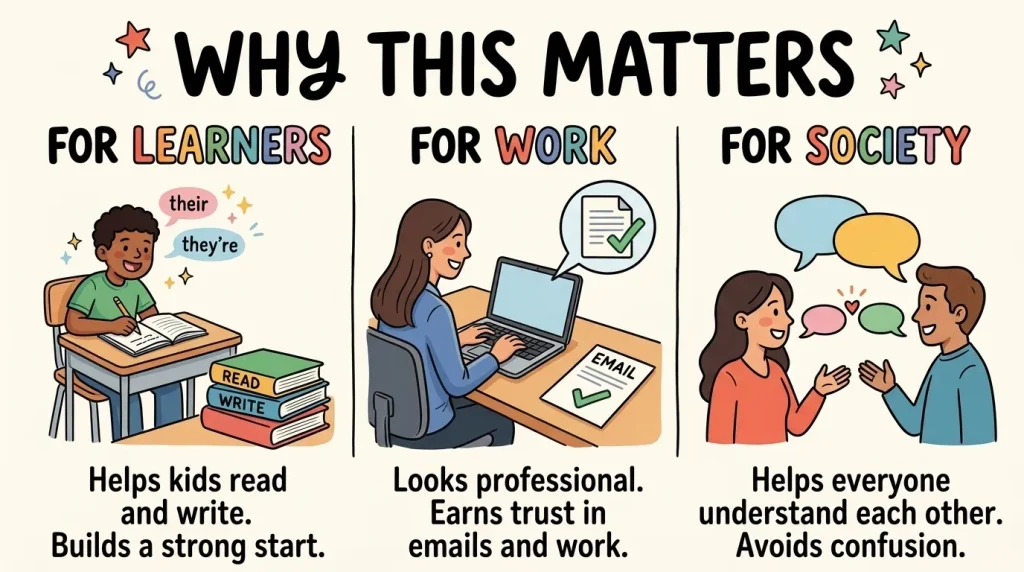
For learners: Their and they’re are among the first words that learners mix up. Knowing them builds a strong base. It helps with reading, writing, and speaking.
For work: In emails, resumes, and reports, small mistakes can look careless. A clean message earns trust. A right word looks sharp.
For society: Words carry meaning. When people write clearly, we understand each other more. Learning small rules also builds confidence.
Usefulness in Daily Life
At home: You write a note: “The kids left their shoes by the door. They’re sleeping now.”
At school: A student writes, “The class finished their tests. They’re going home.”
At work: A manager writes, “The team sent their reports. They’re waiting for feedback.”
On the phone: You text, “Their flight lands at 6. They’re on time.”
In shopping: A sign says, “Customers, please take their items with them.”
The Expand Test
Try this quick test every time:
- Say “they are” in place of the word.
- If it makes sense, write they’re.
- If not, ask: “Does it belong to them?” If yes, write their.
- If it shows a place, or starts a sentence like “There is…”, write there.
Situational Preference
Pick your word by asking what you want to say. In a text or chat, use they’re for a friendly, quick tone. In a formal report, you may prefer “they are.” Use their whenever something belongs to a group, like their team, their home, or their work.Choose “their” for one person when the person’s gender is not known or not stated, as in “Someone lost their phone.” Use there for places and for starters like “There is a problem.” When speed is high, stop and use the expand test. It takes two seconds. Careful writing wins trust, and a small check can save you from a big mistake.
Print and Save: Cheat Card
Take a screenshot or print this card. Keep it on your phone.
| They’re | Their | There | |
| Means | They are | Belonging to them | A place, or a starter word |
| Apostrophe | Yes | No | No |
| Clue | Missing “a” | “heir” inside | Has “here” inside (a place) |
| Test | Say “they are” | Say “belonging to them” | Say “here” or “in that place” |
| Example | They’re happy. | Their house is big. | Put it over there. |
Quick Answers
1. What is the difference between they’re and their?
They’re means “they are.” Their shows that something belongs to them.
2. Do they’re and their sound the same?
Yes. Both are said “THAIR.” That is why people mix them up.
3. How do I remember which one to use?
Use the expand test. Say “they are.” If it works, write they’re. If not, and it shows ownership, write their.
4. Is “their” ever used for one person?
Yes. It has been used this way since around 1300. Major dictionaries list it. For example, “Someone left their coat here.”
5. Is “their’s” correct?
No. The correct word is “theirs,” with no apostrophe.
6. What is the third word, “there”?
There shows a place, like “over there.” It also starts phrases, like “There is a cat.”
7. Are the spellings different in British and American English?
No. They are the same. Only the sound is a little different.
Conclusion
They’re or Their can be easy to mix up. They’re means “they are,” while their shows that something belongs to them. There is used for places and starter phrases. To choose the right word in They’re or Their, try the “they are” test. If it works, use they’re. If not, use their when something belongs to them. When you mean a place, use there. This guide makes They’re or Their easier to understand with simple rules and examples. The spelling stays the same in British and American English. Learning They’re or Their becomes easier when you know what each word means. With these simple rules, They’re or Their will be much easier to use.







1 thought on “They’re or Their: Easy Difference + Memory Trick”