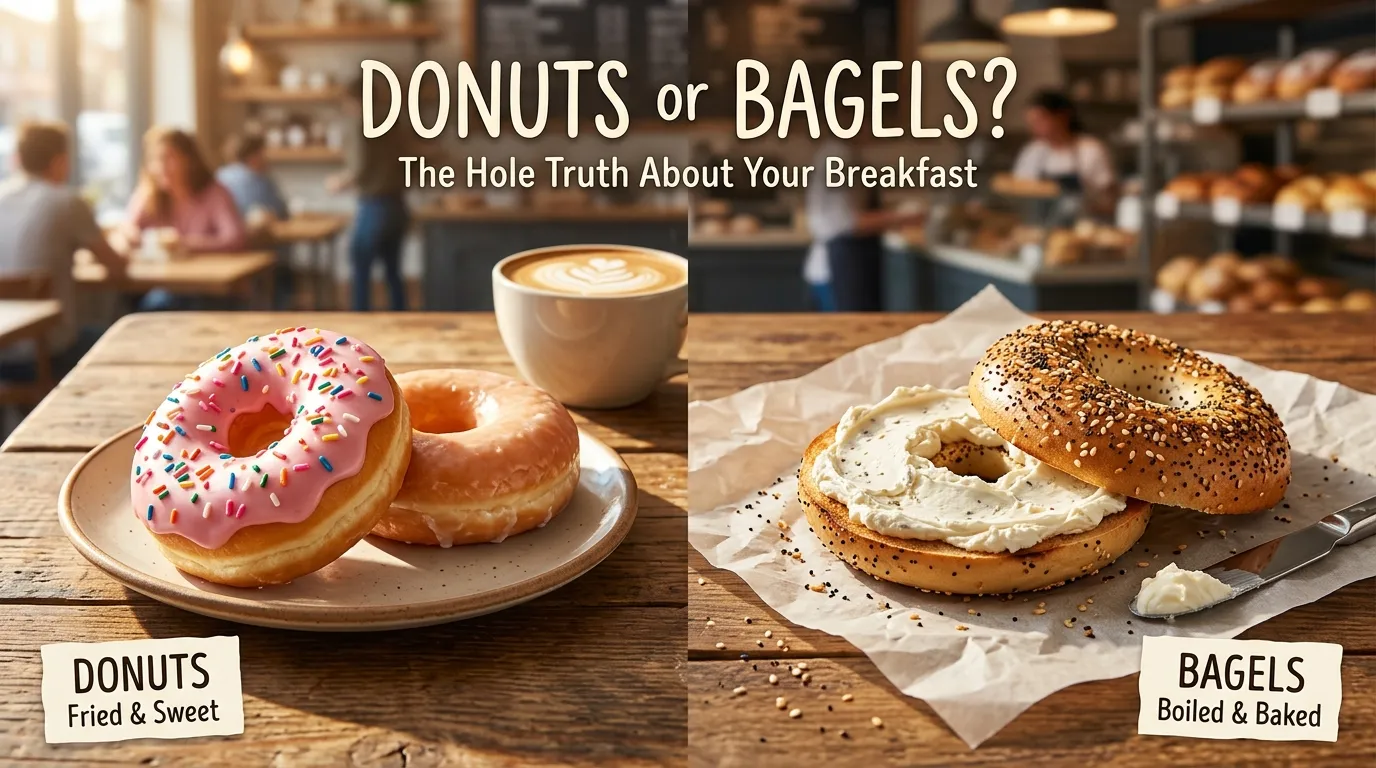
Leo stood in a busy bakery on Saturday morning. The line was long, and the smell was wonderful. On the left, shiny glazed donuts sat in neat rows. On the right, a basket of warm bagels waited beside a tub of cream cheese. His sister wanted something sweet. His dad wanted something filling. Leo looked at both trays and wondered if they were even close to the same food. Both have a hole.
They are both round. Both are made of dough. Then he pulled out his phone and typed donuts or bagels.
The answer is simple once you know how each one is made. Donuts are fried, and bagels are boiled and baked. That one step changes the taste, the feel, and the way people eat them. In this guide, you will learn the clear differences, a quick memory trick, and a simple test to help you choose. In addition, you will see easy examples, so the facts stay with you.
Pronunciation
Both words are short and friendly.
Donut
- US: /ˈdoʊ.nʌt/ (DOH-nut)
- UK: /ˈdəʊ.nʌt/ (DOH-nut)
Bagel
- US: /ˈbeɪ.ɡəl/ (BAY-gul)
- UK: /ˈbeɪ.ɡəl/ (BAY-gul)
Notice that “bagel” sounds the same in both countries. “Donut” changes only a tiny bit in the first sound. However, the spelling can change, and you will see why in the British and American section below.
Difference Between Donuts and Bagels
1. Basic Meaning
A donut is a sweet, fried dough treat. A bagel is a dense bread roll that is boiled and then baked.
- She ate a glazed donut with her coffee.
- He toasted a bagel for breakfast.
2. How They Are Cooked
This is the biggest difference. A donut is fried in hot oil. A bagel is boiled in water first, and then baked in an oven.
- The baker dropped the donut dough into hot oil.
- The baker lowered the bagel dough into a pot of boiling water.
3. Texture
A donut is soft, light, and airy inside. A bagel is dense, chewy, and a little shiny on the outside. As a result, a bagel takes more bites to chew, while a donut seems to melt.
- The donut felt soft and fluffy.
- The bagel had a chewy crust.
4. Taste
A donut is usually sweet. It often has sugar, glaze, or icing on top. A bagel is usually plain or lightly salty. People then add toppings, such as cream cheese, butter, or eggs.
- The donut tasted like sweet vanilla glaze.
- The bagel tasted mild until she added cream cheese.
5. Toppings and Fillings
Donuts often come with icing, sprinkles, powdered sugar, or jelly inside. Bagels often come with cream cheese, butter, smoked fish, eggs, or vegetables.
- A jelly donut hides sweet fruit in the middle.
- A bagel with cream cheese is a classic pair.
6. When People Eat Them
People often eat donuts as a treat, a snack, or a dessert. People often eat bagels as a full breakfast or a lunch sandwich.
- She grabbed a donut as an afternoon treat.
- He ate a bagel sandwich for lunch.
7. Shape and Size
Both can have a hole in the middle. However, many donuts have no hole at all. Filled donuts, for example, are round and full. Bagels almost always have a hole, and they are usually thicker and heavier than ring donuts.
- A jelly donut has no hole.
- A bagel nearly always has a hole.
8. Ingredients
A donut dough often has more sugar, eggs, milk, and fat. A bagel dough is simpler. It has flour, water, salt, and yeast, and bakers often add a little sweetener to the boiling water.
- Donut dough tastes rich and sweet.
- Bagel dough tastes plain and grainy.
9. Word Type
Both words are nouns. You can also use them in plural form, as in “donuts” and “bagels.”
- I bought a donut. (noun)
- She ordered two bagels. (noun)
10. The Swap Test
Ask, “Do I want something sweet and soft, or something chewy and filling?” If you want sweet and soft, think donut. If you want chewy and filling, think bagel.
- “I want a (sweet, soft) treat.” Think donut.
- “I want a (chewy, filling) breakfast.” Think bagel.
Before and After: Fix It Fast
❌ “A bagel is just a donut without sugar.”
✅ “A bagel is a different food, because it is boiled and baked, not fried.”
The cooking method makes them two very different foods.
❌ “Donuts and bagels are both baked.”
✅ “Donuts are fried, and bagels are boiled and then baked.”
Frying and boiling lead to very different results.
❌ “All donuts have a hole.”
✅ “Many donuts have a hole, but filled donuts do not.”
Jelly and cream donuts are round and full.
❌ “Bagels are always plain.”
✅ “Bagels come in many flavors, like sesame, onion, cinnamon raisin, and everything.”
Both sweet and savory bagels exist.
❌ “A bagel is always healthier than a donut.”
✅ “A bagel can have fewer sugars, but the toppings and size matter a lot.”
Cream cheese and large bagels can add a lot more food than people expect.
Nature and Behaviour of Donuts and Bagels
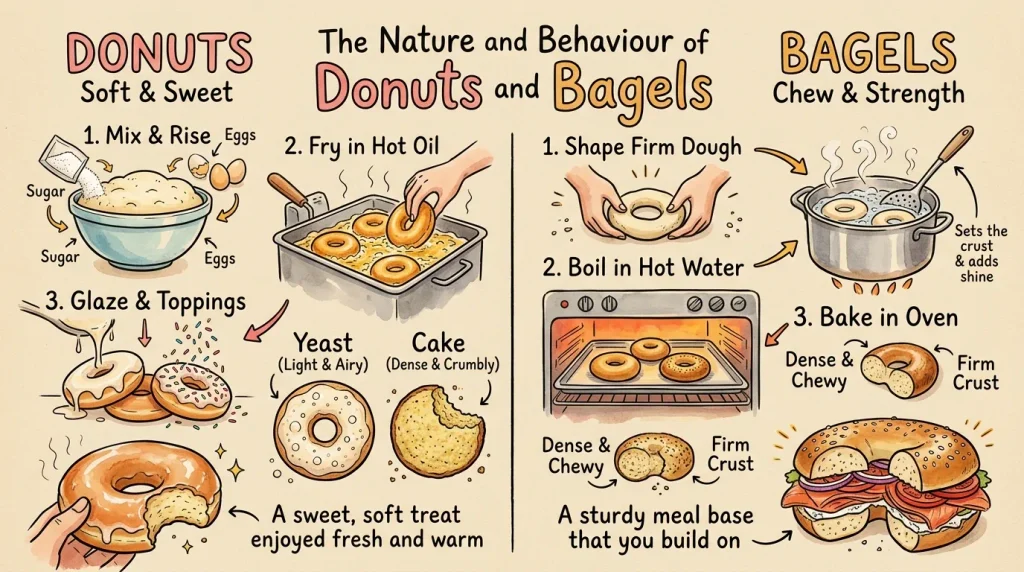
Donuts are all about softness and sweetness. First, a baker mixes a rich dough with sugar and eggs. Next, the dough rises, so it becomes light and puffy. Then the baker fries it in hot oil until it turns golden. After that, the donut gets a glaze, icing, or sugar coating. There are two main kinds. Yeast donuts are light and airy. Cake donuts are denser and crumbly, a bit like a small cake. Because of the frying, donuts are best when they are fresh and warm.
Bagels are all about chew and strength. First, a baker mixes a firm dough and shapes it into a ring. Next, the baker boils each ring for a short time. This step sets the outside and gives the bagel its shine. Then the baker bakes the ring in a hot oven. Because of this two-step process, a bagel stays chewy inside and gets a firm crust. A bagel is also sturdy, so it holds heavy toppings well. That is why people use it for sandwiches.
So the two foods act very differently. A donut is a treat that you enjoy for its sweet, soft bite. A bagel is a meal base that you build on.
Why People Get Confused About Donuts and Bagels
There are four simple reasons.
- Both foods are round and often have a hole. Therefore, at a quick glance, they look alike.
- Both are made from dough. As a result, many people think they must be close cousins.
- Both are common in bakeries and coffee shops, and they often sit side by side on the same counter.
- Some shops sell sweet bagels, like cinnamon raisin, and savory donuts, like bacon-topped ones. This blurs the line.
The fix is easy. Ask, “Was it fried, or boiled and baked?” Fried means donut. Boiled and baked means bagel.
Read more a bout:https://verboix.com/butt-or-but/
Comparison Table
| Point | Donuts | Bagels |
| Main meaning | Sweet fried dough | Boiled, then baked bread ring |
| How it is cooked | Fried in oil | Boiled, then baked |
| Texture | Soft, light, airy | Dense, chewy, firm |
| Taste | Sweet | Plain or lightly salty |
| Common toppings | Glaze, icing, sprinkles | Cream cheese, butter, eggs |
| Usual meal | Treat or snack | Breakfast or lunch |
| Hole | Often, but not always | Almost always |
| Similarity | Both are round dough foods | Same |
The Origin of Donuts and Bagels
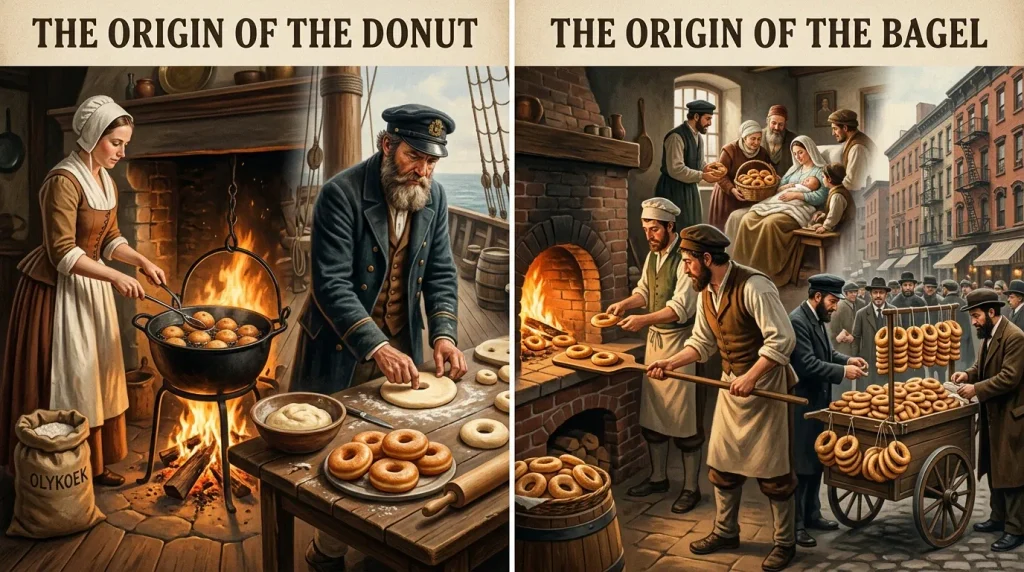
The story of the donut starts with Dutch settlers. They brought a treat called olykoek, which means “oily cake,” to what is now New York. These were small balls of sweet dough fried in oil. Over time, the treat changed shape and name. A popular story says a ship captain named Hanson Gregory made the first hole in 1847. However, historians still debate who really did it, so treat the story as a fun tale and not a proven fact. In the United States, National Doughnut Day takes place on the first Friday of June. It began in 1938 to honor Salvation Army workers who gave donuts to soldiers in World War I.
The story of the bagel starts in Jewish communities in Poland. A written rule from the city of Kraków in 1610 mentions bagels as a gift for a woman after childbirth, which is often named as the earliest record of the word. Later, Jewish families carried bagels to North America. There, bagels became famous in New York City. Today, bagels have their own special day, National Bagel Day, on January 15 in the United States.
British vs American English
The two words are used in both countries. However, small habits differ.
- Spelling of donut: Americans often write “donut” or “doughnut.” Britons usually write “doughnut.”
- Spelling of bagel: “Bagel” is spelled the same everywhere.
- Popularity: Donuts are a classic treat in both countries. Bagels are especially common in the United States and Canada, though they are easy to find in the UK too.
- Toppings: Americans often pair bagels with cream cheese. Britons also enjoy bagels with cream cheese, but they might add smoked salmon or other fillings too.
Examples:
- US: “I grabbed a donut and a bagel on my way to work.”
- UK: “I grabbed a doughnut and a bagel on my way to work.”
Which One Should You Use?
Use one simple rule: pick a donut when you want a sweet treat, and pick a bagel when you want a filling meal.
- For a sweet snack or dessert: Choose a donut.
- For a full breakfast: Choose a bagel with eggs, cream cheese, or other toppings.
- For a sandwich: Choose a bagel, because it holds fillings well.
- For a party tray: Choose both, so every guest has a favorite.
- For a kid’s treat day: Choose a donut with sprinkles.
If you feel unsure, think about how hungry you are. If you want a small sweet bite, grab a donut.
For a filling snack, grab a bagel.
Common Mistakes
❌ “Donuts are baked, just like bagels” ✅ “Most donuts are fried, while bagels are boiled and baked”
Frying and boiling lead to very different textures.
❌ “A bagel is a type of donut” ✅ “A bagel is a boiled and baked bread, which is different from a fried donut”
Bagels belong to the bread family, not the donut family.
❌ “Every donut has a hole in the middle” ✅ “Some donuts have a hole, but filled donuts do not”
Jelly and cream donuts are round and full.
❌ “Bagels are always sweet” ✅ “Most bagels are plain or savory, and some have sweet flavors like cinnamon raisin”
Plain, sesame, and onion bagels are far more common than sweet ones.
❌ “Donuts and bagels have the same amount of sugar” ✅ “Donuts usually have much more sugar, especially with glaze and icing”
Everyday Usage Examples
In conversation
- “Do you want a donut or a bagel with your coffee?”
- “I’ll take a toasted bagel with cream cheese, please.”
On social media
- “Friday means donuts for the whole office! 🍩”
- “Nothing beats a warm bagel with butter on a cold morning. 🥯”
In emails
- “Please bring a dozen donuts to the team meeting.”
- “I ordered bagels and coffee for the morning workshop.”
News Examples
- “A local bakery sold out of donuts on National Doughnut Day.”
- “Bagel shops are opening in more neighborhoods across the city.”
In formal writing
- “The bakery is known for its hand-rolled bagels.”
- “Doughnuts remain a popular treat at community events.”
Usage Trends
Both foods stay very popular today. Donuts remain a favorite treat at coffee shops and bakeries. Many shops now offer fun flavors, like maple bacon, salted caramel, and vegan options. Meanwhile, bagels remain a breakfast staple, and many cafes sell them as sandwiches for lunch too.
In recent years, more small bakeries have started making bagels by hand, with a focus on fresh, local ingredients. At the same time, many shops now make donuts in creative shapes and bright colors for social media. As a result, both foods keep finding new fans, and people search donuts or bagels often when they plan a party, a team breakfast, or a morning meeting.
Metaphors and Similes
Donuts
- “The donut was a small cloud of sugar.” (metaphor)
- “The glaze shone like a coat of glass.” (simile)
Bagels
- “The bagel was a sturdy little life ring for his breakfast.” (metaphor)
- “The crust crackled like a fresh sheet of paper.” (simile)
Donuts suggest sweetness, comfort, and play. Bagels suggest strength, routine, and a hearty start to the day.
Connotative Meaning
Donuts
- Positive: “The donuts made the whole office smile.” It shows joy and sharing.
- Neutral: “She bought a box of donuts.” It states a fact.
- Negative: “He felt guilty after eating three donuts.” It suggests too much indulgence.
Bagels
- Positive: “A warm bagel is the perfect morning comfort.” It shows comfort.
- Neutral: “He ordered a plain bagel.” It states a fact.
- Negative: “The bagel was stale and hard as a rock.” It shows disappointment.
Idioms and Proverbs
A few popular phrases use these words.
- Dollars to donuts: A way to say you are very sure about something. “It’s dollars to donuts that she wins.”
- Donut hole: The small gap in a plan or coverage. “There is a donut hole in the middle of the schedule.”
- Everything bagel: A bagel topped with a mix of seeds and spices, often used to describe something that includes it all. “The meeting felt like an everything bagel of ideas.”
- The best thing since sliced bread: A phrase for a great idea. It fits the bakery theme well, even though it does not name donuts or bagels.
Literature and Movies
Both foods show up in popular culture, though they rarely star in famous book titles.
Movies and Television
- The Simpsons (animated television series, United States, 1989 to present): Homer Simpson is famous for his love of donuts, and the treat appears again and again in the show.
- Everything Everywhere All at Once (film, United States, 2022): A giant “everything bagel” plays an important role in the story and has become a well-known image from the film.
Why This Difference Matters
For daily life, knowing the difference helps you choose the right food for the right moment. A donut works well as a quick treat. A bagel works better when you need a real meal that keeps you full.
For people who bake, the difference matters even more. Frying and boiling are not the same skill, and each one gives a different result. For business owners, such as café and bakery owners, knowing what each food offers helps them build a menu that pleases many customers. For anyone who cares about what they eat, knowing that the two foods differ in sugar, fat, and size can help guide choices. If you have special health needs, ask your doctor or a registered dietitian for advice that fits you.
Usefulness in Daily Life
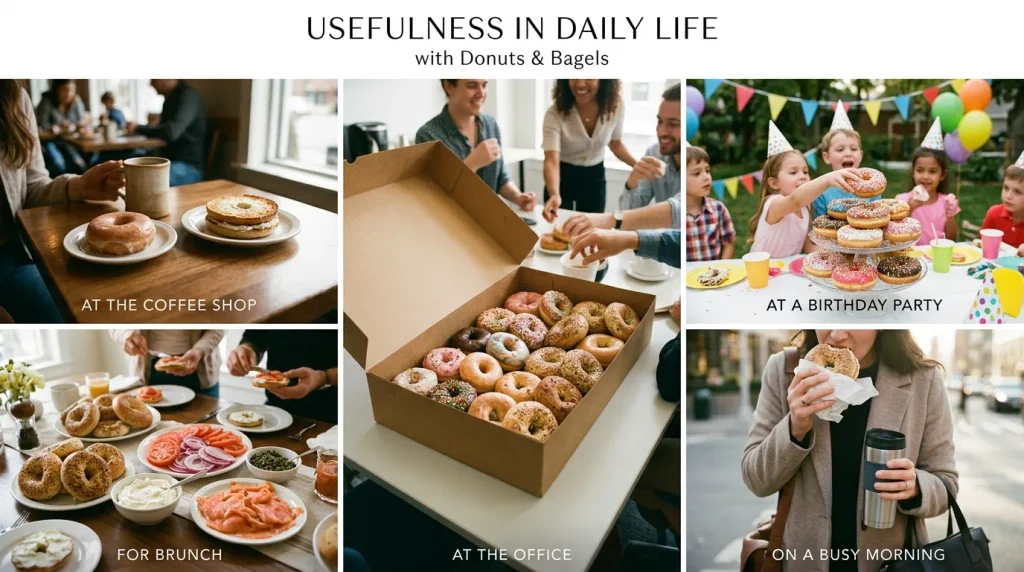
- At a coffee shop: Order a donut for a sweet snack, or a bagel for a bigger bite.
- At the office: Bring a box of mixed donuts and bagels so everyone has a choice.
- At a birthday party: Donuts work as a fun, sweet treat for children.
- At a brunch: Set out a bagel bar with cream cheese, tomatoes, and smoked fish.
- On a busy morning: Grab a bagel with a quick spread, since it keeps you full longer.
A Quick Test You Can Use
Ask these three questions:
- Do I want something sweet and soft? A donut fits best.
- Do I want something chewy and filling? A bagel fits best.
- Do I want to build a sandwich? A bagel holds toppings well.
Situational Preference
Pick your food by thinking about your mood, your hunger, and your plan.
A donut is great for a quick sweet treat. A bagel with eggs or cream cheese makes a hearty breakfast. At team meetings, bring both to suit different tastes. For lunch, a bagel works better for sandwiches because it holds fillings well. When you are unsure, think of the simple rule: sweet and soft means donut, chewy and filling means bagel.
Cheat Card (Print and Save)
| Donuts | Bagels | |
| Means | Sweet fried dough | Boiled, then baked bread ring |
| Cooking method | Fried | Boiled, then baked |
| Texture | Soft and light | Chewy and dense |
| Taste | Sweet | Plain or lightly salty |
| Best for | Treat or snack | Breakfast or sandwich |
| Remember | Fried and sweet | Boiled and chewy |
Quick Answers
1. What is the main difference between donuts and bagels?
Donuts are fried and sweet, while bagels are boiled and then baked. This makes donuts soft and light, and bagels dense and chewy.
2. Are bagels healthier than donuts?
Bagels often have less sugar than glazed or iced donuts, but size and toppings matter a lot. A large bagel with cream cheese can still be a big meal. If you have health needs, ask your doctor or dietitian.
3. Why do bagels get boiled?
Boiling sets the outside of the dough before baking. This gives the bagel its shiny crust and chewy bite.
4. Do all donuts have a hole?
No. Ring donuts have a hole, but filled donuts, like jelly or cream donuts, are round and have no hole.
5. Where did bagels come from?
Bagels began in Jewish communities in Poland. A rule from Kraków in 1610 is often named as the earliest record of the word.
6. How do you spell donut in British English?
Britons usually write “doughnut.” Americans use both “donut” and “doughnut.”
7. Can I eat a bagel as a dessert?
Yes, if you choose a sweet kind, such as cinnamon raisin, and add a sweet spread. However, bagels are most often a breakfast or lunch food.
Conclusion
Donuts or Bagels? Donuts are sweet dough treats fried in oil, so they feel soft and light. Bagels are boiled and then baked, which makes them chewy and firm. Remember this easy rule: fried and sweet means donut, while boiled and chewy means bagel. Neither is better than the other because each suits a different mood and meal. Next time you visit a bakery, you can choose with confidence. Whether you pick donuts, bagels, or both, you now know what makes each one special.