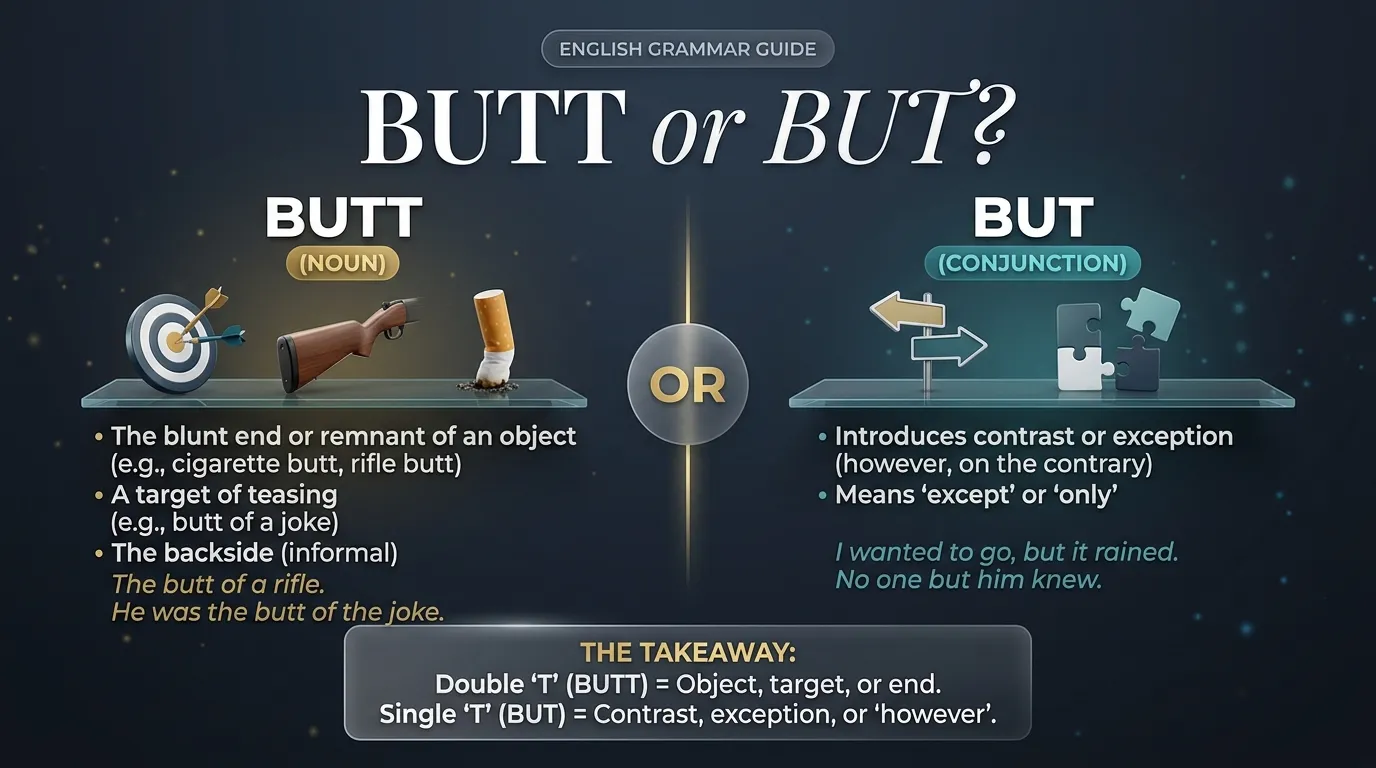
One word joins ideas that go against each other. The other names the thick end of something, the bottom, a target, or a push.
Mia wrote a note to her friend. It said, “I like pizza, butt I like tacos more.” Her friend giggled and said, “What is a butt?” Mia looked at her note. She had added an extra “t” by mistake.
The joining word links two ideas, like “I like pizza, but I like tacos more.” The other spelling means something different. It can name the thick end of a tool, the bottom of a body, or a target. It can also mean to push with the head, like a goat does. People search this pair often because the two words sound the same. Only one small letter changes the meaning. This guide gives clear rules and easy examples, so you can pick the right spelling every time.
Pronunciation
Both spellings sound the same. They are homophones.
But
US: /bʌt/ (BUHT). In fast speech: /bət/ (buht)
UK: /bʌt/ (BUHT). In fast speech: /bət/ (buht)
Butt
US: /bʌt/ (BUHT)
UK: /bʌt/ (BUHT)
The shorter word is often said very softly in a sentence. The longer one is usually said with a full, clear sound.
You cannot hear the difference. You must see it in writing. Let’s look at the details.
The Key Differences
1. Basic Meaning
One joins ideas or shows an exception. The other names a thing, a body part, or an action.
- I wanted to go, but it rained.
- He held the butt of the pencil.
2. Word Type
One is mostly a conjunction. It can also act as a preposition or an adverb. The other is a noun and a verb.
- Everyone came but Tom. (preposition)
- The goat will butt the fence. (verb)
3. Letters
One has three letters. The other has four. The extra “t” is the clue.
4. Job in the Sentence
One connects two parts of a sentence. The other is one of those parts. It names something or shows an action.
- She is small, but she is strong.
- The butt of the rifle was made of wood.
5. Can It Be a Verb?
Only the longer spelling works as a verb.
- The ram will butt the gate.
- We do not say, “He will [that word] the gate.”
6. Number of Meanings
The joining word has a few main uses. Its twin has many separate meanings: a thick end, a target, a barrel, a bottom, and a push.
7. Where It Sits
The connector often sits in the middle of a sentence. Its twin can sit anywhere — as subject or object.
- I like cake, but I love pie.
- The butt of the joke laughed too.
8. Sound in Fast Speech
The connector is often said softly. Its twin keeps a full sound.
9. Plural Form
The noun form has a plural: butts. The connector has a plural only in a set phrase: “no buts.”
10. Origin
One came from a single Old English root. The other comes from several older words that ended up spelled the same.
Before and After: Fix It Fast
- ❌ “I like tea, butt I like juice more.” ✅ “I like tea, but I like juice more.”
You need a joining word, spelled with one “t.” - ❌ “He dropped the cigarette but on the road.” ✅ “He dropped the cigarette butt on the road.”
This means the unused end. - ❌ “Poor Sam was the but of the joke.” ✅ “Poor Sam was the butt of the joke.”
This phrase means the target of the joke. - ❌ “Nothing butt the truth.” ✅ “Nothing but the truth.”
Here the word means “except” or “only.” - ❌ “Please don’t but in while I talk.” ✅ “Please don’t butt in while I talk.”
This phrase means to interrupt.
Nature and Behaviour
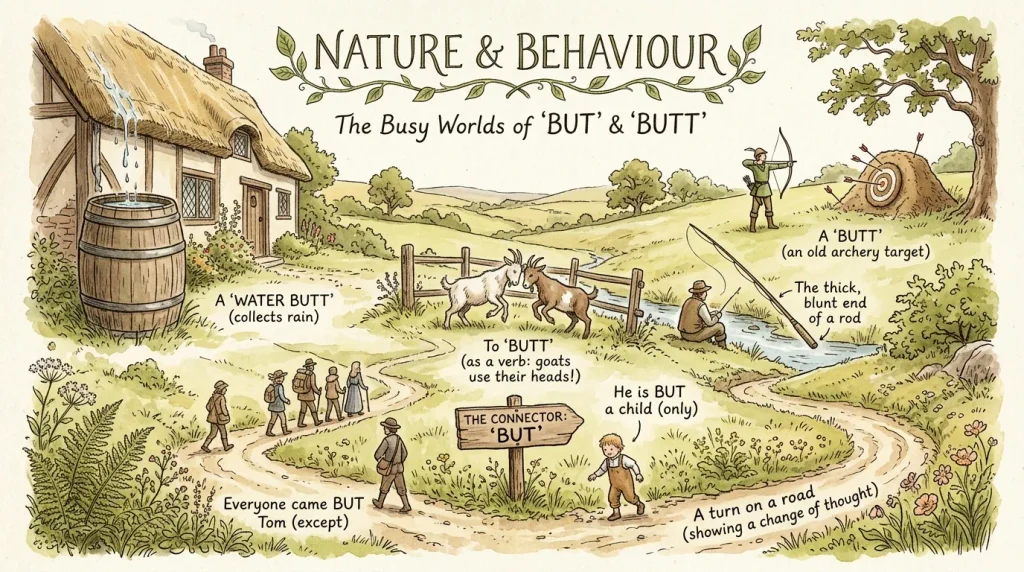
The noun/verb form is a busy word with many jobs. It can mean the thick, blunt end of something — a rifle, a fishing rod, a cigarette. It can also mean a target; in old archery, this word named a mound or mark that archers shot at, and later, the target of a joke.
As a verb, a goat uses its head this way. A person can do it to a conversation, meaning to interrupt. In some places, this same spelling names a large barrel — a “water butt” collects rain in the UK. In casual speech, it is also a friendly word for the bottom.
The connector is a small word with a big job. It links ideas and shows a change of thought, like a turn on a road.“But” can also show an exception: “Everyone came but Tom” means “except.”The word can mean “only” too: “He is but a child” means “he is only a child.” It is one of the most common words in English — short, quiet, yet able to change a whole sentence.
Why People Mix Them Up
There are four simple reasons.
- They sound exactly the same in speech.
- They look almost the same — one extra letter is easy to miss.
- Both are real words, so spell-check will not flag an error.
- The noun form has many meanings — an end, a target, a push — which adds to the confusion.
The fix is simple. Ask, “Am I joining two ideas?” If yes, use the three-letter spelling. If you mean an end, a target, a bottom, or a push, use the four-letter one.
Read more about:https://verboix.com/living-or-nonliving/
Comparison Table
| Point | But | Butt |
|---|---|---|
| Main meaning | Joins ideas, shows contrast or exception | Thick end, bottom, target, barrel, push |
| Word type | Conjunction, preposition, adverb | Noun, verb |
| Letters | 3 (one “t”) | 4 (two “t”s) |
| Sound | BUHT (soft in fast speech) | BUHT |
| Can be a verb? | No | Yes |
| Plural | “No buts” (set phrase) | Butts |
| Origin | Old English būtan (“outside, except”) | Several older words |
Where Each Word Comes From
The connector is very old. It comes from the Old English word būtan, built from be- and ūtan, meaning “on the outside” or “without.” By around the 1100s, it also worked to show contrast.
Its twin did not come from one place. It is really a group of words that share one spelling:
- Thick end: in English by about 1400, possibly linked to Dutch and Low German words for a stump.
- Barrel: in the late 1300s, from Old French bot and Late Latin buttis.
- Target: by the mid-1300s, from Old French but, meaning aim or goal. By the 1610s, also the target of a joke.
- To push: from Old French buter, “to strike or push.”
- Bottom: by the 1400s, used in cooking for the rear cuts of an animal.
This shared history explains why one spelling carries so many meanings.
British vs American English
The spelling is the same in both countries. Usage has small differences.
- Bottom: Americans use the four-letter word more often. Britons often say “bum.”
- Barrel: In the UK, a “water butt” holds rainwater. Americans usually say “rain barrel.”
- Cigarette end: Americans say “cigarette butt.” Britons also use it, though many say “cigarette end.”
- Scottish use: In parts of Scotland, the three-letter word can be a noun meaning the outer room of a small cottage.
Which One Should You Use?
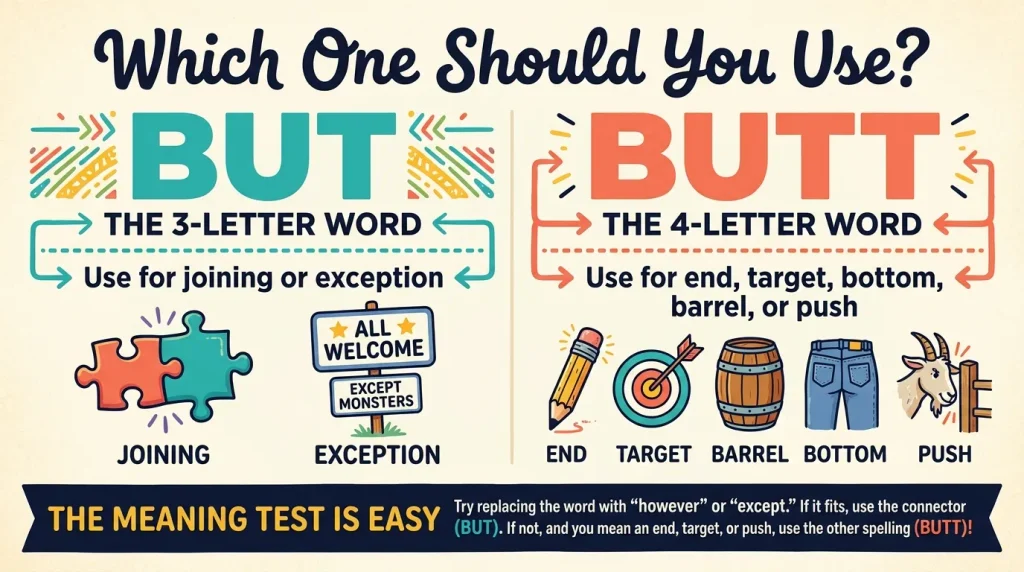
Use one rule everywhere: joining or exception means the three-letter word. End, target, bottom, barrel, or push means the four-letter word.
The meaning test is easy. Try replacing the word with “however” or “except.” If it fits, use the connector. If not, and you mean an end, target, or push, use the other spelling.
Common Mistakes
- ❌ “I was tired, butt I kept going.” ✅ “I was tired, but I kept going.”
- ❌ “Pick up your cigarette but.” ✅ “Pick up your cigarette butt.”
- ❌ “He is the but of every joke.” ✅ “He is the butt of every joke.”
- ❌ “The goat but the gate.” ✅ “The goat butted the gate.”
- ❌ “Everyone butt me came.” ✅ “Everyone but me came.”
Watch one more word: butte — with an “e” at the end. A butte is a tall, lonely hill with a flat top. It is a completely different word.
Everyday Usage Examples
In emails
- “Thank you for the offer, but I have to say no.”
- “Please do not interrupt on the call while I am talking.”
On social media
- “I love cake, but I love ice cream more! 🍦”
- “Found a cigarette end on the trail. Please keep our parks clean.”
In the news
- “The team played well, but lost in the last minute.”
- “The mayor became an online joke target.”
In formal writing
- “The results are strong, but more study is needed.”
Usage Trends
The connector is one of the most common words in English, used in every kind of writing. Its twin shows up less often, but appears in talk about the body, cigarettes, jokes, and tools. Many people mix the two up online simply because they sound identical.
Metaphors and Similes
The connector: “It is a small door that opens a new idea.” / “His hesitation hung in the air like a dark cloud.”
Its twin: “He was a rock, always the target of jokes.” / “The goat charged like a small bull, ready to strike the gate.”
Idioms and Proverbs
With the three-letter spelling:
- No ifs, ands, or buts
- Last but not least
- All but (meaning “almost”)
- Nothing but (meaning “only”)
With the four-letter spelling:
- Butt of the joke
- Butt in (to interrupt)
- Butt heads (to argue)
- Butt out (stay out of something private)
Proverb: “Sticks and stones may break my bones, but words will never hurt me.”
Literature and Movies
- Romeo and Juliet (Shakespeare, c. 1595): the famous line “But soft,” when Romeo sees Juliet at her window.
- Richard III (Shakespeare, c. 1592): a character is said to drown in a large wine barrel.
- The Tempest (Shakespeare, c. 1611): a character escapes on a barrel of wine.
- The Adventures of Robin Hood (1938): features an archery contest, where the old target term applies.
Why This Difference Matters
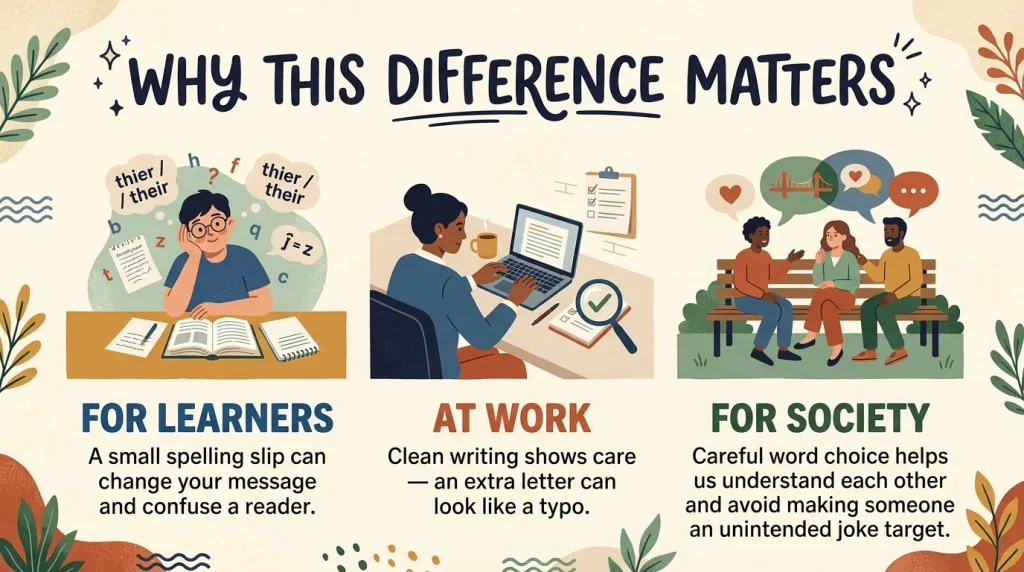
For learners, a small spelling slip can change your message and confuse a reader. At work, clean writing shows care — an extra letter can look like a typo. For society, careful word choice helps us understand each other and avoid making someone an unintended joke target.
A Quick Test You Can Use
- Can you replace the word with “however” or “except”? If yes, use the connector.
- Do you mean an end, a target, a bottom, a barrel, or a push? If yes, use the other spelling.
- Is it acting as a verb, like “the goat ___ the gate”? If yes, use the four-letter form.
Cheat Card
| But | Butt | |
|---|---|---|
| Means | Joins ideas, or “except”/”only” | Thick end, bottom, target, barrel, push |
| Letters | 3 (one “t”) | 4 (two “t”s) |
| Word type | Conjunction, preposition, adverb | Noun, verb |
| Example | “I’m tired, but I’ll go.” | “The goat butted the gate.” |
Quick Answers
1. What is the difference between the two spellings?
One joins ideas that go against each other. The other means the thick end of something, a bottom, a target, a barrel, or a push.
2. Do they sound the same?
Yes, in both the US and the UK.
3. Is “to interrupt” spelled with one “t” or two?
Two — this comes from the verb form.
4. What does “the butt of the joke” mean?
It means the person who is teased; here, “butt” means target.
5. Can the connector start a sentence?
Yes. Good writers do this often to show a turn in thought.
6. What does the four-letter word mean on a cigarette?
The leftover end that is not used.
7. What is a “water butt”?
A large barrel that collects rainwater, a term common in the UK.
Conclusion
Butt or But is easy to understand once you know what each word means. But joins ideas that go against each other, and it can also mean “except” or “only.” Butt can mean the thick end of something, a bottom, a target, or a barrel. As a verb, butt means to push with the head. The two words sound the same, so people often mix them up. A simple trick is to remember But = 3 letters and Butt = 4 letters. Keep this easy tip in mind, and you can choose the right word with confidence.