
Sara sat at her first wine tasting with her uncle Omar. A kind man gave her a small glass. She took a careful sip. Then she looked around the room. Every person was leaning over a small steel bucket and spitting the wine into it. Sara froze. She had always thought you drink wine, not spit it out. She whispered, “Uncle, do I swallow it or spit it?” Omar smiled. “Both words are easy,” he said. “Swallow goes in. Spit comes out. At a tasting, we spit, so our heads stay clear.” Sara laughed. Then she picked the right word, and the right action too.
Swallow and spit look like simple words, and they are. However, many learners still mix them up. The reason is clear. Both words are about the mouth, and both can appear in the same sentence. People search swallow or spit because they want one fast, clear answer. This guide gives you that answer. In addition, it shows easy examples, a memory trick, and a quick test, so you can choose the right word every time.
Pronunciation
Both words are short, so they are easy to say.
Swallow
- US: /ˈswɑː.loʊ/ (SWAH-loh)
- UK: /ˈswɒl.əʊ/ (SWOL-oh)
Spit
- US: /spɪt/ (SPIT)
- UK: /spɪt/ (SPIT)
Notice that “spit” sounds the same in both countries. “Swallow,” on the other hand, changes a little. Americans say “SWAH-loh,” with an open “ah” sound in the middle. Britons say “SWOL-oh,” with a shorter “o” sound. In both cases, the “w” is a soft “w,” and the last sound is a gentle “oh.” Now let us look at the real differences.
Difference Between Swallow and Spit
1. Basic Meaning
Swallow means to move food, drink, or other things from your mouth down your throat. Spit means to push something out of your mouth.
- She swallowed the cold water.
- He spit the seed into a napkin.
2. Direction
Swallow goes in. Spit goes out. This is the biggest difference, so remember it first. Everything else in this guide grows from this one idea.
- Soup goes down when you swallow.
- Water goes out when you spit.
3. Word Type
Both words work as verbs. However, each word also has a second job as a noun. “Swallow” can name a small bird. “Spit” can mean saliva, a rod for roasting meat, or a thin strip of land in the sea.
- The swallow built a nest under the roof. (noun)
- There was spit on the glass. (noun)
4. Past Tense
Swallow is a regular verb. You add “-ed,” so the past tense is swallowed. Spit is different. It does not take “-ed” when it means to push something out of the mouth. Americans usually say “spit” for the past tense. Britons often say “spat.” Both forms are correct, and people in both countries understand them.
- He swallowed the pill.
- She spit out the gum. (US)
- She spat out the gum. (UK)
5. What Happens to the Food
When you swallow, your body keeps what goes down. When you spit, your body gets rid of it. As a result, you can taste something with spit, but you never take it in.
- You swallow soup to eat it.
- You spit out a sour grape to get rid of the taste.
6. Where You Hear Each Word
You hear swallow at meals, at the doctor’s office, and with medicine. In contrast, you hear spit at the dentist, at wine tastings, and on sports fields.
- The nurse said, “Swallow the tablet with water.”
- The dentist said, “Spit into the sink, please.”
7. Feeling and Manners
Swallow feels normal and polite. Spit can feel rude in public. Still, spit is fine in the right place, like at the dentist or at a tasting. The place decides the manners.
- It is polite to swallow your food before you speak.
- It is not polite to spit on the street.
8. Other Meanings
Both words also have meanings that have nothing to do with the mouth. Swallow can mean to believe something, or to hide a feeling. Spit can mean a metal rod for roasting meat, or a narrow piece of land that reaches into the sea.
- He swallowed her story. (he believed it)
- She swallowed her anger. (she hid it)
- The chicken turned slowly on a spit. (a roasting rod)
9. Common Pairings
Swallow often pairs with words like pill, water, pride, and hard. Spit often pairs with words like out, fire, image, and polish.
- Swallow a pill, swallow your pride, hard to swallow.
- Spit out, spit fire, spitting image.
10. The Swap Test
Ask, “Does it go in, or does it come out?” If it goes in, use swallow. If it comes out, use spit.
- “Please (take it down) with water.” Use swallow.
- “Please (push it out) into the sink.” Use spit.
Before and After: Fix It Fast
❌ “Please spit the pill with water.”
✅ “Please swallow the pill with water.”
A pill goes down your throat, so you need swallow.
❌ “The dentist said to swallow the toothpaste into the sink.”
✅ “The dentist said to spit the toothpaste into the sink.”
Toothpaste leaves your mouth and goes into the sink, so you need spit.
❌ “He swallowed the seeds out of his mouth.”
✅ “He spit the seeds out of his mouth.”
Seeds that leave the mouth need spit.
❌ “She spitted her pride and said sorry.”
✅ “She swallowed her pride and said sorry.”
Swallowing pride means setting it aside. Spit does not fit this idiom.
❌ “The man spitted the gum on the ground yesterday.”
✅ “The man spit (or spat) the gum on the ground yesterday.”
Spit does not take “-ed” when it means to push something out of the mouth.
Nature and Behaviour of Swallow and Spit
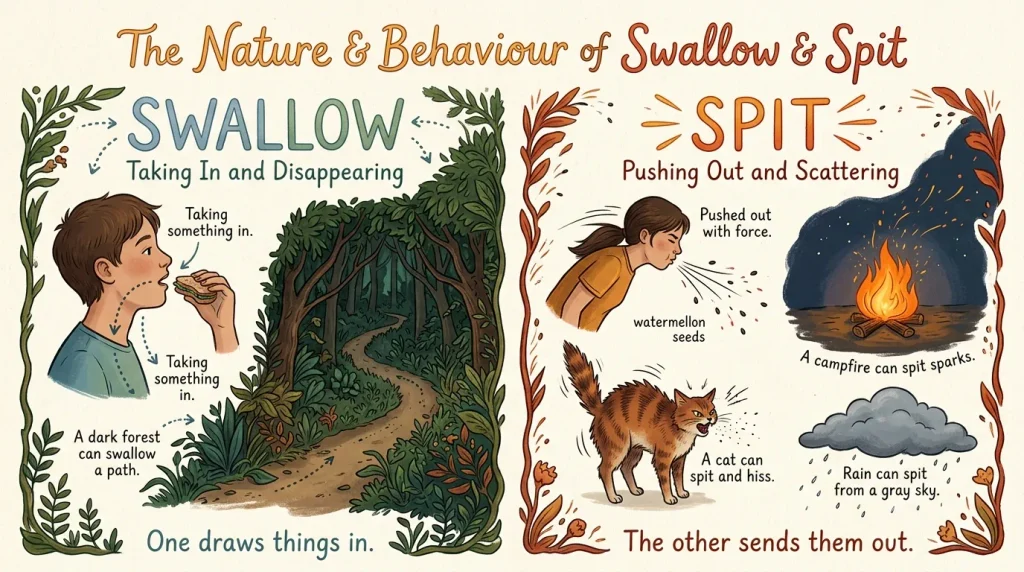
Swallow is a word about taking something in. First, you chew your food. Next, your tongue pushes it toward the back of your mouth. Then it moves down your throat. This is why we use swallow for food, drink, and medicine. Doctors use the word all the time, since most pills and tablets must go down whole. Swallow also works in bigger, less physical ways. A big company can swallow a small one. A dark forest can swallow a path. In each case, the idea stays the same: something is taken in and disappears.
Spit is a word about pushing something out. First, you gather something in your mouth. Then you send it out with a quick force. Because of this, spit often feels sudden and strong. We use it for seeds, bad food, and water at the dentist. We also use it at wine tastings, where tasters sip the wine, swirl it, and spit it out, so they can taste many wines without getting dizzy. Spit has playful uses too. A campfire can spit sparks. A cat can spit and hiss. Even rain can spit from a gray sky. In each case, small bits fly out.
So the two words act like opposites. One draws things in. The other sends them out. When you hold on to this picture, you rarely make a mistake.
Why People Get Confused About Swallow and Spit
There are four simple reasons.
- Both words are about the mouth. Therefore, they feel close in meaning, even though they are opposites.
- Some places allow both choices. At a wine tasting, for example, a person can swallow or spit. This makes the two words seem alike.
- Spit has an odd past tense. Since both “spit” and “spat” are used, learners wonder if they are saying it right.
- Both words appear in idioms. As a result, people remember the fancy phrases but forget the simple meanings.
The fix is easy. Ask, “In or out?” That one question clears up almost every case. In addition, picture a small door in your mouth. Swallow walks in. Spit walks out.
Read more about: https://verboix.com/turkey-or-ham/
Comparison Table
| Point | Swallow | Spit |
| Main meaning | Take down the throat | Push out of the mouth |
| Direction | In | Out |
| Word type | Verb, and a noun (a bird) | Verb, and a noun (saliva, rod, land) |
| Past tense | Swallowed | Spit (US), spat (UK) |
| Common place | Meals, medicine | Dentist, wine tasting |
| Idiom example | Swallow your pride | Spit it out |
| Feeling | Normal, polite | Can feel rude in public |
| Similarity | Both are mouth actions | Same |
The Origin of Swallow and Spit
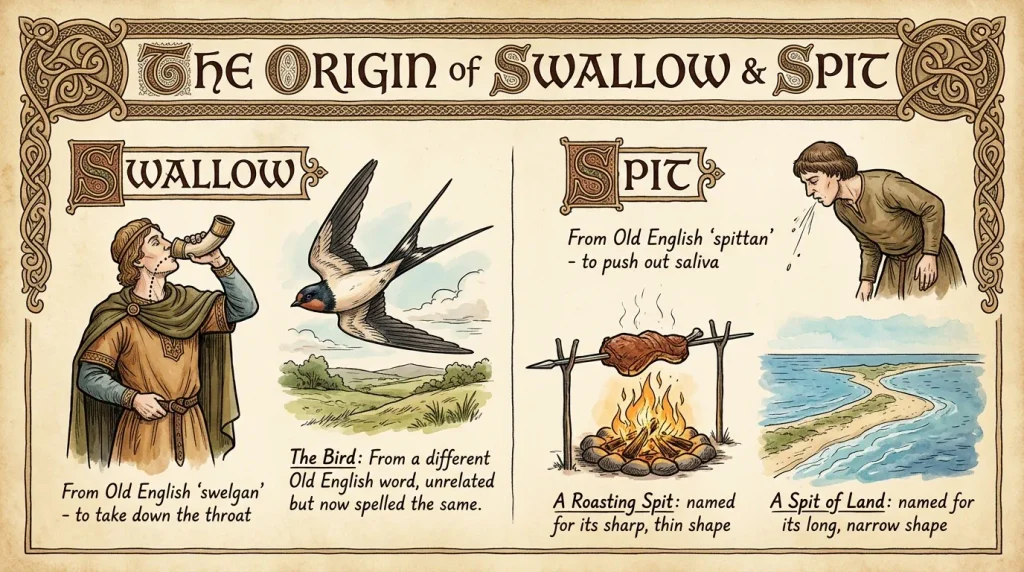
The word “swallow” comes from the Old English word swelgan, which meant to take something down the throat. Over many years, the spelling changed, but the main idea stayed the same. The bird called a swallow has its own, separate history. It comes from a different Old English word, but the two words now look exactly alike. As a result, English has two unrelated words with the same spelling.
The word “spit” also comes from Old English. In the old language, spittan meant to push out saliva. English speakers have used the word for a very long time. Later, people also used “spit” for the rod that holds meat over a fire, because the rod was sharp and thin. The strip of land called a spit shares this idea of a long, narrow shape. These extra meanings grew from their own roots, so they are not the same as the mouth meaning.
British vs American English
The spelling is the same in both countries. Only a few small habits differ.
- Spelling: “Swallow” and “spit” are spelled the same in the US and UK.
- Past tense of spit: Americans usually say “spit.” Britons often say “spat.” Both are correct, and both are understood everywhere.
- Sound: “Swallow” sounds a little different in each country, as shown in the pronunciation section above.
Examples:
- US: “He spit the water into the sink.”
- UK: “He spat the water into the sink.”
Which One Should You Use?
Use one simple rule: if it goes in, use swallow. If it comes out, use spit.
- For food, drink, and medicine: Use swallow.
- For things you want out of your mouth: Use spit.
- For a small bird with a forked tail: Use swallow.
- For a roasting rod or a narrow strip of land: Use spit.
- For hiding a feeling or believing a story: Use swallow.
If you feel unsure, picture the action. Then decide if the thing goes in or out. That one step settles almost every case.
Common Mistakes
❌ “Swallow the toothpaste into the sink” ✅ “After brushing your teeth, spit the toothpaste into the sink”
Toothpaste leaves your mouth, so spit is the right word here.
❌ “Spit the pill with a glass of water” ✅ “Take the pill with a glass of water”
A pill goes down your throat, which makes “take” the better choice.
❌ “They spitted on the ground” ✅ “Someone spit on the ground”
Spit does not add “-ed” when it means to push something out of the mouth.
❌ “I had to spit my pride” ✅ “In the end, I had to swallow my pride”
Setting pride aside is exactly what swallow means in this phrase.
❌ “The spit flew south for the winter” ✅ “A swallow flew south for the winter”
Only the bird can fly south, so swallow is the word to use.
Everyday Usage Examples
In conversation
- “Can you swallow this big pill?”
- “Please spit out the gum before class.”
On social media
- “Tried a wine tasting today. Learned to spit, not swallow! 🍷”
- “Had to swallow a giant vitamin this morning. Not fun.”
In the news
- “Doctors say to swallow the tablet whole with water.”
- “The coach told the player not to spit on the field.”
In formal writing
- “Patients should swallow the medicine with a full glass of water.”
- “Professional tasters usually spit the wine to keep a clear mind.”
Usage Trends
Both words stay common in daily English. Swallow shows up in health talk, like pills, drinks, and food. Spit shows up in dental talk, sports, and wine tasting.
In recent years, more people ask about this pair online. Often, they ask while sitting in a dentist’s chair or after a doctor’s visit. Many dental guides tell people to spit out the extra toothpaste after brushing, rather than rinse it all away. As a result, more people now look up both the right word and the right step. The idioms stay popular too, especially “spit it out” and “swallow your pride,” which show up in books, shows, and daily talk.
Metaphors and Similes
Swallow
- “The dark cave swallowed the hikers whole.” (metaphor)
- “He swallowed his lunch like a hungry bear.” (simile)
Spit
- “The old engine spit black smoke into the air.” (metaphor)
- “The rain fell like tiny drops of spit from the gray sky.” (simile)
Swallow suggests taking in, hiding, or giving up. Spit suggests sending out, rejecting, or lashing out.
Connotative Meaning
Swallow
- Positive: “She swallowed the tasty soup with a smile.” It shows enjoyment.
- Neutral: “He swallowed the tablet.” It states a fact.
- Negative: “It was a hard truth to swallow.” It shows pain or doubt.
Spit
- Positive: “The soldiers’ boots had spit and polish.” It shows pride and care.
- Neutral: “Please spit the seed into the bin.” It states an action.
- Negative: “He spit at the ground in anger.” It shows disrespect.
Idioms and Proverbs
Both words appear in fun English phrases.
- Swallow your pride: To stop being proud and do the right thing. “He swallowed his pride and said sorry.”
- Hard to swallow: Difficult to accept. “The bad news was hard to swallow.”
- Swallow the bait: To fall for a trick. “She swallowed the bait and clicked the fake link.”
- Spit it out: Say what you mean, and say it fast. “Come on, spit it out!”
- Spitting image: A person who looks just like another. “She is the spitting image of her mother.”
- Spit and polish: Very careful cleaning and shine. “The soldiers’ boots showed plenty of spit and polish.”
Literature and Movies
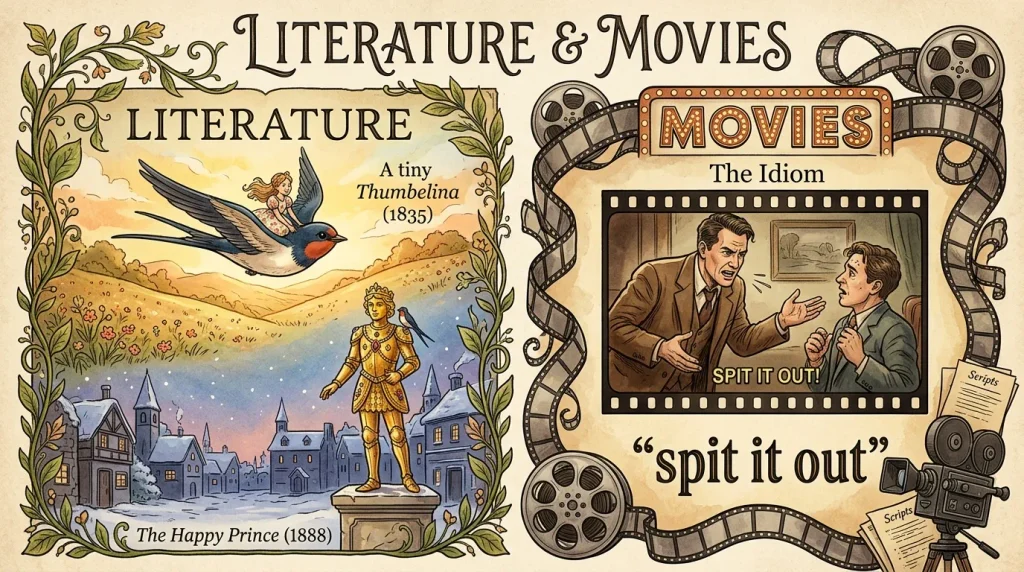
Both words appear often in stories, though usually as a bird or as part of an idiom.
Literature
- Thumbelina (fairy tale, Hans Christian Andersen, 1835): A kind swallow carries the tiny heroine to a warmer land. This is a classic use of “swallow” as a bird.
- The Happy Prince (short story, Oscar Wilde, 1888): A little swallow stops to rest beside a golden statue and becomes its helper.
Spit does not star in famous titles as often. Still, the phrase “spit it out” shows up in many stories and films, usually when one person wants another to speak clearly.
Why This Difference Matters
For daily life, the right word keeps your meaning clear. For example, a note that says “spit the pill” can confuse a child. In the same way, a sign that says “swallow the water” at a dentist’s office can cause trouble. Small words carry real instructions.
For writers and learners, getting small words right builds trust. Moreover, it helps readers move through your writing without stopping. For health care, clear words matter even more, since medicine and mouth care come with rules. When the words are right, people follow the steps with confidence.
Usefulness in Daily Life
- At the doctor’s office: The nurse says, “Swallow the pill with water.”
- At the dentist: The dentist says, “Spit into the sink.”
- At a wine tasting: Tasters sip the wine, then spit it into a bucket.
- At the table: Children learn to swallow their food before they talk.
- In sports: Coaches ask players not to spit on the field.
- In writing: A good writer picks swallow for “in” and spit for “out.”
A Quick Test You Can Use
Ask these three questions:
- Does it go down my throat? If yes, use swallow.
- Does it leave my mouth? If yes, use spit.
- Am I talking about a bird? If yes, use swallow.
Situational Preference
Pick your word by picturing the action. For medicine, food, and drink, use swallow. For toothpaste at the sink, use spit. At a wine tasting, you may do either one, so choose the word that matches what happens. For feelings, use swallow when someone hides pride or anger. For a clear, direct request, use spit, as in “spit it out.” When you feel unsure, ask, “In or out?”
Cheat Card (Print and Save)
| Swallow | Spit | |
| Means | Take down the throat | Push out of the mouth |
| Direction | In | Out |
| Past tense | Swallowed | Spit (US), spat (UK) |
| Example | “Swallow the pill.” | “Spit in the sink.” |
| Idiom | Swallow your pride | Spit it out |
| Remember | Swallow goes in | Spit comes out |
Quick Answers
1. What is the difference between swallow and spit?
Swallow means to take something down your throat. Spit means to push something out of your mouth.
2. Is spit a verb or a noun?
It is both. As a verb, it means to push something out of the mouth. As a noun, it can mean saliva, a roasting rod, or a narrow strip of land in the sea.
3. What is the past tense of spit?
Americans usually say “spit.” Britons often say “spat.” Both forms are correct.
4. Can swallow be a bird?
Yes. A swallow is a small bird with a forked tail. In that case, it is a noun.
5. What does “swallow your pride” mean?
It means to set aside your pride and do what is right, like saying sorry.
6. What does “spit it out” mean?
It means to say something quickly and clearly, even if it is hard to say.
7. Do dentists say to swallow or spit toothpaste?
Dentists often say to spit out the extra toothpaste after you brush. Ask your own dentist for advice that fits you.
Conclusion
Swallow or Spit? Swallow means to take something down your throat, while spit means to push something out of your mouth. The rule is easy to remember: swallow goes in, and spit comes out. Also, remember the past tense. Swallow becomes swallowed, while spit becomes spit in American English and often spat in British English. Next time you write about food, medicine, or a trip to the dentist, you can choose the right word with ease. Keep the cheat card close to help you remember the difference.












1 thought on “Swallow or Spit? The Two-Second Trick to Never Mix Them Up”