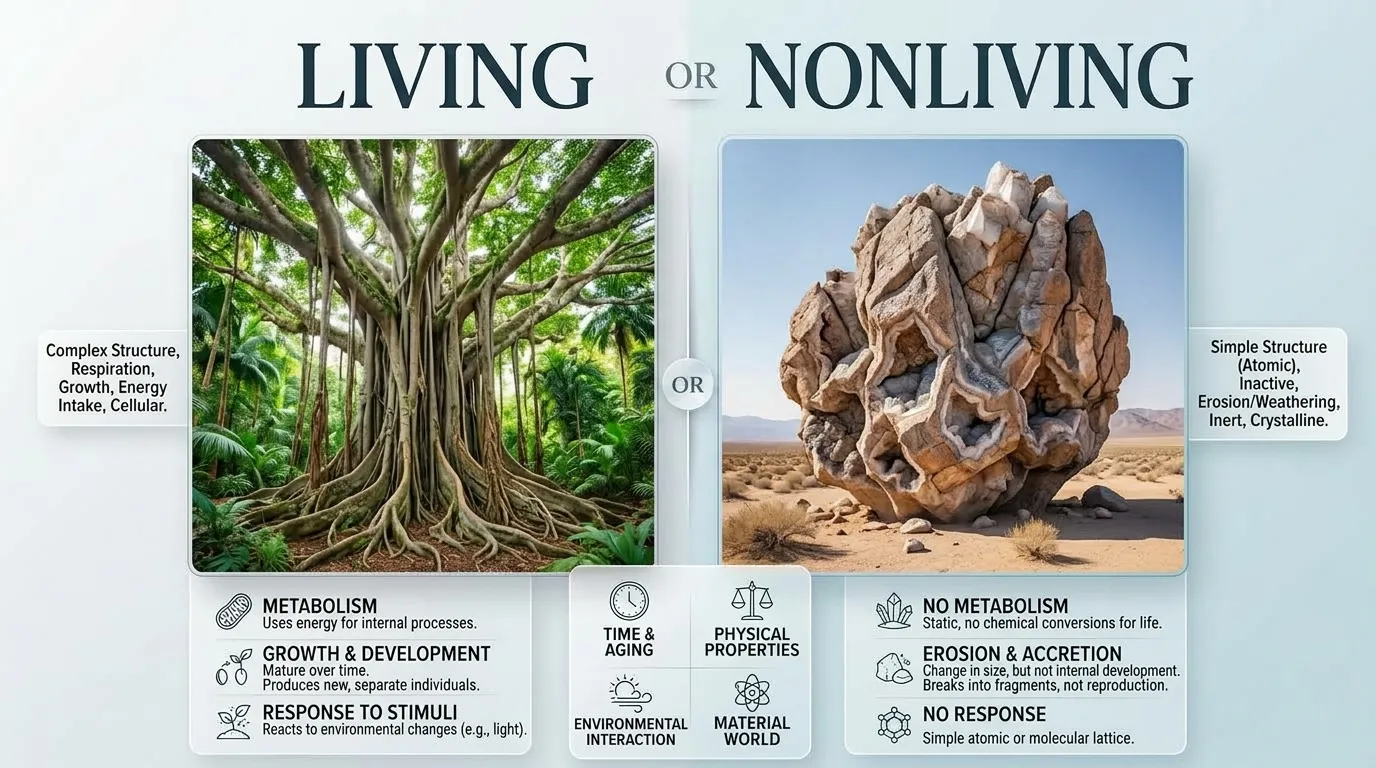
Living things grow, need energy, and make more of their kind, and nonliving things do not.
Leo’s teacher held up a rock, a seed, and a toy robot. “Which ones are living?” she asked. Leo pointed at the robot. It moved and beeped. The class laughed. The robot was not alive. It moved because of a battery. The seed was the surprise. It looked dead, but it was alive.
Living things are alive. They use energy, grow, and make new life. Nonliving things are not alive. Rocks, water, and robots are nonliving. Plants, animals, and people are living.
People search for living or nonliving because the line can look blurry. A car moves, but it is not alive. A seed sits still, but it is alive. Fire grows and needs air, but it is not alive. This guide clears up the mix-up with simple rules and clear examples. After you read it, you can decide between living or nonliving in seconds.
Pronunciation
- Living
- US: /ˈlɪv.ɪŋ/ (LIV-ing)
- UK: /ˈlɪv.ɪŋ/ (LIV-ing)
- Nonliving
- US: /ˌnɑːnˈlɪv.ɪŋ/ (nahn-LIV-ing)
- UK: /ˌnɒnˈlɪv.ɪŋ/ (non-LIV-ing)
The “liv” part rhymes with “give.” Do not say it like “live music,” which rhymes with “hive.” The difference between US and UK is the first sound. Americans say “nahn.” Britons say “non.”
Now let’s look at the ten key differences.
Difference Between Living and Nonliving
1. Basic Meaning
Living means alive. Nonliving means not alive.
- A dog is a living thing.
- A stone is a nonliving thing.
2. Cells
Living things are made of cells. Some have one cell. Some have trillions. Nonliving things are not made of cells.
- A tree is made of cells.
- A glass of water has no cells.
3. Energy and Food
Living things need energy to stay alive. They eat food or make it. Nonliving things do not eat.
- A plant makes food from sunlight.
- A chair never needs a snack.
4. Growth
Living things grow from the inside. They take in food and get bigger. Nonliving things may get bigger, but only when something is added from outside.
- A puppy grows into a dog.
- A pile of sand gets bigger when you add more sand.
5. Reproduction
Living things can make more of their kind. Nonliving things cannot.
- A hen lays eggs, and chicks hatch.
- A pencil can never make a new pencil.
6. Response to the World
Living things sense changes and react. Nonliving things may change, but they do not sense anything.
- A sunflower turns toward the sun.
- A ball rolls only if you push it.
7. Movement
Living things move on their own. Even plants move, though slowly. Nonliving things move only when a force pushes them, or a machine drives them.
- A fish swims by itself.
- A toy car moves because of a battery.
8. Life Span
Living things are born, grow, and die. Nonliving things do not die. They wear out, break, or melt.
- A leaf grows, turns brown, and dies.
- A candle melts, but it never died.
9. Word Forms
“Living” can be an adjective, a noun, or part of a verb. “Nonliving” is only an adjective.
- She makes a living as a nurse. (noun)
- Plants are living things. (adjective)
10. Science Words
In science, living things are called biotic. Nonliving things are called abiotic. These two words show up in ecology.
- Trees and birds are biotic parts of a forest.
- Rocks and rain are abiotic parts of a forest.
Before and After: Fix It Fast
See the mistake. See the fix. Read the reason.
1.
❌ Before: “A dead tree is a nonliving thing, like a rock.”
✅ After: “A dead tree was living once. A rock was never living.”
Why: Dead and nonliving are not the same.
2.
❌ Before: “Fire is a living thing because it grows.”
✅ After: “Fire is nonliving. It grows only when you add fuel.”
Why: Fire has no cells and cannot make more of its kind.
3.
❌ Before: “A seed is nonliving because it does not move.”
✅ After: “A seed is living. It is resting until it gets water.”
Why: A seed has a small plant inside it.
4.
❌ Before: “A robot is living because it moves.”
✅ After: “A robot is nonliving. It moves because of a machine.”
Why: Moving alone does not make something alive.
5.
❌ Before: “Viruses are definitely living things.”
✅ After: “Most scientists call viruses nonliving, but they still debate it.”
Why: Viruses have some traits of life but lack others.
Nature and Behaviour of Living and Nonliving
Living
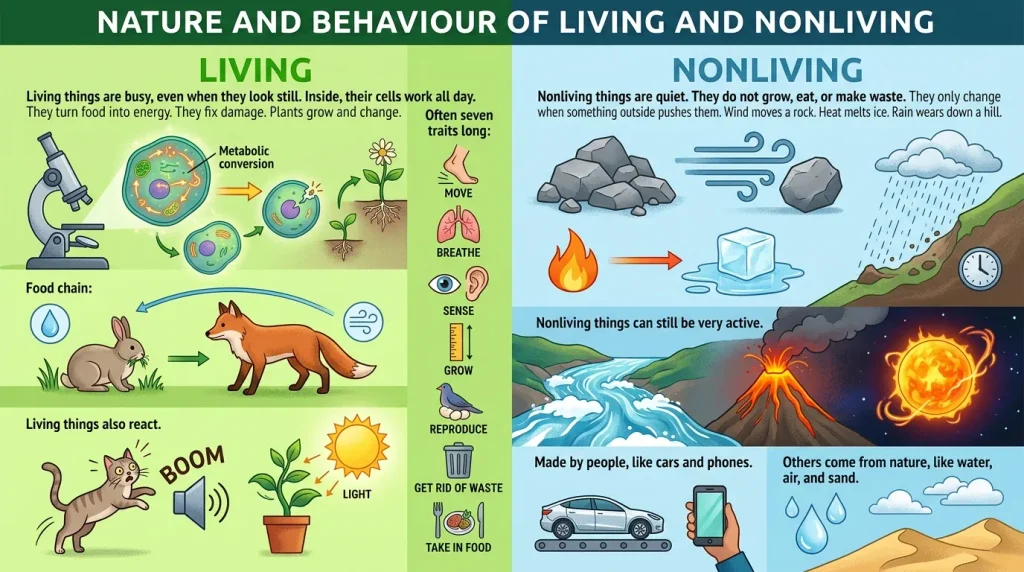
Living things are busy, even when they look still. Inside, their cells work all day. They turn food into energy. They fix damage.Plants grow and change.
Living things are also connected. A rabbit eats grass. A fox eats the rabbit. They all need water, air, or both. Living things also react. A cat jumps at a loud noise. A plant bends toward light.
Most textbooks give a list of traits for life. The list is often seven traits long: move, breathe, sense, grow, reproduce, get rid of waste, and take in food. The exact list can change from book to book. But the main idea is the same.
Nonliving
Nonliving things are quiet. They do not grow, eat, or make waste. They only change when something outside pushes them. Wind moves a rock. Heat melts ice. Rain wears down a hill.
Nonliving things can still be very active. A river flows. A volcano erupts. A star burns. But these things are not alive. They do not have cells. They do not make more of their kind.
Nonliving things can also be made by people, like cars and phones. Others come from nature, like water, air, and sand.
Read more about:https://verboix.com/buret-or-burette/
Why People Get Confused About Living and Nonliving
There are five simple reasons.
Some nonliving things move. Cars, clouds, and rivers move. So people think they are alive.
Some living things look still. Seeds, trees, and sleeping animals look quiet. So people think they are not alive.
Fire looks alive. It grows, eats fuel, and needs air. But it has no cells and cannot make more of itself.
Dead things confuse people. A dead tree looks like wood. But it was alive once. That makes it different from a rock.
Viruses sit on the edge. They are not made of cells. Yet they can copy themselves inside living cells. Scientists still argue about them.
The fix is simple. Ask, “Does it have cells, use energy, grow, and make more of its kind?” If yes, it is living. If no, it is nonliving.
Comparison Table
| Point | Living | Nonliving |
| Main meaning | Alive | Not alive |
| Cells | Made of cells | No cells |
| Energy | Needs food or makes food | Does not need food |
| Growth | Grows from inside | Grows only if added from outside |
| Reproduction | Yes | No |
| Response | Senses and reacts | Does not sense |
| Life span | Born and dies | Wears out or breaks |
| Word type | Adjective, noun, verb form | Adjective only |
| Science word | Biotic | Abiotic |
| Example | Bird, tree, human | Rock, water, robot |
| Similarity | Both can be found in nature and both can change | Same |
The Origin of Living and Nonliving
Living comes from the verb “live.” The verb goes back to Old English words that meant “to be alive.” The “-ing” ending turns the verb into a describing word. So “living” means “being alive.”
Nonliving was built from two parts. The first is “non-,” a Latin word part that means “not.” The second is “living.” Together they mean “not living.” Merriam-Webster gives 1868 as the first known use of the word.
Scientists used to sort things into two groups: living and nonliving. Later, they added more careful words. Biotic means having to do with life. Abiotic means having no life. Teachers and books use these words for ecosystems.
Even today, the line is not always clear. Scientists still argue about viruses. Some call them a borrowed life. Others say they live only inside cells. Most textbooks still place viruses on the nonliving side.
British vs American English
The meaning is the same in both countries. Only spelling and sound differ a little.
- Spelling: Merriam-Webster, Dictionary.com, and Collins write “nonliving” as one word. Cambridge Dictionary writes “non-living” first and lists “nonliving” as another spelling. You will see both.
- Rules: Use the same spelling in your whole paper.
- Sound: Americans say “nahn-LIV-ing.” Britons say “non-LIV-ing.”
Examples:
- US: “Rocks are nonliving things.”
- UK: “Rocks are non-living things.”
If your school gives a style guide, follow it. If not, “nonliving” is the safer choice for US readers.
Which One Should You Use?
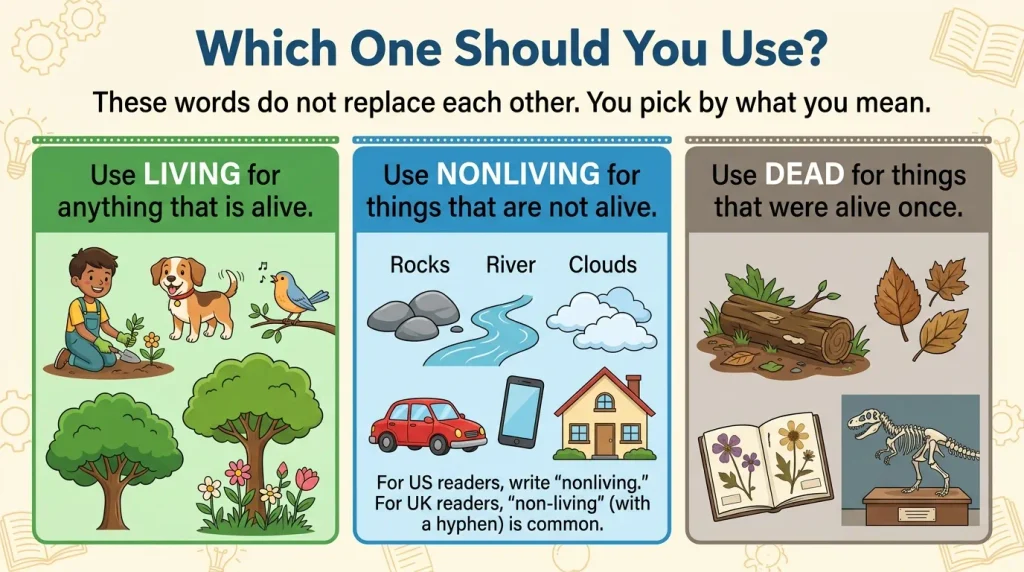
The two words do not replace each other. You pick by what you mean.
- Use living for anything that is alive.
- Use nonliving for things that are not alive.
- Use dead for things that were alive once.
For US readers, write “nonliving.” UK readers can use “non-living” or “nonliving.” For global readers, “nonliving” is fine, and it matches most big dictionaries.
Common Mistakes
Here are common errors, with fixes.
- ❌ “A dead leaf is nonliving, like plastic.” ✅ “A dead leaf was living once. Plastic was never living.”
- ❌ “Fire is alive because it grows.” ✅ “Fire is nonliving. It needs fuel to grow.”
- ❌ “The sun is a living thing.” ✅ “The sun is nonliving. It gives energy to living things.”
- ❌ “Water is a living thing because we need it.” ✅ “Water is nonliving. Living things need it.”
- ❌ “A seed is a nonliving thing.” ✅ “A seed is living. It waits for the right time to grow.”
- ❌ “Non living things” ✅ “Nonliving things” (or “non-living things”)
Everyday Usage Examples
In emails
- “Please sort these items into living and nonliving groups.”
- “Our class will study living and nonliving things on Monday.”
On social media
- “Kids sorted rocks, leaves, and bugs into living or nonliving today! 🌱🪨”
- “Is a seed living or nonliving? We planted one to find out.”
In the news
- “Scientists study how life began from nonliving matter.”
- “The rover looks for signs of living things on Mars.”
In formal writing
- “Ecosystems include living and nonliving parts.”
- “The study compares living cells with nonliving materials.”
Usage Trends
People use living and nonliving all over the world. Schools teach them in early science classes. Students in many countries learn to sort things into living and nonliving groups.
The words also appear in news stories about space, medicine, and nature. Reporters ask if life could start from nonliving matter. Doctors talk about living cells and nonliving materials.
People also search for tricky cases. Viruses, fire, seeds, and robots come up a lot. That is why many people search “living or nonliving.”
Metaphors and Similes
Living
- “The city is a living thing that never sleeps.” (metaphor)
- “The garden was as alive as a busy market.” (simile)
Nonliving
- “His eyes were stones, cold and nonliving.” (metaphor)
- “The house sat quiet, like a nonliving shell.” (simile)
Living shows energy and change. Nonliving shows stillness or cold.
Connotative Meaning
Living
- Positive: “She loves living things.” It shows care and warmth.
- Neutral: “Living things need water.” It is a plain fact.
- Negative: “It was a living nightmare.” It shows fear or pain.
Nonliving
- Positive: “Nonliving materials are safe for the test.” It shows safety.
- Neutral: “Rocks are nonliving.” It is a plain fact.
- Negative: “His face was cold and nonliving.” It shows a lack of feeling.
Idioms and Proverbs
Idioms with “living”
- Make a living: “She makes a living as a teacher.”
- Living room: “We watched a film in the living room.”
- Living proof: “He is living proof that hard work pays off.”
- Scare the living daylights out of someone: “The loud noise scared the living daylights out of me.”
- Living the dream: “He lives by the sea. He is living the dream.”
Related idioms about life and its absence
- Dead as a doornail: “The old battery is dead as a doornail.”
- Come alive: “The town comes alive on weekends.”
- Bring to life: “The teacher brought the story to life.”
Proverbs
- “Live and let live.” It means to accept other people’s ways.
- “Where there’s life, there’s hope.”
Literature and Movies
Literature
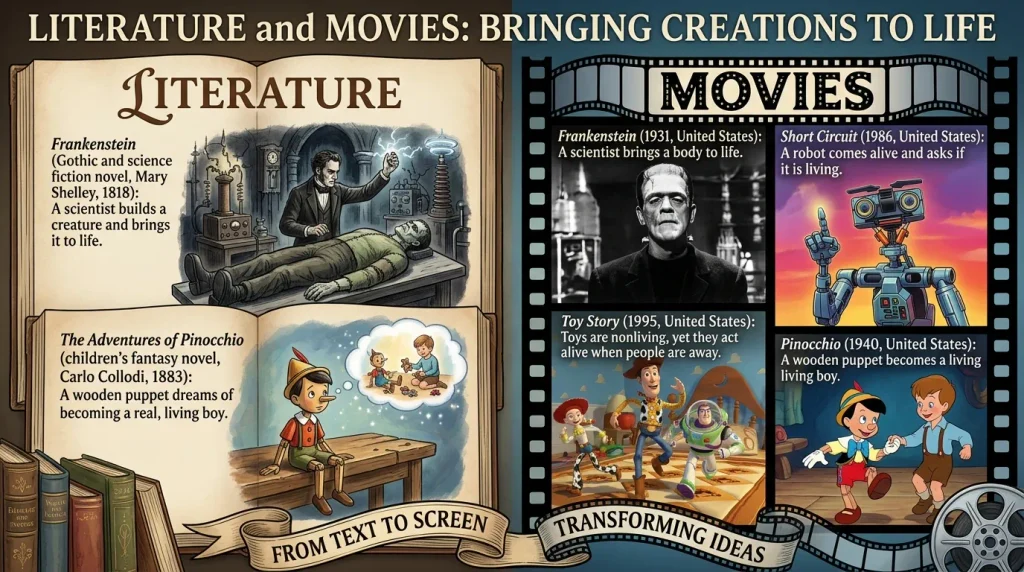
- Frankenstein (Gothic and science fiction novel, Mary Shelley, 1818): A scientist builds a creature and brings it to life.
- The Adventures of Pinocchio (children’s fantasy novel, Carlo Collodi, 1883): A wooden puppet dreams of becoming a real, living boy.
Movies
- Frankenstein (1931, United States): A scientist brings a body to life.
- Short Circuit (1986, United States): A robot comes alive and asks if it is living.
- Toy Story (1995, United States): Toys are nonliving, yet they act alive when people are away.
- Pinocchio (1940, United States): A wooden puppet becomes a living boy.
Why This Difference Matters
For learners: Sorting living and nonliving is one of the first science skills. It builds good habits of asking questions and using proof.
For work: Doctors, farmers, and scientists need to know the difference. A doctor treats living cells. A farmer cares for living crops. An engineer works with nonliving materials.
For society: We make choices about food, health, and nature. Knowing what is alive helps us protect life. It also helps us think about hard questions, like whether a virus is alive, or whether a machine can ever be.
Usefulness in Daily Life
At home: You water your plants, which are living. You wash your dishes, which are nonliving.
At school: Students sort items into living and nonliving groups. Teachers use it to build early science skills.
In the garden: Soil holds living things like worms and nonliving things like sand and water. Both help a plant grow.
In cooking: Yeast is living. It makes bread rise. Salt is nonliving. It adds flavor.
In health: Germs can be living, like bacteria. Doctors also study viruses, which many scientists call nonliving.
A Quick Test You Can Use
Ask these five questions:
- Does it have cells?
- Does it use energy?
- Does it grow from the inside?
- Can it make more of its kind?
- Does it react to its world?
If you answer yes to most, it is living. Otherwise, it is nonliving. If it was alive once but is not now, call it dead.
Situational Preference
Pick your word by asking what you want to say. In a science class, use living for plants and animals. Use nonliving for rocks, water, and air. Use biotic and abiotic for older students. In a story, use living to show energy. Use nonliving to show cold or stillness. When talking about a dead plant or animal, say dead, not nonliving. When talking about viruses, say most scientists call them nonliving, but they still debate it. In everyday talk, use lifeless or inanimate for a more gentle tone. Choose the word that fits the fact, not the feeling.
Print and Save: Cheat Card
Take a screenshot or print this card. Keep it near your desk.
| Living | Nonliving | |
| Means | Alive | Not alive |
| Cells | Yes | No |
| Grows from inside | Yes | No |
| Makes more of its kind | Yes | No |
| Examples | Tree, dog, seed, bacteria | Rock, water, robot, fire |
| Science word | Biotic | Abiotic |
| Careful | Dead = was alive once | Nonliving = never alive |
Quick Answers
1. What is the difference between living and nonliving?
Living things are alive. They have cells, use energy, grow, and make more of their kind. Nonliving things do not.
2. Is a dead thing nonliving?
Not exactly. A dead thing was living once. A nonliving thing was never alive. Science books often call these “dead” and “nonliving.”
3. Is fire a living thing?
No. Fire grows and needs air, but it has no cells. It cannot make more of its own kind.
4. Is a seed living or nonliving?
A seed is living. It is resting and waiting for water and warmth.
5. Are viruses living or nonliving?
Most scientists call viruses nonliving because they have no cells and cannot make copies alone. But they copy themselves inside living cells, so scientists still debate it.
6. Are robots living?
No. Robots move because of machines and power. They do not have cells or grow.
7. Is it “nonliving” or “non-living”?
Both are used. US dictionaries like Merriam-Webster write “nonliving.” Cambridge lists “non-living” first.
Conclusion
Living or Nonliving is easy to understand once you know the basic signs. Living things are alive. They have cells, use energy, grow, and make more of their kind. Nonliving things are not alive, even if they can move or change. A dead tree was alive once, but a rock never was. Seeds are living, even when they look still. Fire and robots may seem alive, but they are not. Viruses are harder to classify, and scientists still debate them. The meaning is the same in the US and UK, but spelling and sound can differ a little. For a safe choice, use nonliving. Next time you see a seed, rock, or robot, ask the five simple questions and you will know the answer.






3 thoughts on “Living or Nonliving: How to Tell the Difference”