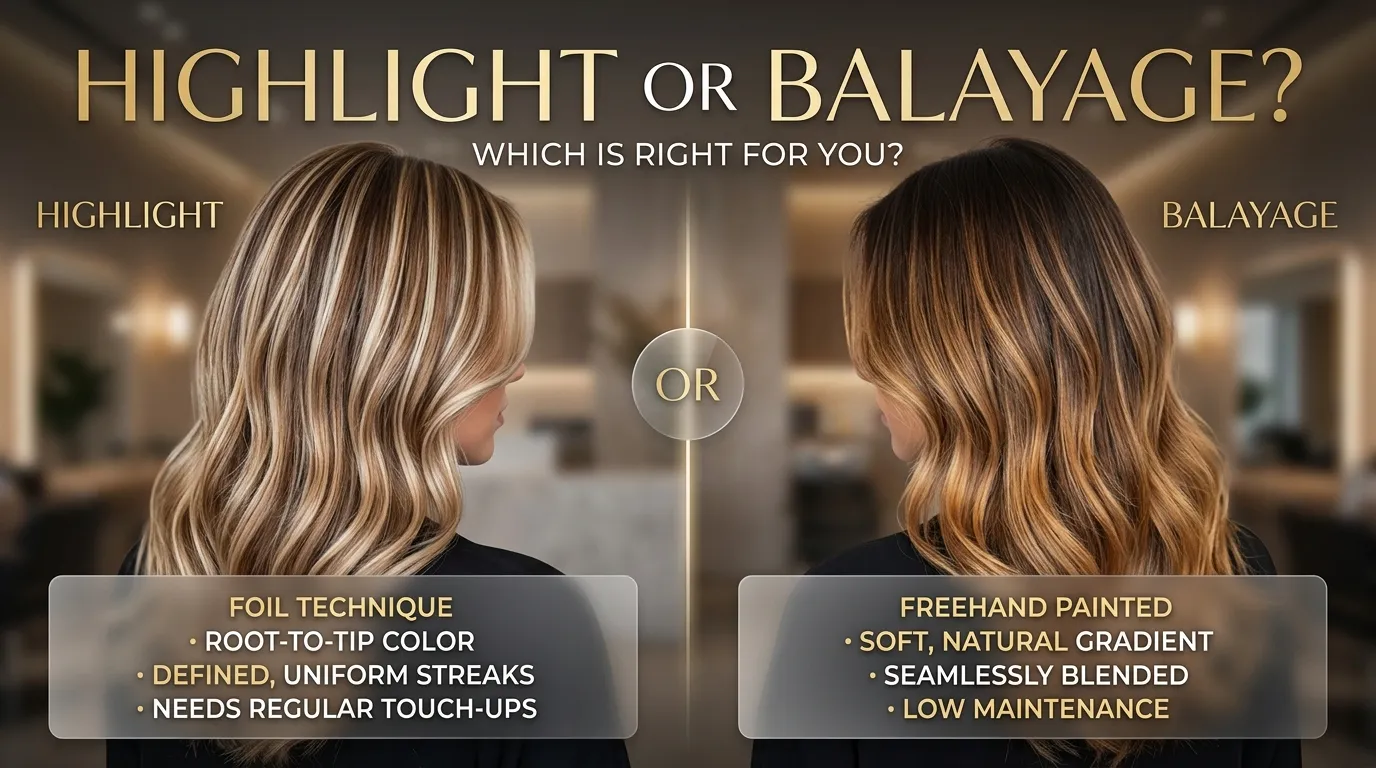
Highlights mean lighter strands in your hair, and balayage is a hand-painted way to make them.
Zara walked into the salon with a photo. Her stylist asked, “Do you want highlights or balayage?” Zara froze. She thought the two words were opposites. She said, “Um, which one looks like my photo?” The stylist smiled. “Good news,” she said. “Balayage is a kind of highlights. It is just a different way to paint them.”
Many people ask about highlight or balayage before they book a visit. The words sound like two different things. They are not. Highlights is the general word for lighter strands. Balayage is a French word for a hand-painted style. This guide clears up the mix-up with simple words and clear examples. You will know how to pick between highlight or balayage, and how to say what you want.
Pronunciation
- Highlight
- US: /ˈhaɪˌlaɪt/ (HIGH-lite)
- UK: /ˈhaɪlaɪt/ (HIGH-lite)
- Balayage
- US: /ˈbɑːleɪˌɑːʒ/ (BAH-lay-AHZH)
- UK: /ˈbælɪjɑːʒ/ (BAL-ee-yahzh)
Highlight sounds the same in both places. Balayage changes a little. Americans say “BAH-lay-AHZH.” Britons often say “BAL-ee-yahzh.” In French, it sounds closer to “bah-leh-YAHZH.” The last part sounds like the “s” in “measure.”
Now let’s look at the ten key differences.
Difference Between Highlight and Balayage
1. Basic Meaning
Highlights is a big word for lighter strands. Balayage is one way to make them.
- She has blonde highlights.
- She has balayage, which is hand-painted highlights.
2. Word Origin
Highlight is an English word. Balayage is a French word.
- “Highlight” was built from “high” and “light.”
- “Balayage” comes from the French word for “to sweep.”
3. Method
Classic highlights use foils. The stylist wraps hair in small foil packets. Balayage uses a brush. The stylist paints the color by hand.
- The stylist folded the hair in foil.
- The stylist swept the color on with a brush.
4. Where the Color Goes
Foil highlights often start close to the root. Balayage often starts away from the root and goes to the middle and ends.
- Foils can lighten from root to tip.
- Balayage is often heavier at the ends.
5. The Look
Foil highlights often look even and neat. Balayage often looks soft and natural, like sun-kissed hair.
- Her highlights looked like clean stripes.
- Her balayage looked like she spent a summer at the beach.
6. Grow-Out
When hair grows, a line can show near the root. Foil highlights can show this line. Balayage often grows out more softly.
- Her foil highlights showed a line at the root.
- Her balayage grew out with no hard line.
7. Time Between Visits
Many stylists say balayage needs fewer touch-ups. Foil highlights often need more visits to keep the roots fresh.
- She can wait longer between balayage visits.
- She books foil highlights more often.
8. Size of Change
Foils are often used for a bigger color change. Balayage often gives a softer change.
- She went four shades lighter with foils.
- She added a few soft shades with balayage.
9. Word Type
“Highlight” can be a noun or a verb. “Balayage” is mainly a noun. Some dictionaries also list it as a verb.
- The teacher will highlight the main idea. (verb)
- She loves her new balayage. (noun)
10. Use Outside Hair
“Highlight” is used for many things. “Balayage” is only about hair.
- Please highlight the key words in yellow.
- Balayage is not used for a school book.
Before and After: Fix It Fast
See the mistake. See the fix. Read the reason.
1.
❌ Before: “Balayage is the opposite of highlights.”
✅ After: “Balayage is a kind of highlights.”
Why: Balayage is one way to make highlights.
2.
❌ Before: “I want ballage on my hair.”
✅ After: “I want balayage on my hair.”
Why: The word is spelled b-a-l-a-y-a-g-e.
3.
❌ Before: “The teacher balayaged the main idea in the book.”
✅ After: “The teacher highlighted the main idea in the book.”
Why: Balayage is only for hair.
4.
❌ Before: “Balayage means painting color from root to tip in foil.”
✅ After: “Balayage is painted by hand. Stylists often start away from the root.”
Why: Balayage is usually freehand and often does not use foil.
5.
❌ Before: “Highlights are always made with foil.”
✅ After: “Highlights are usually made with foil. Painting can also make highlights.”
Why: Highlights is a general word. It covers more than one method.
Nature and Behaviour of Highlight and Balayage
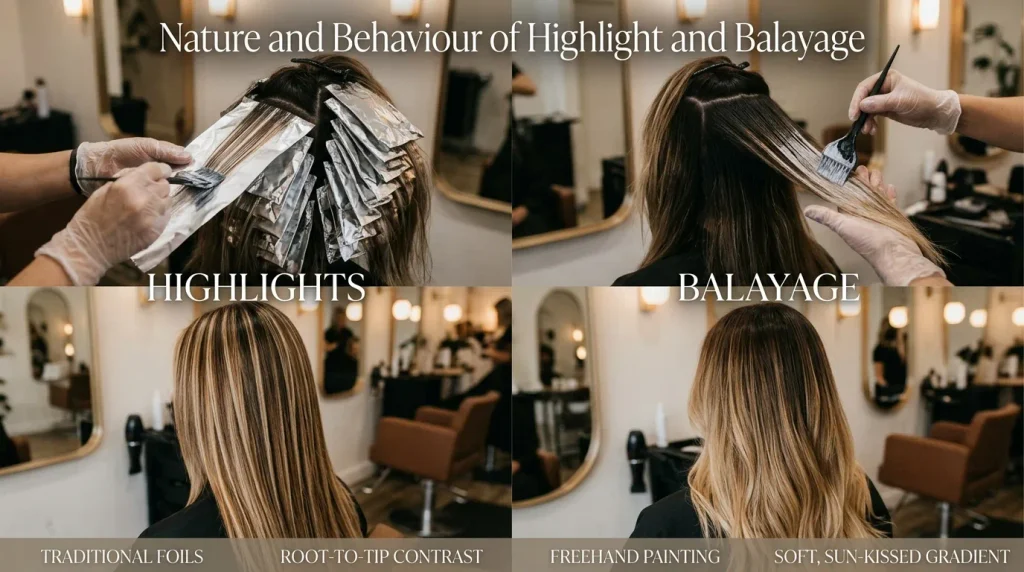
Highlight
Highlight is a flexible word. In hair, it means strands that are lighter than the base color. They can be blonde, gold, or even bright colors. They are not only for blondes. Anyone can have highlights.
Highlights are traditionally made with foils. The stylist picks small sections of hair. Then the stylist puts color or lightener on them. Then the stylist wraps them in foil. The foil keeps the color in place while it works.
Outside hair, highlight is a busy word. It can mean the best part of a day.“Highlight” can mean a yellow mark on a page. It can mean the top moments of a game. The word can also mean to make something stand out.
Read more about:https://verboix.com/living-or-nonliving/
Balayage
Balayage is a special style. It is a way of painting highlights by hand. The stylist uses a brush or a small paddle. The stylist sweeps the color onto the hair in soft strokes.
Balayage often uses no foil. It often leaves the hair a little darker near the scalp. It grows lighter toward the ends. This makes a smooth blend. It looks like the sun lightened the hair over time.
Balayage is a hair word only. It also has a cool feel. Many people use it to show a soft, natural style.
Why People Get Confused About Highlight and Balayage
There are four simple reasons.
Salons use both words. One salon menu lists “highlights.” The next lists “balayage.” People think they are two different things.
Many pages say “versus.” Web pages often say “balayage vs highlights.” That makes it sound like a fight. But balayage is really one type of highlights.
Balayage is a French word. Many people are not sure how to say it or spell it.
There are more names. Ombré, foilayage, babylights, and hair painting all come up. The list can feel long.
The fix is easy. Think of highlights as the big group. Think of balayage as one style inside it.
Comparison Table
| Point | Highlight | Balayage |
| Main meaning | Any lighter strands of hair | Hand-painted highlights |
| Word origin | English | French |
| Usual method | Foils | Freehand brush |
| Placement | Often from root to tip | Often mid-length to ends |
| Look | Even, bold, neat | Soft, blended, natural |
| Grow-out | Line can show at the roots | Softer grow-out |
| Word type | Noun and verb | Mainly a noun |
| Use outside hair | Yes, many uses | No |
| Example | “I got blonde highlights.” | “I got a soft balayage.” |
| Similarity | Both add lighter color to hair | Same |
The Origin of Highlight and Balayage
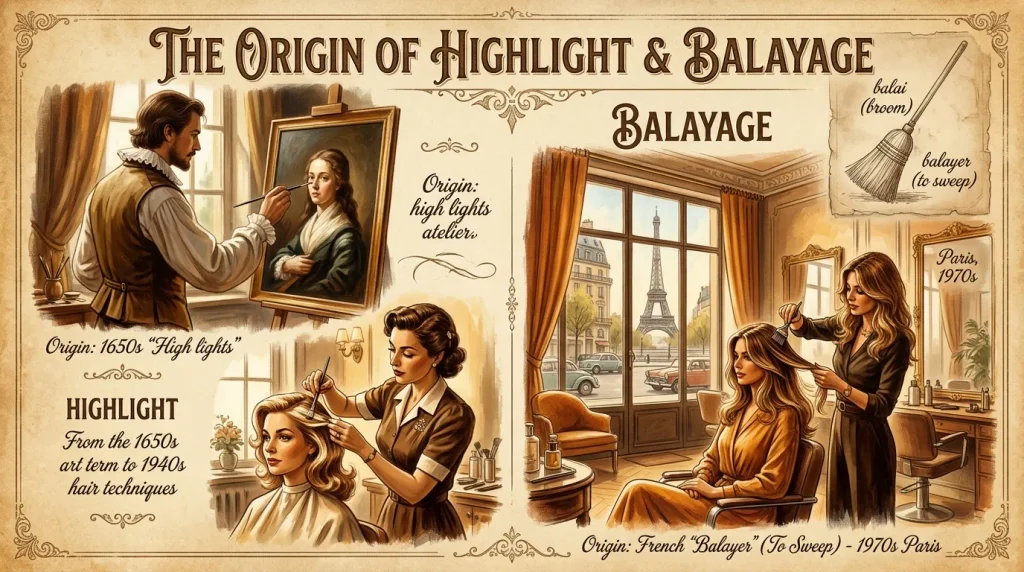
Highlight is an old English compound. It was built from “high” and “light.” In the 1650s, it meant the brightest part of a painting. Painters used “high lights” to show the brightest spots. The word then moved into photography and engraving.
Later, people used “highlight” for the best part of anything. This meaning was not common before about 1920. The hair meaning came next. One dictionary dates it to 1941. Another shows hair uses from the 1890s.
Balayage is a French word. It comes from the French verb balayer, which means “to sweep.” The French word for a broom is balai. So the word first pictures a stylist sweeping color onto hair, like sweeping with a broom.
The style was born in France in the 1970s. Many sources point to the Carita salon in Paris. The goal was a natural, sun-kissed look. English took the word in the 1900s. Over the last few decades, it has spread around the world.
British vs American English
Both words are used in both countries. Spelling is the same. Sound and small spelling of nearby words differ.
- Spelling: Highlight and balayage are spelled the same in the US and UK.
- Nearby words: Americans write “color” and “colorist.” Britons write “colour” and “colourist.”
- Sound: Balayage sounds a little different. Americans say “BAH-lay-AHZH.” Britons say “BAL-ee-yahzh.”
Examples:
- US: “I want caramel highlights and a soft balayage in my color.”
- UK: “I want caramel highlights and a soft balayage in my colour.”
Which One Should You Use?
Use one rule: highlights is the general word. Balayage is the hand-painted style.
- For US readers: Say “highlights” for foil styles. Say “balayage” for the soft, painted look.
- For UK readers: The same rule applies. Use “colour” in your spelling.
- For global readers: Bring a photo. Words can mean slightly different things to different stylists. A photo makes it clear.
If you are unsure, say what you want to see. Say “soft and natural” or “bold and bright.” Your stylist can pick the method.
Common Mistakes
Here are common errors, with fixes.
- ❌ “I want balayage, not highlights.” ✅ “I want balayage highlights.” (or “I want hand-painted highlights.”)
- ❌ “Baleyage” or “ballage.” ✅ “Balayage.”
- ❌ “Balayage is a hair cut.” ✅ “Balayage is a coloring style.”
- ❌ “Balayage always looks the same.” ✅ “Balayage can be soft or bold, depending on the stylist.”
- ❌ “Highlights are only for blonde hair.” ✅ “Highlights can be done on any hair color.”
- ❌ “Balayage and ombré are the same thing.” ✅ “Ombré blends from darker roots to lighter ends. Balayage adds painted strands with a softer blend.”
Everyday Usage Examples
In emails
- “Please book me for highlights on Friday.”
- “I would like a soft balayage. I will send a photo.”
On social media
- “New balayage day! ☀️ Sun-kissed and happy.”
- “My highlights turned out warmer than I planned.”
In the news
- “The star showed off fresh balayage on the red carpet.”
- “The salon says highlights are back in style this fall.”
In formal writing
- “Balayage is a French technique that paints color onto the hair by hand.”
- “The report lists highlights as the most common salon color service.”
Usage Trends
Both words are used all over the world. Highlights is an older and wider word. People use it for hair, books, sports, and news. Balayage is newer in English. It spread over recent decades, as more people wanted a natural, sun-kissed look.
People search for balayage more with questions. They ask about the price, the look, and the care. They also ask how to say the word.
Salons around the world now list both words on their menus. Many also add newer terms, like foilayage. Foilayage means painting by hand and then wrapping the hair in foil. It gives a soft look with a bit more lift.
Metaphors and Similes
Highlight
- “Her smile was the highlight of the party.” (metaphor)
- “The highlights in her hair shone like honey in the sun.” (simile)
Balayage
- “Her hair was a painting, and balayage was the brush.” (metaphor)
- “The color melted from dark to light like a sunset.” (simile)
Highlight shows the brightest point. Balayage shows a soft, blended fade.
Connotative Meaning
Highlight
- Positive: “The trip was the highlight of my year.” It shows joy.
- Neutral: “Highlight the key words in yellow.” It is a plain task.
- Negative: “The report highlights the flaws.” It points out problems.
Balayage
- Positive: “Her balayage looks fresh and natural.” It shows style and ease.
- Neutral: “She booked balayage on Tuesday.” It just states a service.
- Negative: “Balayage can be pricey.” It can suggest a cost people worry about.
Idioms and Proverbs
Idioms with “highlight”
- The highlight of the day: “The picnic was the highlight of the day.”
- Highlight reel: “The highlight reel showed the best goals.”
- Highlight the key points: “Please highlight the key points in your talk.”
Ideas linked to “balayage” (the sweep)
- A clean sweep: “The team made a clean sweep of the games.”
- Sweep someone off their feet: “The song swept her off her feet.”
- Sweep it under the rug: “Do not sweep the problem under the rug.”
- Sun-kissed: “Her sun-kissed hair glowed.”
Proverb
- “A new broom sweeps clean.” It means a new person often makes fresh changes. It fits the sweeping idea behind balayage.
Literature and Movies

Literature
- The Rape of the Lock (mock-epic poem, Alexander Pope, 1712): A poem about a cut lock of hair and how big a fuss it makes.
- Little Women (novel, Louisa May Alcott, 1868): Jo cuts and sells her long hair to help her family.
Movies
- Steel Magnolias (1989, United States): The story takes place in a small-town hair salon.
- Legally Blonde (2001, United States): Hair and style are big parts of the story.
Why This Difference Matters
For learners: Knowing that balayage is a kind of highlights clears up a common mix-up. It also helps English learners see how a general word and a special word work together.
For work: Stylists and clients need clear words. Bringing a photo and using the right term saves time and money. It also stops results that feel like a surprise.
For society: Hair style is a way many people show who they are. Clear words help people ask for what they want. It also shows how English takes words from other languages, like balayage from French.
Usefulness in Daily Life
At the salon: You say “I want soft, natural highlights.” Your stylist may suggest balayage.
At home: You look at photos online. You save the ones that look like your dream color.
At school or work: You highlight the key words in your notes. Here, the word has nothing to do with hair.
In shopping: You see “balayage kit” or “highlight kit” on a box. The words tell you the style and the method.
In social media: You post a photo with the tag #balayage. Your friends know it is a soft, painted look.
A Quick Test You Can Use
Ask yourself these questions:
- Do I want a bold, even, striped look? Ask for foil highlights.
- Do I want a soft, sun-kissed, blended look? Ask for balayage.
- Do I want a mix? Ask for foilayage or ask your stylist for advice.
Situational Preference
Pick your word by asking what you want. For a soft, natural, low-fuss look, ask for balayage. For a bright, bold, or more even look, ask for foil highlights. When making a big change in color, many stylists pick foils. For a small, sun-kissed change, they may pick balayage. In a photo to a stylist, use both words and show the picture. In everyday talk, say “highlights” for any lighter strands.“In school or work, use ‘highlight’ to mark the main points.” When you feel unsure, bring a photo and ask your stylist which method fits your hair.
Print and Save: Cheat Card
Take a screenshot or print this card. Keep it on your phone before you book a visit.
| Highlights | Balayage | |
| Means | Lighter strands in hair | Hand-painted highlights |
| Method | Usually foils | Freehand brush, often no foil |
| Look | Even, bold, neat | Soft, blended, natural |
| Grow-out | Line may show at the roots | Softer grow-out |
| Word | English, general | French, for one style |
| Say it | “I want highlights.” | “I want a soft balayage.” |
| Remember | The big group | One style inside the group |
Quick Answers
1. What is the difference between highlight and balayage?
Highlights is the general word for lighter strands of hair. Balayage is a hand-painted way to make them.
2. Is balayage a type of highlights?
Yes. Balayage is a technique for highlighting hair. It is painted by hand.
3. What does balayage mean?
It comes from a French word that means “to sweep.” It shows how the color is swept onto the hair.
4. How do you say balayage?
Americans often say “BAH-lay-AHZH.” Britons often say “BAL-ee-yahzh.”
5. Does balayage use foil?
Usually not. It is often painted freehand. Some stylists use foil with a painted look. That style is called foilayage.
6. Which one looks more natural?
Balayage often looks more natural, since the color blends softly. Foil highlights often look more even and bold.
7. Can I use “highlight” for things other than hair?
Yes. You can highlight a word, a game moment, or a main point. Balayage is only for hair.
Conclusion
Highlight or Balayage is easy to understand once you know the difference. Highlights are lighter strands of hair, while balayage is one way to create them. Balayage is painted by hand with a brush, often without foil. The word balayage comes from French and means “to sweep.” Highlights can give a neat, bold look, while balayage often gives a soft, natural look. Both can look beautiful. Next time a stylist asks, “Highlights or balayage?” you will know what to choose. You can name the look you want and show a photo.






1 thought on “Highlight or Balayage: Which One Should You Ask For?”