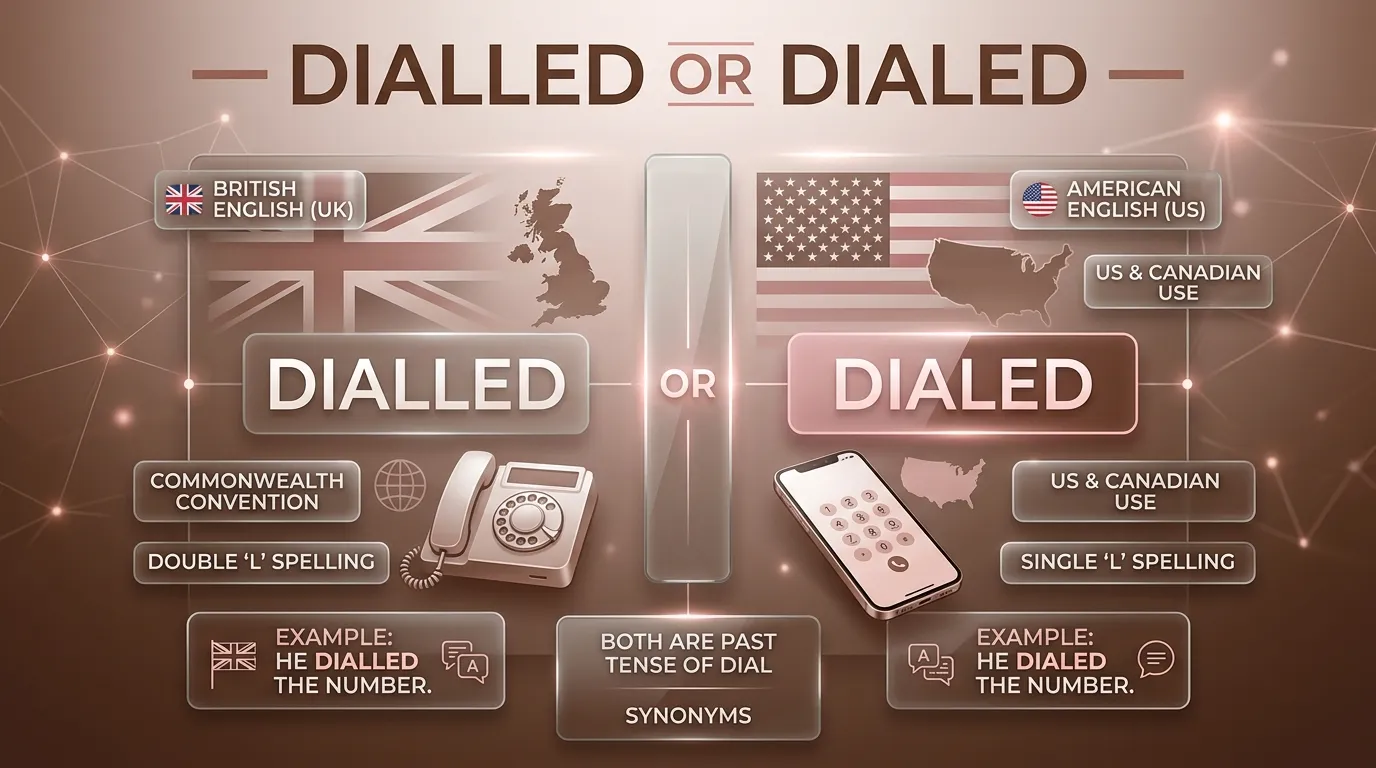
Dialled and dialed have the same meaning. Dialled is mainly used in British English, while dialed is mainly used in American English.
Have you ever written a word and then stopped because you were not sure if it needed one l or two? This can happen when you use dialled or dialed. Both forms look correct. Both are used in real English. The main difference is the spelling style.
Imagine that you need to call your friend. You pick up your phone and enter the number. Later, you tell someone what happened. In American English, you may write, “I dialed her number.” In British English, you may write, “I dialled her number.” The action is the same.
This is why many learners search for dialled or dialed. They want to know if one form is wrong. They may also want to know which spelling to use at school, at work, or on a website.
The word dial is used for entering a phone number. It can also mean using a dial or changing a setting. Modern phones do not usually have a round phone dial, but the word is still common. Cambridge lists the British spelling as dialled and the US form as dialed.
Once you learn the simple difference, dialled or dialed is easy to understand.
How to Pronounce Dialled and Dialed
Dialled and dialed normally have the same basic pronunciation.
dialled
ˈdaɪəld
Give feedback
For dialed, the pronunciation is also commonly shown as /ˈdaɪəld/.
The extra l in the British spelling does not create a different sound. The main difference is in the written form.
Cambridge gives dial the same basic UK and US pronunciation, while showing the spelling difference between dialled and dialed.
So, when you hear the word, you may not know which spelling the speaker would write. You need to look at the English variety and the context.
Now let us look at the difference more closely.
Difference Between Dialled and Dialed
1. They Have the Same Meaning
The first thing to remember is simple.
Dialled and dialed mean the same thing.
They are both past forms of dial.
For example:
She dialled the number.
She dialed the number.
Both sentences tell us that she entered the number on a phone.
Another example:
I dialled your number yesterday.
I dialed your number yesterday.
Again, the action is the same.
The spelling changes, but the meaning does not. Cambridge lists dialled as the past simple and past participle of dial.
2. Dialled Is Mainly Used in British English
Dialled is mainly used in British English.
It has two l letters.
For example:
I dialled the number this morning.
She dialled the office.
If your writing follows British English, dialled is the natural choice.
This spelling is not old or wrong. It is a normal British form.
Cambridge gives dialled as the British past form.
3. Dialed Is Mainly Used in American English
Dialed is mainly used in American English.
It has one l.
For example:
I dialed the number this morning.
She dialed the office.
If your writing follows American English, dialed is the normal choice.
Dictionary.com lists dialed as the past and past participle form of dial.
4. The Difference Is Spelling, Not Meaning
This is the most important point.
There is no basic meaning difference between the two forms.
Compare:
He dialled the number.
He dialed the number.
Both mean that he entered the number.
You should not think of dialled and dialed as two separate words with different meanings.
They are two spelling forms of the same past-tense word.
5. The Base Verb Is the Same
The base verb is:
dial
Both forms come from it.
British English:
dial → dialled
American English:
dial → dialed
The present form does not change because of the English variety.
For example:
I dial the number.
She dials the number.
The difference appears in the past form.
This makes the word easier to learn. You only need to remember the spelling pattern.
6. The -ing Forms Are Different Too
The same difference appears in the -ing form.
British English commonly uses:
dialling
American English commonly uses:
dialing
For example:
She is dialling the number.
She is dialing the number.
Both sentences have the same meaning.
This is useful because you may see both forms in books, websites, emails, and other writing.
Cambridge specifically notes the British -ll- spelling and the usual US -l- spelling.
7. Both Forms Can Describe a Phone Call
Both forms can describe the act of entering a phone number.
For example:
He dialled his friend’s number.
He dialed his friend’s number.
You can also use dial with a number:
Please dial this number.
Please dial the office number.
The word can still be used even when there is no physical dial on the phone. Dictionary.com notes that dialing can mean entering a number by using a touchscreen, buttons, or a rotary dial.
8. Both Forms Can Describe a Wrong Number
A very common phrase is dial the wrong number.
British English:
I dialled the wrong number.
American English:
I dialed the wrong number.
Both sentences mean that the person entered the wrong number.
You can also say:
She dialled a wrong number by mistake.
She dialed a wrong number by mistake.
The spelling changes with the English style.
9. Both Forms Work With Old and New Phones
The word dial has a strong link with older telephones.
Older phones often had a round part that people turned to enter numbers.
Today, most people tap a screen.
Still, we can use the same verb:
She dialled the number on her phone.
She dialed the number on her smartphone.
The technology changed, but the verb stayed useful.
This is a good example of how old words can remain in modern English.
10. Your Audience Can Guide Your Choice
Your audience is one of the easiest ways to choose.
For American readers, use:
dialed
For British readers, use:
dialled
For example, a US website may say:
The customer dialed the number.
A UK website may say:
The customer dialled the number.
Neither form is wrong in its own English variety.
The main goal is consistency.
You may also like:https://verboix.com/casablanca-or-marrakech/
Nature and Behaviour of Dialled and Dialed
Dialled
Dialled is the British spelling of the past tense and past participle of dial.
It can describe an action that happened before now.
She dialled her mother yesterday.
It can also work with has, have, and had.
She has dialled the number.
He had dialled before I arrived.
So, dialled is not limited to one type of sentence.
Dialed
Dialed is the American spelling of the same past form.
For example:
She dialed her mother yesterday.
It can also be used with helping verbs:
She has dialed the number.
He had dialed before I arrived.
The grammar is the same.
The spelling is what changes.
Why People Get Confused About Dialled and Dialed
The main reason for confusion is the extra l.
A learner may learn:
dialed
and later see:
dialled
The learner may think one of them contains a spelling mistake.
But both forms are used.
English has many differences between British and American spelling. Cambridge gives examples such as colour/color, centre/center, and other spelling pairs.
Dialled/dialed is another example.
There is also a second source of confusion. Some learners learn British English at school but read a lot of American websites. Others do the opposite.
This means they can see both spellings in normal English.
The easiest rule is:
British English → dialled
American English → dialed
For the -ing form:
British English → dialling
American English → dialing
Comparison Table
| Feature | Dialled | Dialed |
| Main spelling style | British English | American English |
| Base word | dial | dial |
| Past form | dialled | dialed |
| Past participle | dialled | dialed |
| -ing form | dialling | dialing |
| Number of l’s | Two | One |
| Meaning | Same | Same |
| Phone use | Yes | Yes |
| Pronunciation | Basically the same | Basically the same |
| Example | She dialled the number. | She dialed the number. |
The key point is simple:
The meaning stays the same. The spelling changes.
The Origin of Dialled and Dialed
The history of dialled and dialed begins with the word dial.
The word dial has a long history. It came into English through Middle English and is linked to Medieval Latin. The older word was connected with things used to show or measure the time.
A dial was found on clocks and other devices.
Later, the word became strongly linked with telephones.
Early telephones had a physical dial. A person moved the dial to enter a number. The action became known as dialing or dialling.
The word then stayed in English even after telephone technology changed.
Today, someone can say:
I dialed her number.
even if that person only touched a phone screen.
Dictionary.com also gives dial as a verb for entering a phone number and for using a dial to make a selection or change a setting.
The British and American past forms developed as different spelling forms:
dial → dialled
dial → dialed
They do not represent two separate histories.
British vs American English
British English
In British English:
dialled
and:
dialling
Examples:
I dialled the number twice.
She is dialling the office.
This spelling fits a text that uses other British forms such as colour, centre, and favourite.
American English
American English commonly uses:
dialed
and:
dialing
Examples:
I dialed the number twice.
She is dialing the office.
This spelling fits a text that uses forms such as color, center, and favorite.
Cambridge identifies -ll- as the British pattern for this word and -l- as the usual US pattern.
Canadian English
Canadian English can show more than one spelling pattern.
This means it is better not to make a strict rule that every Canadian writer must use only one form.
If you are writing for Canadian readers, follow the style guide used by your school, company, publisher, or website.
Australian and New Zealand English
Writers in Australia and New Zealand often use spelling patterns that are close to British English.
You may therefore see dialled and dialling.
But style can vary by writer and publication.
For professional writing, the safest rule is to follow the spelling guide used by the publication.
The Easy Rule
For most learners, this short rule is enough:
UK → dialled
US → dialed
And:
UK → dialling
US → dialing
You do not need to worry about the meaning changing.
Which One Should You Use?
Use dialed if you are writing in American English.
I dialed the number.
Use dialled if you are writing in British English.
I dialled the number.
If you are writing for a global audience, either form will usually be understood.
Still, consistency is better.
Look at the other spelling choices on your website.
If you write:
- color
- center
- favorite
then dialed will fit that style.
If you write:
- colour
- centre
- favourite
then dialled will fit that style.
Do not choose one because you think it is “more correct.” Choose the form that matches your English style.
Common Mistakes
Mistake 1: Thinking Dialled Is Wrong
Some learners see two l letters and think the word is misspelled.
That is not true.
Dialled is a normal British spelling.
Correct:
She dialled the number.
Mistake 2: Thinking Dialed Is Wrong
Some learners think the American form has lost an l by mistake.
That is also wrong.
Dialed is a standard American spelling.
Correct:
She dialed the number.
Mistake 3: Mixing the Two Forms
A writer may use both forms in the same article.
For example:
She dialled the number and then dialed it again.
This can look odd if there is no reason for the change.
It is better to choose one spelling style and keep it throughout your article.
Mistake 4: Adding Too Many Ls
Do not write:
❌ dialllled
Write:
✅ dialled
The British form has two l’s before -ed.
Mistake 5: Confusing Dial With Call
Dial and call are related, but they are not always the same.
Dial often focuses on entering the number.
I dialed her number.
Call focuses more broadly on contacting someone by phone.
I called her.
You can dial a number without the other person answering.
Mistake 6: Using the Past Form for a Present Action
If you mean something that happens now or regularly, use the present form.
Incorrect for a present habit:
Every morning, I dialed my manager.
Better:
Every morning, I dial my manager.
For a completed past action:
Yesterday, I dialed my manager.
The same rule works with dialled.
Everyday Usage Examples
In Emails
British:
I dialled the number you sent me, but no one answered.
American:
I dialed the number you sent me, but no one answered.
Both are natural.
In Text Messages
A person may write:
I dialed you by mistake.
A British writer may write:
I dialled you by mistake.
The message is easy to understand either way.
On Social Media
You might see:
I dialed the wrong number again!
Or:
I dialled the wrong number again!
The spelling depends on the writer.
In News Writing
A British news report may use:
The caller dialled the emergency number.
An American report may use:
The caller dialed the emergency number.
The spelling follows the publication’s English style.
In Formal Writing
British:
The customer dialled the number printed on the notice.
American:
The customer dialed the number printed on the notice.
The word can be used in formal writing without a problem.
In School Work
A British student may write:
I dialled my father’s number.
An American student may write:
I dialed my father’s number.
The correct form depends on the English style expected by the school.
Usage Trends
The main pattern is still easy to see.
Dialed is strongly associated with American English.
Dialled is strongly associated with British English.
Modern dictionaries continue to show both forms. Cambridge gives dialled as the British form and dialed as the usual US form.
The technology behind the word has changed, too.
People once turned a physical dial.
Now, most people tap a number on a screen.
Yet the word dial is still used.
For example:
I dialed her number.
The speaker does not need to have used an old rotary phone.
The word has kept its old name while its everyday action has changed.
Dictionary.com also shows modern uses of dial for entering numbers through touchscreens and buttons.
Dial In, Dial Up, and Dial Down
The word dial has grown beyond its old phone meaning.
Dial In
Dial in can relate to joining a phone or online meeting.
For example:
Please dial in at 10 a.m.
It can also mean becoming very focused on a task.
The team is dialed in today.
Dial Up
Dial up can mean increase something.
The company dialed up its advertising.
It can mean making something stronger or greater.
Dictionary.com gives examples of dial up meaning to increase or intensify something.
Dial Down
Dial down means reduce something.
The manager dialed down the pressure.
You may also hear:
Please dial down the volume.
These phrases show that dial is still useful even though old telephone dials are much less common.
Connotative Meaning
Dialled: Neutral Meaning
Most uses of dialled are neutral.
She dialled the number.
The sentence simply tells us what happened.
There is no special positive or negative feeling.
Dialed: Neutral Meaning
Dialed is also normally neutral.
He dialed the office.
Again, the sentence gives simple information.
A Feeling of Older Technology
The word dial can sometimes remind readers of older phones.
For example:
He dialled the number on the old black phone.
The sentence creates an old-fashioned setting because of the phone, not because dialled has a negative meaning.
Modern Use
The American spelling dialed is also completely normal with modern phones.
She dialed the number on her smartphone.
The word does not mean that the phone has a physical dial.
Dialed In
Dialed in can have a positive meaning.
It can describe someone who is focused and ready.
The players were completely dialed in.
The British spelling can be:
The players were completely dialled in.
The meaning stays the same.
Idioms and Common Expressions
There are no major English proverbs that depend on the spelling dialled or dialed.
However, dial appears in several useful expressions.
Dial In
Please dial in before the meeting starts.
This can refer to joining a call.
Dial Into
She dialled into the meeting.
American English:
She dialed into the meeting.
This phrase can refer to joining by phone.
Dial Up
The team dialed up the pressure.
Here, dial up means increase.
Dial Down
The manager dialled down the pressure.
Here, dial down means reduce.
These expressions are useful because they show that dial is not limited to old telephone language.
Literature and Movies
Dial M for Murder
A well-known title connected with telephone dialing is Dial M for Murder.
The story began as a play by British writer Frederick Knott. The stage play opened in London in 1952. The story uses a telephone call as an important part of its plot.
The story later became the 1954 film Dial M for Murder, directed by Alfred Hitchcock. The American Film Institute lists the film’s release date as May 29, 1954, and credits Knott as the writer and Hitchcock as director.
The title is a nice example of older telephone language.
At that time, the idea of dialing a telephone number was a very familiar part of daily life.
Phone Words in Fiction
Telephone words often appear in stories.
Writers may use words such as:
- dial
- ring
- answer
- call
- number
- line
- hang up
Older stories may describe someone turning a telephone dial.
Newer stories may describe someone tapping a screen.
The basic idea is still easy to understand.
Why This Difference Matters
At first, dialled or dialed may seem like a very small spelling question.
It is a small difference.
But spelling style can make writing look more natural.
Imagine reading an article that uses British spelling in one sentence and American spelling in the next. You may understand every word, but the article can feel less consistent.
This matters for:
- English learners
- students
- teachers
- bloggers
- editors
- website owners
- content writers
- publishers
It also teaches an important lesson about English.
English is used in many countries.
It does not always have only one spelling.
Dialled and dialed show how two major English varieties can use different spellings while keeping the same meaning.
Usefulness in Daily Life
You may not often talk about a telephone dial today.
Still, dial remains useful.
You may hear:
Dial this number.
I dialed the wrong number.
She dialled her friend.
Dial 9 for an outside line.
The word is also used for devices.
For example:
Turn the dial to the left.
Turn the dial to lower the heat.
Set the dial to number five.
So, dial is not only a phone word.
It can also describe a control that you turn.
The past forms still follow the same main spelling difference:
British: dialled
American: dialed
Situational Preference
Use dialled when your writing follows British English. Use dialed when your writing follows American English. Both forms have the same basic meaning. You can use either one for a past phone action or for other meanings of dial. If your website uses British spelling in words such as colour and centre, dialled will fit better. If it uses American spelling such as color and center, choose dialed. For a global audience, either form is normally clear. The most important thing is to keep the same spelling style throughout your writing. The same idea applies to dialling and dialing.
Questions about Dialled or Dialed
Is dialled or dialed correct?
Both are correct.
Dialled is mainly used in British English.
Dialed is mainly used in American English.
Is dialled British or American?
Dialled is mainly the British spelling.
Example:
She dialled the number.
Is dialed British or American?
Dialed is mainly the American spelling.
Example:
She dialed the number.
Do dialled and dialed have different meanings?
No.
They have the same basic meaning.
The main difference is spelling.
What is the British spelling of dialed?
The usual British form is:
dialled
The -ing form is:
dialling
What is the American spelling of dialled?
The usual American form is:
dialed
The -ing form is:
dialing
Is dialled still used today?
Yes.
It is still a normal spelling in British English.
Modern phones may not have physical dials, but the verb dial remains in everyday English.
Is dialed only used for old phones?
No.
You can use dialed with a modern smartphone.
For example:
I dialed her number on my phone.
The word does not require a physical dial.
Should I use dialled or dialed on my website?
Look at the English style used by your website.
Use dialed for American English.
Use dialled for British English.
Most importantly, stay consistent.
Conclusion
The difference between dialled or dialed is simple once you know the main rule. Both forms come from the verb dial and have the same basic meaning. Dialled is mainly used in British English, while dialed is mainly used in American English. The same rule applies to the -ing form: dialling is mainly British, while dialing is mainly American. So, “I dialled the number” fits British English, while “I dialed the number” fits American English. Neither spelling is wrong. The right choice depends on the English style you use. For US readers, dialed is usually the better fit. For UK readers, dialled is usually the better fit.In short, British English uses “dialled,” while American English uses “dialed.”











1 thought on “Dialled or Dialed: US or UK Spelling Explained”