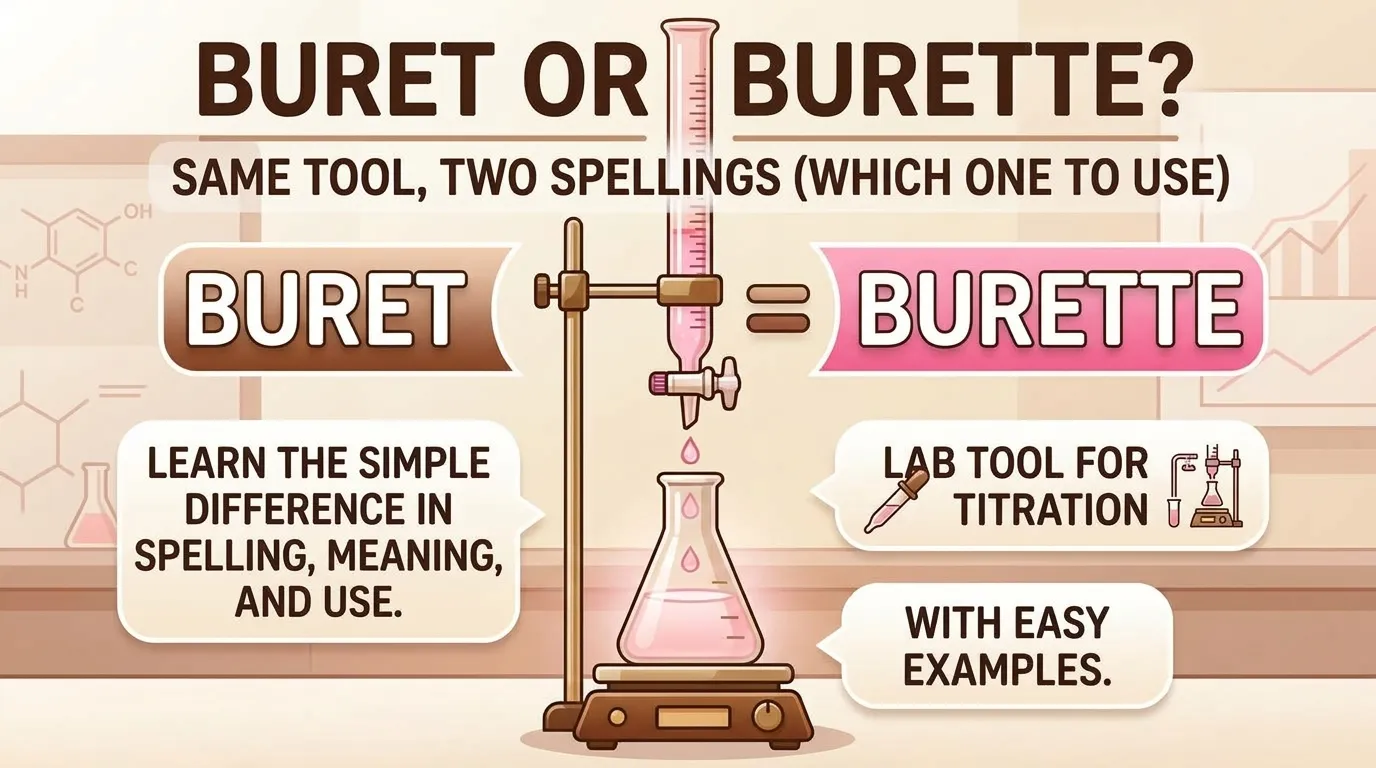
Buret and burette are two spellings of the same lab tool.
Ana was in her first chemistry class. Her teacher wrote “burette” on the board. Ana’s book said “buret.” She looked at both words. The student thought they were two tools. She asked her teacher. The teacher smiled and said, “Same tool. Different spelling.”
A burette is a long glass tube with a tap at the bottom. Chemists use it to add liquid a little at a time. People search for buret or burette because both spellings show up in books, labs, and tests. One book says one thing. Another book says the other. It is easy to think one is wrong. Neither is wrong.
This guide clears up the mix-up. You will see what the word means, where each spelling is used, and how to choose. When you meet buret or burette next time, you will know exactly what to do.
Pronunciation
Both spellings sound the same. They are one word said aloud.
- Buret
- US: /bjʊˈrɛt/ (byoo-RET)
- UK: /bjʊˈrɛt/ (byoo-RET)
- Burette
- US: /bjʊˈrɛt/ (byoo-RET)
- UK: /bjʊˈrɛt/ (byoo-RET)
Stress the second part. Say “byoo-RET.” Do not say the extra “te” at the end of burette.
You cannot hear the difference. You can only see it on paper. Let’s start with the main points.
Difference Between Buret and Burette
Here is the honest truth. The meaning is the same. The differences are only in spelling and style.
1. Meaning
Both words name a glass tube with a tap. It gives out liquid in small, exact amounts.
- The student filled the buret with acid.
- The student filled the burette with acid.
2. Number of Letters
Buret has five letters. Burette has seven.
- “Buret” is short and quick to write.
- “Burette” is longer and looks more formal.
3. Word Ending
Buret ends in “-et.” Burette ends in “-ette.” The “-ette” ending came from French. It means “small.”
- Burette ends like “cigarette” and “kitchenette.”
- Buret drops the extra “te.”
4. Where People Use It
One dictionary marks burette as the UK spelling and buret as the US one. In practice, both spellings are used and understood in every country.
- A US school book may say “buret.”
- A UK lab sheet may say “burette.”
5. Dictionary Listing
Merriam-Webster and Dictionary.com list “burette” as the main word. They show “buret” as the other spelling.
- Look up “burette” and you find the full meaning.
- Look up “buret” and you are sent to the same word.
6. Plural Forms
The plural follows the spelling.
- Two burets sat on the shelf.
- Two burettes sat on the shelf.
7. Sound
The sound is exactly the same. Both are said “byoo-RET.”
- “Hand me the buret” sounds like “Hand me the burette.”
- You cannot tell them apart when someone speaks.
8. Tool Design
There is no design difference. Some websites say a burette has a finer scale. Dictionaries do not say this. The tool is the same.
- A buret has marks on the tube and a tap at the bottom.
- A burette has marks on the tube and a tap at the bottom.
9. School and Exam Use
Follow your teacher, book, or exam board. If your book says buret, write buret. If it says burette, write burette.
- A UK exam paper may use “burette.”
- A US lab report may use “buret.”
10. Extra Meaning
Burette has an older second meaning. In some church rituals, it is a small cruet for wine or water. Most lab writers never use this meaning.
- In a lab, a burette helps with titration.
- In a church, a burette can hold water for a ritual.
Before and After: Fix It Fast
See the mistake. See the fix. Read the reason.
1.
❌ Before: “We used a buret and a burette for the test.”
✅ After: “We used one burette for the test.”
Why: They are the same tool, not two tools.
2.
❌ Before: “Fill the burrette with water.”
✅ After: “Fill the burette with water.”
Why: The spelling is b-u-r-e-t-t-e. There is only one “r.”
3.
❌ Before: “The buret was clean. Then the burette was full.”
✅ After: “The burette was clean. Then the burette was full.”
Why: Pick one spelling and keep it the same in the whole paper.
4.
❌ Before: “Use a burette to pick up 10 mL fast.”
✅ After: “Use a pipette to pick up 10 mL. Use a burette to add liquid drop by drop.”
Why: A pipette and a burette do different jobs.
5.
❌ Before: “The burette shows how much liquid is in the flask.”
✅ After: “The burette shows how much liquid you added.”
Why: The burette measures what comes out of it.
Nature and Behaviour of Buret and Burette
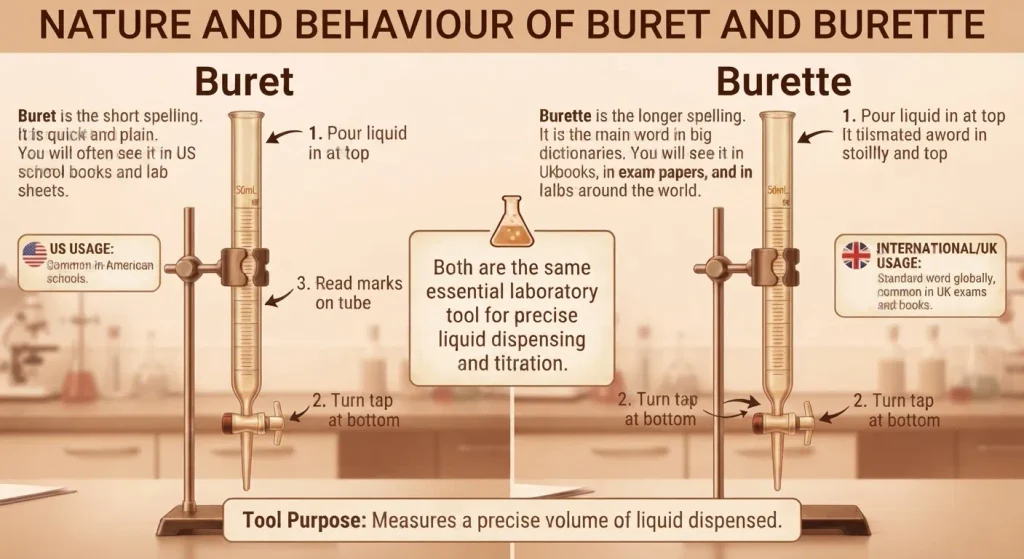
Buret
Buret is the short spelling. It is quick and plain. You will often see it in US school books and lab sheets.
The tool stands upright in a clamp. You pour liquid in at the top. You turn the tap at the bottom. The liquid comes out slowly. You read the marks on the tube to see how much came out.
Burette
Burette is the longer spelling. It is the main word in big dictionaries. You will see it in UK books, in exam papers, and in labs around the world.
The tool is the same. It gives a chemist very careful control. One drop can matter. In a titration, the chemist adds liquid until the color changes. The burette shows how much was needed.
Both spellings bring up the same picture: a tall glass tube, a tap, and a steady hand.
Why People Get Confused About Buret and Burette
There are four simple reasons.
Both spellings appear in books. One book says buret. Another says burette. Learners think there must be two tools.
Some websites give wrong facts. A few pages say a burette is a “finer” kind of buret. The main dictionaries do not say this.
They sound the same. In class, the teacher says “byoo-RET.” You cannot tell which spelling is meant.
The ending looks odd. Many “-ette” words look strange. Learners cannot tell if the double “t” is needed.
The fix is easy. Same tool, same sound, same meaning. Only the spelling changes.
Read more about:https://verboix.com/centigrade-or-celsius/
Comparison Table
| Point | Buret | Burette |
| Meaning | Glass tube with a tap for exact liquid amounts | Same |
| Letters | 5 | 7 |
| Ending | -et | -ette (French style) |
| Sound | byoo-RET | byoo-RET |
| Common use | Marked as the US spelling by Collins | Main spelling in the UK and in big dictionaries |
| Dictionary | Listed as a variant | Listed as the main entry |
| Plural | Burets | Burettes |
| Tool design | Same | Same |
| Example | Read the buret. | Read the burette. |
| Similarity | Same tool, same meaning, same sound | Same |
The Origin of Burette and Buret
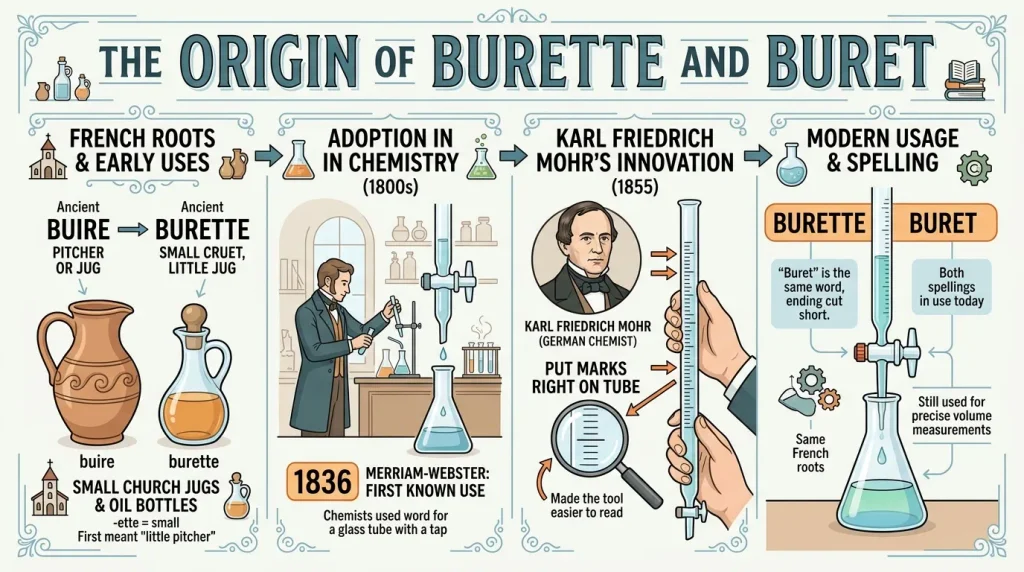
The word came from French. In French, burette means a small cruet, or a little jug. It grew from the older word buire, which means pitcher or jug. The “-ette” ending means “small.” So a burette was first a “little pitcher.”
Long ago, people used the word for small church jugs and oil bottles. That old meaning still lives on in some church use.
Chemists began to use the word for a glass tube with a tap in the 1800s. Merriam-Webster gives 1836 for the first known use in this sense. In 1855, the German chemist Karl Friedrich Mohr made an improved version. He put the marks right on the tube. That made the tool easier to read.
“Buret” is the same word with the ending cut short. It has the same French roots. Both spellings are in use today.
British vs American English
Both spellings work in both countries. But each side has a favorite.
- Spelling: UK writers use burette. US writers often use buret. US dictionaries list burette first and buret second.
- Rules: No rule forces one over the other. Both are correct.
- Sound: Same on both sides: “byoo-RET.”
Examples:
- US: “The teacher showed us how to read the buret.”
- UK: “The teacher showed us how to read the burette.”
If your school, journal, or exam board gives a style guide, follow it.
Which One Should You Use?
Use one rule: pick one spelling and stay with it.
- For US readers: Buret is common and fine. Burette is also fine.
- For UK readers: Use burette.
- For global readers: Use burette. It is the main dictionary spelling and works everywhere.
If you write for a class, copy the spelling in your book. Do not switch in the middle of a paper.
Common Mistakes
Here are more common errors, with fixes.
- ❌ “A burette and a buret are not the same.” ✅ “Burette and buret are two spellings of one tool.”
- ❌ “Fill the burrette.” ✅ “Fill the burette.”
- ❌ “Fill the burete.” ✅ “Fill the buret.” (or “burette”)
- ❌ “Use a buret to store chemicals.” ✅ “Use a buret to add liquid slowly. Store chemicals in bottles.”
- ❌ “Read the number at the top of the liquid.” ✅ “Read the number at the bottom of the curve, with your eye level with the liquid.”
- ❌ “This burette is finer than that buret.” ✅ “These two are the same kind of tool. Only the spelling is different.”
Everyday Usage Examples
In emails
- “Please bring a clean burette to the lab on Monday.”
- “The buret needs a new tap before class.”
On social media
- “My first titration! The burette made it look easy. 🧪”
- “Steady hands and a buret. That’s chemistry class!”
In the news
- “Students at the science fair used a burette to test the water.”
- “The school bought new glass burets for the lab.”
In formal writing
- “The acid was added slowly from the burette until the color changed.”
- “A 50 mL buret was used to measure the sodium hydroxide.”
Usage Trends
People use both spellings around the world. Burette is common in the UK and in many other countries. Buret is a common choice in the US, especially in school books and lab sheets.
Many students search for the difference because they see both words. Teachers often give the same answer: same tool, two spellings.
Science books, exam papers, and lab shops follow their own style. Some pick buret. Some pick burette. The best plan is to match the place you write for.
Metaphors and Similes
Buret and burette
- “Her patience was a burette. It gave out kindness one drop at a time.” (metaphor)
- “Time is a burette. It lets out one drop each second.” (metaphor)
- “He shared the news like a burette, slow and careful.” (simile)
- “Her hand was as steady as a burette tap.” (simile)
The tool stands for slow, careful, exact control.
Connotative Meaning
Positive
- “She has the careful touch of a chemist with a burette.” It shows skill and patience.
Neutral
- “The lab has ten burettes.” It just states a fact.
Negative
- “The news came out in drips, like a leaky burette.” It shows something too slow or hard to control.
The word itself is neutral. It names a tool. The feeling comes from the picture around it.
Idioms and Proverbs
No well-known idiom uses the word burette. But these phrases fit the idea of the tool.
- Drop by drop: “He filled the jar drop by drop.”
- Reach the end point: “The color changed, and we reached the end point.” (A chemistry term for the moment a titration is done.)
- Measure twice, cut once: “She checked the marks twice before she wrote them down.”
- Slow and steady wins the race: “She turned the tap slowly. Slow and steady wins the race.”
Literature and Movies
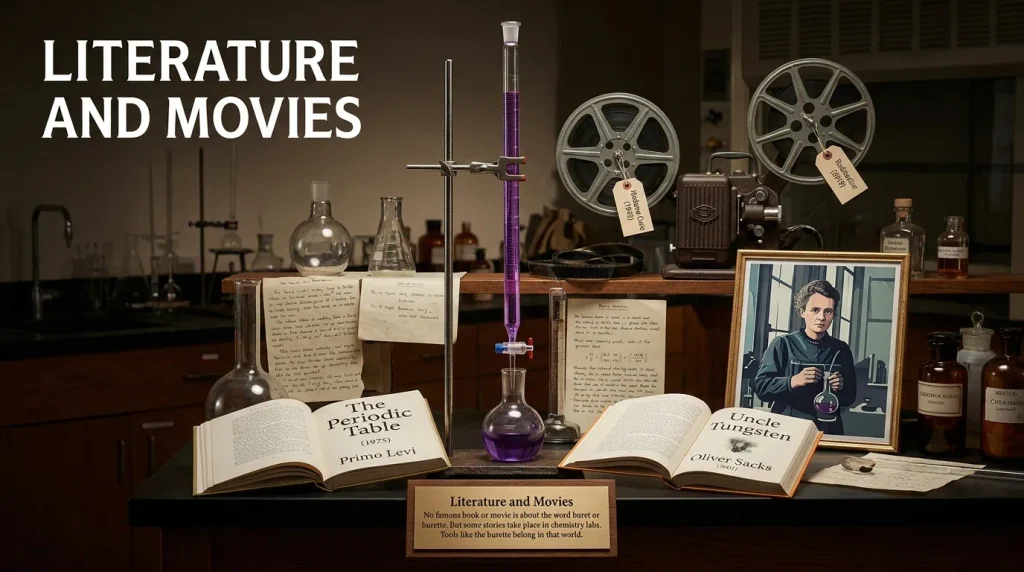
No famous book or movie is about the word buret or burette. But some stories take place in chemistry labs. Tools like the burette belong in that world.
Literature
- The Periodic Table (memoir, Primo Levi, 1975): A chemist writes about his life and work through the elements.
- Uncle Tungsten (memoir, Oliver Sacks, 2001): A writer remembers his childhood love of chemistry.
Movies
- Madame Curie (1943, United States): A story about the scientist Marie Curie and her lab work.
- Radioactive (2019, United Kingdom): Another film about Marie Curie’s life and work.
Why This Difference Matters
For learners: Many students think the two spellings are two tools. That can waste time and cause worry. Knowing the truth saves effort.
For work: In lab reports and papers, steady spelling looks careful. Switching in the middle can look messy.
For society: Science needs clear words. When we know two spellings mean one tool, we share knowledge faster. It also stops wrong facts from spreading online.
Usefulness in Daily Life
At school: Students meet the burette in chemistry class. They learn to read the marks and turn the tap.
At work: Lab workers use burettes to test water, food, and medicine.
In shopping: A teacher orders a burette or buret from a lab shop. Both names bring up the same product.
In study abroad: A student moves from the US to the UK. Knowing both spellings helps them read new books with ease.
How to Read a Burette
- Stand the burette straight in a clamp.
- Fill it with liquid. Let a little run out to clear air from the tip.
- Put your eye level with the liquid.
- Read the number at the bottom of the curve. This curve is called the meniscus.
- Turn the tap slowly to add liquid.
- Read the number again. Subtract the first from the second. This is how much you added.
Burette vs Pipette vs Beaker
| Tool | Main job |
| Burette | Add liquid slowly and measure how much you added |
| Pipette | Pick up and move a set amount of liquid |
| Beaker | Hold and mix liquid (not exact for measuring) |
Situational Preference
Pick your spelling by asking where you write. In a US class or lab sheet, buret is common, and burette is also fine. For a UK exam or report, use burette.For a science paper, burette is the safer choice.In a school assignment, follow your book. In a shop or online order, search both words. In a note to a friend, either one works. The key rule is to stay steady. Do not switch between buret and burette in the same paper. Choose one, and use it from the first line to the last.
Print and Save: Cheat Card
Take a screenshot or print this card. Keep it near your lab notes.
| Buret | Burette | |
| Means | Glass tube with a tap for exact liquid amounts | Same |
| Sound | byoo-RET | byoo-RET |
| Spelling | Short (5 letters) | Long (7 letters) |
| Where | Common in the US | Main spelling in the UK and in big dictionaries |
| Plural | Burets | Burettes |
| Rule | Pick one spelling and stay with it | Pick one spelling and stay with it |
Quick Answers
1. What is the difference between buret and burette?
There is no difference in meaning. They are two spellings of the same lab tool.
2. Which spelling is correct?
Both are correct. Burette is the main entry in big dictionaries. Buret is a common US spelling.
3. Is a burette more exact than a buret?
No. Some websites say so, but the tool is the same.
4. How do you say buret and burette?
Both are said “byoo-RET.”
5. What is a burette used for?
It adds liquid slowly and shows how much you added. It is common in titration.
6. Can I use both spellings in one paper?
It is better not to. Pick one and keep it the same.
7. Does burette have another meaning?
Yes. It can mean a small cruet for wine or water used in some church rituals. Most lab writers do not use this meaning.
Conclusion
Buret or Burette are the same tool and have the same meaning. The only difference is the spelling. Burette is the longer form and is common in the UK, while buret is the shorter form and is common in the US. Both spellings are correct. So, pick one spelling and use it throughout your paper. If your teacher, book, or exam board uses one form, follow that spelling. A small spelling change does not change the tool.











2 thoughts on “Buret or Burette: Same Tool, Two Spellings (Which One to Use)”