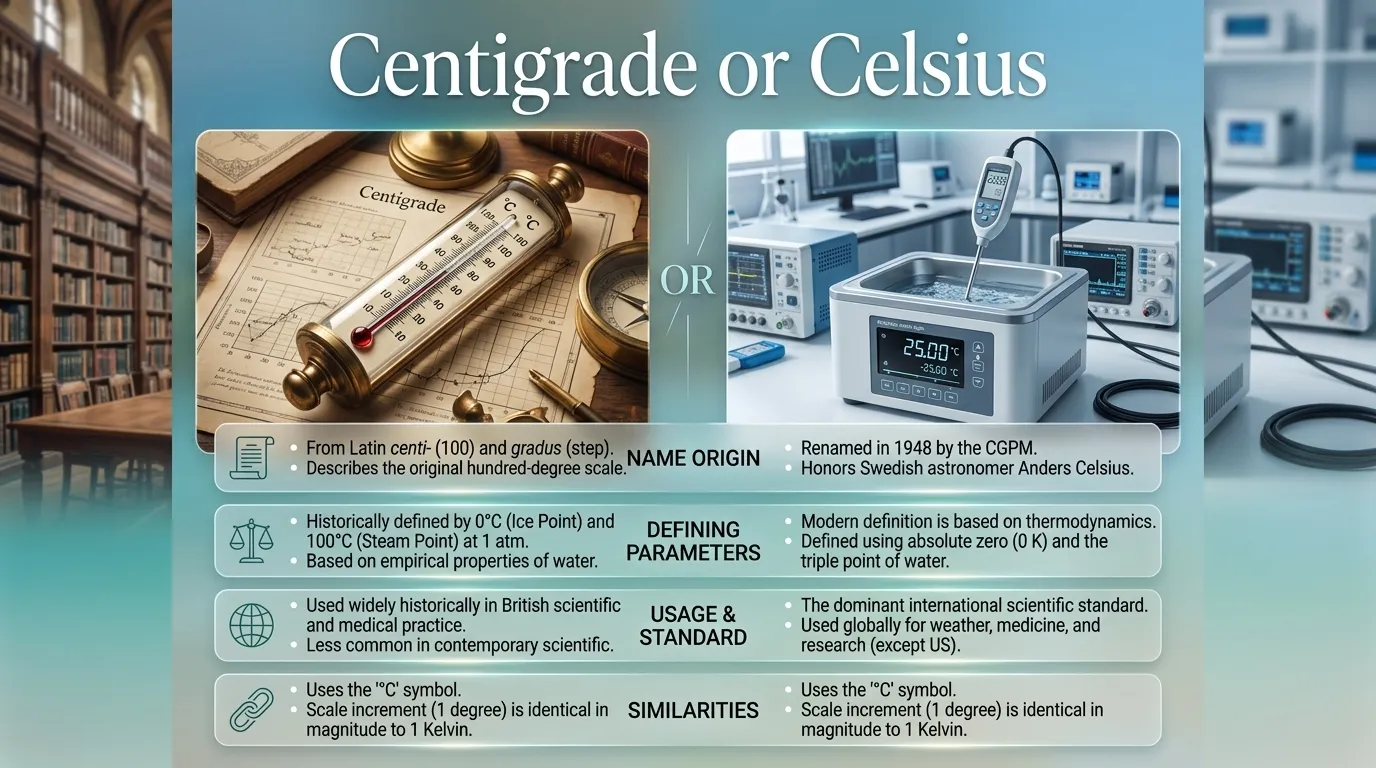
Centigrade and Celsius name the same temperature scale. Celsius is the official name today.
Leo was planning a trip to London. His weather app said 18°C. His grandmother said, “That’s 18 centigrade, dear. Bring a coat.” Leo froze. Were these two different scales? He typed centigrade or celsius into his phone. Now he knows. It is one scale with two names.
Here is the simple truth. “Centigrade” means “100 steps.” The scale has 100 steps between freezing and boiling water. “Celsius” is the same scale, named after Anders Celsius, a Swedish scientist. In 1948, scientists chose Celsius as the official name. Still, many people, mostly older ones, say centigrade. That is why people search centigrade or celsius. They want the right word for school, science, and weather. This guide makes centigrade or celsius easy, with clear tricks and simple examples.
Pronunciation
Centigrade
- US: SEN-tuh-grayd
- UK: SEN-tih-grayd
Celsius
- US: SEL-see-us
- UK: SEL-see-uss
Both words are said with the stress on the first part.
Now let’s see how the two names differ.
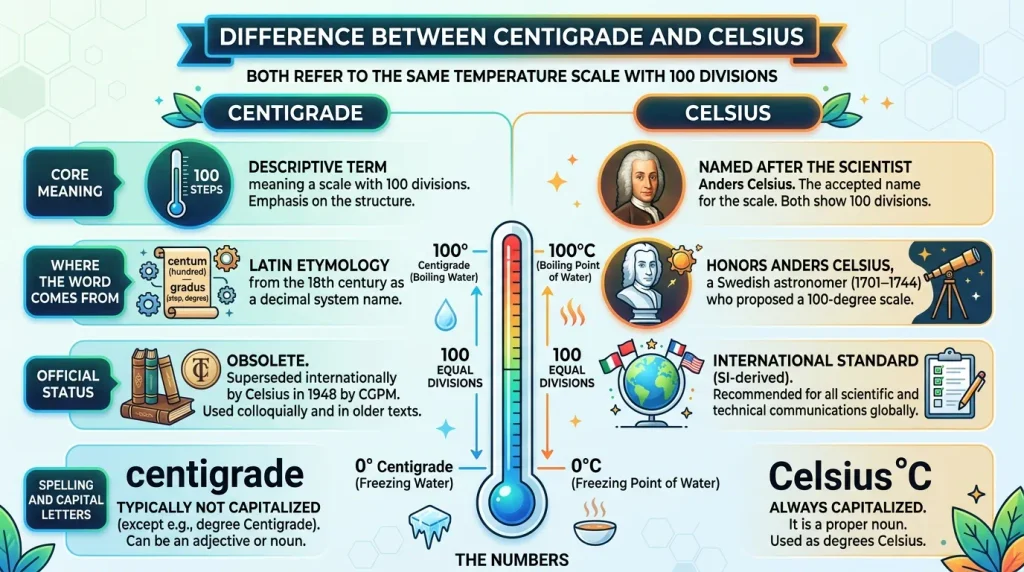
Difference Between Centigrade and Celsius
1. Core Meaning
Centigrade means “100 steps.” Celsius is the name of a scientist.
- Centigrade tells you how the scale is built.
- Celsius tells you who made the scale.
2. Where the Word Comes From
Centigrade comes from Latin. “Centum” means hundred, and “gradus” means step. Celsius comes from the last name of Anders Celsius.
- “Cent” is also in “century” and “percent.”
- Celsius is a person, like Fahrenheit and Kelvin.
3. Official Status
Celsius is the official name. Centigrade is an old name.
- A science test wants “degrees Celsius.”
- An old book may say “degrees centigrade.”
4. Spelling and Capital Letters
Celsius always starts with a capital C, because it is a name. Centigrade starts with a small letter, unless it is at the start of a sentence.
- It is 25 degrees Celsius.
- It was 25 degrees centigrade in the old report.
5. The Numbers
The numbers are the same in both. Water freezes at 0 and boils at 100 (at sea level).
- 0°C and 0 degrees centigrade are the same.
- 100°C and 100 degrees centigrade are the same.
6. Where You See It
Celsius shows up in science, weather apps, schools, and news. Centigrade shows up in old books, old films, and older speech.
- The weather app shows 22°C.
- Grandpa still says, “It’s a warm 22 centigrade.”
7. Tone
Celsius sounds modern and formal. Centigrade sounds old-fashioned, but friendly.
- The report used Celsius.
- My aunt said centigrade out of habit.
8. Other Jobs of the Word
Celsius has one job: naming the scale. In some languages, centigrade also names a tiny unit of angle. That is one reason scientists dropped it.
- Celsius always means a temperature scale.
- Centigrade could confuse a math or map reader.
9. How You Write It
With numbers, write “degrees Celsius” or the symbol °C. The symbol has no space before C in most style guides, but you may see a space in some. “Degrees centigrade” is rare in new writing.
- Write 30°C.
- Write 30 degrees Celsius.
10. The Swap Test
Ask, “Is this new writing or an old quote?” New writing needs Celsius. An old quote can keep centigrade.
- “The lab set the oven to 180 (degrees ___).” Use Celsius.
- “A 1950s thermometer says centigrade.” Keep it.
Explore more about:https://verboix.com/complement-or-compliment/
Quick Cheat Sheet
| Ask yourself | Answer | Word |
| Am I writing for school, science, or news? | Yes | Celsius |
| Do I need the official name? | Yes | Celsius |
| Am I quoting an old book or a person? | Yes | Centigrade (keep it) |
| Am I using the symbol? | Yes | °C |
| Are they two scales? | No | Same scale |
One-line trick: Centigrade = “100 steps.” Celsius = the scientist’s name. Same scale.
Nature and Behaviour of Centigrade and Celsius
Centigrade is a descriptive word. It tells you the scale has 100 steps. It is easy to understand, because “cent” hints at the number 100.Centigrade was popular for a long time, especially in the UK and older schoolbooks. Today it sounds like a word from the past.
Celsius is a name word. It honors a scientist and works like a label. It sits well beside other scale names, such as Fahrenheit and Kelvin.Celsius is the word used in schools, labs, news, and weather apps around the world.
Why People Get Confused About Centigrade and Celsius
There are four simple reasons.
- Older people say centigrade. Younger people hear Celsius. So it seems like two scales.
- Both use °C. The same symbol makes it look like one thing with two names.
- Fahrenheit is in the mix. The US uses Fahrenheit, so any other scale can feel like a puzzle.
- Old books and films. They still use centigrade.
Many people wonder if the numbers change between the two. They do not. 20°C is 20 degrees centigrade.
Exceptions and Tricky Cases
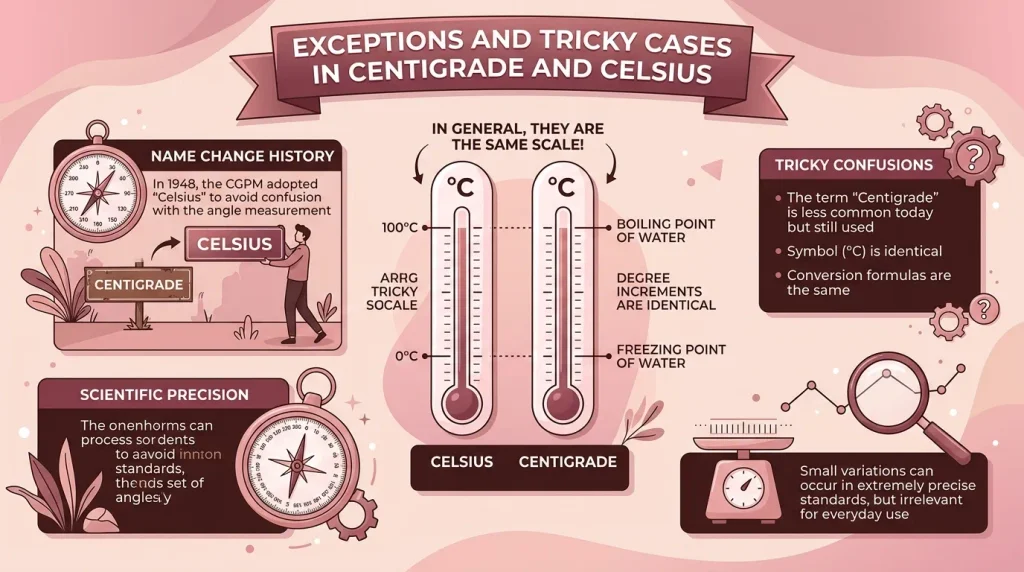
- Centigrade is not wrong in history. If you quote an old text, keep the old word.
- Celsius is capitalized. Kelvin is different. Kelvin does not use the word “degree.” You write 300 K, not 300 degrees Kelvin.
- One degree, many degrees. Write “1 degree Celsius” and “5 degrees Celsius.”
- Celsius is not Fahrenheit. 0°C equals 32°F. 100°C equals 212°F.
- Celsius is not a measure of “heat.” It is a measure of temperature.
Comparison Table
| Point | Centigrade | Celsius |
| Kind of word | Descriptive (“100 steps”) | Name of a person |
| Status today | Old name | Official name |
| Spelling | Lowercase | Capital C |
| Numbers | 0 (freezing), 100 (boiling) | 0 (freezing), 100 (boiling) |
| Where used | Old books, older speech | Science, weather, news, schools |
| Tone | Old-fashioned | Modern and formal |
| Symbol | °C (old use) | °C |
| Scale | The same scale | The same scale |
| Similarities | Same numbers, same symbol, same scale | Same numbers, same symbol, same scale |
| Example | It was 20 degrees centigrade. | It is 20 degrees Celsius. |
Similarities: same scale, same numbers, same symbol.
Usage: use Celsius in new writing. Keep centigrade only for old quotes.
The Origin of Centigrade and Celsius
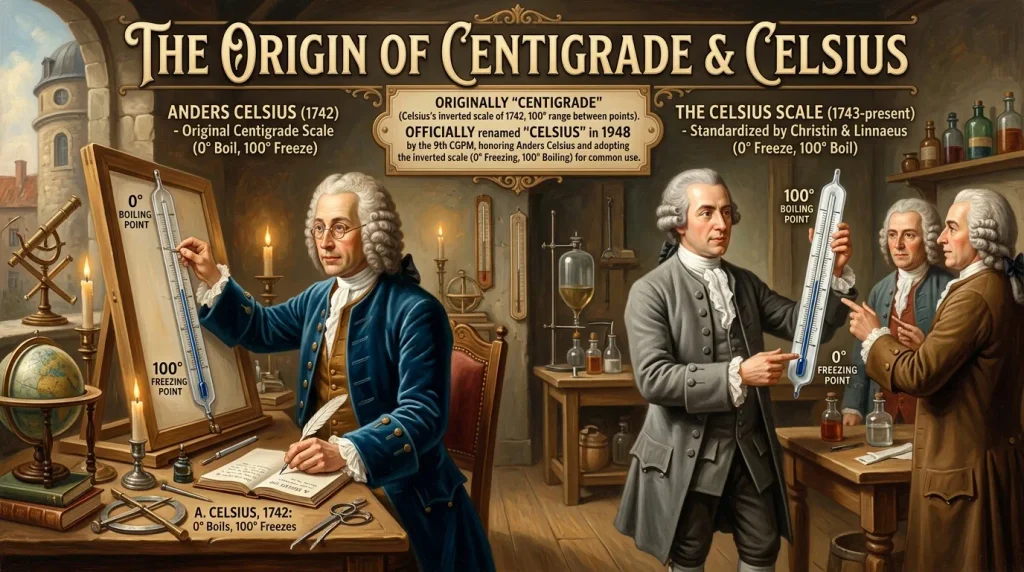
Celsius is named after Anders Celsius, a Swedish astronomer. In 1742, he proposed a temperature scale based on water. His first scale was upside down. Water boiled at 0, and it froze at 100. Soon after, the scale was flipped to the form we use now. People often credit Swedish scientists of that time for the change.
Centigrade is the descriptive name. It comes from Latin words for “hundred” and “step.” It fits because the scale has 100 steps between freezing and boiling. The name was common for a long time.
In 1948, an international group of scientists and measurement experts chose Celsius as the official name. One reason was that “centigrade” also meant a small angle unit in some languages. Celsius ended the mix-up.
British vs American English
Good news. The spelling is the same in both. The bigger change is which scale people use every day.
- Spelling: Celsius and centigrade are the same in the US and UK.
- Sound: Both accents say them in a similar way, with small vowel changes.
- Daily use: The UK uses Celsius for weather. The US uses Fahrenheit in daily life, and Celsius in science.
- Older speech: Some older UK speakers still say centigrade.
Examples:
- UK: Today will reach 22 degrees Celsius.
- US: Today will reach 72 degrees Fahrenheit. (about 22°C)
- UK: My gran still says centigrade.
- US: In science class, we used Celsius.
Which One Should You Use?
- For US readers: Use Celsius in science and school. For weather, give Fahrenheit and add Celsius in brackets, such as 72°F (22°C).
- For UK readers: Use Celsius everywhere. Use centigrade only for an old quote.
- For a global audience: Write °C, and add °F in brackets if you write for the US.
If you feel stuck, use the swap test from above. Celsius is the safe pick.
Common Mistakes
| Mistake | Correction |
| Celcius | Celsius |
| Celcious | Celsius |
| 25 degrees celsius | 25 degrees Celsius |
| 10 degree Celsius | 10 degrees Celsius |
| Centigrade and Celsius are two different scales. | They are the same scale with two names. |
| 300 degrees Kelvin | 300 kelvins (or 300 K) |
Everyday Usage Examples
Emails
- “The room must stay under 25°C.”
- “Please set the oven to 180 degrees Celsius.”
Social media
- “It is 3°C and I am not ready for winter.”
- “My gran still says centigrade. I love it.”
News
- “Temperatures may reach 35°C this weekend.”
- “The fever reached 39 degrees Celsius.”
Formal writing
- “The sample was kept at 4 degrees Celsius.”
- “The report used degrees Celsius for all readings.”
Usage Trends
Around the world, Celsius is now the standard. It is used in science, schools, news, and weather apps in most countries. Centigrade is fading. You will still hear it from older speakers, and you will still see it in old books and films.
The United States is the main country that uses Fahrenheit for daily weather. So many searches for “centigrade or celsius” come from people who travel, study, or read science in English.
Metaphors and Similes
Centigrade
- Metaphor: “Centigrade is the ruler with a hundred marks.” It measures step by step.
- Simile: “He said ‘centigrade’ like an old song, familiar and warm.”
Celsius
- Metaphor: “Celsius is the world’s shared thermometer.” Most people read it the same way.
- Simile: “Her mood dropped like the Celsius reading on a winter night.”
Connotative Meaning
Centigrade
- Positive: Warm and familiar. “Grandpa’s centigrade always made me smile.”
- Neutral: An old word. “The label said degrees centigrade.”
- Negative: Old-fashioned in a science paper. “Using centigrade looked out of date.”
Celsius
- Positive: Clear and trusted. “Celsius made the report easy to read.”
- Neutral: A plain science word. “Water freezes at 0 degrees Celsius.”
- Negative: Confusing for people who only know Fahrenheit. “The Celsius numbers meant nothing to him.”
Idioms and Proverbs
There are no idioms for the words centigrade or Celsius themselves. But temperature ideas make many idioms.
- Boiling point: the moment things reach the limit. “The argument reached boiling point.”
- Freezing point: the level where things stop. “Talks reached freezing point.”
- Break the ice: to start a friendly chat. “A joke broke the ice at the meeting.”
- Take the temperature: to check the mood. “The boss took the temperature of the room.”
- Blow hot and cold: to change your mind again and again. “He blows hot and cold about the plan.”
Literature and Movies
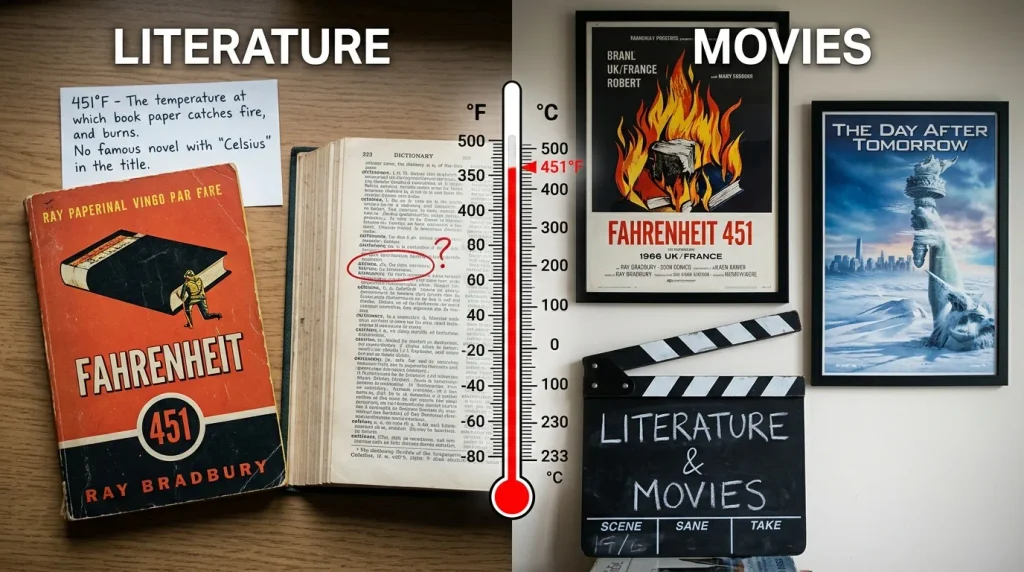
Literature
- Fahrenheit 451 by Ray Bradbury (1953, science fiction). The title uses the Fahrenheit scale, a cousin of Celsius. It refers to the heat at which paper is said to burn.
- There is no famous novel with “centigrade” or “Celsius” in the title. The words live in science and school books.
Movies
- Fahrenheit 451 (1966, UK and France). A film of Bradbury’s book.
- The Day After Tomorrow (2004, USA). A disaster film about sudden cold, where temperature drops are a big part of the story.
Why This Difference Matters
For learners, the right word keeps science clear. If a test asks for the unit, “Celsius” is the right answer. Spelling it “Celcius” can lose marks.
For society, clear units keep people safe. Doctors, cooks, pilots, and engineers all depend on temperature numbers. Using the wrong unit can cause real harm, such as a wrong oven setting or a wrong dose of care. A shared name helps everyone.
Usefulness in Daily Life
- Cooking: Read oven numbers in °C or °F, and check which one.
- Travel: Weather in Europe, Asia, and most places is in Celsius.
- Health: A normal body temperature is about 37°C (98.6°F).
- School: Write “degrees Celsius” on science tests.
- Writing: Use the swap test to pick the right word fast.
Situational Preference
In school and science, use Celsius. It is the official name. In weather news, use Celsius or the symbol °C. When you talk with older people, you may hear centigrade. In old books and films, centigrade may appear. Keep it as it is when you quote. In a US home, people say Fahrenheit for weather, so add both if your readers are American. For global readers, write °C and add °F in brackets. When you feel stuck, ask one question. Is this new writing? Then pick Celsius. Is it an old quote? Then leave centigrade as it is. That is all.
Mini Quiz
Pick Celsius, centigrade, or “same”.
- Water freezes at 0 degrees ____.
- Are Celsius and centigrade two different scales? ____.
- Which name is official today?
- Which spelling is right: Celcius or Celsius?
- Which word starts with a capital letter?
Answers: 1. Celsius (or centigrade, the scale is the same). 2. No, same. 3. Celsius. 4. Celsius. 5. Celsius.
Possible Questions
1. What is the main difference between centigrade and Celsius?
There is no difference in the scale. Celsius is the official name of the scale that was once called centigrade.
2. Are the numbers the same?
Yes. Water freezes at 0 and boils at 100 in both.
3. Why did scientists change the name?
In 1948, they chose Celsius as the official name. One reason was that “centigrade” also named a small angle unit in some languages.
4. Is it wrong to say centigrade?
It is not wrong in speech. But Celsius is the standard in schools, science, and news.
5. Who was Celsius?
Anders Celsius was a Swedish astronomer. He proposed the scale in 1742.
6. How do I change Celsius to Fahrenheit?
Multiply by 9, divide by 5, and add 32. For example, 20°C is 68°F.
7. Is the spelling different in the US and UK?
No. Both spell Celsius and centigrade the same way.
Conclusion
Centigrade or Celsius is easier to understand once you know they are the same temperature scale. Centigrade means “100 steps,” while Celsius honors Anders Celsius. Since 1948, Celsius has been the official name, so it is the better choice for new writing. The scale was created by Celsius in 1742 and later changed to its present form. The spelling is the same in US and UK English, but “Celcius” is a common mistake. For everyday use, choose Celsius. If you see centigrade in an old quote, remember that it means the same scale.











1 thought on “Centigrade or Celsius: Are They Really the Same Thing?”