A carrot is a reward. A stick is a punishment. So, this old saying asks one question: will you use a treat or a threat?Sam runs a small shop. His helper, Lily, is often late. Sam thinks, “Should I give her a bonus for coming on time? Or should I warn her?” His friend hears this and smiles. “That is the classic choice between a treat and a threat,” she says.
Many people see this phrase in books, news, and work emails. As a result, they wonder what it truly means. They also wonder if the right form is “carrot and stick” or “carrot or stick.” Both are used. In fact, the words paint the same picture. A carrot pulls you forward with a prize, while a stick pushes you forward with fear.
People search for this topic because they want to clear up the small mix-up between the two forms. Therefore, this guide gives simple answers, clear examples, and the real story behind the words.
Pronunciation
- Carrot (US): /ˈkær-ət/ (say: KAIR-uht)
- Carrot (UK): /ˈkær-ət/ (say: KA-ruht)
- Stick (US): /stɪk/ (say: STIK)
- Stick (UK): /stɪk/ (say: STIK)
Now, let’s look at the words one by one.
Difference Between Carrot and Stick
1. A Carrot Is a Reward. A Stick Is a Punishment.
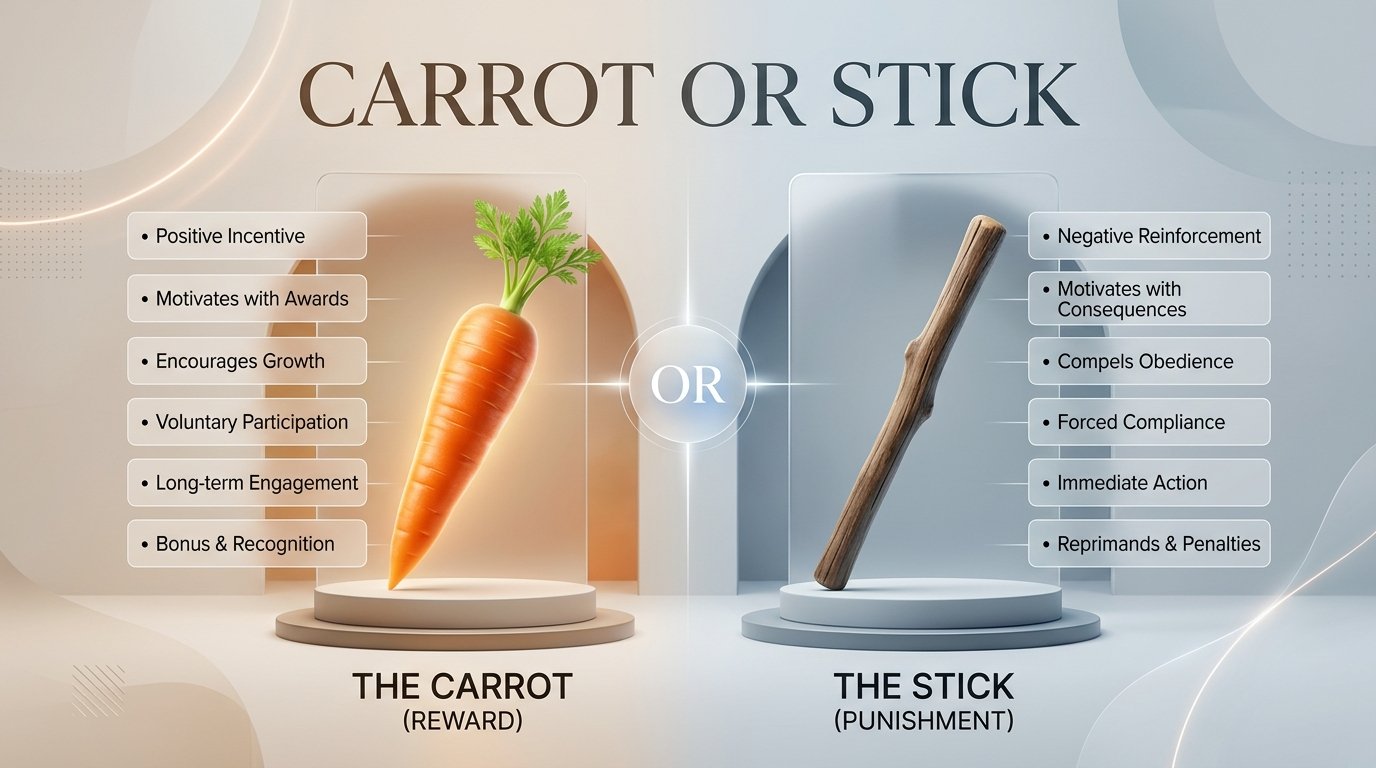
The treat says, “Do this and get something good.” The threat says, “Do this or something bad happens.”
- “If you finish your homework, you get ice cream.” (reward)
- “If you skip homework, no games.” (punishment)
2. One Pulls. One Pushes.
The reward pulls a person toward a goal. The punishment pushes a person from behind.
- A boss offers a big bonus. That pulls.
- A boss warns about losing a job. That pushes.
3. One Feels Good. One Feels Bad.
Rewards bring happy feelings. Threats bring worry.
- A gold star makes a child smile.
- A loud warning makes a child nervous.
4. One Is About Hope. One Is About Fear.
The treat gives hope of something nice. The threat gives fear of something bad.
- “Work hard and you might win a prize.”
- “Work hard or you might lose your seat.”
5. The Treat Is Given. The Threat Is Used.
People hand out treats. People use punishment as a warning.
- A teacher gives extra play time.
- A rule takes play time away.
6. Kindness Can Build Trust. Fear Can Build Worry.
Kind rewards often make people trust you. Harsh threats can make people afraid of you.
- A team likes a coach who praises them.
- A team may fear a coach who yells.
7. Rewards Work Best Over a Long Time.
People often keep working when they enjoy the prize.
- A child reads every day for a sticker chart.
- A worker stays happy because of fair pay.
8. Punishments Often Work Fast but Not for Long.
Fear can make people act quickly. However, it may fade.
- A speeding ticket makes a driver slow down today.
- The driver may speed again next month.
9. In Politics, One Side Offers Help. The Other Applies Pressure.
Countries use both to change what other countries do.
- A reward: money or trade deals.
- A punishment: rules that block trade.
10. Together, They Make One Famous Saying.
The full phrase means using both reward and punishment.
- “The school used a plan with rewards and rules.”
- “The city used both to cut litter.”
Learn more about:https://verboix.com/nana-vs-nanna/
Nature and Behaviour of Carrot or Stick
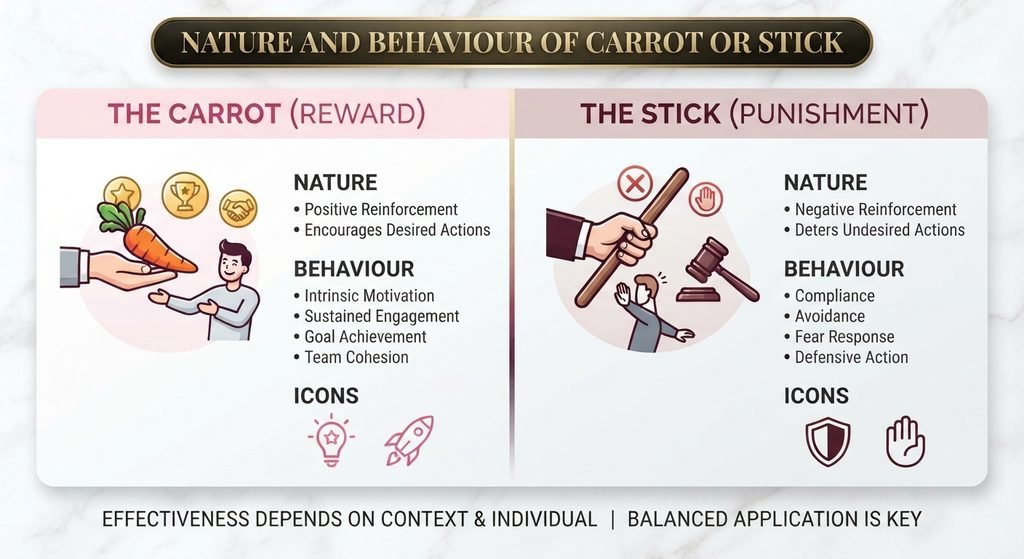
The carrot side is gentle. It says, “Come this way. Here is something you want.” Because of this, it works well when people care about the prize. It can lift hope and effort. But if the prize is too small, people may not try.
The stick side, on the other hand, is firm. It says, “Move, or there will be a cost.” This method works when people fear the cost. Therefore, it can stop bad acts fast. However, if used too much, people may feel angry or scared. As a result, they may only work when someone is watching.
Why People Get Confused About This Phrase
Three things cause the mix-up. First, it comes in many forms: joined by “and,” joined by “or,” and paired with “on a stick.” Second, “and” and “or” change the feel a little, since “and” means using both, while “or” means picking one. Third, “a treat on a stick” sounds close, but it actually points to a different picture: a prize held out of reach. Because of these overlaps, people often blend the forms and mix up the meanings.
Comparison Table
| Feature | Reward (Carrot) | Punishment (Stick) |
|---|---|---|
| Meaning | A prize or treat | A penalty or threat |
| Feeling | Hope, joy | Fear, worry |
| Direction | Pulls forward | Pushes from behind |
| Best for | Long-term habits | Quick stops |
| Risk | Small prize, low effort | Anger, fear |
| In politics | Aid, deals | Rules, threats |
| Example | Bonus pay | Fine or penalty |
The Origin of the Phrase
The saying comes from a simple picture. Imagine a donkey that will not move. So, you can lure it with a treat, or you can hit it with a stick. This picture gave people an easy way to talk about reward and punishment.
Some early English writers, for example, pointed to a cartoon of donkey riders, where one jockey beat his animal while the winner held a treat on a stick. Old records also show this kind of comparison in newspapers in the 1860s.
Likewise, the idea showed up in a letter by Winston Churchill in 1938. He wrote about using every device to make a donkey pull a heavy load. Because of this, the phrase then spread widely in the 1940s, helped by articles in The Economist.
Some experts say there are two old readings. One is a treat dangled on a stick in front of a donkey. The other, however, is a mix of reward and punishment. Today, most people use the second one.
British vs American English
Good news: the spelling stays the same in both. In fact, neither word changes across the two forms of English.
| Use | American English | British English |
|---|---|---|
| Noun phrase | carrot and stick | carrot and stick |
| Adjective | carrot-and-stick approach | carrot-and-stick approach |
| “Or” form | carrot or stick | carrot or stick |
Both countries, therefore, use this idea in politics, business, and schools.
Which One Should You Use?
Use the joined form (“and”) when you mean both reward and punishment together. On the other hand, use the split form (“or”) when you mean a choice between the two. This works in the US, the UK, and around the world. If you mean a treat that is always out of reach, say “a treat on a stick” instead.
Common Mistakes
| Mistake | Correction |
|---|---|
| “carrots and sticks” for one plan | Use the singular form as one set phrase |
| “a treat on a stick” for reward-and-punishment | Use the joined “and” form instead |
| “carrot and sticks” | Keep both words singular |
| Using “or” when both are used | Switch to “and” |
| “cariot” (spelling) | Fix to the correct spelling with two r’s |
Everyday Usage Examples
Email: “We will use a mixed plan. Meet the goal for a bonus. Miss it and we review things.”
Social Media: “Parents, treat or threat? Which one works for chores at your house?”
News: “The government paired rewards with penalties to cut pollution.”
Formal Writing: “The policy pairs incentives with penalties, a classic reward-and-punishment approach.”
Text Message: “Mom offered pizza if I clean my room. Reward time!”
Usage Trends
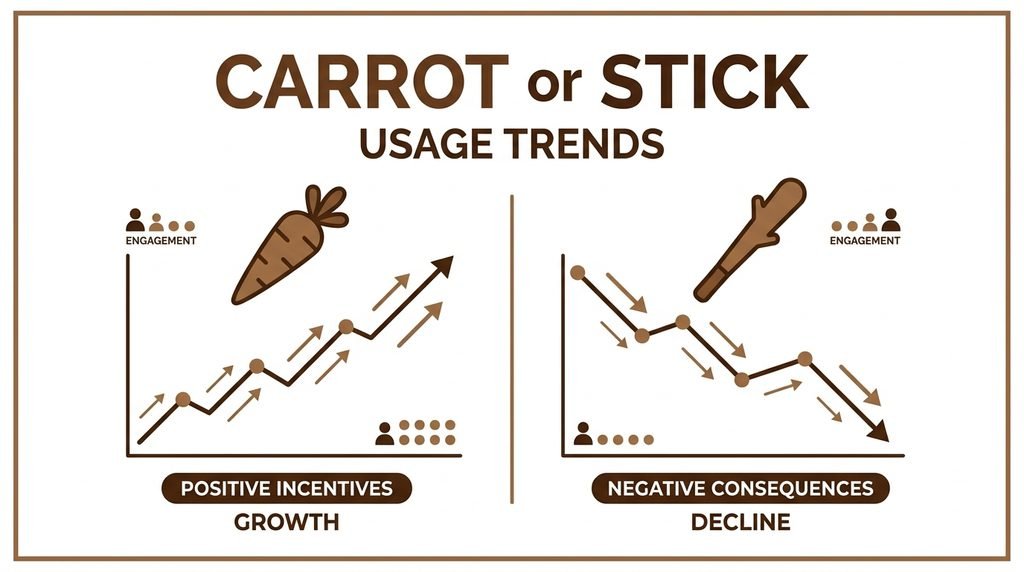
Because both ideas appear constantly in business, politics, and parenting, this saying remains widely used. Writers use it when they talk about rules, pay, and school. It has grown since the 1940s. People online often ask if rewards or penalties work better. Many experts say incentives work better for creative tasks. However, they add that some tasks still need clear rules and limits too. As a result, the saying feels modern, and it is still growing.
Metaphors and Similes
- “A bonus was the treat.” A prize that pulls someone forward.
- “The fine was the punishment.” A penalty that pushes someone.
- “Working for him was like chasing a prize.” You keep trying, but you never reach it.
- “The rules felt like pressure at my back.” The strain felt hard.
Connotative Meaning
- Positive: “The teacher used rewards, and the class loved learning.” (kind, fair)
- Negative: “The boss only used threats.” (harsh, scary)
- Neutral: “The plan has both a reward and a rule.” (plain fact)
Because context shapes tone, the feeling changes with the person who uses it. For instance, a fair mix feels neutral, while too much pressure feels negative.
Idioms and Proverbs
- “Dangle a carrot” means to offer a reward to get someone to act. Example: “The company dangled a raise to keep him.”
- “Speak softly and carry a big stick” is a saying used by US President Theodore Roosevelt in 1901. It means to talk calmly but have strength ready. Example: “She spoke softly and carried a big stick.”
- “The short end of the stick” means getting the worse deal. Example: “He got the short end of the stick.”
- “Carrot top” is a playful name for a person with orange hair. However, this is a different use, not the same idiom.
Literature and Movies
Literature: “Drive” is a nonfiction book by Daniel Pink, published in 2009. It talks about what really motivates people, and it questions how well rewards and penalties work together. Similarly, “Freakonomics” is a nonfiction book by Steven Levitt and Stephen Dubner, published in 2005. It looks at how people respond to incentives and penalties. Please double-check exact details before using them in your own work. Churchill’s 1938 letter, meanwhile, is another real example of this idea’s early use.
Movies: “Whiplash” (2014, USA) shows a teacher who pushes a student very hard, so it is a strong example of the harsh side. “The Godfather” (1972, USA), on the other hand, is a well-known crime film about offers and threats. These films show the idea, although they do not always name the phrase itself.
Why This Difference Matters
Knowing this idea helps learners understand English better. It also helps people in real life, since teachers, parents, and bosses all choose between rewards and rules. Because of this, knowing the words helps you talk about fair ways to guide people. It also helps you read news and books with more clarity. In short, small language habits can shape how we treat each other.
Usefulness in Daily Life
You can use this idea at home, at school, and at work. For example, a parent can offer a fun trip for good grades. Likewise, a boss can set clear rules for late work. A friend can also share a goal and a prize. Knowing the phrase, therefore, helps you spot it when others use it. You can ask, “Is this a reward or a punishment?” That one small question can help you choose kinder and smarter ways to reach a goal.
Situational Preference
Use rewards when you want long-term effort and good feelings, since they can help with learning, teamwork, and new habits. Follow rules, however, when safety or clear limits matter, such as traffic laws. Use both when a plan needs balance. In writing, pick the joined form for a combined plan, but pick the split form when you want to show a choice. In the US, UK, and global writing, both forms are easy to understand and easy to use.
Quick Answers
What does this phrase mean?
It means choosing between a reward and a punishment to get someone to act.
Is it “carrot and stick” or “carrot or stick”?
The joined form is more common for a combined plan, while the split form shows a choice.
Where does the phrase come from?
It comes from the picture of a donkey led by a treat or pushed by a stick.
What is the difference between this saying and “a carrot on a stick”?
The full phrase means reward and punishment. The other one, however, means a treat held out of reach.
Does this idea work in politics too?
Yes. Leaders often use rewards like aid and threats like penalties to shape choices.
Is the phrase the same in the US and UK?
Yes. Both the spelling and the meaning stay the same in both.
Which works better, rewards or punishments?
Many experts say rewards work better over time, although some tasks still need clear rules.
Conclusion
Carrot or Stick pulls people forward. A treat pulls people forward, while a threat pushes them along. Together, they make one of the best-known sayings in English. The picture is simple: a donkey, a prize, and a stick. However, the idea reaches schools, homes, offices, and world leaders. Some people join the words with “and,” while others split them with “or.” Both are understood. Use the joined form for a plan that uses both. Use the split form for a choice. Avoid mixing it up with “a treat on a stick,” which means something else. Rewards often build trust and lasting habits. Threats can stop harm fast, but they can also breed fear. The wise choice often mixes fairness, kindness, and clear limits. Next time you hear Carrot or Stick, picture the donkey. Ask yourself, “Is this a reward or a punishment?” That one question can help you read, write, and lead with more care.