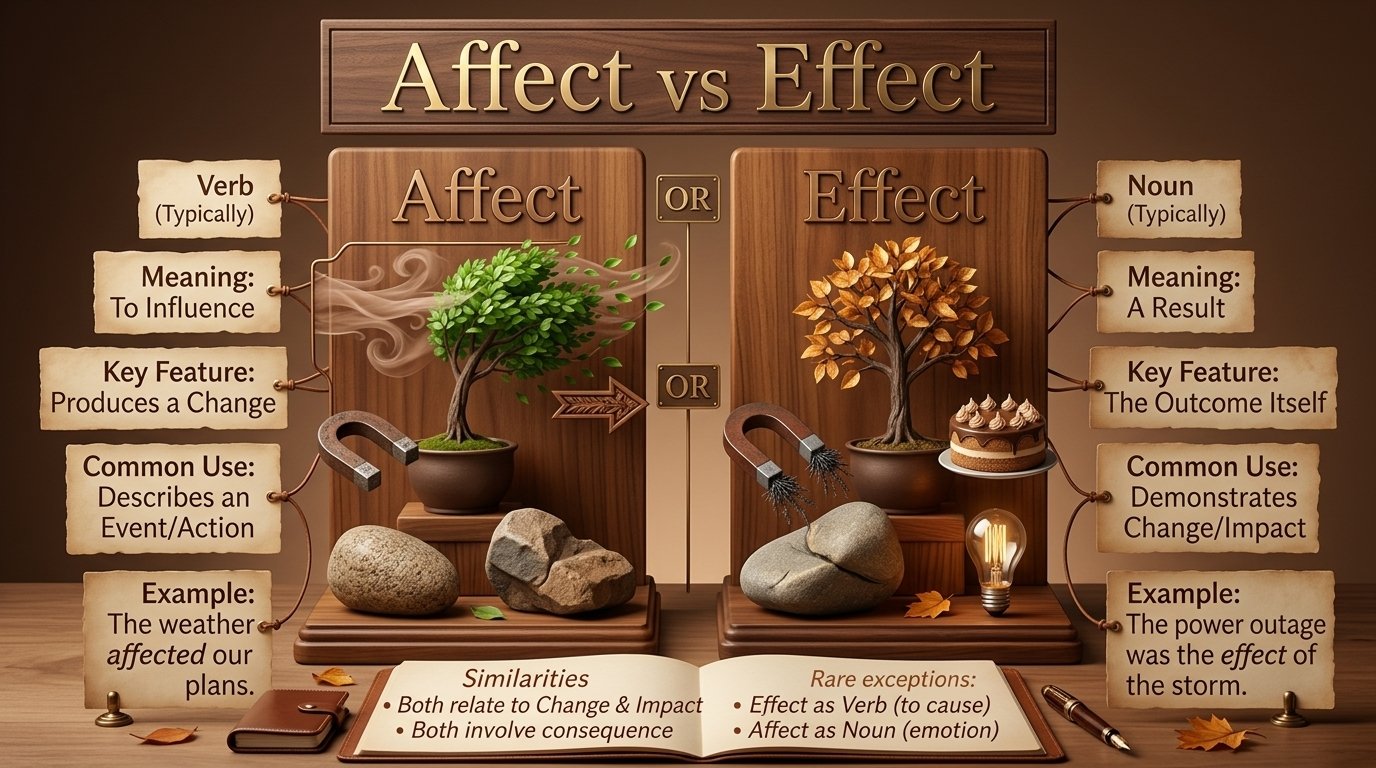
Affect is usually a verb (an action). Effect is usually a noun (a thing or result).Tom writes an email to his boss. He types, “The storm will effect our shipping schedule.” He pauses. Something feels wrong. He deletes it and writes, “The storm will affect our shipping schedule.” Now it feels right. Tom is not alone. Millions of people face this exact moment every single day.
The Affect vs Effect confusion is one of the most common mistakes in English. Affect usually means “to change” or “to influence” something. Effect usually means “a result” or “an outcome.” Because both words sound alike and relate to change, people often swap them by mistake. As a result, this small mix-up shows up in emails, essays, and even news headlines.
People search for Affect vs Effect because they want to sound clear and professional. This guide breaks the confusion down into simple steps, so you never second-guess yourself again.
Pronunciation
- Affect (US): /əˈfɛkt/ (say: uh-FEKT)
- Affect (UK): /əˈfɛkt/ (say: uh-FEKT)
- Effect (US): /ɪˈfɛkt/ (say: ih-FEKT)
- Effect (UK): /ɪˈfɛkt/ (say: ih-FEKT)
Both words sound almost the same when spoken quickly, which is exactly why writing them correctly matters so much.
Now, let’s break down the real difference, step by step.
Difference Between Affect and Effect
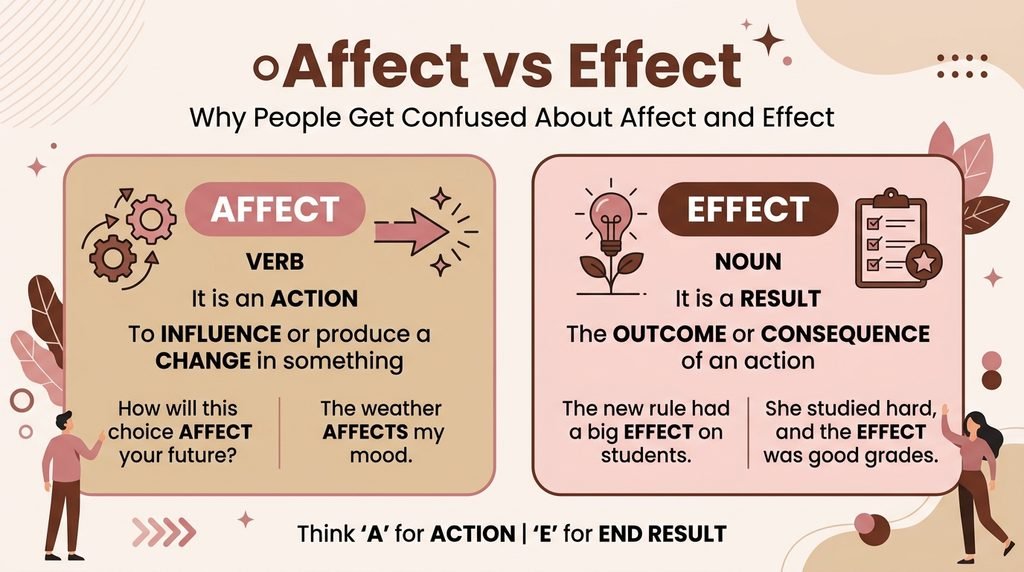
1. Affect Is Usually a Verb. Effect Is Usually a Noun.
Because of this, affect shows action, while effect shows a result.
- “The rain will affect the game.”
- “The rain had a big effect on the game.”
2. Affect Means to Change or Influence Something.
- “Stress can affect your sleep.”
- “Music can affect your mood.”
3. Effect Means the Result of a Change.
- “The medicine had a strong effect.”
- “The new rule had a positive effect.”
4. You Can Count Effects, but Not Affects.
- “There were three effects of the storm.”
- “The storm did not have three affects.” (incorrect)
5. Affect Often Pairs With Feelings or Health.
- “The news affected her deeply.”
- “Sadness can affect your energy.”
6. Effect Often Pairs With Results in Science or Business.
- “The drug’s effect lasted six hours.”
- “The policy had a strong effect on sales.”
7. “Take Effect” Is a Common Fixed Phrase.
- “The new law will take effect in June.”
- “The rule takes effect tomorrow.”
8. Affect Rarely Follows “The” Directly.
- Wrong: “The affect was huge.”
- Right: “The effect was huge.”
9. Effect Can Rarely Be a Verb Too.
As a verb, effect means “to cause” or “to make happen.”
- “The team hopes to effect change.”
- “Leaders often try to effect real change.”
10. Affect Is More Common in Daily Speech.
- “How did that affect you?”
- “What was the effect?” (also common, but slightly more formal)
Nature and Behaviour of Affect and Effect
Affect behaves like an action word. It shows movement, change, or influence happening in real time. Because it usually works as a verb, it often sits right before a noun, showing what gets changed.
Effect, on the other hand, behaves like a finished result. It usually names the outcome after something has already happened. Since it works mainly as a noun, it often follows words like “the,” “an,” or “a.”
Read more about:https://verboix.com/selling-or-saling/
Why People Get Confused About Affect and Effect
Three reasons cause most of the confusion. First, both words sound nearly identical when spoken. Second, both words relate closely to the idea of change. Third, “effect” can sometimes act as a verb too, which breaks the simple “verb vs noun” rule people rely on. Because of these overlaps, even careful writers slip up sometimes.
Comparison Table
| Feature | Affect | Effect |
| Word type | Usually a verb | Usually a noun |
| Meaning | To influence or change | A result or outcome |
| Common phrase | “affect your mood” | “take effect” |
| Can be counted | No | Yes |
| Rare second use | Noun (emotional expression, in psychology) | Verb (to cause) |
| Everyday frequency | Very common | Very common |
The Origin of Affect and Effect
Both words trace back to Latin. “Affect” comes from the Latin word “afficere,” which means “to influence” or “to act upon.” “Effect” comes from “efficere,” meaning “to accomplish” or “to bring about.” Since both Latin roots relate to action and result, it makes sense that English speakers later confused these two words, especially as pronunciation grew closer over centuries.
British vs American English
Good news here: both words are spelled and used the same way in British and American English. Neither country treats this as a spelling difference. Instead, the confusion is purely about meaning and grammar, not regional spelling rules like “colour” versus “color.”
| Word | American English | British English |
| Affect | Verb (mainly) | Verb (mainly) |
| Effect | Noun (mainly) | Noun (mainly) |
Which One Should You Use?
If you are describing an action or change, use “affect.” If you are describing a result or outcome, use “effect.” This rule works the same in the US, the UK, and everywhere else English is spoken. When unsure, try this quick trick: if you can replace the word with “influence,” use “affect.” If you can replace it with “result,” use “effect.”
Common Mistakes
| Mistake | Correction |
| “The news will effect my decision.” | “The news will affect my decision.” |
| “The effect was very strong on him.” | “The effect on him was very strong.” |
| “This had a big affect on sales.” | “This had a big effect on sales.” |
| “We need to affect real change.” | “We need to effect real change.” (rare, formal use) |
| “How did it effected you?” | “How did it affect you?” |
Everyday Usage Examples
Email: “Please note that the delay may affect your delivery date.”
Social Media: “This weather is really affecting my mood today!”
News: “Experts say the new policy will have a lasting effect on the economy.”
Formal Writing: “The study examined the effect of sleep on memory performance.”
Text Message: “Ugh, this headache is affecting my whole day.”
Usage Trends
Because both words appear constantly in news, business, and science writing, this remains one of the most searched grammar topics online. As more people write emails and reports quickly, small mix-ups continue to rise. However, grammar tools and spellcheckers now catch many of these errors, which slowly helps more writers get it right.
Metaphors and Similes
- “Ripple effect” describes one action causing many smaller results. Example: “His kindness created a ripple effect through the office.”
- “Affected like a leaf in the wind” describes someone easily influenced. Example: “She was affected like a leaf in the wind by every rumor.”
- “Domino effect” describes one event triggering a chain of others. Example: “The layoff caused a domino effect across departments.”
Connotative Meaning
- Positive: “The kind words had a wonderful effect on her mood.” (uplifting)
- Negative: “The harsh criticism affected his confidence badly.” (harmful)
- Neutral: “The medicine’s effect lasted two hours.” (plain fact)
Because context shapes tone so strongly, the same word can feel gentle or harsh depending on the sentence around it.
Idioms and Proverbs
- “In effect” means “in reality” or “basically.” Example: “In effect, the plan failed.”
- “Cause and effect” describes how one action leads directly to a result. Example: “Every action has a cause and effect.”
- “Take effect” means a rule or change begins to apply. Example: “The new law takes effect next month.”
Literature and Movies
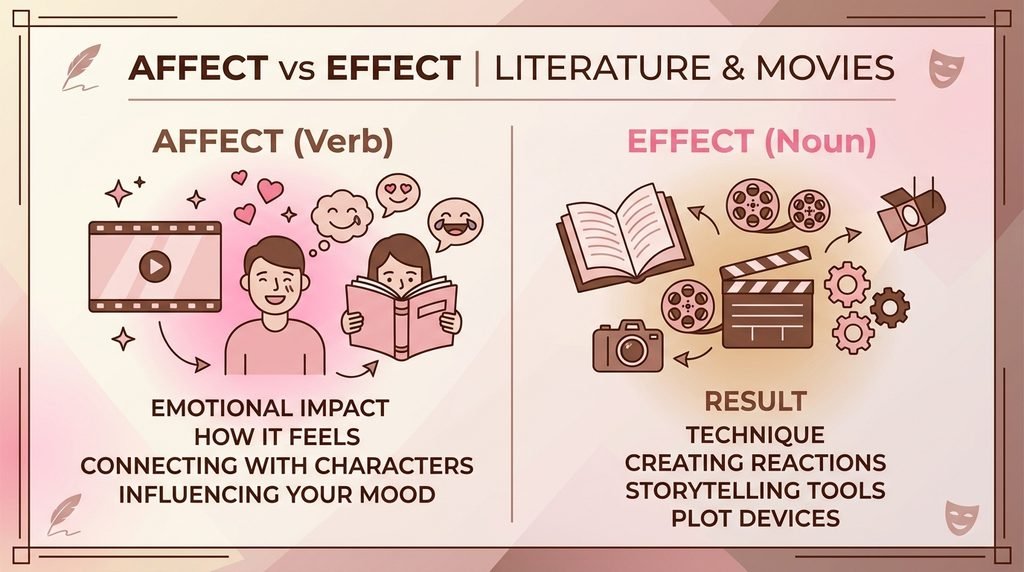
Literature: Many grammar guides and style books, such as Strunk and White’s “The Elements of Style” (1959, USA), specifically address the affect vs effect confusion as a classic writing trap. Please double-check exact editions before citing this as a source.
Movies: “The Butterfly Effect” (2004, USA) uses the word “effect” directly in its title, showing how one small change can create huge, unexpected results later. This is a well-known and easily verified reference.
Why This Difference Matters
Getting this right matters more than people realize. A wrong word can confuse readers or make writing look careless, especially in job applications, business emails, or school papers. Since clear communication builds trust, learners benefit greatly from mastering this small but powerful grammar rule.
Usefulness in Daily Life
Knowing this difference helps in real, everyday moments. It helps you write clearer work emails and reports. It helps you sound more confident during interviews or presentations.This also helps you understand news articles and studies more accurately, especially when they discuss results and outcomes.
Situational Preference
Use “affect” whenever you describe an action, influence, or change happening to something. Use “effect” whenever you describe the result or outcome of that change. In academic writing, both words appear often, so double-checking your sentence structure helps avoid mistakes. In casual writing, like texts or social media, small slips are common and usually forgiven. However, in professional writing, getting this right builds credibility. When in doubt, always apply the simple “influence vs result” trick before hitting send.
Quick Answers
What is the easiest way to remember affect vs effect?
Affect is an action (verb), and effect is an ending result (noun).
Can effect ever be a verb?
Yes, but rarely. “Effect” as a verb means “to cause,” as in “effect change.”
Can affect ever be a noun?
Yes, but this use is rare and mostly appears in psychology, meaning an emotional expression.
Is this difference the same in British and American English?
Yes, both countries use the words the same way.
Why do people confuse these two words so often?
They sound alike and both relate closely to change, which causes frequent mix-ups.
Is there a quick trick to choose the right word?
Yes, replace the word with “influence” for affect, or “result” for effect.
Does this mistake matter in casual writing?
It matters less casually, but it still affects how professional your writing looks.
Conclusion
Affect and effect may sound alike, but they play very different roles in English. Affect usually shows an action or influence, while effect usually shows a finished result. This small but important difference shapes how clear and professional your writing feels, whether in emails, reports, or everyday conversations.Remembering the simple trick, “affect equals action, effect equals ending,” can save you from constant second-guessing. Since both words appear constantly in daily life, mastering this rule pays off quickly. Over time, using them correctly becomes second nature, and your writing naturally grows clearer and more confident.The next time you sit down to write, pause for just a second. Ask yourself: am I describing an action, or a result? That one simple question can instantly guide you toward the right word, every single time.












1 thought on “Affect vs Effect: Easy Difference + Memory Trick”