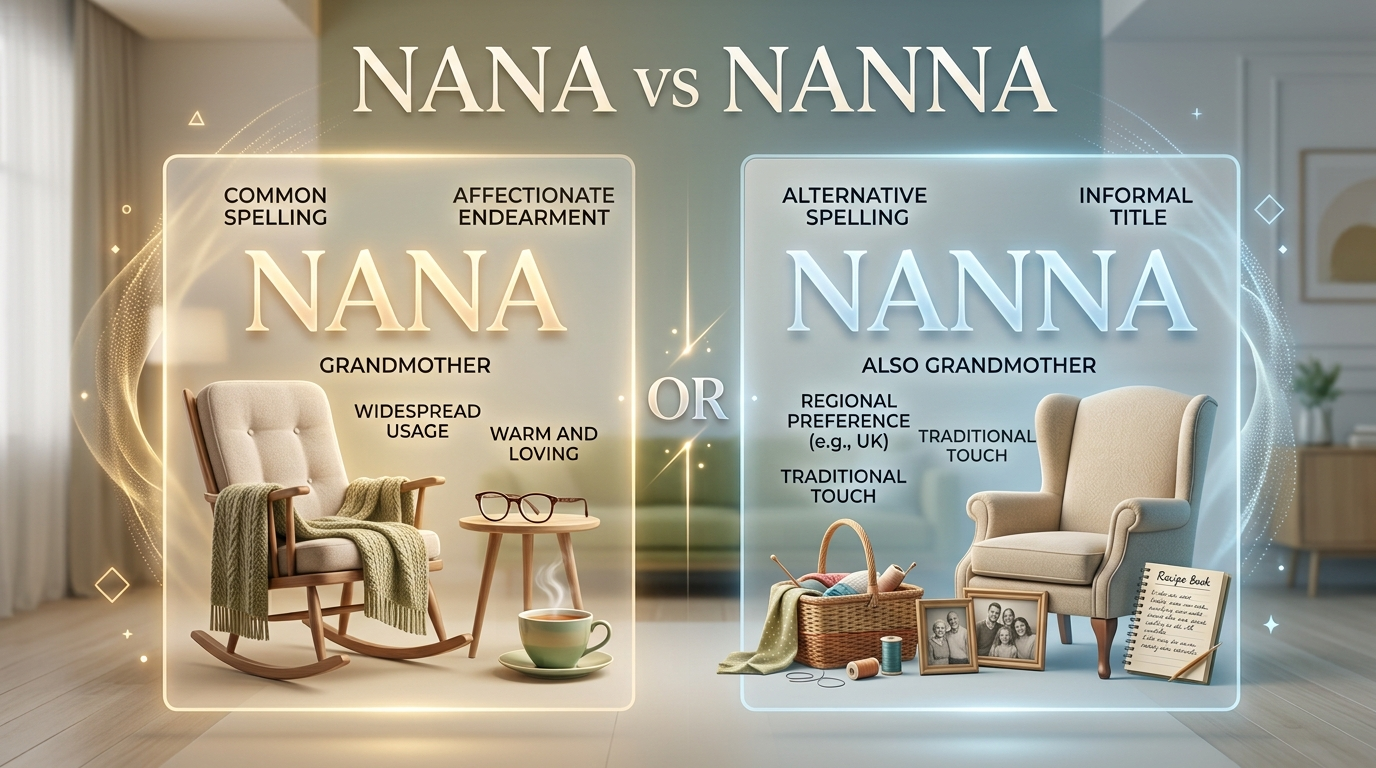
Both words can mean grandmother, but the Nana vs Nanna difference is that “Nana” has extra meanings, while “Nanna” mostly has one. For example, Ella writes a card for her grandmother that says, “Happy Birthday, Nana!” Her cousin in London reads it and grins. Meanwhile, her friend in Sydney writes “Nanna” on her own card. Nobody is wrong, but the Nana vs Nanna question can still cause confusion. Both words are loving names for grandmother. Nana is the shorter spelling, while Nanna has an extra “n.” However, in British English, “nana” can also mean a silly person. It can also be a short word for banana. Nanna does not carry these extra meanings. That is why people search for Nana vs Nanna. Above all, they want to know which spelling is safe. This guide clears up the confusion with simple facts, real examples, and clear advice.
Pronunciation
- Nana (US): /ˈnæn-ə/ (say: NAN-uh). Some people say /ˈnɑː-nə/ (NAH-nuh).
- Nana (UK): /ˈnæn-ə/ (NAN-uh) for grandmother. /ˈnɑː-nə/ (NAH-nuh) for the “fool” meaning.
- Nanna (US): /ˈnæn-ə/ (say: NAN-uh)
- Nanna (UK): /ˈnæn-ə/ (say: NAN-uh)
As a result, the two words often sound the same when they mean grandmother.
So, let’s look at the small but real differences.
Difference Between Nana and Nanna
1. The spelling is different.
Nana has one “n” in the middle, while Nanna has two.
- “I called Nana today.”
- “I called Nanna today.”
2. Nana has more meanings.
Nana can mean grandmother, a nanny, or a fool. However, nanna mainly means grandmother.
- “My nana lives in Ohio.”
- “The nana watched the baby.” (nanny meaning)
3. Nana can mean “fool” in the UK.
This is British slang. Nanna, on the other hand, does not mean this.
- “Don’t be a nana!” (UK slang)
- “Nanna gave me a hug.” (always grandmother)
4. Nana can be short for banana.
Some people also use it as a casual word for the fruit. Since the meaning changes, context matters.
- “I ate a nana for lunch.”
- “Pass me a nana, please.”
5. Some dictionaries treat nana as a form of nanna.
One online dictionary calls “nana” a variant spelling of “nanna.” As a result, nanna is often seen as the base spelling.
- Nanna is often the base spelling.
- Nana is a common short form.
6. The two spellings live in different places.
Nana is used in parts of the US, especially the Northeast. In Britain and Australia, however, both are heard.
- A child in Boston says “Nana.”
- A child in Melbourne says “Nanna.”
7. Pronunciation can differ.
Nana can be said NAN-uh or NAH-nuh. Nanna, in contrast, is almost always NAN-uh.
- “NAH-nuh” means fool in the UK.
- “NAN-uh” means grandmother.
8. Nanna is clearer in writing.
It avoids the fool and banana meanings. Therefore, it is a safer choice when you write for many readers.
- “Nanna is coming to dinner.” (clear)
- “Nana is coming to dinner.” (also clear, but has more meanings)
9. Nana is also a common given name.
People in many countries are named Nana. Likewise, Nanna is a name too, and it is also a goddess in Norse myth.
- “Nana Mensah” is a common name in Ghana.
- “Nanna” is the name of a goddess in Norse stories.
10. Both are informal.
Neither is used in formal writing. Instead, both are warm family words.
- Formal: “My grandmother is ninety.”
- Casual: “My nana is ninety.”
Explore more about:https://verboix.com/selling-or-saling/
Nature and Behaviour of Nana and Nanna
Nana is a busy word. It works as a family name, a pet name, and a bit of slang. Its meaning also depends on where you are and who says it. As a result, it is fun but a little tricky.
Nanna is a calmer word. It nearly always means grandmother, so it feels warm and homey. In writing, therefore, it leaves little room for a mix-up.
Why People Get Confused About Nana and Nanna
Three things cause the mix-up. Firstly, the words look almost the same. Secondly, they often sound the same when they mean grandmother. Thirdly, “nana” has other meanings, like fool or banana, so people wonder if it is “safe.” In the end, both spellings are fine for grandmother. In fact, the only real danger is a mix-up of meaning, not spelling.
Comparison Table
| Feature | Nana | Nanna |
| Main meaning | Grandmother | Grandmother |
| Other meanings | Nanny, fool (UK slang), banana | Few in English |
| Spelling | One “n” | Two “n”s |
| Pronunciation | NAN-uh or NAH-nuh | NAN-uh |
| Common places | US (Northeast), UK, Australia | UK, Australia |
| Formality | Informal | Informal |
| Risk of mix-up | Higher | Lower |
The Origin of Nana
Both words come from baby talk. For instance, small children say sounds like “na-na” very early. Then adults turn these sounds into pet names. Dictionaries record “nana” as a child’s word for grandmother or nurse, first seen around 1844. Also, it is linked to the word “nanny.”
“Nanna” has a similar story. One dictionary says it may come from an old Celtic word for grandmother, but it likely began as imitation of child speech. Similarly, a word in Greek meant “aunt,” and a word in Latin meant “old woman.”
The slang meaning is separate, since the British slang word “nana,” meaning a fool, likely comes from banana.
British vs American English
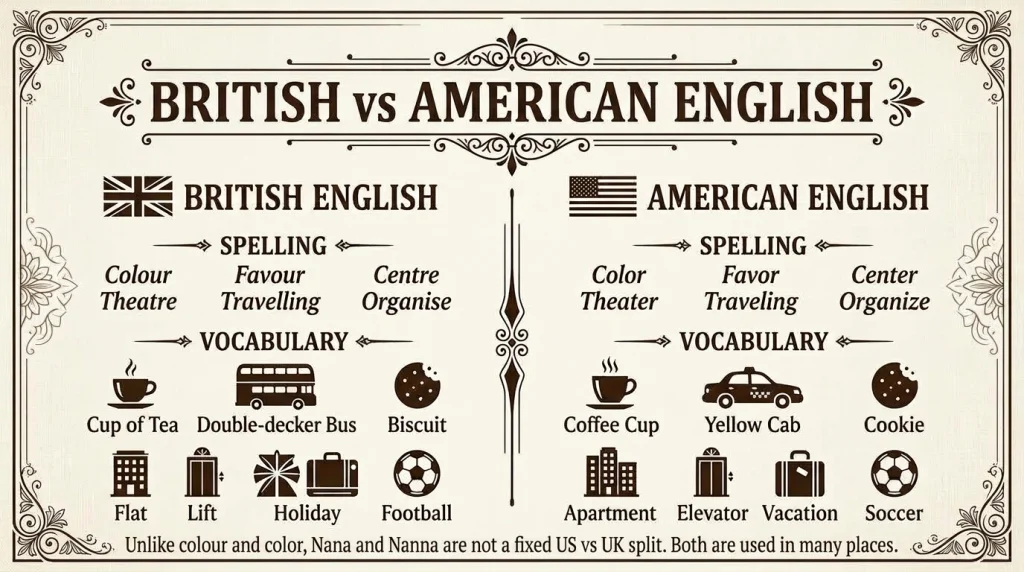
Both spellings appear on both sides of the ocean. However, in the US, “nana” is used mainly in the Northeast to mean grandmother. In Britain, Australia, and New Zealand, “nana” also means grandmother. Besides, Britons often say “nan,” which is very common.
| Word | American English | British English |
| Nana | Grandmother (esp. Northeast) | Grandmother, or slang for a fool |
| Nanna | Less common | Common for grandmother |
| Nan | Rare | Very common for grandmother |
There is no strict rule here. Instead, it is about habit and region.
Which One Should You Use?
- US readers: Use “Nana” because it is the familiar choice.
- UK and Australian readers: Use “Nanna” or “Nan.” Nana is fine too, but remember the slang meaning.
- Global readers: “Nanna” is the safest, since it has fewer extra meanings.
In personal writing, however, follow your family’s spelling.
Common Mistakes
Because the words are so close, small errors are common. Here are the ones to watch for.
| Mistake | Correction |
| Thinking one spelling is wrong | Both are accepted for grandmother |
| Using “nana” as a joke without knowing UK slang | Know that it can mean “fool” in Britain |
| Mixing both spellings in one text | Pick one spelling and stay with it |
| Mixing up “nanna” with “nanny” | Nanna is grandmother; nanny is a paid carer |
| Writing “nanna” as one “n” by accident | Check your spelling twice |
Everyday Usage Examples
For example, here is how each spelling can look in real life.
Email: “I’m visiting Nanna this weekend, so do you want to come?”
Social Media: “Sunday lunch at Nana’s house was the best day ever!”
News: “The charity honored local grandmothers, or ‘nannas,’ at a party.”
Formal Writing: “Many children use pet names such as Nana or Nanna for their grandmothers.”
Text Message: “Nan just called because she’s bringing cake.”
Usage Trends
Both spellings stay popular in family talk, cards, and social posts. For example, online shops often list both on gifts like mugs and photo frames. Also, people search for each spelling every day. Although the slang meaning of “nana” keeps some writers careful, it does not stop its use as a loving name. As a result, there is no single “winner” across the world.
Metaphors and Similes
Comparisons with grandmother words feel warm because they bring up family memories.
- “Warm as Nanna’s kitchen” means very cozy. Example: “The cafe felt warm as Nanna’s kitchen.”
- “Soft as Nana’s hug” means gentle and safe. Example: “The blanket was soft as Nana’s hug.”
- “Wise as a nana” means kind and sensible. Example: “My teacher is wise as a nana.”
Connotative Meaning
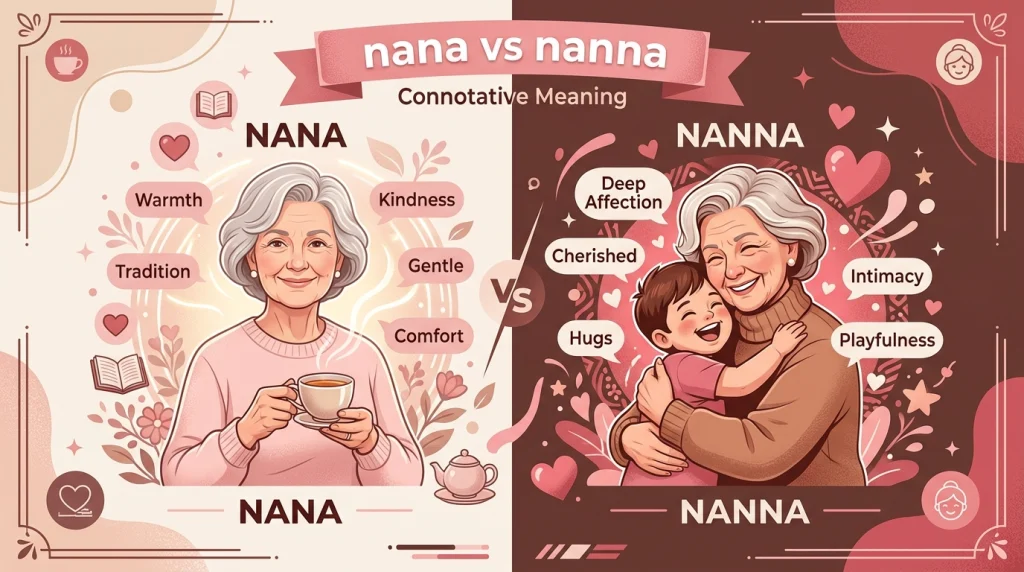
- Positive: “Nanna always makes me feel safe.” (love, comfort)
- Neutral: “She calls her grandmother Nana.” (simple fact)
- Negative: “Don’t be such a nana.” (UK slang for a fool, a little rude)
Context matters. For instance, as a family name, “nana” is warm. However, as slang, it can sting.
Idioms and Proverbs
- “Off one’s nana” is Australian slang that means “wild” or “out of control.” Example: “You must be off your nana!”
- “Do one’s nana” is Australian slang that means “get very angry.” Example: “Dad did his nana when I broke the vase.”
- “Just like Nan used to make” means old-fashioned and homemade. Example: “This pie is just like Nan used to make.”
Please note that the first two are slang, so use them only if your readers know them.
Literature and Movies
Literature: Peter Pan is a play by J. M. Barrie, first staged in 1904. It has a dog named Nana who acts as the family’s nursemaid. This fits the older “nurse” meaning of the word. Nana is also a novel by Émile Zola, published in France in 1880. However, its title character is a young woman, not a grandmother.
Movies: Peter Pan (1953, USA) is a Disney film that also features Nana the dog. Nana (2005, Japan) is a film about two women who share the name, so it is not about grandmothers.
Why This Difference Matters
Words shape how others see us. Small choices can therefore change the meaning of a message. For example, a British reader may smile at “nana” as a joke, while an American reader sees only a loving name. Knowing this helps learners write clearly. It also helps families, teachers, and writers speak to a global audience with care.
Usefulness in Daily Life
You can use this in real life. Firstly, you can pick the right spelling for a birthday card. Secondly, you can avoid an awkward joke in a message to a friend abroad. In addition, you can label family photos with confidence. Finally, you can teach kids that words can have more than one meaning. Overall, this is a small skill, but it makes writing warmer and clearer.
Situational Preference
Use “Nana” in the US, and for family writing where your family already uses it. On the other hand, choose “Nanna” for UK or Australian readers, or when you want to avoid the slang meaning. Also, use “Nan” when writing casually in the UK. In business writing, pick one spelling and stick with it. If your readers come from many countries, “Nanna” is therefore the safer choice. In a family card, however, always follow your family’s habit, because love matters more than the rulebook.
Quick Answers
Is it nana or nanna?
Both are accepted for grandmother, but “nanna” has fewer other meanings.
Does “nana” mean something rude in the UK?
It can. In British slang, “nana” can mean a fool.
Are nana and nanna pronounced the same?
Often yes, since both can be said NAN-uh.
Is nana the same as nanny?
No. Some dictionaries list “nanny” as one meaning of “nana,” but today it mostly means grandmother.
Which spelling is more common in the US?
“Nana” is the usual choice in the US, especially in the Northeast.
Is nanna common in Australia?
Yes, because Australians often use “Nanna” or “Nan” for grandmother.
Should I keep one spelling in my writing?
Yes, since picking one spelling keeps your text clear.
Conclusion
The Nana vs Nanna question is simple because both are warm words for grandmother. They come from the same baby-talk roots, but the Nana vs Nanna difference comes from their extra meanings and regional use. For example, Nana can also mean a nanny, a fool in British slang, or a short word for banana, while Nanna mostly keeps one meaning. Region and family habit also matter, since Nana vs Nanna can vary across the US, UK, and Australia. Therefore, neither spelling is wrong, and the best choice depends on your family and readers. If you write for a global audience, “Nanna” can be a clear choice. Most importantly, the Nana vs Nanna choice is about the love behind the word. A card that says “Nana” or “Nanna” can make a grandmother smile. So pick the spelling your family loves, and use it consistently.







2 thoughts on “Nana vs Nanna Difference: Spelling, Meaning, and UK Slang”