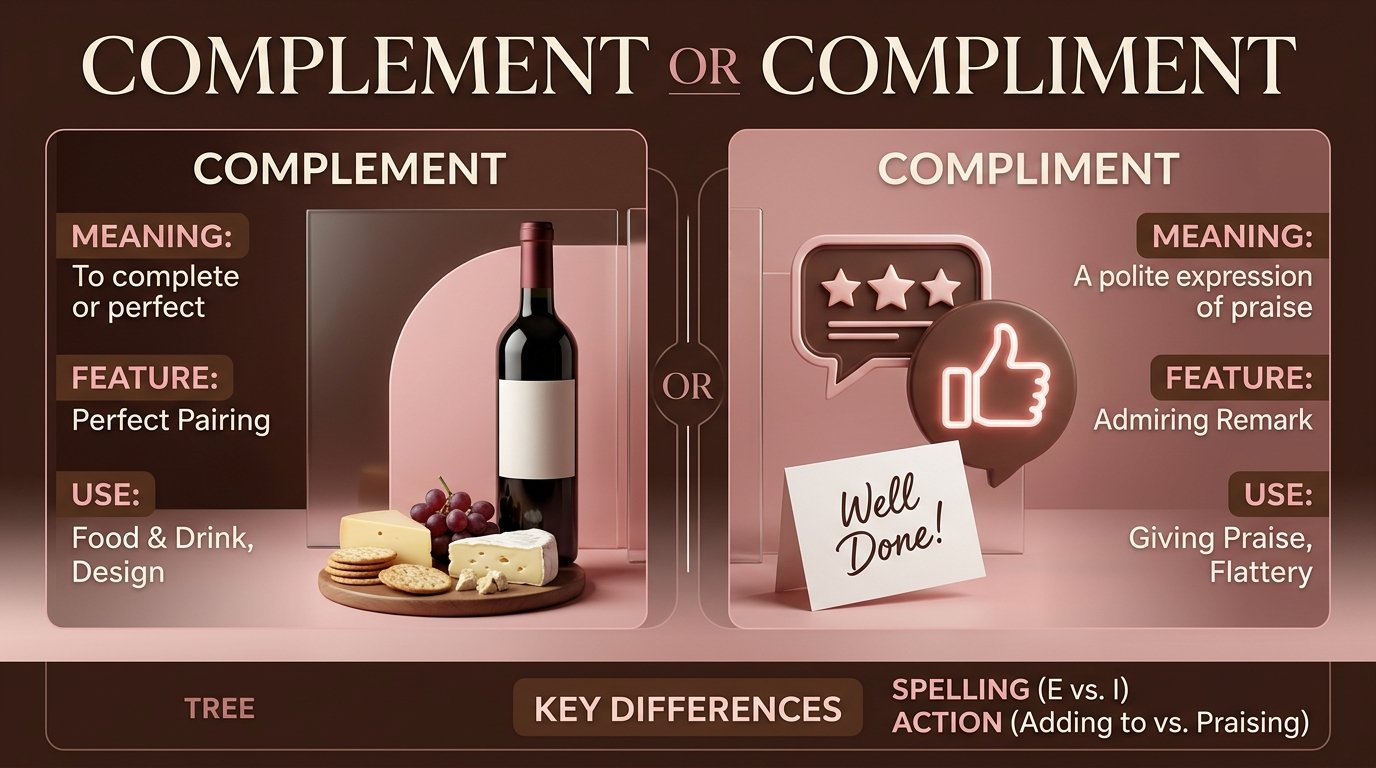
Complement means to complete or go well with something. Compliment means to say something kind about someone.
Ali wanted to thank his boss. He wrote, “Thanks for the complement.” His friend smiled. “You mean compliment,” she said. Ali felt shy. That night, he typed complement or compliment into Google.
Here is the simple truth. A complement completes a thing. Think of a tie that matches a shirt. A compliment is praise. Think of “Great job!” The two words sound the same. They look almost the same. That is why the complement or compliment question is so common. People search for it to fix a mistake before they hit send.
This guide ends the confusion. You will get easy rules, quick tricks, and real examples. Soon, complement or compliment will feel simple.
Pronunciation
Complement
- Noun: US: KAHM-pluh-munt. UK: KOM-pluh-munt.
- Verb: US: KAHM-pluh-ment. UK: KOM-pluh-ment.
Compliment
- Noun: US: KAHM-pluh-munt. UK: KOM-pluh-munt.
- Verb: US: KAHM-pluh-ment. UK: KOM-pluh-ment.
Both words sound the same. Only spelling and meaning tell them apart.
Now let’s see how they differ.
Difference Between Complement and Compliment
1. Core Meaning
Complement means to complete or improve. Compliment means to praise.
- Lemon is a good complement to fish.
- My teacher paid me a compliment.
2. Spelling
Complement has an e. Compliment has an i.
- The rug is a complement to the room.
- She gave me a compliment at lunch.
3. Memory Trick
Complement has “e” like “complete.” Compliment has “i” like “I like it.”
- Salt and pepper complement each other. They complete a meal.
- “I like your bag” is a compliment.
4. What It Is About
Complement is often about things that fit together. Compliment is about people and what they do.
- The music is a complement to the film.
- He got a compliment for his speech.
5. Feeling
Complement is neutral. Compliment is warm.
- A cool color can complement a warm one.
- Her compliment made him smile.
6. Noun Meaning
As a noun, complement is a part that completes. Compliment is a kind remark.
- The ship has a full complement of sailors.
- Thank you for the compliment.
7. Verb Meaning
As a verb, complement means to go well with. Compliment means to praise.
- This sauce complements the pasta.
- Please compliment the cook.
8. Adjective Form
Complementary means “fits well together.” Complimentary means “praising” or “free.”
- Blue and orange are complementary colors.
- The hotel gave us complimentary tea.
9. Plural Meaning
Complements are parts that complete each other. Compliments can mean praise or polite greetings.
- The two tools are complements.
- Send my compliments to the chef.
10. The Swap Test
Swap in “praise” and see if it fits. If yes, use compliment. If “complete” or “go well with” fits, use complement.
- “She gave me a (praise).” Use compliment.
- “Rice will (go well with) the curry.” Use complement.
Learn more about:https://verboix.com/affect-vs-effect/
Nature and Behaviour of Complement and Compliment

Complement is about balance. It works like a puzzle piece. One piece feels empty. Two pieces make a whole. A complement adds what is missing. It can be a color, a taste, a skill, or a word in a sentence. No person is needed.It only needs a match.
Compliment is about people. It is a small gift made of words. It says, “I saw what you did, and it was good.The sentence can be short or long. A compliment can be spoken or written. A compliment makes people feel good. An honest compliment builds trust.
Why People Get Confused About Complement and Compliment
There are four simple reasons.
- They sound the same. You cannot hear the difference.
- They look alike. Only one vowel changes.
- They share a root. Both come from an old Latin word.
- Their adjectives are tricky. “Complementary” and “complimentary” look the same but mean different things.
Spellcheck often fails here. Both words are real, so the tool sees no error. You must know the meaning.
Comparison Table
| Point | Complement | Compliment |
| Main meaning | Completes or matches | Praise or kind words |
| Spelling clue | e for complete | i for “I like it” |
| Feeling | Neutral | Warm and kind |
| Used with | Things and ideas | People and their work |
| Adjective | Complementary (fits well) | Complimentary (praising or free) |
| Common fields | Science, math, grammar, design | Daily talk, service, social life |
| Sound | Same as compliment | Same as complement |
| Word type | Noun and verb | Noun and verb |
| Shared root | Latin complere | Latin complere |
| Example | Wine complements dinner. | She complimented my dinner. |
Similarities: same sound, close spelling, same Latin root, both nouns and verbs.
Usage: complement for fitting and completing, compliment for praising.
The Origin of Complement and Compliment
Both words come from the Latin word complere. It means “to fill up” or “to complete.”
Complement came into English from Latin through French. It kept the old idea of filling up. So it means “the thing that makes something whole.”
Compliment took a different road. It came through Italian and Spanish, where a similar word meant “polite manners.” Long ago, a compliment was a sign of good manners, like a kind greeting. Over time, it came to mean words of praise.
So they are cousins. They grew apart in meaning. Now only the spelling shows the family tie.
British vs American English
Good news. The spelling is the same in both.
- Spelling: Complement and compliment are spelled the same in the US and UK.
- Sound: The first vowel differs. US: “KAHM.” UK: “KOM.”
- Rules: The meaning rules are the same.
- Usage: In the UK, a “compliments slip” is a short business note. The US rarely uses it. Both use “complimentary” for “free.”
Examples:
- UK: Her tie complements her suit.
- US: Her tie complements her suit.
- UK: He paid me a compliment.
- US: He paid me a compliment.
Which One Should You Use?
- For US readers: Ask, “Am I praising or completing?” Praising is compliment. Completing is complement.
- For UK readers: The same rule works. Spelling does not change.
- For a global audience: Keep sentences short. Skip rare uses like “a ship’s complement.” Choose the simple meaning.
Stuck? Try the swap test from above. It works in every type of English.
Common Mistakes
| Mistake | Correction |
| She gave me a complement on my dress. | She gave me a compliment on my dress. |
| Cheese is a nice compliment to wine. | Cheese is a nice complement to wine. |
| Thanks for the complement! | Thanks for the compliment! |
| The two colors compliment each other. | The two colors complement each other. |
| The hotel offers complementary breakfast. (meaning free) | The hotel offers complimentary breakfast. |
| These angles are complimentary. | These angles are complementary. |
Everyday Usage Examples
Emails
- “Thank you for the kind compliment on my report.”
- “This plan will complement our current work.”
Social media
- “Got a compliment on my new haircut today!”
- “This scarf complements my coat so well.”
News
- “The mayor paid a compliment to the rescue team.”
- “The new bridge will complement the city’s road system.”
Formal writing
- “The charts complement the written findings.”
- “We send our compliments to all staff.”
Usage Trends

People use compliment more in daily life. It fits chats, texts, and posts. People use complement more in school, work, science, and design.
Many learners look up both words together. They want to avoid mistakes. Online guides and writing tools help a lot. Still, the mix-up stays common because the words sound alike. As more people write online, clear tips like these stay useful.
Metaphors and Similes
Complement
- Metaphor: “Her calm voice was the complement to his loud one.” She balanced him.
- Simile: “The two friends fit like puzzle pieces, each a complement to the other.”
Compliment
- Metaphor: “A kind word is a small gift.” A compliment is a gift of words.
- Simile: “Her praise felt like sunshine, a compliment that warmed the room.”
Connotative Meaning
Complement
- Positive: It shows balance and teamwork. “Their skills complement each other.”
- Neutral: It is often a plain, technical word. “The complement of a 50-degree angle is 40 degrees.”
- Negative: It is rarely negative.
Compliment
- Positive: Warm and kind. “That was a lovely compliment.”
- Neutral: A polite greeting. “Please send my compliments.”
- Negative: It turns sour when it is fake. “That was a backhanded compliment.”
Idioms and Proverbs
- Fishing for compliments: trying to get people to praise you. “He posted a selfie to fish for compliments.”
- Return the compliment: to praise someone back. “She liked my shoes, so I returned the compliment.”
- Backhanded compliment: praise that hides an insult. “‘You look good for your age’ is a backhanded compliment.”
- Compliments of the season: a warm holiday greeting. “We send you the compliments of the season.”
- A full complement: the whole number needed. “The team has its full complement of players.”
- Complement each other: fit together well. “Their styles complement each other.”
- Related proverb: “Imitation is the sincerest form of flattery.” Copying someone can be a kind of compliment.
Literature and Movies
Literature
- Pride and Prejudice by Jane Austen (1813, romance novel). Mr. Collins is known for his long, awkward compliments.
- Symposium by Plato (about 385 BC, philosophy). It tells of two halves that seek to become whole, a story of complements.
Movies
- Jerry Maguire (1996, USA). The line “You complete me” shows the idea of a complement.
- Pride & Prejudice (2005, UK). Its scenes with Mr. Collins show funny, awkward compliments.
Why This Difference Matters
For learners, the right word keeps writing clear. A wrong word can change your message. “She gave me a complement” sounds odd to a native reader. It can hurt grades, job letters, and emails.
For society, clear words build trust. Kind words matter, and so does using them well. The right word shows care and respect. That helps at school, at work, and online.
Usefulness in Daily Life
- At work: Give a real compliment to a coworker. Say how your skills complement the team.
- At home: Compliment your child for hard work. Pick a rug that complements the couch.
- At school: Learn how angles complement each other in math.
- Shopping: Find a tie that complements your shirt. Enjoy complimentary tea at the shop.
- Travel: When you read “complimentary breakfast,” know it means free.
Situational Preference
At a party, praise your friend’s cooking. Use compliment. At work, thank a coworker for good effort. Use compliment. When two skills fit well, use complement. In science, angles and colors complement each other.In grammar, a complement helps complete a sentence. A scarf can also match a coat.
In a thank-you card, use compliment. On a menu, complimentary bread is free. In a résumé, say your skills complement the team. When you feel stuck, ask one question. Am I praising, or am I completing? If you praise, pick compliment. If you complete, pick complement. That simple check works every time.
Quick Answers
1. What is the main difference between complement and compliment?
Complement means to complete or go well with something. Compliment means kind words of praise.
2. Do complement and compliment sound the same?
Yes. In most accents they sound the same. Context and spelling tell them apart.
3. Is “complimentary” the same as “complementary”?
No. Complimentary means praising or free. Complementary means fitting well together.
4. How can I remember which is which?
Complement has an “e” like “complete.” Compliment has an “i” like “I like it.”
5. Can both words be verbs?
Yes. “The sauce complements the pasta.” “She complimented my work.”
6. Is the spelling different in the US and UK?
No. Both spell the words the same way. Only the first vowel sound changes a little.
7. What does “complimentary breakfast” mean?
It means the breakfast is free. The hotel gives it as a kind gesture.
Conclusion
Complement or Compliment can be easy to remember. Complement means to complete something or go well with it. Compliment means kind words of praise. They sound the same and look alike, so many people mix them up. Remember two easy tricks. Complement has an “e” like “complete.” Compliment has an “i” like “I like it.” You can also use the swap test. If “praise” fits, use compliment. If “complete” or “go well with” fits, use complement. Both words grew from one old Latin root. The spelling is the same in US and UK English. You also learned about complementary and complimentary, plus common mistakes and useful examples. Use these tips in emails, schoolwork, posts, and daily talk. Next time you write a thank-you card, you will know which word to choose.









1 thought on “Complement or Compliment? Learn the Difference in a Minute”