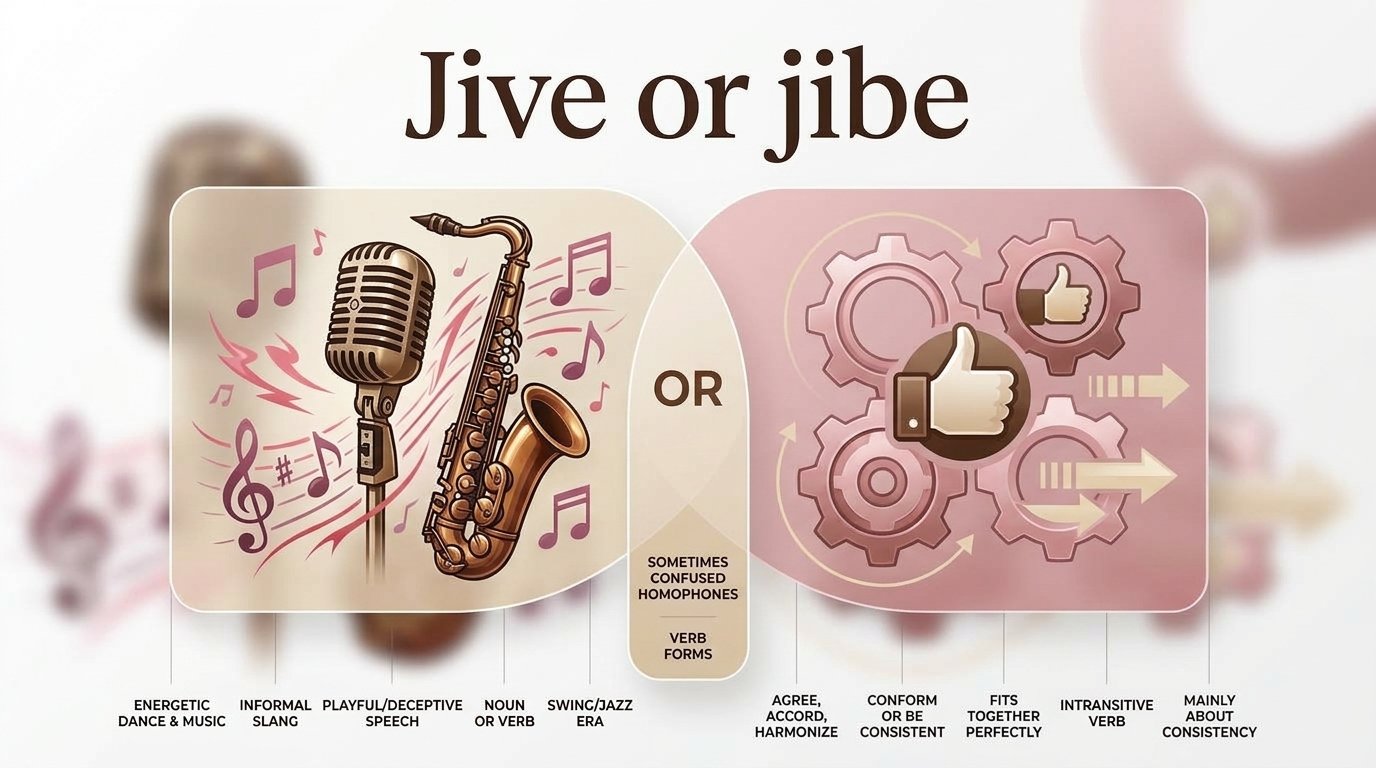
Jive is a fast dance, or slang talk. Jibe means to agree or match.
Nina read her friend’s report. She wrote, “Your numbers don’t jive with mine.” Then she stopped. Was that the right word? So, she typed jive or jibe into her phone.
Here is the answer. Jive is a lively dance. It is also a style of slang and a word for empty talk. Jibe, however, means to fit or agree. For example, if two stories match, they jibe. Still, many people say “jive” for this too. Some dictionaries allow it, but many editors prefer jibe. That is why the jive or jibe question is so common. People search for jive or jibe to be safe in emails, essays, and posts. This guide gives you simple rules and quick tricks. As a result, jive or jibe will soon feel easy.
Pronunciation
Jive
- US: JAHYV (rhymes with “five”)
- UK: JAHYV (rhymes with “five”)
Jibe
- US: JAHYB (rhymes with “bribe”)
- UK: JAHYB (rhymes with “bribe”)
The two words sound almost the same. However, only the last sound changes: “v” and “b.”
Now let’s see how they differ.
Difference Between Jive and Jibe
1. Core Meaning
Jive is a dance, a style of music and slang, or empty talk. Jibe, on the other hand, means to agree or match.
- They danced the jive all night.
- His story does not jibe with the facts.
2. Spelling
Jive ends in -ve. Jibe ends in -be. So, the last letter is the clue.
- She loves to jive.
- The two reports jibe.
3. Memory Trick
Jive has a “v” like “vibes.” Jibe, however, has a “b” like “both.” Both things match.
- Good music has good vibes. Use jive.
- Two stories tell the same thing. So, they jibe.
4. Word Type
Jive can be a noun or a verb. Jibe is mostly a verb. However, it can also be a noun for a taunt.
- Stop the jive. (noun)
- Her words jibe with mine. (verb)
5. Where You See It
Jive appears in music, dance, and slang. Jibe, in contrast, appears when facts, stories, or numbers are compared.
- The band played a jive tune.
- Your numbers jibe with the bank’s numbers.
6. Feeling
Jive can feel fun, like a dance. However, it can also sound fake, like “jive talk.” Jibe, on the other hand, feels calm and plain.
- The dance floor was full of joy and jive.
- Do not give me that jive.
7. The Opposite
The opposite of jibe is to clash. In contrast, jive has no simple opposite. When it means empty talk, however, the opposite is the truth.
- The two stories clash. They do not jibe.
- She told the truth, not jive.
8. Sailing
In American sailing, “jibe” means turning the boat so the sail swings across. In contrast, jive has no sailing use.
- The crew will jibe at the next buoy.
- Watch your head when the boat jibes.
9. Use for “Agree”
Editors prefer the form “jibe with.” However, “jive with” is common in speech, and some dictionaries list it too.
- Her plan jibes with our goals.
- Her plan jives with our goals. (casual)
10. The Swap Test
Try “agree” in your sentence. If it fits, use jibe. Next, try “dance” or “slang.” If it fits, use jive.
- “His story does not (agree) with hers.” Use jibe.
- “They learned a new (dance).” Use jive.
Explore more about: https://verboix.com/alternate-or-alternative/
Quick Cheat Sheet
| Ask yourself | Answer | Word |
|---|---|---|
| Do two things match or agree? | Yes | Jibe |
| Is it a dance or music style? | Yes | Jive |
| Is it slang or empty talk? | Yes | Jive |
| Is it a sail turn on a boat (US)? | Yes | Jibe |
| Does “agree” fit? | Yes | Jibe |
One-line trick: Jive = vibes. Jibe = both agree.
Nature and Behaviour of Jive and Jibe
Jive is a lively word. It began in music and dance. It is fast, playful, and full of energy. This word can also mean talk that is not fully true. In addition, people use it for “agree” in casual speech. That use is common, but it is not the safest choice in formal writing.
Jibe is a plain, steady word. Its main job is to say that two things fit. For example, it is used for facts, stories, plans, and numbers. This word also has a sailing meaning. Finally, it can mean a mocking remark, which is often spelled “gibe.”
Why People Get Confused About Jive and Jibe
There are four simple reasons.
- They sound close. Only the last sound changes.
- They look alike. In fact, only one letter is different.
- Jive is used for “agree.” As a result, people hear it and copy it.
- Dictionaries differ. For example, some allow “jive with,” while others prefer “jibe.”
Spellcheck stays quiet here, because both are real words.
Exceptions and Tricky Cases

- “Jive with” is common. Many people say it, and some dictionaries list it. Still, “jibe with” is the safer choice for school and work.
- Jibe can mean a taunt. For example, a rude remark is a jibe. It is often spelled “gibe.”
- UK sailors write “gybe.” However, in US English, the same sailing move is “jibe.”
- “Jive talk” is not the dance. Instead, it means slang or empty talk. Also, use it with care, because it can sound old-fashioned.
- “Jive” does not need “with” to be a dance. For example, you can simply say, “We jive on Fridays.”
Comparison Table
| Point | Jive | Jibe |
|---|---|---|
| Main meaning | Dance, slang, empty talk | To agree or match |
| Spelling clue | -ve, “vibes” | -be, “b” for “both” |
| Word type | Noun and verb | Verb, and noun (taunt) |
| Used with | Music, dance, talk | Facts, stories, numbers |
| Feeling | Playful, or fake | Calm and plain |
| Sailing meaning | None | Turn the sail across (US) |
| Formal writing | Only for dance or slang | Yes, for “agree” |
| Sound | JAHYV | JAHYB |
| Similarities | Look and sound close, both are verbs, both start with “ji” | Look and sound close, both are verbs, both start with “ji” |
| Example | We danced the jive. | The numbers jibe. |
The Origin of Jive and Jibe
Jive is a fairly new word. It appeared in American jazz culture in the 1920s and 1930s. At first, it meant slang or misleading talk. Then it named a lively swing dance and music. No one is fully sure where the word came from. Later, the jive became a set dance in ballroom contests.
Jibe for “agree” is American, from the 1800s. However, its exact source is not clear. Some people think it came from the sailing word, because sails must pull together. Jibe for sailing came from an old Dutch word for swinging a sail. Meanwhile, the taunt meaning (“gibe”) is a separate old word.
So, the two words are not close relatives. They just look and sound alike.
British vs American English
Good news. The spelling of jive and jibe is the same in both. However, the only real change is in sailing.
- Spelling: Jive and jibe are the same in the US and UK.
- Sound: The words sound almost the same in both accents.
- Rules: The meaning rules are the same.
- Usage: In sailing, the US writes “jibe,” while the UK writes “gybe.” For “agree,” UK writers also often choose “tally” or “match” instead.
Examples:
- US: The crew will jibe at the marker.
- UK: The crew will gybe at the marker.
- US: Her story jibes with the facts.
- UK: Her story tallies with the facts.
Which One Should You Use?
- For US readers: Use jibe for “agree.” Use jive for dance and slang.
- For UK readers: Use jive for dance. For “agree,” “tally” or “match” is very natural. Also, use gybe in sailing.
- For a global audience: Write “match” or “agree” if you feel unsure. After all, simple words never go wrong.
If you feel stuck, use the swap test from above.
Common Mistakes
| Mistake | Correction |
|---|---|
| His story does not jive with the facts. (formal writing) | His story does not jibe with the facts. |
| We danced the jibe all night. | We danced the jive all night. |
| The two reports jive perfectly. (in a report) | The two reports jibe perfectly. |
| Stop giving me that jibe. | Stop giving me that jive. |
| The crew will jive the boat. | The crew will jibe the boat. |
| Her plan gibes with ours. | Her plan jibes with ours. |
Everyday Usage Examples
Emails
- “These figures do not jibe with last month’s report. So, can we check them?”
- “Our team is learning the jive for the office party.”
Social media
- “Took my first jive class today. It was so fun!”
- “His story just doesn’t jibe.”
News
- “The witness’s account did not jibe with the video.”
- “Dancers from ten countries competed in the jive.”
Formal writing
- “The results jibe with earlier studies.”
- “The jive is one of the five Latin dances in ballroom contests.”
Usage Trends
Around the world, people use jive far more in music, dance, and pop talk. In contrast, they use jibe more in news, business, and school writing, where facts must match.
Because “jive with” is common in speech, many people search for jive or jibe. They want to know which one is correct in print. As a result, clear guides help them choose.
Metaphors and Similes
Jive
- Metaphor: “The city was a jive band, loud and full of life.” The city had rhythm.
- Simile: “She moved like jive music, quick and full of joy.”
Jibe
- Metaphor: “Two true stories are two gears that jibe.” They turn together.
- Simile: “His words fit the facts like a key in a lock, and they jibed.”
Connotative Meaning
Jive
- Positive: Lively and fun. “The jive lifted everyone’s mood.”
- Neutral: A dance name. “She teaches the jive.”
- Negative: Fake talk. “That’s just jive. I don’t believe it.”
Jibe
- Positive: Things fit well. “Her plan jibes with our goals.”
- Neutral: A plain check. “The two totals jibe.”
- Negative: A taunt. “He ignored the cruel jibe.”
Idioms and Proverbs
- Jive talk: slang or empty talk. “The coach hates jive talk, and wants plain answers.”
- Hand jive: a rhythm game of hand moves. “The kids did the hand jive at the party.”
- Jive turkey: an old slang insult. It is dated, so use it with care.
- Jibe with: to agree with. “Her account jibes with the video.”
- Doesn’t jibe: does not match. “His story doesn’t jibe with the facts.”
Proverb: There is no well-known proverb with these words. However, a close idea is “Actions speak louder than words,” which warns against empty talk.
Literature and Movies
Literature
- Hepster’s Dictionary (1938, slang glossary, Cab Calloway): The jazz star listed the words of the jive world.
- Also, there is no famous novel built on the word jibe. Instead, it lives mostly in news and business writing.
Movies
- Airplane! (1980, USA): A comic scene has two passengers who speak in jive talk.
- Grease (1978, USA): A dance scene features “Born to Hand Jive.”
Why This Difference Matters
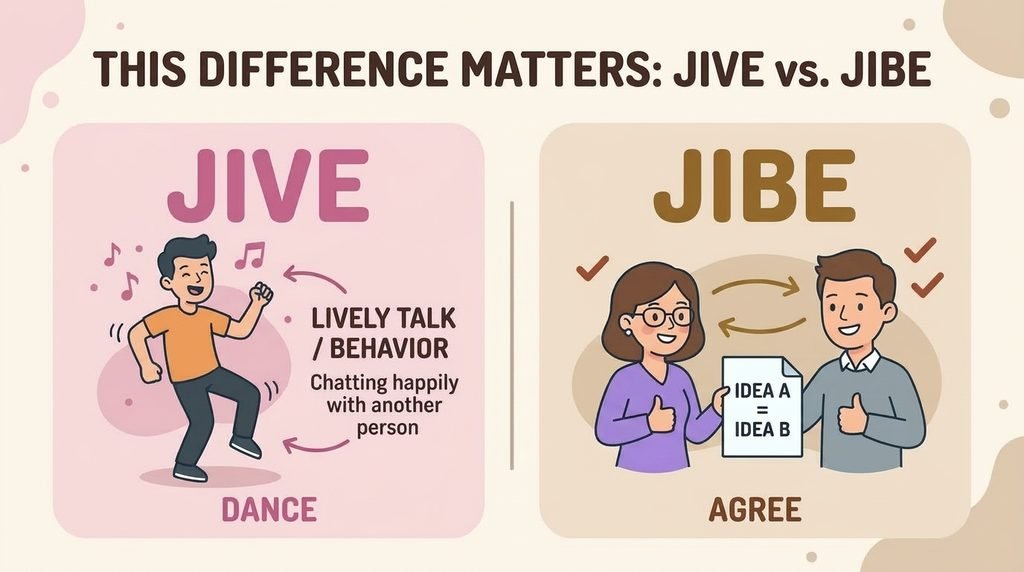
For learners, the right word keeps writing clear. For example, “We danced the jibe” sounds strange. So does “the jive of the numbers.” In fact, a small slip can hurt a school paper or a work report.
For society, careful words build trust. Editors and readers notice small errors. Also, the word jive has a rich history in music and culture. Therefore, using it in the right place shows respect for that history.
Usefulness in Daily Life
- At work: Check if two reports jibe before you send them.
- At a party: Learn the jive for a fun dance.
- In school: Use jibe when you compare facts in an essay.
- On a boat: Know that a jibe swings the sail across.
- In writing: Use the swap test to pick the right word fast.
Situational Preference
Use jive when you talk about dance, music, or slang. For example, say “they danced the jive” or “stop the jive talk.” Use jibe when two things agree. For example, say “her story jibes with the facts.” Also, use jibe for a sail turn on a boat in US English. In a casual chat, jive for agree is fine. However, for a school paper or work report, pick jibe. In a dance class, only jive works. Meanwhile, in a sailing club in the UK, write gybe. When you feel stuck, ask one question. Am I dancing, or am I agreeing? Dancing means jive. Agreeing means jibe.
Mini Quiz
Pick jive or jibe.
- Her story does not ____ with the facts.
- They learned the ____ for the school show.
- The witness’s words did not ____ with the video.
- I don’t want any more of that ____ talk.
- The crew will ____ at the next buoy.
Answers: 1. jibe. 2. jive. 3. jibe. 4. jive. 5. jibe.
Quick Answers
1. What is the main difference between jive and jibe?
Jive is a dance, a slang style, or empty talk. Jibe means to agree or match.
2. Is it “jive with” or “jibe with”?
Both are used. However, “jibe with” is the safer choice in formal writing.
3. Do jive and jibe sound the same?
They sound close. However, only the last sound is different: “v” and “b.”
4. What is a jibe in sailing?
It is turning the boat so the sail swings across. However, UK sailors write “gybe.”
5. Can jibe mean an insult?
Yes. A jibe can be a mocking remark. Also, it is spelled “gibe.”
6. Is the spelling different in the US and UK?
No. Both use jive and jibe. However, the sailing word changes to “gybe” in the UK.
7. What is jive talk?
It is slang, or talk that is not fully true. In fact, it grew from the jazz age.
Conclusion
Jive or jibe can be easy to tell apart once you know the simple difference. Jive is a lively dance, a slang style, or empty talk, while jibe means to agree or match. Because they sound close, people often mix them up. First, remember that jive has a “v” like “vibes,” while jibe has a “b” like “both,” because both things match. Next, use the swap test. If “agree” fits, use jibe. If “dance” or “slang” fits, use jive. You also learned some tricky points. For example, “jive with” is common in speech, but “jibe with” is safer in print. Also, jibe can mean a taunt or a sailing turn. In the UK, however, sailors write “gybe.” The spelling of jive and jibe is the same in US and UK English. Finally, use these tips in emails, posts, and schoolwork. Next time two reports do not match, you will know to use jibe. When the music starts, you will know how to use jive.






1 thought on “Jive or Jibe? Easy Difference + Memory Trick”