
Defuse means to make something less dangerous or less tense. Diffuse means to spread something out.
Tom’s team meeting turned tense. His boss was angry. Tom wanted to calm the room. He wrote in his notes, “I will diffuse the situation.” Then he paused. Was that right? He typed defuse or diffuse into his phone. Now he knows. To calm anger, he must defuse it. Light, heat, and smell diffuse, which means they spread out.
Here is the clear meaning. Defuse comes from taking the fuse out of a bomb. Now we also use it for calming a fight. Diffuse is about spreading. Think of light through a curtain. The two words sound almost the same, and they look alike. That is why people search defuse or diffuse. They fear a wrong word in an email or a post. Tom fixed his note. You can fix yours too. This guide makes defuse or diffuse easy, with simple tricks and quick examples.
Pronunciation
Defuse
- US: dee-FYOOZ
- UK: dee-FYOOZ
Diffuse
- Verb (to spread): US: dih-FYOOZ. UK: dih-FYOOZ.
- Adjective (spread out, not clear): US: dih-FYOOS. UK: dih-FYOOS.
Defuse and the verb diffuse sound almost the same. Only the first vowel is different: “dee” and “dih.”
Now let’s see how the two words differ.
Difference Between Defuse and Diffuse
1. Core Meaning
Defuse means to make less dangerous or less tense. Diffuse means to spread out.
- The police defused the bomb.
- The lamp shade diffuses the light.
2. Word Type
Defuse is only a verb. Diffuse is a verb and an adjective.
- She defused the fight with a smile. (verb)
- He felt a diffuse pain in his back. (adjective)
3. Spelling
Defuse has one f in the middle. Diffuse has two f’s.
- The guard defused the danger.
- The smell will diffuse through the house.
4. Memory Trick
Defuse starts with “de,” which means take away. You take the fuse out. Diffuse has two f’s that spread apart, like light rays.
- To defuse a bomb, you remove its fuse.
- Fog can diffuse the sun into a soft glow.
5. What It Acts On
Defuse acts on danger, anger, and fear. Diffuse acts on light, heat, gas, smell, and ideas.
- Her joke defused the anger.
- Ideas diffuse fast on the internet.
6. Direction of Action
Defuse brings something down. Diffuse moves something outward.
- A kind word defuses stress.
- Perfume diffuses across the room.
7. Sound of the Ending
The verb diffuse ends with a “z” sound. The adjective diffuse ends with an “s” sound. Defuse always ends with “z.”
- They defuse (dee-FYOOZ) the crisis.
- It is a diffuse (dih-FYOOS) light.
8. Feeling
Defuse feels calming and helpful. Diffuse feels soft, or sometimes vague.
- The teacher defused a hard moment.
- The plan was diffuse and unclear.
9. The Opposite
An opposite of defuse is to inflame or make worse. The opposite of diffuse is to focus or concentrate.
- Angry words inflame a fight. Kind words defuse it.
- A laser focuses light. A curtain diffuses it.
10. The Swap Test
Try “calm down” in your sentence. If it fits, use defuse. Try “spread out.” If it fits, use diffuse.
- “The nurse tried to (calm down) the panic.” Use defuse.
- “The oil will (spread out) in the room.” Use diffuse.
Quick Cheat Sheet
| Ask yourself | Answer | Word |
| Am I calming a bomb, fight, or fear? | Yes | Defuse |
| Am I spreading light, smell, heat, or ideas? | Yes | Diffuse |
| Does “calm down” fit? | Yes | Defuse |
| Does “spread out” fit? | Yes | Diffuse |
| Do I mean “not clear” or “wordy”? | Yes | Diffuse (adjective) |
One-line trick: Defuse = take the fuse out. Diffuse = two f’s spread out.
Nature and Behaviour of Defuse and Diffuse
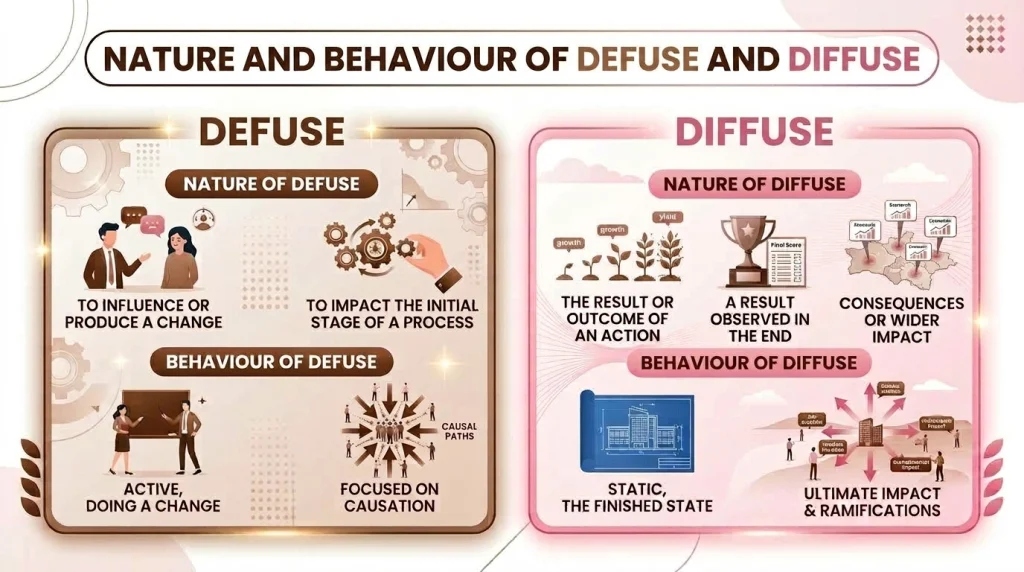
Defuse is a calming word. It is an action that lowers danger. It started with bombs. A worker cuts the fuse, and the bomb cannot blow up. Now people use it for anything tense: an argument, a crisis, or a hard talk. It always ends with a safer or calmer result.
Diffuse is a spreading word. It moves something from one place to many places. Light, heat, gas, smell, and news can all diffuse. As an adjective, it describes something spread out or not clear. A diffuse pain has no exact spot. A diffuse speech has no clear point. It is a quiet, slow word.
Why People Get Confused About Defuse and Diffuse
There are four simple reasons.
- They sound almost the same. The verb forms are near twins in speech.
- They look alike. Only one letter is different in the middle.
- Both deal with “making things less strong.” Spreading can weaken something, and defusing can too.
- Spellcheck stays silent. Both are real words, so a tool may see no error.
The most common mix-up is “diffuse the situation.” Most writers and editors call that an error. The right phrase is “defuse the situation.”
Also read more about:https://verboix.com/nana-vs-nanna/
Exceptions and Tricky Cases
- Diffuse can be an adjective. Defuse cannot. You can say “diffuse light.” You cannot say “defuse light.”
- The “s” and “z” sounds change the meaning. “Diffuse” with “z” is a verb. “Diffuse” with “s” is an adjective.
- You can diffuse blame. This means you spread the blame across many people. It is correct, but it is not the same as calming a fight.
- The machine is a diffuser. A “diffuser” spreads oil scent or light. It is never a “defuser.” A defuser is a person or tool that makes a bomb safe.
- “Diffuse the tension” is usually wrong. If you mean calm it down, write “defuse.”
Comparison Table
| Point | Defuse | Diffuse |
| Main meaning | Make less dangerous or tense | Spread out |
| Word type | Verb only | Verb and adjective |
| Spelling clue | One f, “de” means remove | Two f’s spread apart |
| Acts on | Bombs, anger, fear, tension | Light, heat, smell, ideas |
| Feeling | Calming | Soft, or vague |
| Opposite | Inflame, escalate | Focus, concentrate |
| Noun form | Defusal (rare) | Diffusion |
| Tool or machine | Bomb defuser (rare) | Diffuser (oil, light) |
| Similarities | Both are verbs, look and sound alike, both start with “d” | Both are verbs, look and sound alike, both start with “d” |
| Example | She defused the row. | Oil diffuses in the air. |
The Origin of Defuse and Diffuse
Defuse is a fairly new word. It appeared in the 1940s, around the time of World War II. It joins “de,” which means remove, with “fuse.” The word “fuse” comes from a Latin word for a spindle, which was the shape of old fuses. At first, defuse meant to take the fuse out of a bomb. Later, people used it for calming any tense moment.
Diffuse is much older. It comes from the Latin word diffundere. That word means “to pour out” or “to spread.” It joins “dis,” meaning apart, with “fundere,” meaning to pour.
So the two words are not related. They just look alike. One comes from the idea of a fuse. The other comes from the idea of pouring.
British vs American English
Good news. The spelling is the same in both. There is no US or UK version.
- Spelling: Defuse and diffuse are spelled the same in the US and UK.
- Sound: Both accents say them nearly the same. The UK “r” and vowel sounds do not change these words much.
- Rules: The meaning rules are the same.
- Usage: “Diffuser” is the usual spelling in both. Some technical texts use “diffusor,” but it is rare.
Examples:
- UK: The team defused the crisis.
- US: The team defused the crisis.
- UK: The lamp gives a diffuse light.
- US: The lamp gives a diffuse light.
Which One Should You Use?
- For US readers: Use defuse for calming. Use diffuse for spreading.
- For UK readers: The same rule works.
- For a global audience: Use “calm” or “spread” if you feel unsure. Simple words are always safe.
If you are stuck, use the swap test from above. It works in every kind of English.
Common Mistakes
| Mistake | Correction |
| The officer tried to diffuse the bomb. | The officer tried to defuse the bomb. |
| She diffused the argument with a joke. | She defused the argument with a joke. |
| We must diffuse the tension in the room. | We must defuse the tension in the room. |
| I bought an oil defuser. | I bought an oil diffuser. |
| The lamp gives defuse light. | The lamp gives diffuse light. |
| The smell defused through the house. | The smell diffused through the house. |
Everyday Usage Examples
Emails
- “I would like to defuse any worry about the deadline.”
- “The new plan diffuses the work across the whole team.”
Social media
- “My cat defused the whole fight by sitting on the laptop.”
- “Just bought a diffuser for my room. It smells great!”
News
- “Leaders met to defuse the growing tension.”
- “Smoke from the fire diffused across the city.”
Formal writing
- “The manager acted quickly to defuse the dispute.”
- “The report calls the pain ‘diffuse’ because it has no single spot.”
Usage Trends
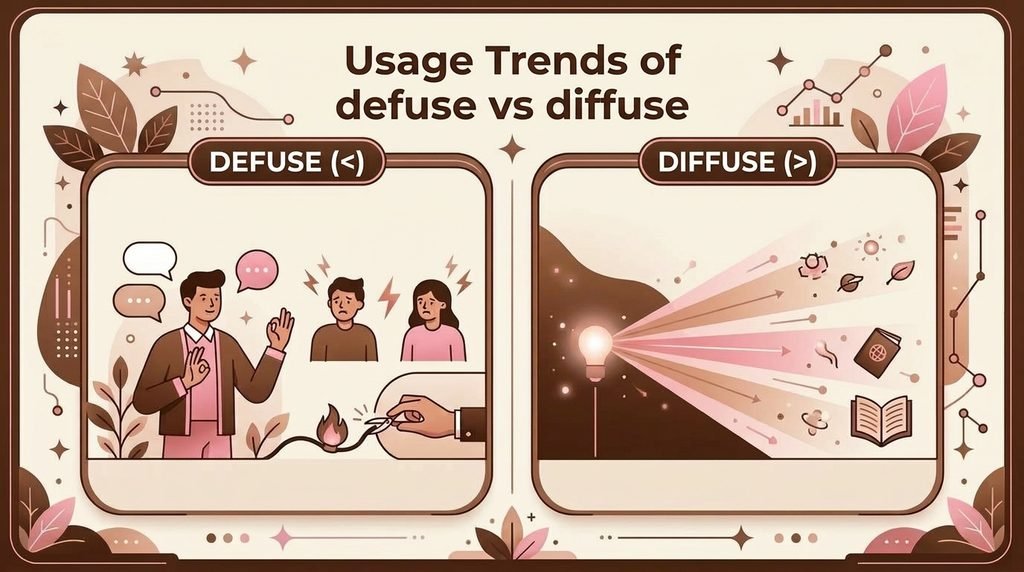
Around the world, people use defuse often in news. Reporters write about defusing tension, a crisis, or a bomb. People use diffuse often in science and home life. It appears in talk about light, heat, and gas. It also appears in home shops, where essential oil diffusers are common.
Because the words sound close, many people search for them together. They want to be sure before they write or publish. Clear guides help them do that.
Metaphors and Similes
Defuse
- Metaphor: “Her calm voice was a cool cloth on a hot fuse.” She cooled the anger.
- Simile: “His joke worked like scissors on a bomb wire, and the whole room relaxed.”
Diffuse
- Metaphor: “Rumors were smoke, and they diffused through the town.” They spread quietly.
- Simile: “The morning fog diffused the streetlights like soft, glowing clouds.”
Connotative Meaning
Defuse
- Positive: Calming and helpful. “She defused the fight and saved the party.”
- Neutral: A plain, technical word. “The expert defused the old shell.”
- Negative: It can sound cold if used to hide a real problem. “They defused the protest by ignoring it.”
Diffuse
- Positive: Soft and gentle. “The room had a warm, diffuse light.”
- Neutral: A science word. “Gas diffuses through the air.”
- Negative: Unclear or wordy. “His diffuse speech lost the crowd.”
Idioms and Proverbs
- Defuse the situation: calm a tense moment. “The coach defused the situation with a quick joke.”
- Defuse the tension: lower stress in a room. “A laugh defused the tension.”
- Defuse a time bomb: solve a big problem before it explodes. “The city must defuse the water crisis.”
- Diffuse the light: make light soft. “Use a curtain to diffuse the light.”
- Diffuse the blame: spread blame among many. “The boss tried to diffuse the blame across the team.”
- A related proverb: A gentle answer turns away anger (Book of Proverbs). It is the idea of defusing in a few words.
Literature and Movies
Literature
- Black Sunday by Thomas Harris (1975, thriller). It tells of a race to stop a deadly bomb plot.
- There is no famous novel built on the word diffuse. It appears mostly in science, art, and photography books.
Movies
- The Hurt Locker (2008, USA). It follows a bomb disposal team, the world of defusing.
- Speed (1994, USA). A bus holds a bomb, and the hero must defuse it.
Why This Difference Matters
For learners, the right word keeps writing clear. “He diffused the bomb” is a funny mistake. It says he spread the bomb around. That changes the meaning in a big way. It can hurt grades, job papers, and reports.
For society, clear words matter in the news. Reporters write about crises and safety. If a word is wrong, readers may get the wrong idea. Careful words build trust.
Usefulness in Daily Life
- At work: Defuse a tense meeting with calm words.
- At home: Use a diffuser to spread a pleasant scent.
- In a photo: Use a soft screen to diffuse harsh light.
- In the kitchen: Notice how smells diffuse from the stove.
- In writing: Use the swap test to pick the right word fast.
Situational Preference
Use defuse when danger or anger needs to go down. Say “defuse a bomb” or “defuse the tension.” Use diffuse when something spreads out. Say “diffuse the light” or “the smell will diffuse.” In a fight at work, defuse. In a science class, diffuse. At home with oils, use a diffuser. In a news story about a crisis, defuseIn a photo class, diffuse light means soft light. In a report, a diffuse plan is a vague plan. When you feel stuck, ask one question. Am I calming it, or am I spreading it? Calming means defuse. Spreading means diffuse.
Mini Quiz
Pick defuse or diffuse.
- The nurse tried to ____ the panic.
- A soft curtain will ____ the sunlight.
- The expert ____ the old bomb.
- He felt a ____ pain across his back.
- A kind reply can ____ an angry email.
Answers: 1. defuse. 2. diffuse. 3. defused. 4. diffuse. 5. defuse.
Quick Answers
1. What is the main difference between defuse and diffuse?
Defuse means to make less dangerous or less tense. Diffuse means to spread out.
2. Do defuse and diffuse sound the same?
The verbs sound almost the same. The first vowel is a little different: “dee” and “dih.”
3. Is it “defuse the situation” or “diffuse the situation”?
It is “defuse the situation.” You calm it down. You do not spread it.
4. Can diffuse be an adjective?
Yes. It means spread out or not clear. Example: “a diffuse light.”
5. Is it “oil diffuser” or “oil defuser”?
It is “oil diffuser.” The machine spreads the scent.
6. Is the spelling different in the US and UK?
No. Both spell the words the same way.
7. Where did the word defuse come from?
It came from taking the fuse out of a bomb. It became common in the 1940s.
Conclusion
Defuse or Diffuse can be easy to tell apart once you know the simple difference. Defuse means to make something less dangerous or less tense, while diffuse means to spread something out. They sound almost the same, so people often mix them up. Remember two easy tricks: defuse starts with “de,” like taking away a fuse, while diffuse has two f’s that spread apart like light rays. If “calm down” fits, use defuse. If “spread out” fits, use diffuse. The words also have different roots. Defuse comes from bombs and fuses, while diffuse comes from a Latin word meaning “pour out.” Their spelling is the same in US and UK English. Use these tips in emails, posts, and schoolwork. Next time a meeting gets tense, you will know which word to use.