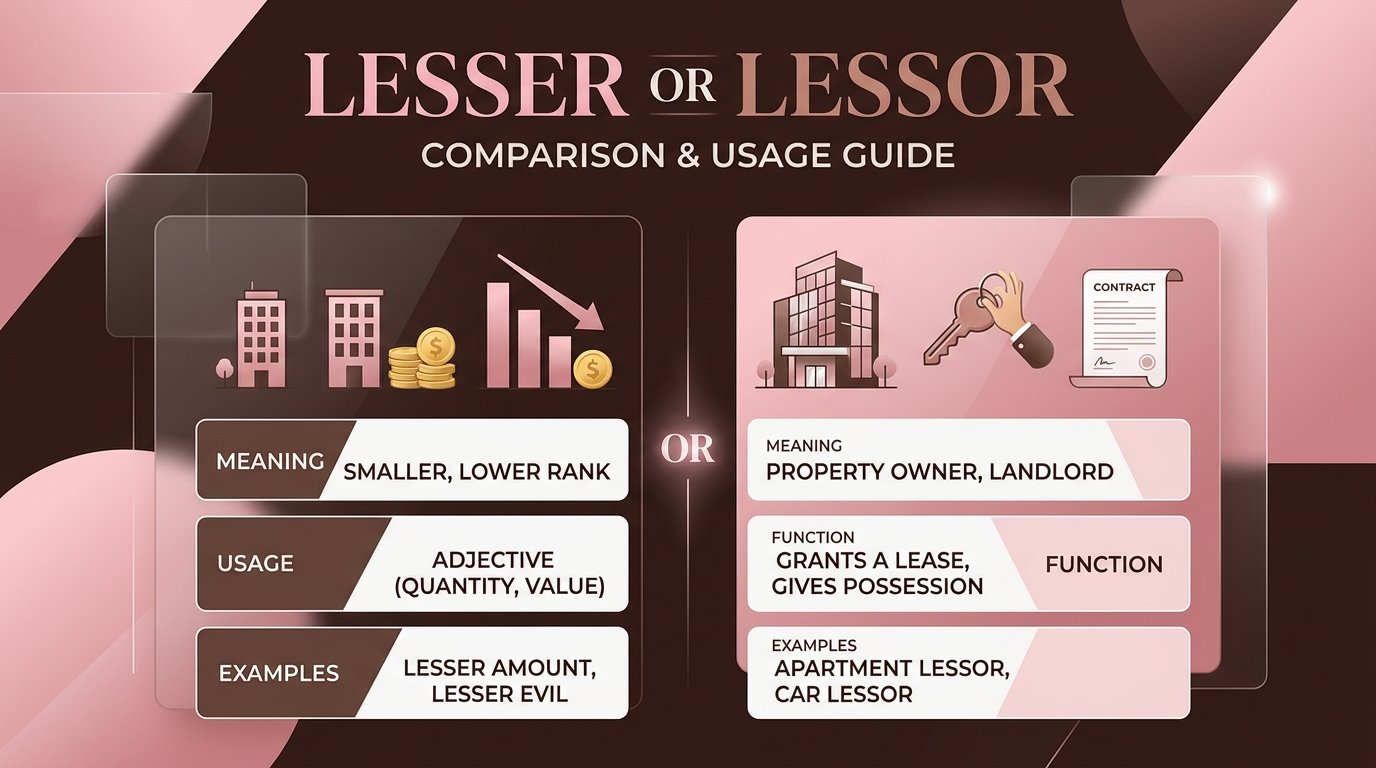
Lesser means smaller or less important. Lessor means the owner who rents out a place, a car, or a machine.
Maya was about to sign her first flat lease. She saw the word “lessor” on page one. “Is that a typo for lesser?” she wondered. So she typed lesser or lessor into her phone.
Here is the answer. Lesser is about size or rank. Think of “the lesser of two evils.” Lessor is about renting. It names the owner who lets you use a place. The person who rents is called the lessee. The two words sound close and look close. That is why so many people search lesser or lessor. They want to sign or send with no mistake.
Lessor is a rare word. Most people meet it once, in a lease. So they think it is a typo. It is not. This guide gives you easy rules and quick tricks. By the end, lesser or lessor will feel simple.
Pronunciation
Lesser
- US: LESS-er
- UK: LESS-uh
Lessor
- US: LESS-or, or less-OR
- UK: less-AW, or LESS-aw
In fast speech, the two words can sound close. Lawyers often stress the “or” in lessor so nobody mixes them up.
Now let’s see how the two words differ.
Difference Between Lesser and Lessor
1. Core Meaning
Lesser means smaller, lower, or less important. Lessor means the one who rents out property.
- Pick the lesser fee.
- The lessor owns the shop.
2. Word Type
Lesser is an adjective. It describes a noun. Lessor is a noun. It names a person or company.
- She took the lesser road.
- The lessor phoned the tenant.
3. Spelling
Lesser ends in -er. Lessor ends in -or.
- It was a lesser worry.
- The lessor signed the form.
4. Memory Trick
Lesser has “less” in it. It means less. Lessor ends with “or,” like “owner.” The lessor is the owner.
- A lesser risk is a smaller risk.
- The lessor is the owner of the car.
5. What It Describes
Lesser talks about size, rank, or amount. Lessor talks about who gives something for rent.
- He plays a lesser part in the play.
- The lessor rents out trucks.
6. Where You See It
Lesser shows up in chats, news, and books. Lessor shows up in leases, law, and business.
- Try the lesser-known beaches.
- The lease names the lessor on page one.
7. Plural Form
Lesser has no plural. It is an adjective. Lessor has a plural: lessors.
- A lesser evil is still an evil.
- Two lessors share this building.
8. Partner Word
Lesser has an opposite: greater. Lessor has a partner: lessee, the one who rents.
- The greater gain beat the lesser gain.
- The lessor and the lessee agreed on the price.
9. Who Is the Word About
Lesser can describe anything: a cost, a role, a pain. Lessor is always about a person or a company.
- She felt a lesser pain today.
- The bank is the lessor of the car.
10. The Swap Test
Try “smaller” in the sentence. If it fits, use lesser. Try “owner who rents.” If it fits, use lessor.
- “She chose the (smaller) plan.” Use lesser.
- “The (owner who rents) fixed the door.” Use lessor.
Quick Cheat Sheet
| Ask yourself | Answer | Word |
| Am I comparing size, rank, or cost? | Yes | Lesser |
| Am I talking about who rents out a thing? | Yes | Lessor |
| Does “smaller” fit? | Yes | Lesser |
| Does “owner who rents” fit? | Yes | Lessor |
| Is there a lessee in the story? | Yes | Lessor |
One-line trick: Lesser = less. Lessor = owner (or).
Nature and Behaviour of Lesser and Lessor
Lesser is a comparing word. It puts one thing below another. This word shows a smaller size, a lower rank, or a smaller amount.It comes before a noun, like “lesser damage.” It works quietly in a sentence. It never names a person by itself.
Lessor is a legal role. It names the one who gives something for rent. It can be a person, a company, or a bank. A lessor can rent a home, a car, or a machine. The word feels formal. You meet it in contracts more than in chats. It always has a partner, the lessee.
Why People Get Confused About Lesser and Lessor
There are four simple reasons.
- They sound alike. In fast talk, the gap is hard to hear.
- They look alike. Both start with “less” and end with a small change.
- Lessor is rare. Most people see it once, in a lease.
- Spellcheck may stay silent. Both are real words, so a tool may see no error.
Many people think lessor is a typo. It is not. It is a real word with its own job.
Exceptions and Tricky Cases
- Lesser is not “less.” Use less for amounts: “I have less time.” Use lesser before a noun: “the lesser cost.” Avoid “lesser than.” Say “less than.”
- Lessor is not always a person. It can be a bank, a firm, or a city.
- A lessor can also be a lessee. If a lessee rents a flat and rents a room to a friend, that person becomes a sublessor.
- In daily talk, use “landlord.” It is fine for homes. Lessor is best for papers and contracts.
- Lesser-known needs a hyphen before a noun: “a lesser-known town.”
Comparison Table
| Point | Lesser | Lessor |
| Main meaning | Smaller or less important | Person who rents out property |
| Word type | Adjective | Noun |
| Ending | -er | -or |
| Memory clue | “Less” means less | “or” for owner |
| Used in | Daily talk, news, books | Law, business, contracts |
| Partner or opposite | Greater | Lessee |
| Plural | None | Lessors |
| Sound (US) | LESS-er | LESS-or or less-OR |
| Similarities | Close sound, close spelling, both start with “less” | Close sound, close spelling, both start with “less” |
| Example | We chose the lesser cost. | The lessor keeps the keys. |
The Origin of Lesser and Lessor
Lesser grew from the old English word for “less.” People once used “less” to mean smaller. Later, English added “-er” to it again. So lesser is a comparing word built on a comparing word. Over time, it came to mean smaller in size, rank, or worth.
Lessor came from Old French. The French word came from a verb meaning “to let” or “to lease.” A lessor is one who lets you use a thing for a time. The partner word, lessee, comes from the same family.
So the two words are not cousins. They just look alike. One comes from the idea of “less.” The other comes from the idea of “letting.”
British vs American English
Good news. The spelling is the same in both. There is no US or UK version of these words.
- Spelling: Lesser and lessor are spelled the same in the US and UK.
- Sound: The UK soft “r” makes lesser sound like “LESS-uh.” The US “r” is clear.
- Rules: The meaning rules are the same.
- Usage: Both use lessor in leases for cars, machines, and property. In daily talk about homes, people often say “landlord.”
Examples:
- UK: The lessor repaired the roof.
- US: The lessor repaired the roof.
- UK: She took the lesser option.
- US: She took the lesser option.
Which One Should You Use?
- For US readers: Use lessor for the one who rents out something. Use lesser for smaller or lower.
- For UK readers: The same rule works. Landlord is common in daily talk. Lessor is right in legal papers.
- For a global audience: Use lesser in most writing. Use lessor only when you write about leases or contracts.
If you feel stuck, use the swap test from above. It works in every kind of English.
Common Mistakes
| Mistake | Correction |
| The lessor of two evils | The lesser of two evils |
| The lesser signed the lease. | The lessor signed the lease. |
| Lesser and lessee sign here. | Lessor and lessee sign here. |
| It is a lessor-known fact. | It is a lesser-known fact. |
| This costs lesser than that. | This costs less than that. |
| To a lessor degree | To a lesser degree |
Everyday Usage Examples
Emails
- “Please send the signed lease to the lessor by Friday.”
- “We picked the lesser option to save time.”
Social media
- “Got my keys from the lessor today!”
- “Lesser-known cafes have the best coffee.”
News
- “The lessor agreed to lower the rent.”
- “The storm caused lesser damage than feared.”
Formal writing
- “The lessor shall keep the building in good repair.”
- “The lesser penalty applies to first offenses.”
Usage Trends
Around the world, people use lesser far more than lessor. Lesser appears in stories, news, and daily chat. Lessor lives mostly in contracts, law, banking, and business.
People who rent homes, cars, or machines often meet lessor for the first time. Then they look up the meaning. As more people rent and lease, more people ask the same question. Clear guides help them feel sure before they sign.
Metaphors and Similes
Lesser
- Metaphor: “In the shadow of great trees, lesser plants must fight for light.” Smaller things struggle near bigger ones.
- Simile: “He felt like a lesser star beside the moon.”
Lessor
- Metaphor: “The lessor is the keeper of the gate.” The lessor decides who may enter.
- Simile: “She held the keys like a lessor holds a home, with care.”
Connotative Meaning
Lesser
- Positive: It can mean a smaller harm. “We chose the lesser risk, and it paid off.”
- Neutral: It can just mean smaller. “Use the lesser amount.”
- Negative: It can sound like “not good enough.” “He was called a lesser player.”
Lessor
- Positive: A helpful owner. “Our lessor fixed the leak the same day.”
- Neutral: A plain legal term. “The lessor and lessee signed.”
- Negative: A hard owner. “The lessor raised the rent again.”
Idioms and Proverbs
- The lesser of two evils: the less bad of two bad choices. “Both plans were poor, but we chose the lesser of two evils.”
- Lesser mortals: ordinary people, said as a joke. “That hill is too steep for lesser mortals.”
- To a lesser degree: by a smaller amount. “It rained in the south, and to a lesser degree in the north.”
- Lesser known: not famous. “This is a lesser-known trail.”
- Lessor and lessee: the two sides of a lease. “The lessor and lessee both signed the deal.”
Literature and Movies
Literature
- Nicomachean Ethics by Aristotle (about 340 BC, philosophy). It talks about hard choices, and the idea that the lesser of two evils can seem good next to a worse one.
- For lessor, there is no famous novel built on the word. It lives in law books, contracts, and business texts.
Movies
- The Dark Knight (2008, USA and UK). Its heroes face hard choices between bad options. It shows the lesser-evil idea.
- Rent (2005, USA). It follows tenants and a landlord, a real-life lessor and lessee story.
Why This Difference Matters
For learners, the right word keeps writing clear. A wrong word can change the whole meaning. “The lesser signed the lease” makes no sense to a reader. It can hurt grades, job papers, and business emails.
For society, clear words protect people. A lease is a legal paper. If you mix up the words, others may doubt your care. Knowing who the lessor is helps renters know their rights and who to ask for help.
Usefulness in Daily Life
- Renting a home: Find the lessor’s name on your lease. That is the owner.
- Leasing a car: The company that leases you the car is the lessor.
- At work: Choose the lesser cost when two plans are equal.
- In the news: Read “lesser-known” and know it means “not famous.”
- In writing: Use the swap test to pick the right word fast.
Situational Preference
Use lesser when you compare. It fits size, rank, cost, or harm. Say “the lesser cost” or “the lesser risk.” Use lessor when you write about renting. It fits leases for homes, cars, and machines. Say “the lessor signed the lease.” In a story or an email about choices, pick lesser. In a contract or a rent letter, pick lessor. If you mean the owner who rents, write lessor. If you mean something smaller, write lesser. When you feel stuck, ask one question. Am I comparing, or am I renting? Comparing means lesser. Renting means lessor. Simple as that, really.
Mini Quiz
Pick lesser or lessor.
- She chose the ____ of two bad plans.
- The ____ gave the tenant a new key.
- It is a ____-known island.
- The lessee paid the ____ every month.
- He got a ____ punishment for his first mistake.
Answers: 1. lesser. 2. lessor. 3. lesser. 4. lessor. 5. lesser.
Quick Answers
1. What is the main difference between lesser and lessor?
Lesser means smaller or less important. Lessor means the person or company that rents out property.
2. Do lesser and lessor sound the same?
They sound close, but not always the same. Lessor is often said with more stress on the last part.
3. Is lessor a real word?
Yes. It is a real legal term. It is used in leases and contracts.
4. What is a lessee?
A lessee is the person who rents from the lessor. The tenant is the lessee.
5. Can I use lesser to mean landlord?
No. Use lessor or landlord for the one who rents out a place.
6. Is it “lesser than” or “less than”?
Use “less than” to compare amounts. Use lesser before a noun, like “the lesser cost.”
7. Is the spelling different in the US and UK?
No. Both spell the words the same way. Only the sound of the ending changes a little.
Conclusion
Lesser or Lessor is easy to tell apart. Lesser means smaller or less important, while lessor means the person or company that rents out property. Remember: lesser has “less” in it, while lessor ends with “or,” like “owner.” If “smaller” fits, use lesser. If “owner who rents” fits, use lessor. The spelling is the same in US and UK English. Use these simple tips in emails, contracts, and schoolwork.