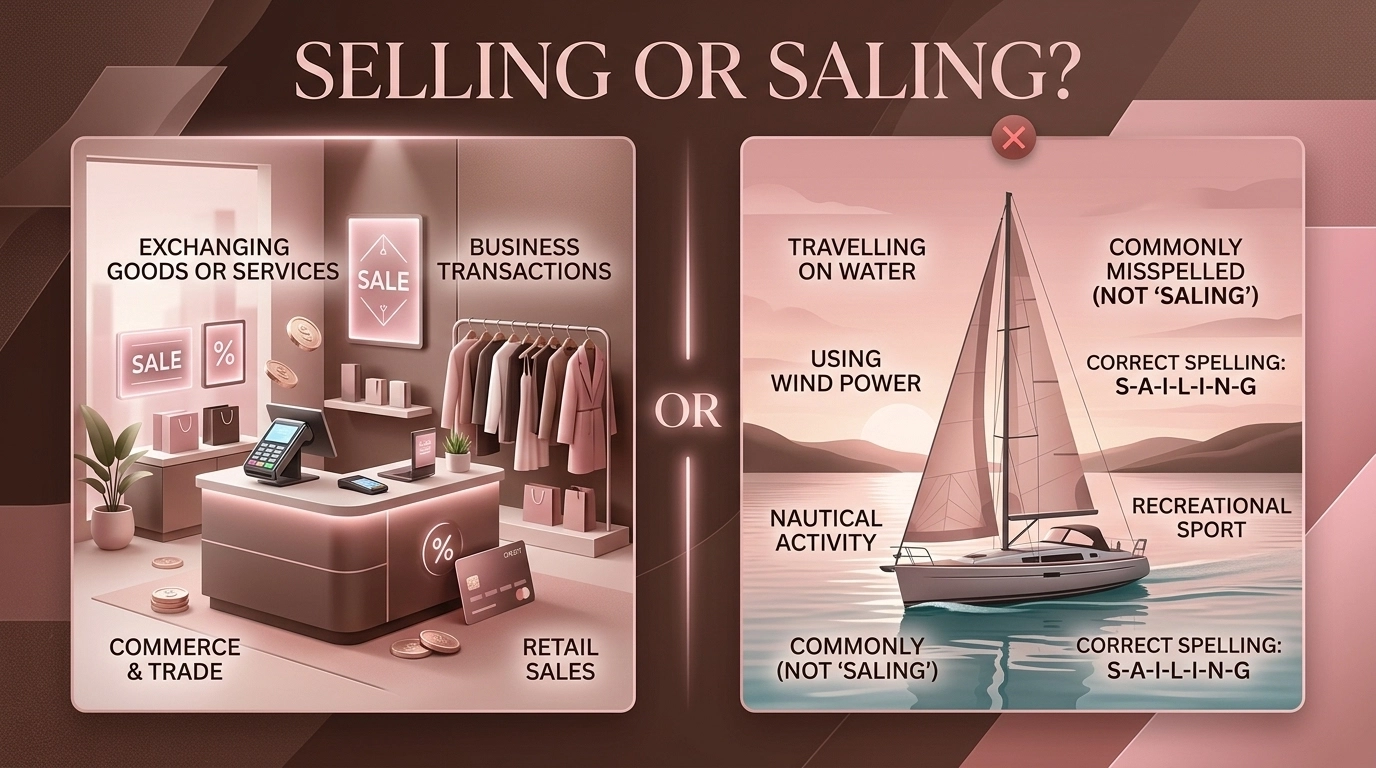
“Selling” is correct. “Saling” is not a real word.
Picture this. Tom wants to sell his old bike. He posts online, “I am saling my bike today.” A friend replies, “Do you mean selling?” Tom feels embarrassed. He always thought “saling” looked right. He is not alone. Many people make this same small mistake every single day, without even noticing it.
People search “selling or saling” because they are unsure which spelling is correct. This small mix-up causes bigger problems than people expect. It shows up in resumes, business ads, emails, and social media posts. A wrong spelling in the wrong place can make a person look careless, even if their message is clear. Learning the truth about selling and saling helps you write with more confidence every time you type, whether for work, school, or fun.
This mix-up happens often, in schools, offices, and online shops. Selling means giving something to someone for money. It comes from the old verb “sell.” Saling is not found in any dictionary. It is simply a spelling mistake that looks like a real word, which is exactly why it fools so many people.
Pronunciation
- Selling (US): /ˈsel-ing/
- Selling (UK): /ˈsel-ɪŋ/
- Saling: Not a standard word. Some people say it like “SAY-ling,” which sounds close to “sailing.”
Now let’s look at the full picture, one clear point at a time.
learn more about:https://verboix.com/alternate-or-alternative/
Difference Between Selling and Saling
1. One is real, one is not.
“Selling” is a true English word. “Saling” is not.
- “She is selling books.” ✅
- “She is saling books.” ❌
2. Selling has a real root word.
It comes from “sell.” “Saling” has no true root word behind it.
- Sell → Selling ✅
- Sale → Saling ❌
3. Saling is often a typing slip.
People type fast and skip a letter without noticing.
- Wrong: “I am saling my car.”
- Right: “I am selling my car.”
4. Selling is a verb form called a gerund.
A gerund shows action happening right now.
- “He is selling shoes.”
- “They are selling tickets.”
5. Saling is confused with sailing.
“Sailing” means traveling on water using a boat and wind.
- Wrong: “We went saling last weekend.”
- Right: “We went sailing last weekend.”
6. Selling is common in business talk.
It appears in shops, ads, and markets every day.
- “This store is selling winter coats.”
- “We are selling handmade candles.”
7. Saling has no place in formal writing.
No teacher, editor, or publisher accepts it.
- Wrong: “Saling strategies matter for growth.”
- Right: “Selling strategies matter for growth.”
8. Selling can also mean persuading someone.
It can describe convincing a person of an idea.
- “He is selling his idea to investors.”
- “She sold me on the new plan.”
9. Saling may come from mixing up “sale.”
People sometimes guess wrong when adding “-ing” to a word.
- Wrong: Sale + ing = Saling
- Right: Sell + ing = Selling
10. Spellcheck often misses it.
“Saling” can slip past some spellcheck tools because it looks close to real words.
- Always read your sentence twice before posting it.
Nature and Behaviour of Selling and Saling

Selling is an active, working word. It shows up constantly in daily life. You see it in shop windows, online ads, job titles, and news reports. It describes a real action that people do every single day, all around the world. It carries weight in business, in casual talk, and even in law, where selling goods or property follows clear rules.
Saling, on the other hand, behaves like a ghost word. It looks like it should carry meaning, but it does not.The word has no history, no dictionary entry, and no accepted use. It only appears by accident, usually when someone types quickly or feels unsure about spelling. Because it has no real job to do in the language, it never earns a proper place in any sentence.
Why People Get Confused About Selling and Saling
This mix-up happens for a few simple reasons. First, “sale” and “sell” look and sound alike, so people guess the wrong spelling pattern. Second, many English words form their “-ing” version differently, so learners sometimes apply the wrong rule from a different word. Third, “saling” sounds close to “sailing,” which adds another layer of confusion between two totally different ideas. Fourth, autocorrect tools on phones do not always catch this error, since “saling” is close enough to real words that some systems let it pass. Put all these reasons together, and small spelling slips become common, even among careful writers.
Comparison Table
| Feature | Selling | Saling |
| Real word? | Yes | No |
| Root word | Sell | None |
| Meaning | Trading goods for money | No real meaning |
| Correct use | Always correct | Never correct |
| Common mix-up | Confused with “sailing” | Meant to say “selling” |
| Found in dictionaries | Yes | No |
| Used in formal writing | Yes, often | Never |
The Origin of Selling
“Selling” comes from the old English word “sellan.” Long, long ago, “sellan” meant “to give” or “to hand over” something, not just to trade it for money. Over hundreds of years, the meaning slowly narrowed. It became linked only to trading goods or services for a price. This shift happened as trade and markets grew across early England, and people needed a clear word just for buying and selling.
Today, “selling” is used across the globe, in shops, markets, offices, and online stores of every kind. It has grown far beyond its old, simple meaning of “giving.” Now it covers everything from selling a single apple at a market stall to selling shares on a stock exchange.
British vs American English
Here is some good news. “Selling” is spelled exactly the same way in both British and American English. There is no split here, unlike words such as “traveling” (US) versus “travelling” (UK), or “color” (US) versus “colour” (UK). Since “sell” already ends in a double “l,” adding “-ing” keeps the spelling steady on both sides of the ocean.
This is actually rare in English. Many action words change slightly between American and British spelling. “Selling” avoids this problem completely, which makes it one less thing for learners to worry about.
| Word | US English | UK English |
| Selling | Selling | Selling |
| Saling | Not a word | Not a word |
Which One Should You Use?
Always use “selling,” whether you live in the US, the UK, Australia, Canada, or anywhere else English is spoken. “Saling” is wrong in every country and in every type of English, formal or casual. If your sentence is really about boats, wind, or water travel, use the word “sailing” instead, since that word carries its own separate meaning and history.
Common Mistakes
| Mistake | Correction |
| “I am saling my house.” | “I am selling my house.” |
| “This shop is saling shoes.” | “This shop is selling shoes.” |
| “We went saling on the lake.” | “We went sailing on the lake.” |
| “Best saling products this year.” | “Best-selling products this year.” |
| “Saling techniques for beginners.” | “Selling techniques for beginners.” |
| “She is saling her old furniture.” | “She is selling her old furniture.” |
Everyday Usage Examples
Email: “We are selling our summer collection at a special discount.”
Social Media: “Selling my old phone this week, message me if interested!”
News: “The company reported strong selling numbers this quarter.”
Formal Writing: “The report outlines our selling strategy for the coming year.”
Job Listings: “We are hiring a manager to lead our selling team.”
Text Messages: “Hey, still selling that couch? I might want it.”
Usage Trends
“Selling” appears more and more often today, especially in business, marketing, and online shopping. As more people buy and sell items on apps and websites, this word shows up constantly in ads, reviews, and product listings. Online marketplaces, social media shops, and small business pages all rely on this word to describe what they do.
“Saling,” meanwhile, only appears as a mistake, usually in casual texts or quick social media posts where no one double-checks spelling. It has no growing use anywhere, since it carries no real meaning to build on. Over time, spelling tools and better education continue to reduce how often this mistake appears in professional spaces.
Metaphors and Similes
- “Selling like hotcakes” means something sells very quickly. Example: “The new shoes are selling like hotcakes.”
- “Selling your soul” means giving up your values for money or gain. Example: “He felt like he was selling his soul for the deal.”
- “Sold on an idea” means fully convinced of something. Example: “I’m sold on this new plan.”
- “Selling ice to people in cold places” means selling something to people who do not need it, showing great persuasion skill.
- “Selling someone a dream” means offering an exciting idea that may not be fully real. Example: “The ad was just selling us a dream.”
Connotative Meaning
- Positive: “She is a great salesperson; she is always selling with a warm smile.” (skill, charm)
- Negative: “He is selling out his old friends just for money.” (betrayal, greed)
- Neutral: “The shop is selling groceries and household goods.” (plain fact, no emotion attached)
Context always shapes how “selling” feels in a sentence. A kind, honest sale feels positive. A selfish, dishonest one feels negative. A simple daily transaction feels neutral.
Idioms and Proverbs
- “Sell someone short” means to not give them enough credit. Example: “Don’t sell yourself short; you did excellent work.”
- “Hard sell” means pushing very hard to convince someone to buy or agree. Example: “That salesman gave me a real hard sell.”
- “Sell like hotcakes” means to sell fast and in large amounts.
- “Buyer beware” is a related proverb reminding buyers to check things carefully before a sale is final.
- “Nothing is sold until it’s sold” is a common sales saying, reminding people that a deal is not final until it is truly closed.
Literature and Movies
Literature: “Death of a Salesman” is a famous American play. Arthur Miller wrote it in 1949. It tells the sad story of a man’s whole life built around selling and chasing success, only to feel forgotten by the world he tried to please.
Movies: “The Wolf of Wall Street” is a well-known movie from 2013, made in the USA. It shows the fast, wild world of selling stocks to eager buyers. Another example is “Jerry Maguire” (1996, USA), which follows a sports agent learning what real, honest selling means. A third example is “Boiler Room” (2000, USA), which also explores high-pressure selling inside a fast-talking stock office.
Why This Difference Matters
Getting this spelling right matters for learners and for everyone who writes in English. A wrong spelling can make writing look careless or rushed, even when the writer’s ideas are strong. It can hurt a resume, a business ad, or a school paper without the writer even realizing it. Clear, correct spelling builds trust between the writer and the reader, which matters in both personal and professional life. In business especially, small spelling errors can make a company look less reliable to new customers.

Knowing the correct word helps in many real, everyday moments. It helps you write clear ads when selling something online, which can lead to faster, easier sales. Using the right words helps you sound professional in emails, cover letters, and job applications. It also helps you avoid mixing up “selling” with unrelated words like “sailing,” which could confuse your reader completely and change the whole meaning of your message.
Situational Preference
Always choose “selling” when your sentence is about giving goods or services for money, in any setting, whether casual or formal. Never use “saling,” since it has no place in any type of sentence, anywhere, no matter how relaxed the setting feels. If your topic instead involves boats, wind, or water travel, use “sailing” instead of either word, since that word carries its own clear, separate meaning. When you feel unsure, pause and think about the simple root word “sell.” This one small mental check can help keep your writing clean, correct, and easy to trust, whether you are writing for school, work, or a quick social media post.
Poosible Questions
Is “saling” a real word?
No, “saling” is not a real word. It is a common misspelling of “selling.”
Why do people write “saling” instead of “selling”?
People often type fast or confuse it with the words “sale” or “sailing.”
Is “saling” ever correct in any English dialect?
No, it is not accepted as correct in American, British, or any other standard form of English.
What is the correct spelling: selling or saling?
“Selling” is always the correct spelling in every situation.
Does British English spell “selling” differently from American English?
No, both British and American English spell it the exact same way: “selling.”
What does “selling” mean?
It means giving goods or services to someone in exchange for money.
Is “saling” related to “sailing”?
They sound similar, but they mean different things. “Sailing” means traveling by boat using wind power.
Can “saling” ever become an accepted word in the future?
Language can change over time, but right now, “saling” has no accepted meaning or dictionary entry.
Does autocorrect fix “saling” automatically?
Not always. Some tools miss it because it looks close enough to real words, so it is still smart to check your own spelling.
Conclusion
Selling or Saling? Selling is the correct word, while saling is a common typing mistake. People may mix up sell, sale, and sailing when spelling it. The word selling comes from an old English word linked to giving or handing something over. Today, people use it in business, shopping, and daily talk around the world. Both American and British English use the same spelling. Getting this word right also makes your writing look clear and professional. This matters in a resume, business ad, or social media post. So, when you mean giving something for money, remember one simple rule: always choose “selling,” and leave “saling” behind.












2 thoughts on “Selling or Saling: Which Spelling Is Correct?”